From the Great Wall of China to Hadrian’s Wall and the forgotten Gorgan Wall of Persia, history’s greatest border fortifications promised safety and delivered ruins. Discover the real stories behind the walls that empires built in desperation, and why stone was never enough to stop what was coming.
Not because walls are useless, but because the forces that move people like famine, conquest, trade, desperation, ambition, do not simply stop at stone. They bend around it. They bargain with it. They outlast it.
- 1 When Stone Met the Unstoppable
- 2 The Great Wall: A Monument to Fear
- 3 The Wall That Couldn’t Keep Out the Mongols
- 4 Hadrian’s Wall: The Edge of the Known World
- 5 Rome’s Admission in Stone
- 6 The Gorgan Wall and the Sassanid Gamble
- 7 The Expense of Standing Still
- 8 Danevirke: Scandinavia’s Line in the Marsh
- 9 What the Walls Share
- 10 The Echo That Reaches Today
When Stone Met the Unstoppable
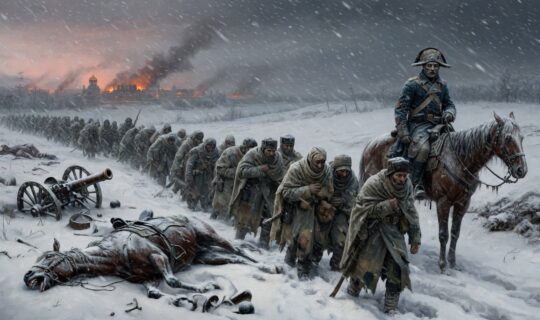
The emperor’s engineers promised it would hold. Thousands of laborers bled into the earth to raise it. Soldiers froze through winters guarding its length, watching the treeline for movement that never quite stopped coming. And yet, sooner or later, every great wall in human history faced the same humbling truth: stone can slow people down, but it cannot change what drives them.
We build walls when we are afraid. And we have always been afraid.
From the windswept highlands of northern Britain to the Eurasian steppe, from the marshes of Denmark to the scorched plains between Mesopotamia and Persia, civilizations at the height of their power drew lines in the earth and dared the world to cross them. Some of these walls stand today, attracting tourists who photograph themselves against ancient stone without fully appreciating what that stone represents: not triumph, but anxiety. Not strength, but the first whisper of decline.
This is the story of the walls that were supposed to save empires. And the relentless human tide that proved otherwise.
The Great Wall: A Monument to Fear
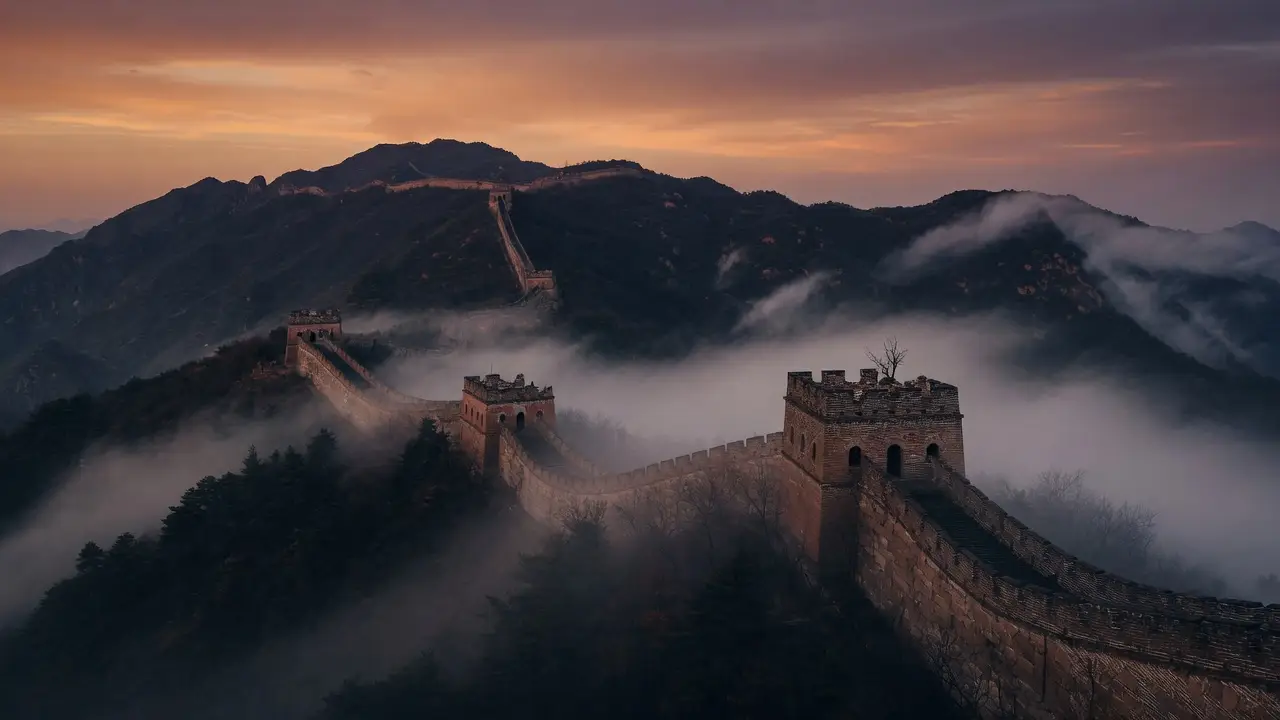
China’s Great Wall is the most recognized fortification on the planet, and also the most misunderstood. Most people envision a single, continuous barrier stretching across northern China like a stone spine. The reality is messier, more desperate, and far more interesting.
The wall was not one project. It was the accumulated anxiety of a dozen dynasties, built and rebuilt over roughly two thousand years, beginning with the Warring States period in the 7th century BCE and reaching its most recognizable form under the Ming dynasty between 1368 and 1644. Different sections were constructed by different rulers for different enemies, patched together and expanded until the total length of all versions exceeded 13,000 miles.
“Build a wall of men rather than of brick.”
Chinese military proverb, frequently attributed to Sun Tzu
The primary adversaries were the nomadic peoples of the northern steppe: the Xiongnu, the Mongols, the Jurchen. These were not primitive raiders. They were supremely mobile military forces built around horse archery, capable of appearing from nowhere, striking hard, and vanishing before a garrison could respond. The wall was, in a sense, an admission that conventional military strategy had limits against an enemy that simply would not stand still.
Join The Archive Briefing
Weekly dispatches. The history they didn't teach you — sourced, subverted, delivered to your inbox.
Construction under the Ming was particularly brutal. Hundreds of thousands of conscripted laborers, soldiers, and criminals worked in extreme conditions. Many died on the job, and local legend holds that the bodies of some were entombed within the wall itself. Whether literally true or not, the story captures something real about the human cost of the project.
The Wall That Couldn’t Keep Out the Mongols
And yet, the wall failed. Spectacularly, repeatedly, and sometimes through sheer human treachery.
In 1644, when the Manchu forces of the later Jin dynasty were pressing against the northern frontier, a Chinese general named Wu Sangui faced a terrible choice. Besieged by rebel forces inside China and Manchu armies outside it, he opened the gates at Shanhai Pass and invited the Manchus in. The Great Wall, the billion-dollar defense system of its era, was undone by one man’s calculation. The Qing dynasty that followed would rule China for nearly three centuries.
LESSER-KNOWN DETAILS
The Great Wall had a sophisticated smoke-and-fire signal system capable of transmitting information across 300 miles in just a few hours, faster than any mounted messenger.
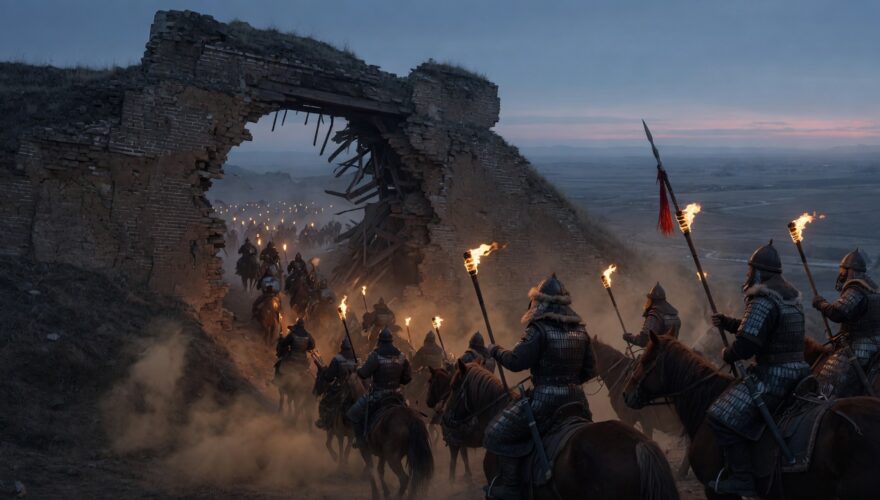
Before that, in the 13th century, the Mongols under Genghis Khan and his successors simply found the gaps. Walls have ends. Walls have unmaintained sections. Walls have guards who can be bribed or overrun. The Mongol approach was methodical: probe the defenses, identify weaknesses, and exploit them. By 1215, Zhongdu, the capital of the Jin dynasty, had fallen, and the wall had done nothing to stop it.
The wall’s greatest achievement may be psychological rather than military. It marked a boundary. It defined what was inside and what was outside. But the steppe does not recognize boundaries, and the people of the steppe never cared much for the map that someone else drew.
Hadrian’s Wall: The Edge of the Known World
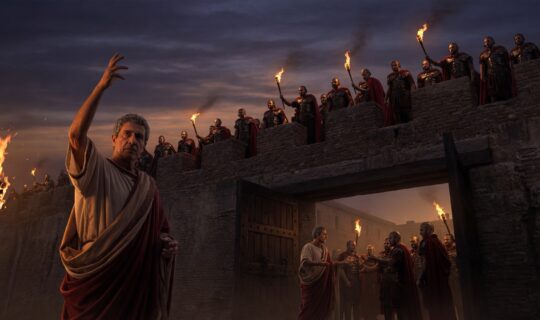
In 122 CE, the Roman Emperor Hadrian arrived in Britannia and looked north. What he saw apparently unsettled him enough to commission an 80-mile stone wall across the entire width of northern England, from the Solway Firth in the west to the mouth of the Tyne in the east.
The official story, then and now, is that the wall was built to keep out the Picts and other northern tribes, the unconquered peoples of what is now Scotland. But historians have grown increasingly skeptical of this clean narrative. The wall is extraordinary overengineering for a simple tribal barrier. It featured 80 small forts called milecastles, 16 larger auxiliary forts, a massive earthwork ditch to the north, and another defensive feature to the south called the Vallum, which suggests the Romans were worried about threats from both directions.
“We have a wall not to stop the Scots, but to know where we are.”
Paraphrased from a Roman administrative document found near Vindolanda
Some scholars now argue that Hadrian’s Wall was as much about controlling movement and taxing trade as it was about military exclusion. Passages through the wall were regulated. People moved through gates. That sounds less like a fortress and more like a customs checkpoint at the edge of empire.
Rome’s Admission in Stone
The wall also represented something politically delicate: Rome stopping. Roman ideology held that the empire was, in theory, infinite. Emperors were expected to expand, to conquer, to push the frontier outward. Building a wall said, quietly but unmistakably, that Rome had reached its limit here.
The troops stationed on the wall were not elite Roman legions. They were auxiliary units drawn from across the empire: soldiers from Syria, from North Africa, from what is now Belgium and the Netherlands. Inscriptions found along the wall’s length record soldiers from the Tigris valley, from Dacia, from Spain. These men spent years on a cold, wet frontier far from anything familiar, maintaining a structure that the empire increasingly struggled to justify.
“…the Britons are unprotected by armor. There are very many cavalry. The cavalry do not use swords, nor do the wretched Britons mount to throw javelins.”
Roman soldier’s report from the Vindolanda tablets, late 1st century CE
The wall was abandoned and reoccupied multiple times over the following centuries. When Roman authority in Britannia finally collapsed in the early 5th century, the wall was simply left behind. The locals built their houses from its stones. The empire that had raised it with such ambition became, in the end, a quarry.

The Gorgan Wall and the Sassanid Gamble
Less famous than Hadrian’s or the Great Wall, but arguably more impressive by any engineering measure, the Gorgan Wall stretched approximately 125 miles across what is now northeastern Iran. Built by the Sassanid Persian Empire between roughly the 420s and 530s CE, it was constructed to hold back the steppe nomads pressing from the north, particularly the Hephthalites, a group sometimes called the White Huns.
LESSER-KNOWN DETAILS
Glutinous rice flour was used in the mortar of some Ming-era Great Wall sections, creating a bond so strong that modern analysis found the walls stronger than ordinary brick.
What makes Gorgan remarkable is the sheer scale of its infrastructure. The wall was not just a wall. It had a canal running parallel to its length to supply water, a road system behind it for troop movement, and somewhere between 30 and 36 garrison forts housing an estimated 30,000 soldiers at peak deployment. Modern archaeological surveys suggest it may be the largest military infrastructure project in the ancient world outside of China.
“The strength of the wall is neither in its stone nor its height, but in the men who stand upon it.”
Attributed to Genghis Khan in later Mongol chronicles
The Sassanids were caught in a geographical nightmare. Their empire stretched between two aggressive powers: the Roman and later Byzantine Empire to the west, and the steppe to the northeast. They could not fight on both fronts indefinitely. The Gorgan Wall was an attempt to purchase security on one border by building it in brick and mortar, freeing up military resources for the other direction.
The Expense of Standing Still
It worked, after a fashion. There is no record of a catastrophic northern invasion in the century after the wall’s construction. But maintaining 30,000 soldiers on a static defensive line is an enormous drain on any treasury, and the Sassanid Empire was simultaneously funding punishing wars against Byzantium.
LESSER-KNOWN DETAILS
Hadrian’s Wall had heated bathhouses at major forts. Soldiers could bathe, eat imported food, and receive mail from across the empire while stationed on what felt like the end of the world.
When the Arab armies emerged from the Arabian Peninsula in the 630s CE, the Sassanid Empire was exhausted. The great northern wall was irrelevant to a threat that came from the south and west. By 651, the last Sassanid emperor was dead, killed by his own subjects, and the empire that had built one of antiquity’s great engineering projects was gone. The Gorgan Wall, without anyone to maintain it, began its long retreat into the earth.
Danevirke: Scandinavia’s Line in the Marsh
Farther north and considerably less dramatic in appearance, the Danevirke is Denmark’s great wall, a network of earthworks, wooden palisades, and later brick fortifications stretching across the base of the Jutland Peninsula. Its first sections may have been built as early as the 7th century CE, but it was significantly expanded in the early 9th century, likely under the Danish king Godfred, who reportedly built it to block Frankish expansion into Scandinavian territory.
The Danevirke is fascinating precisely because its enemy was not nomadic raiders or mysterious northern tribes. It was the Frankish Empire of Charlemagne, the most powerful political entity in Western Europe. The Danes were not the barbarians at the edge of civilization in this story. They were the ones trying to hold civilization’s edge.
LESSER-KNOWN DETAILS
The Gorgan Wall’s canal was not just for water supply but likely used for transporting construction materials, making it a logistics infrastructure project as much as a military one.
The wall was expanded and used across several centuries, seeing its last military action in 1864 during the Second Schleswig War between Denmark and Prussia. Danish forces retreating in winter abandoned the Danevirke rather than attempt a defense in brutal cold, a decision that ignited a political firestorm back home. The wall that had stood for over a thousand years as a symbol of Danish resilience became, in its final moment, a source of national shame.
What the Danevirke reveals is something that the Great Wall and Hadrian’s Wall also suggest but rarely articulate: border walls are not just military structures. They are political statements. They tell a story about who you are and where you end. They manufacture identity as much as they provide protection.
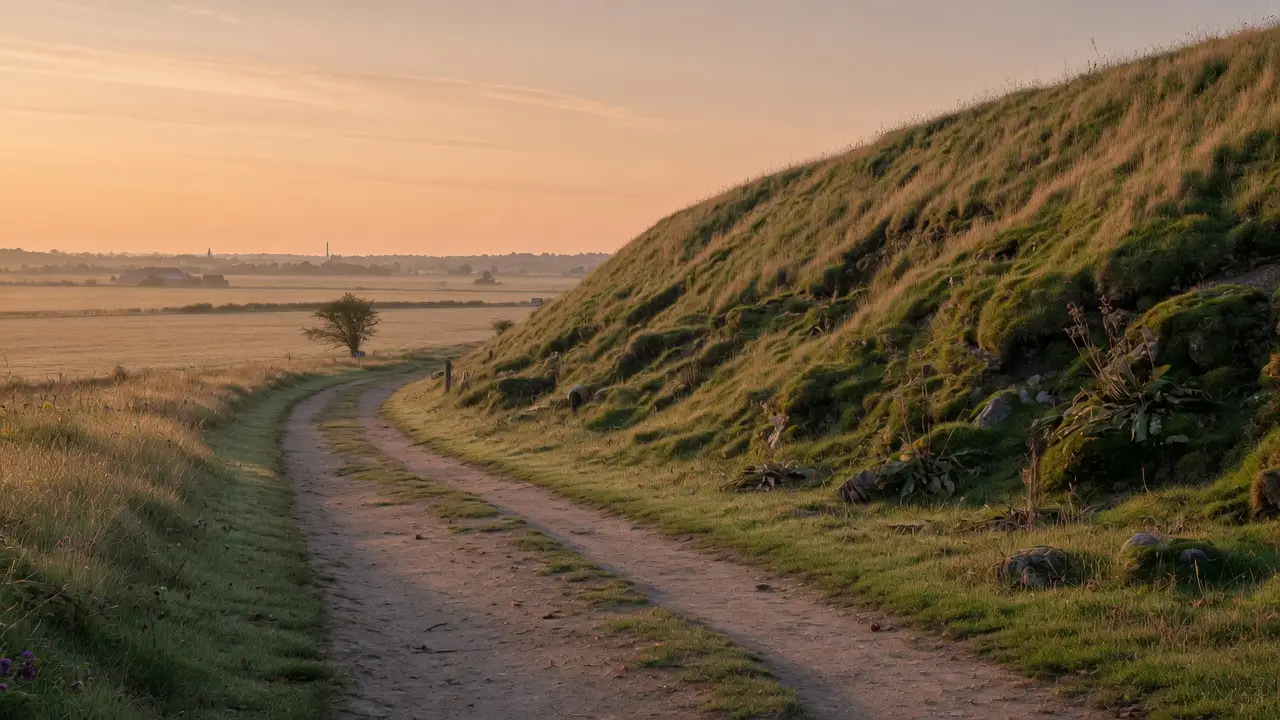
Denmark still celebrates the Danevirke. Sections of it run through farmland and nature reserves, maintained as cultural heritage. The argument over where Denmark ends and Germany begins did not stop with walls. It continued through diplomacy, wars, referendums, and shifting populations for centuries after the last stone was laid.
What the Walls Share
Every wall on this list was built by a society that believed, genuinely, that the threat it faced was existential. Every one of them marshaled extraordinary resources, engineering knowledge, and human labor to construct something meant to endure. And every one of them, ultimately, fell short of its original purpose.
This is not because walls are stupid. It is because the forces that drive human movement, whether famine, conquest, trade, or sheer ambition, are not deterred by stone. They reroute. They negotiate. They wait.
LESSER-KNOWN DETAILS
Danevirke sections were so well integrated into the landscape that farmers plowed around them for centuries without fully understanding what they were walking beside.
The Mongols did not destroy the Great Wall. They went around it, through it, or were let through it. The Picts did not demolish Hadrian’s Wall. Roman authority simply evaporated, and the wall lost its meaning overnight. The Arab armies did not attack Gorgan. They hit the Sassanid heartland from a direction the wall was never meant to face.
Walls work until the threat changes. And threats always change.
The Echo That Reaches Today
Every generation rediscovers the appeal of a hard border and forgets, fairly quickly, what history recorded about its limits. The debate is never really about walls. It is about whether we believe a fixed line can manage a dynamic world.
The emperors who ordered these walls built were not fools. They were leaders facing real dangers with the tools available to them. But stone, however thick, cannot substitute for understanding why people are moving in the first place. The nomads pressing against the Great Wall were often responding to climate shifts and resource scarcity on the steppe. The northern tribes that worried Hadrian were not an invasion force so much as a population living where they had always lived.
LESSER-KNOWN DETAILS
In 1644, when Wu Sangui opened the gates to the Manchus, the Great Wall garrison reportedly stood down without a fight. The wall’s final failure was not military. It was bureaucratic and political.
The most durable borders in history are not the ones most heavily fortified. They are the ones that reflect a genuine accommodation between the people on either side of them.
The walls that remain are beautiful ruins. They draw visitors, inspire awe, and deserve their place in history. But they also deserve an honest reading: they are monuments to the idea that you can stop what you do not understand, and they carry the quiet evidence that you cannot.
Stone crumbles. History does not wait.