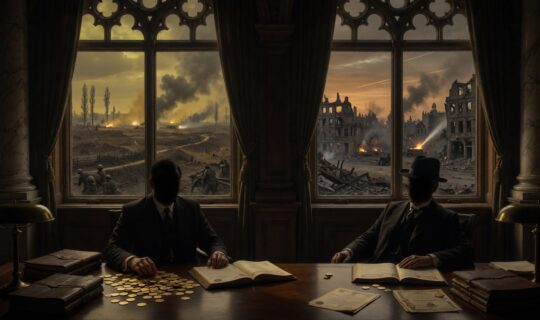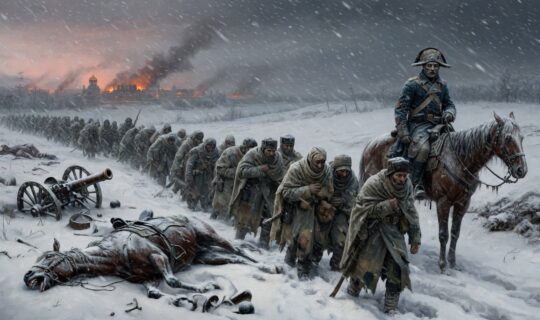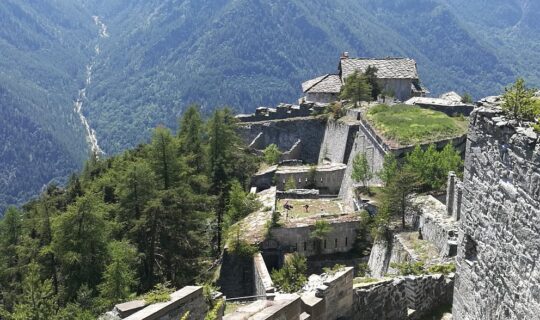
The Hundred Years’ War was not a clean conflict between two nations. It was a dynastic quarrel over inheritance that consumed four generations, bankrupted kingdoms, and destroyed the medieval world’s most cherished myths about war and glory.
The Hundred Years’ War was not just England vs France, it was the war that destroyed medieval chivalry and helped create modern national identity. For more than a century, England tried to take France by bloodline, battlefield, and betrayal. Kings died, peasants starved, knights became obsolete, and by the end, Europe was no longer the same world.
- 1 A War That Lasted Longer Than Anyone Who Started It
- 2 A Crown in Dispute
- 3 What Was Actually at Stake
- 4 The Arrow and the Knight
- 5 The Weight No One Sang About
- 6 Joan of Arc and the Moment France Remembered Itself
- 7 How France Learned to Win
- 8 What the War Broke and What It Built
- 9 Why This War Still Matters
A War That Lasted Longer Than Anyone Who Started It
In 1328, the last Capetian king of France died without a male heir. It sounds like a minor administrative problem. It was not. That single genealogical gap would light a fuse that burned for 116 years, consuming hundreds of thousands of lives, reshaping two kingdoms, and ultimately ending the age of the armored knight.
What followed is commonly called the Hundred Years’ War. The name is deceptively tidy. It was not one war. It was a series of brutal, exhausting conflicts lashed together by the same grudge, the same land, and the same refusal by two royal houses to ever simply let it go.
A Crown in Dispute
The argument started with bloodlines. When Charles IV of France died in 1328, he left behind a throne and no son to sit on it. By the logic of inheritance law, his nearest male relative through the female line was Edward III of England. Edward’s mother was Isabella of France, daughter of Philip IV. That made Edward the dead king’s nephew. Close enough, he believed, to press a claim.
The French disagreed. Loudly. Under what came to be called Salic law, the crown could not pass through a female line. Instead, they elevated Philip of Valois, a cousin through the male side, as Philip VI. Edward was told, politely but firmly, that France had its king and it was not him.
“We few, we happy few, we band of brothers”
William Shakespeare, Henry V (written c. 1599, reflecting the era’s mythology of the battle)
Edward accepted this, at first. He even paid homage to Philip for his French lands. But the humiliation festered. And what people tend to forget is that England was not some foreign power peering at France from across the water. The English crown had controlled vast territories in France for generations. Gascony and Aquitaine in the southwest were English-held land, profitable land, politically vital land. Edward was not merely an outside claimant to a foreign throne. He was already a landholding lord inside France, with vassals, revenues, and interests that Philip increasingly threatened.
By 1337, the friction had become unbearable. Philip confiscated Gascony. Edward responded by formally claiming the French throne. What had been a royal inheritance dispute became the framework for something far longer and far worse.
Join The Archive Briefing
Weekly dispatches. The history they didn't teach you — sourced, subverted, delivered to your inbox.
What Was Actually at Stake
This is where the popular image of the war breaks down. People hear “Hundred Years’ War” and picture two nations at war the way modern nations go to war. That is not what this was.
Medieval France and England were not nation-states in any modern sense. They were webs of lordship, land tenure, feudal obligation, and dynastic ambition. Edward III was simultaneously the King of England and a vassal of the French crown for his French holdings. He owed Philip homage. The act of claiming Philip’s throne was not just military ambition. It was a declaration that the entire feudal relationship between the two crowns had collapsed.
LESSER-KNOWN DETAILS
Capturing a noble prisoner was financially lucrative. After Poitiers, King John II’s ransom was set at three million gold écus, an amount so enormous France could not pay it in full. John II was released on parole, but when one of his sons fled captivity rather than return as a hostage, John II voluntarily returned to English custody, declaring it against his honor to remain free. He died in London in 1364.
Ordinary people on both sides felt the war mostly as taxation, conscription, and the terrifying passage of armed men through their towns. The knights and lords who fought it wrapped themselves in the language of chivalry and honor. But beneath all that ceremony was a simpler reality: two royal families fighting over land, revenue, and the right to say who was in charge.
The Arrow and the Knight
France had the larger army. France had the heavier cavalry. France had the tradition of knightly warfare that had dominated European battlefields for two centuries.
At Crécy in August 1346, none of that helped them.
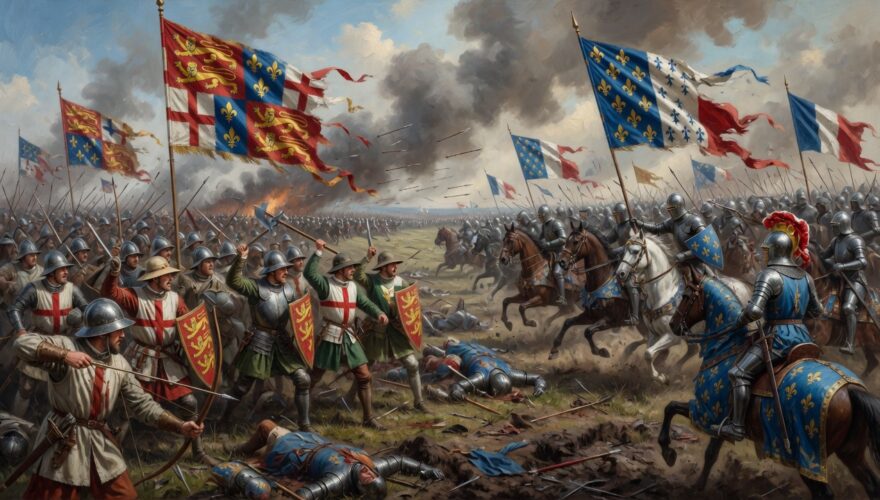
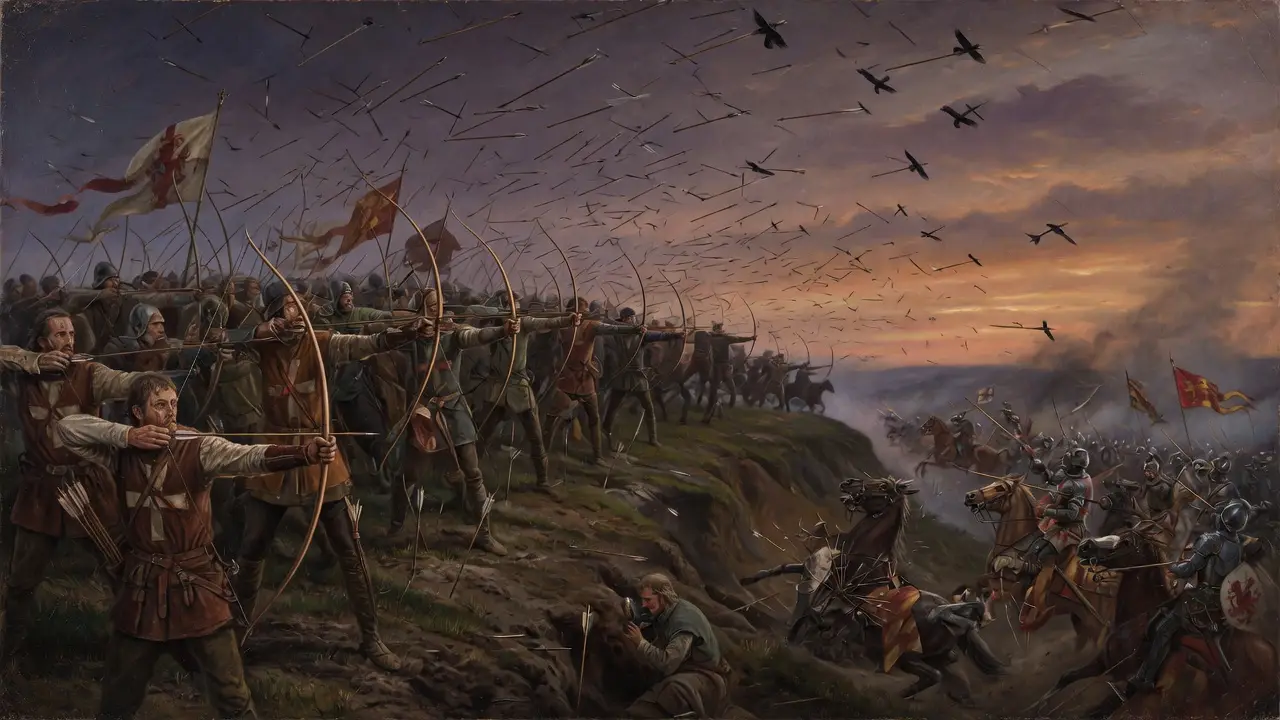
Edward III chose his ground carefully on a ridge near the Somme, positioned his men-at-arms on foot, and placed his longbowmen in angled formations on the flanks. The French cavalry charged. The English archers released. What followed was not a battle in any chivalric sense. It was a slaughter.
LESSER-KNOWN DETAILS
Skeletal remains of English archers from this period show dramatically overdeveloped left arms and deformed spines, evidence of a lifetime of practice that began in childhood. The men who won Agincourt had been shaped, physically, by the bow before they were teenagers.
The longbow was a weapon that required years of training. English and Welsh archers could launch ten to twelve arrows per minute with enough force to penetrate armor at range. Against massed cavalry advancing in formation, the effect was catastrophic. The French charged sixteen times. Each time the arrows fell, horses screamed, riders went down, and the formation collapsed into chaos. Philip VI survived. His army did not.
“The English archers stepped forth one pace and let fly their arrows so wholly and so thick that it seemed snow.”
A French chronicler on Crécy, Jean Froissart
Ten years later, at Poitiers in 1356, Edward’s son the Black Prince replicated the achievement with a smaller force. The English were outnumbered. They held elevated ground behind hedges and vineyards. The French cavalry charged again. The archers again did their work. By the end, not only had the French army broken, but King John II of France was taken prisoner. A king, captured on the battlefield. The ransom negotiations that followed would last for years and drain France to the bone.
Then came Agincourt.
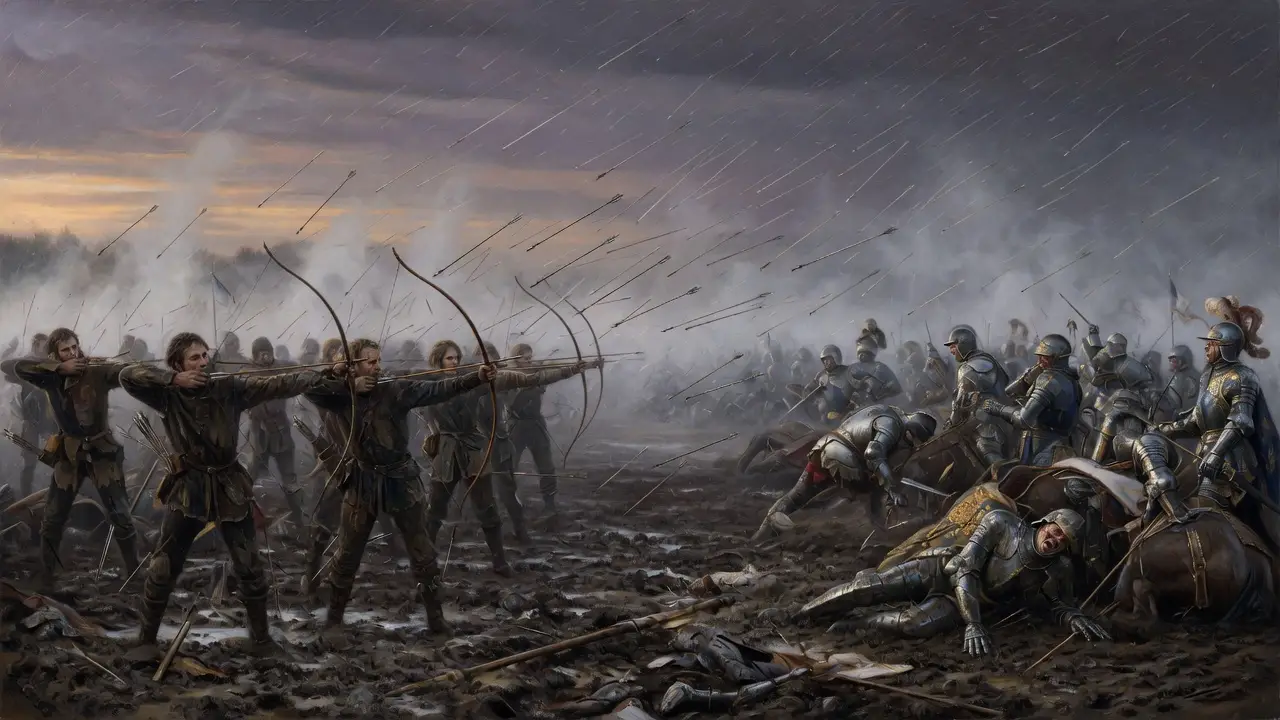
In October 1415, Henry V of England led a diminished, exhausted, disease-ridden army across northern France. He was outnumbered by perhaps three to one. The French, remembering Crécy and Poitiers, should have known better. They did not. They advanced on a narrow field between two woodlands, the muddy ground slowing their heavily armored knights to a crawl. The English archers drove stakes into the earth and waited. When the French came, the arrows found them again. The mud found them. The narrow ground bunched them together until they could barely lift their arms.
Henry V won Agincourt so completely that it entered European mythology almost before the bodies were cold.
The Weight No One Sang About
While lords debated crowns, the people of France and England were living through something the chronicles barely mentioned. The Black Death reached Europe in 1347, one year after Crécy. By the time it burned through France and England, roughly a third of the population was dead.
This is the part of the Hundred Years’ War that no ballad celebrates. Armies moved through a landscape already devastated by plague. Villages emptied by disease were stripped bare by soldiers. Taxation to fund campaigns fell on peasants who had already lost family members, livestock, and harvests. The Jacquerie rebellion in France in 1358 and the English Peasants’ Revolt in 1381 were not random outbursts. They were the accumulated rage of ordinary people crushed between their lords above and catastrophe below.
“Father abandoned child, wife abandoned husband, one brother abandoned another.”
Agnolo di Tura, Sienese chronicler, describing the plague’s social devastation
The war and the plague did not run parallel to each other. They amplified each other. Soldiers spread disease. Disease disrupted food production. Disrupted food production led to famine. Famine made populations more vulnerable to disease. The great battles at Crécy, Poitiers, and Agincourt were the drama that kings and chroniclers recorded. The famine and plague were the catastrophe that actually defined the century for everyone else.
Joan of Arc and the Moment France Remembered Itself
By the late 1420s, England had never been closer to total victory. Henry V had forced the Treaty of Troyes in 1420, which disinherited the French dauphin and made Henry the heir to the French throne. Then Henry died in 1422, leaving an infant king. The dauphin Charles refused to accept his disinheritance and held on in the south. The situation was a stalemate of exhaustion, but the momentum was English.
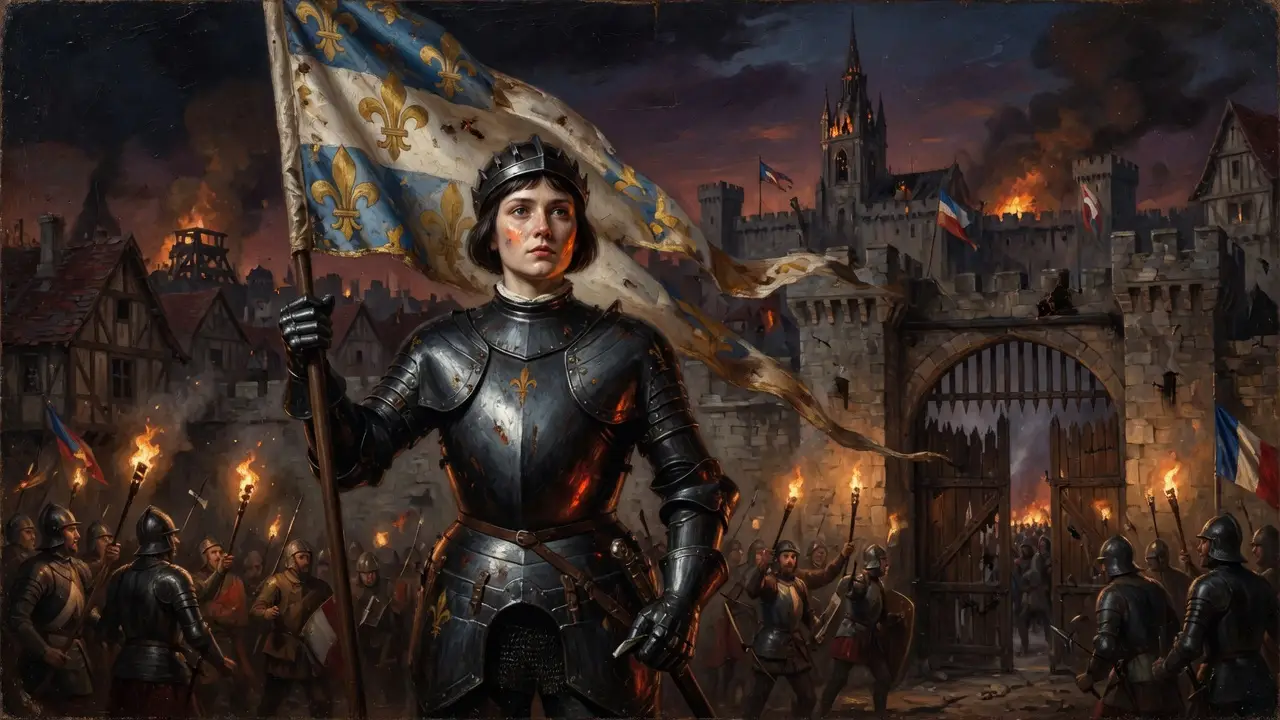
Then an illiterate teenage girl from the village of Domrémy appeared at the French court and told the dauphin she had been sent by God to drive the English out of France.
“I was in my thirteenth year when God sent a voice to guide me.”
Joan of Arc, at her trial, 1431
Joan of Arc’s story is often told as a miracle or a tragedy, depending on who is telling it. What it actually represents, beneath the theology, is something more concrete: the moment French resistance stopped being a feudal obligation and started being something that felt, for the first time, like a national cause. Joan did not invent French patriotism. But she gave it a face and a voice at precisely the moment it was needed.
The siege of Orléans was lifted in 1429. Charles VII was crowned at Reims. Joan was captured by the Burgundians the following year, sold to the English, tried for heresy, and burned at the stake at Rouen in 1431. She was nineteen years old.
Her death did not stop what she had started.
How France Learned to Win
England won Crécy. England won Poitiers. England won Agincourt. England lost the war.
That apparent contradiction is the most interesting part of the whole story. The French eventually understood something that took generations to accept: the military methods that had served feudal France were finished. The longbow had proved it. The question was what to replace them with.
LESSER-KNOWN DETAILS
For much of the war, the Dukes of Burgundy were allied with England against the French crown. It was Burgundians who captured Joan of Arc and sold her to the English. The political fracture within France was as damaging as any English army.
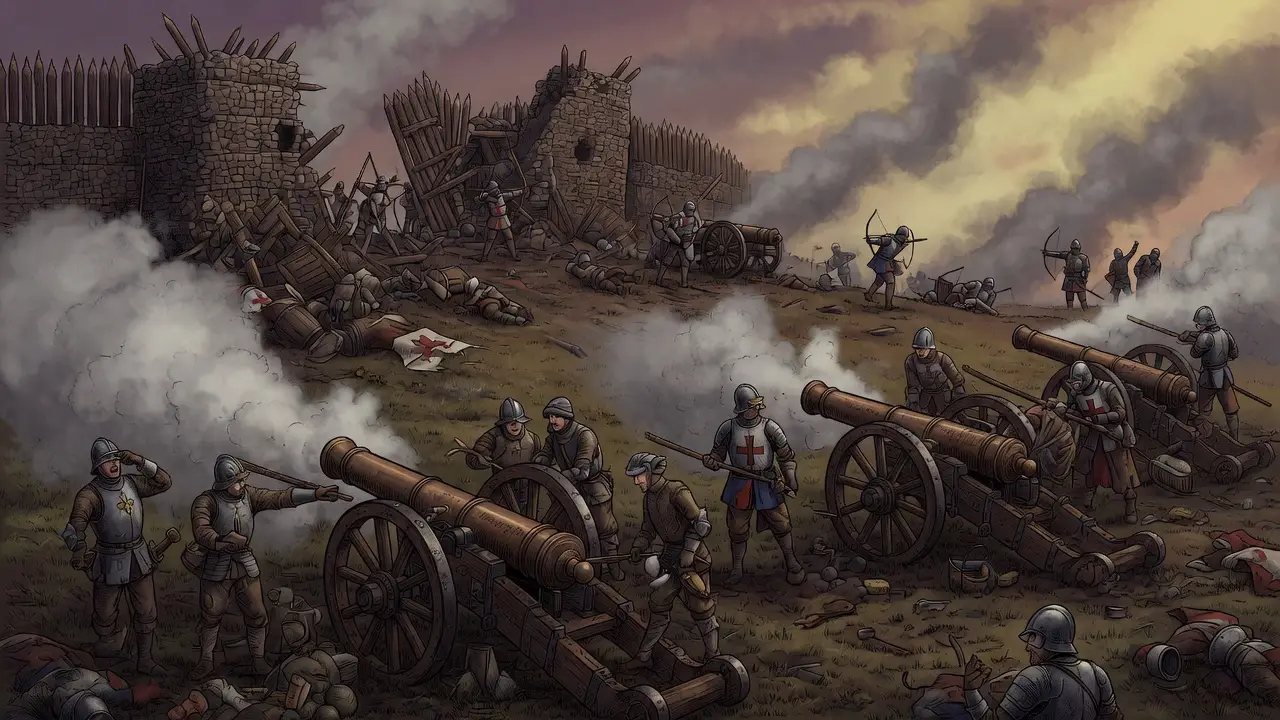
Under Charles VII, France rebuilt systematically. The compagnies d’ordonnance, established in 1445, were the first standing professional army in French history, paid directly by the crown rather than assembled and disbanded by lords. The Bureau brothers, Jean and Gaspard, reorganized French artillery into a coherent force that could reduce English-held castles and fortified towns with a speed that would have seemed impossible a generation earlier.
“I am not afraid. I was born to do this.”
Joan of Arc, on her mission
This is the rarely told half of the story. England kept winning in the field. France kept improving everything else: logistics, taxation, royal authority, artillery. And gradually, systematically, the English positions in France fell. Normandy was retaken in 1450. Gascony, English-held since the twelfth century, fell in 1453 at the Battle of Castillon, where French artillery destroyed an English army attempting a counterattack.
No treaty formally ended the war. England simply ran out of territory to defend. By 1453, Calais was the only English possession left on French soil.
What the War Broke and What It Built
The war destroyed the myth of chivalric warfare more completely than any sermon or philosopher ever could have. The knight in armor, the most expensive and socially prestigious warrior in the medieval world, had been shredded repeatedly by men with bows who cost a fraction as much to equip. Gunpowder weapons, primitive at Crécy and decisive at Castillon, pointed toward a future where castles could be broken and armies could be raised by any ruler who could afford the guns and the men to fire them.
Most histories end the war at Castillon without noting its significance. It was the first major European battle decided primarily by gunpowder cannon rather than infantry or cavalry. The medieval battlefield died there along with English France.
“The fewer men, the greater share of honour.”
Henry V, reportedly before Agincourt
Both France and England emerged from the war transformed in ways that neither would have chosen. France developed stronger royal authority, a professional military, and something that increasingly resembled a national identity built around the French language and French soil. England, expelled from France, turned inward, toward the civil wars of the Roses and, eventually, toward the sea.
The idea that ordinary people shared an identity with their king, that their land was their nation, that a French peasant and a French noble were fighting for the same thing, that idea did not exist cleanly at the start of the conflict. By the end, it was beginning to. That shift, tentative and incomplete as it was, would eventually produce the modern nation-state.
A medieval quarrel over who had the better bloodline for a throne ended up building the foundations of the world we still live in.
Why This War Still Matters
The Hundred Years’ War is where the medieval world ended and the early modern world began. Not cleanly, not on a single date, but across a century of accumulated damage to the old assumptions: that knights were invincible, that feudal loyalty was the basis of political order, that wars were the business of lords and had nothing to do with peasants beyond the taxing and the dying.
England and France emerged from it as recognizably the nations we know today. The English language, increasingly distinct from French after centuries of Norman influence, consolidated around a shared English identity. France developed a royal state capable of projecting power across a unified territory.
Every time a modern nation invokes the idea that ordinary citizens share something worth defending together, it is drawing on a tradition that was forged, imperfectly and violently, in the fields of Crécy, the siege lines at Orléans, and the mud of Agincourt.
The grudge that started it was petty. What it produced was the modern world.