From flat-earth maps to moon landing denial, history’s strangest conspiracy theories reveal more about human psychology than hidden truth. Explore the bizarre, the surprising, and the surprisingly real.
Conspiracy theories are as old as civilization itself. They live where fear, grief, and distrust intersect. And history’s most bizarre ones tell us something extraordinary about the human capacity to find patterns in chaos, and sometimes, to be right about the wrong things.
The Flat Earth Society Predates the Internet by Centuries
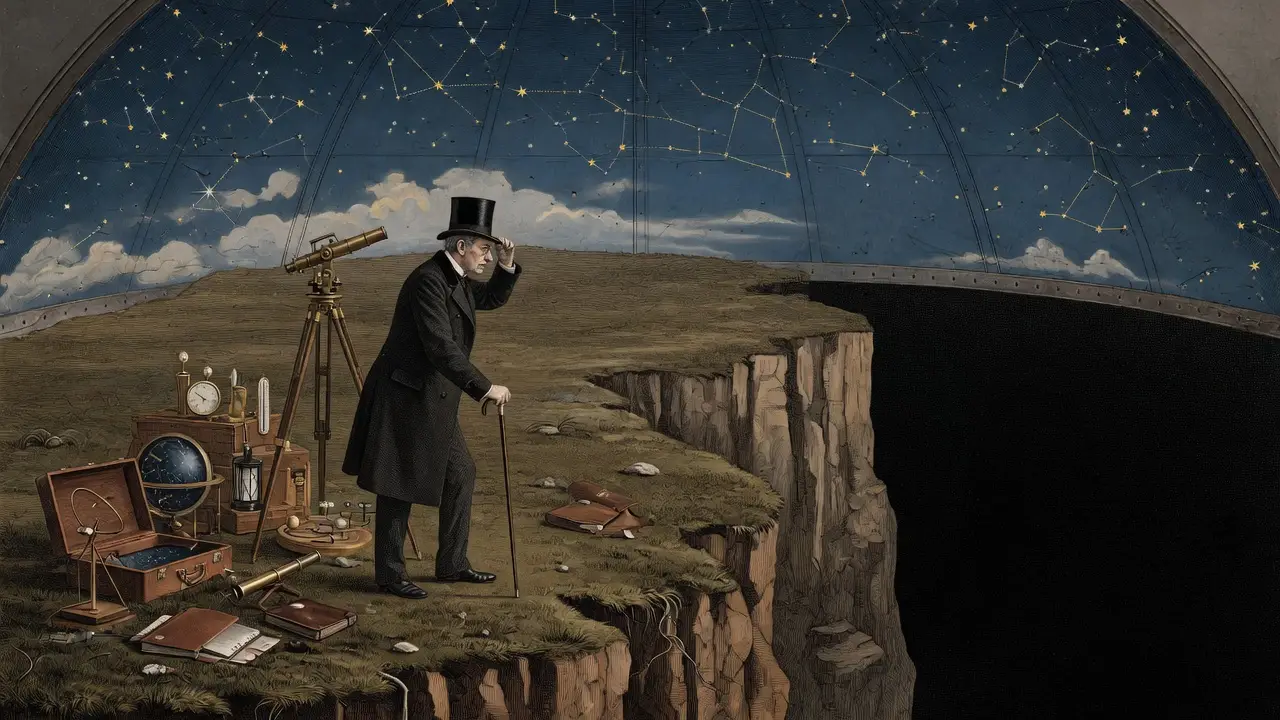
Most people assume flat-earth belief is a modern internet phenomenon, a YouTube rabbit hole that swallowed bored teenagers. It isn’t. Samuel Birley Rowbotham, a British inventor and amateur scientist, published a pamphlet in 1849 called Zetetic Astronomy in which he argued, at considerable length, that the Earth was a flat disc with the North Pole at its center and Antarctica as a wall of ice around the edge.
Rowbotham performed actual experiments. He walked out onto the Bedford Canal and observed a boat from six miles away through a telescope, claiming to see what should have been hidden below the curve of the Earth. He concluded there was no curve. He had, in fact, simply misunderstood atmospheric refraction.
LESSER-KNOWN DETAIL
Rowbotham once accepted a wager from a surveyor named John Hampden to prove the curvature of the Earth using the Bedford Canal. They both examined the same stretch of water and each declared himself the winner. The dispute ended in lawsuits. Hampden spent the remainder of his life sending threatening letters to those who had judged against him.
His followers founded the Universal Zetetic Society in 1884. By 1956, it had been reborn as the Flat Earth Society, which published newsletters, held annual conventions, and maintained membership rolls well into the era of satellite photographs. Their response to NASA’s images of a spherical Earth? Forgeries, every one.
What makes Rowbotham’s theory compelling from a historical standpoint isn’t the claim itself. It’s the methodology. He conducted experiments. He published findings. He invited scrutiny. He was simply, catastrophically, wrong, but his approach mimicked scientific inquiry closely enough to attract educated followers for generations.
“No man of science has ever yet been able to meet the arguments of the Zetetes except by laughter and ridicule.”
Samuel Birley Rowbotham, Earth Not a Globe, 1865
The Dancing Plague and the Devil’s Footprints
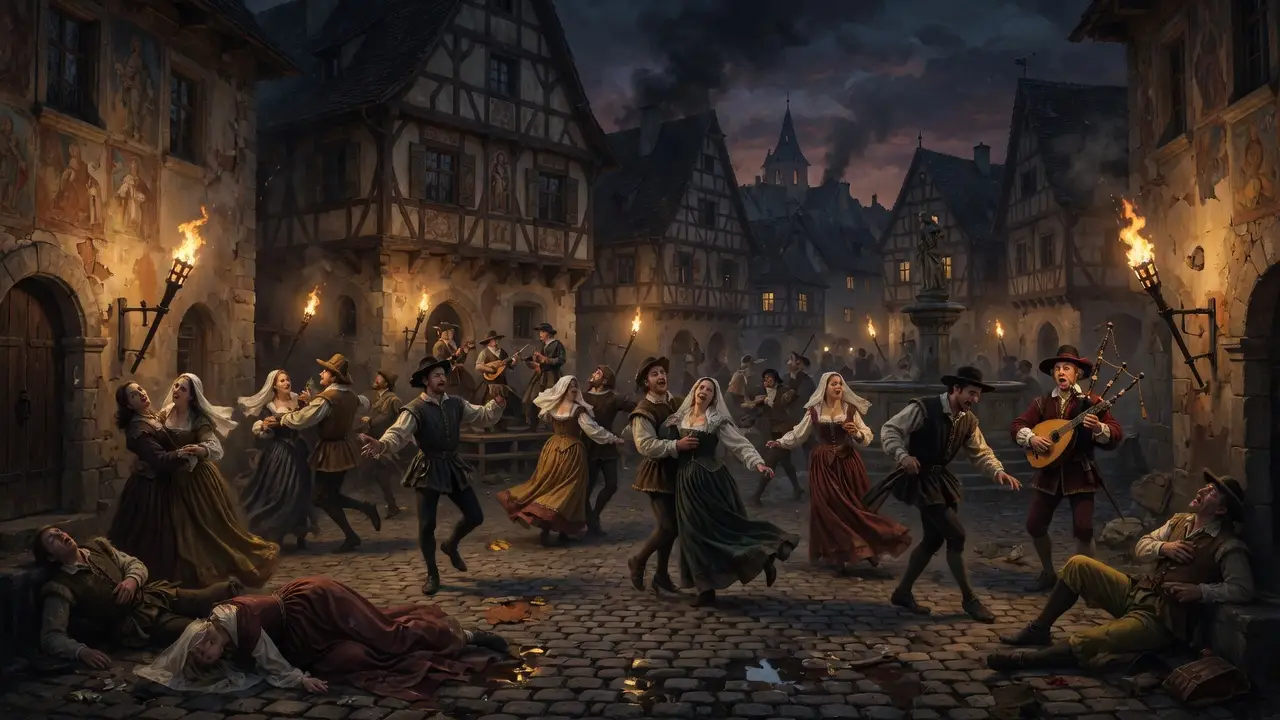
In 1518, Strasbourg collapsed into one of history’s most surreal mass events. It began with a single woman, Frau Troffea, who stepped into the street and began dancing. She couldn’t stop. Within a week, thirty-four people had joined her. Within a month, the number had climbed past four hundred.
City authorities, baffled, hired musicians to play for the dancers, reasoning that the affliction would pass if they simply danced it out. It didn’t. People collapsed from exhaustion. Some died of stroke or heart failure. The city council eventually shipped the afflicted to a mountain shrine to pray.
Join The Archive Briefing
Weekly dispatches. The history they didn't teach you — sourced, subverted, delivered to your inbox.
LESSER-KNOWN DETAIL
Strasbourg was one of at least ten recorded dancing plagues across medieval Europe. The town of Erfurt allegedly saw children dancing on a bridge until some fell off. The town of Metz reported dancing afflictions in 1374. Historians now believe the phenomena were connected to a specific period of crop failure and plague, suggesting stress-induced psychosis has measurable historical weather patterns.
The conspiracy theories that developed around this event were immediate and fevered. Some blamed sorcery, specifically a curse laid by Saint Vitus, the patron saint of dancers. Some claimed the Devil had infiltrated the city in human form and led the people into a frenzy. Several individuals were accused of being the Devil, arrested, examined, and released when no tail or cloven hoof could be located.
Modern scholars believe mass psychogenic illness, a well-documented psychological phenomenon, was responsible. The region had suffered repeated famines, and extreme stress may have triggered a kind of collective nervous breakdown. But the conspiracy framing, the idea of an external, supernatural force corrupting the body politic, proved far more satisfying to those living through it.
“The affliction seemed to proceed not from natural causes, but from a power beyond the stars.”
Chronicler Sebastian Brant’s contemporaries, recorded in Strasbourg municipal records, 1518
The Great Moon Hoax of 1835
Before the internet created modern misinformation, a New York newspaper did it with a telescope and a fictional Scottish astronomer.
In August of 1835, the New York Sun published a series of articles attributed to Sir John Herschel, a genuine and celebrated British astronomer then stationed at the Cape of Good Hope in South Africa. The articles claimed Herschel had developed a revolutionary telescope capable of seeing the moon’s surface in extraordinary detail, and what he’d found there was astonishing.
Bat-winged humanoids. Temples of sapphire. Herds of bison. Forests of translucent crystals. A lunar civilization living in apparent happiness under the protection of stone structures of unknown origin.
The articles were illustrated. They were detailed. They were completely fabricated by a reporter named Richard Adams Locke, who never admitted to writing them during his lifetime.
LESSER-KNOWN DETAIL
The real Sir John Herschel was in South Africa when the articles published and only heard about them weeks later. His reaction, according to letters, was initial amusement followed by profound irritation as strangers continued writing to him for decades requesting confirmation of the bat-people.
The effect was extraordinary. The Sun‘s circulation exploded. Other newspapers reprinted the stories as fact. The Yale College science department sent a delegation to New York to examine the original research papers, which, conveniently, had just been shipped to Scotland. A committee of women in Springfield, Massachusetts, organized a collection to send Bibles to the lunar bat-people.
When the hoax was eventually exposed, several things happened simultaneously. The Sun declined to apologize. Readers who felt deceived became deeply suspicious of all scientific reporting. And Richard Adams Locke quietly took up another beat. The conspiracy theory that followed, the idea that the moon housed life that governments were concealing, persisted in American popular culture for decades.
“The discovery of these creatures does not authorize us to conclude that they are of an intellectual nature.”
New York Sun, fabricated Herschel report, August 28, 1835
The Protocols and the Politics of Fabrication
Not all conspiracy theories are merely bizarre. Some are catastrophic. The Protocols of the Elders of Zion, a document purporting to outline a Jewish plan for global domination, is perhaps the most dangerous forgery in history, and understanding its origins reveals the mechanics of conspiracy theory production at its most deliberate.
The document was fabricated by agents of the Russian Tsar’s secret police, the Okhrana, around 1902. It borrowed heavily from a French political satire called The Dialogue in Hell Between Machiavelli and Montesquieu, replacing references to Napoleon III with Jewish elders. It was not a sophisticated forgery. Scholars in the early twentieth century identified its plagiarized source almost immediately.
LESSER-KNOWN DETAIL
The scholar Herman Bernstein published The Truth About the Protocols of Zion in 1935, tracing the forgery’s origins in painstaking detail. The book was largely ignored in Europe and burned in Germany within the year.
None of that stopped it. The Protocols were distributed across Russia, Germany, Britain, and the United States. Henry Ford funded the American printing of 500,000 copies. Adolf Hitler cited them repeatedly as evidence of a Jewish conspiracy. The document shaped the ideological architecture of the Holocaust.
When a London journalist named Philip Graves exposed the plagiarism in The Times in 1921, anti-Semites responded with their own conspiracy theory: that Graves was himself part of the Jewish conspiracy he was supposedly exposing.
The Protocols remain in circulation today, distributed in countries across the Middle East and South Asia, retranslated, reprinted, and believed by millions who have never heard of the French satire they were copied from.
“The great masses of the people will more easily fall victims to a big lie than to a small one.”
Adolf Hitler, Mein Kampf, 1925
The Man Who Convinced America That Fluoride Was Poison
In 1953, a retired American dentist named George Racey Jordan published a book titled From Major Jordan’s Diaries, claiming that American Communists had been secretly adding sodium fluoride to U.S. water supplies since the 1940s as a method of mind control. The goal, he argued, was to make the American public docile, compliant, and unable to resist Soviet takeover.
The fluoridation conspiracy had an interesting adversary: science, which had been studying fluoride since the 1930s, when researchers noticed that communities drinking naturally fluoride-rich water had significantly lower rates of tooth decay. The U.S. Public Health Service endorsed fluoridation in 1951, making it one of the most studied public health interventions in American history.
Jordan’s theory didn’t require scientific evidence. It required only a single compelling narrative: that the government was poisoning citizens for the benefit of foreign enemies. The argument found immediate traction in the political climate of early-Cold War America, where suspicion of federal authority was running high.
LESSER-KNOWN DETAIL
When Kubrick was writing Dr. Strangelove, he based General Ripper’s fluoride obsession almost verbatim on actual arguments made by anti-fluoridation activists in congressional testimony. The parody barely required exaggeration.
By the 1960s, anti-fluoridation campaigns had blocked or reversed water fluoridation in hundreds of American municipalities. Stanley Kubrick satirized the phenomenon in Dr. Strangelove in 1964, where General Jack D. Ripper obsessively protects his “precious bodily fluids” from Communist contamination.
The fluoride conspiracy remains active. It has mutated over decades to incorporate new villains: pharmaceutical companies, George Soros, the Bill and Melinda Gates Foundation. The mechanism stays the same. The enemy changes with the generation.

What These Theories Actually Reveal
So.. the truth about conspiracy theories: the most successful ones are never purely invented. They attach themselves to real wounds.
The medieval accusations against Jews emerged in societies already traumatized by plague and economic collapse. The Protocols spread through countries experiencing revolutionary upheaval and looking for stable enemies. The moon landing denial found its audience during the Vietnam era, when American government credibility was genuinely, demonstrably, in ruins. Anti-fluoridation took root in communities where federal overreach wasn’t imaginary, where the Tuskegee experiments and forced sterilization programs had made distrust of government medicine entirely rational.
Conspiracy theories are not evidence of stupidity. They are evidence of pattern-seeking minds operating in conditions of genuine uncertainty, genuine threat, or genuine betrayal, attaching explanations to experiences that feel too large to have accidental causes.
The flat-earth community isn’t primarily composed of people who’ve examined the scientific evidence and rejected it. It’s composed of people who feel, often correctly, that institutions have lied to them, and who find in the community of skeptics something institutional science rarely offers: belonging, certainty, and the thrilling sense of seeing through the fog.
That is what makes these theories worth understanding. Not to mock them, but to trace the real fears underneath.
The dancing woman in the streets of Strasbourg in 1518 wasn’t crazy. She was living in a city that had buried half its population in fifteen years. The conspiratorial framework her neighbors built around her collapse was wrong in its specifics and entirely accurate in its emotional logic.
Fear takes the shape of whatever explanation fits the moment. And the moment is always now.