From Sun Tzu’s agents to Elizabethan spymasters. Intelligence work as the real battlefield.
The wars that are remembered are fought with steel. The wars that are decided are fought with paper, with whispers, with men carrying messages across foggy borders in the dark.
The Letter That Never Arrived
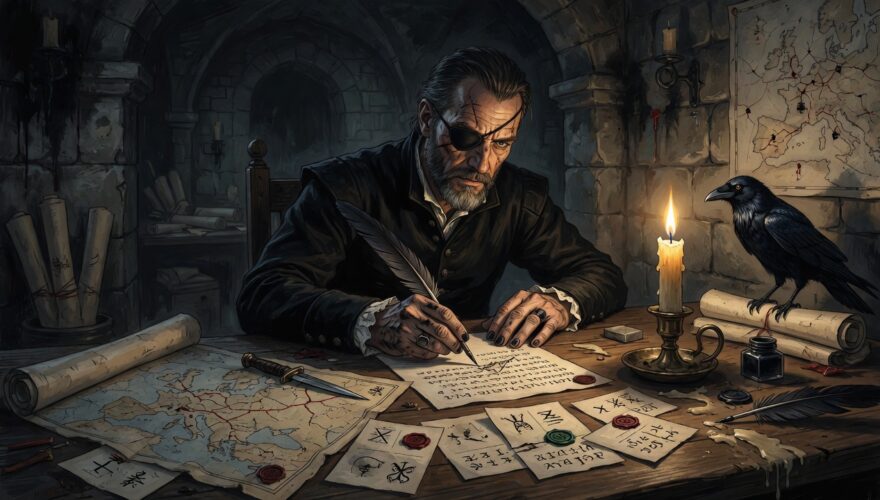
In the summer of 1586, a Catholic priest named Anthony Babington was convinced he was saving a queen. He had spent months crafting the perfect conspiracy: a coded letter sent to Mary, Queen of Scots, outlining a plan to assassinate Elizabeth I and place Mary on the English throne. Babington was meticulous. He was also, catastrophically, unaware that every word he wrote had already been read.
Francis Walsingham, Elizabeth’s Secretary of State and the most feared spymaster in Europe, had turned Mary’s own courier. The letters were intercepted, decoded, copied, and resealed before they ever reached their destination. By the time Babington received Mary’s enthusiastic reply, Walsingham had everything he needed. Babington was arrested, tried for treason, and hanged. Mary followed him to the scaffold six months later.
The throne was never in danger. The “plot” had never been anything more than a controlled detonation, triggered by a man watching from the shadows.
That is what intelligence looks like when it works.
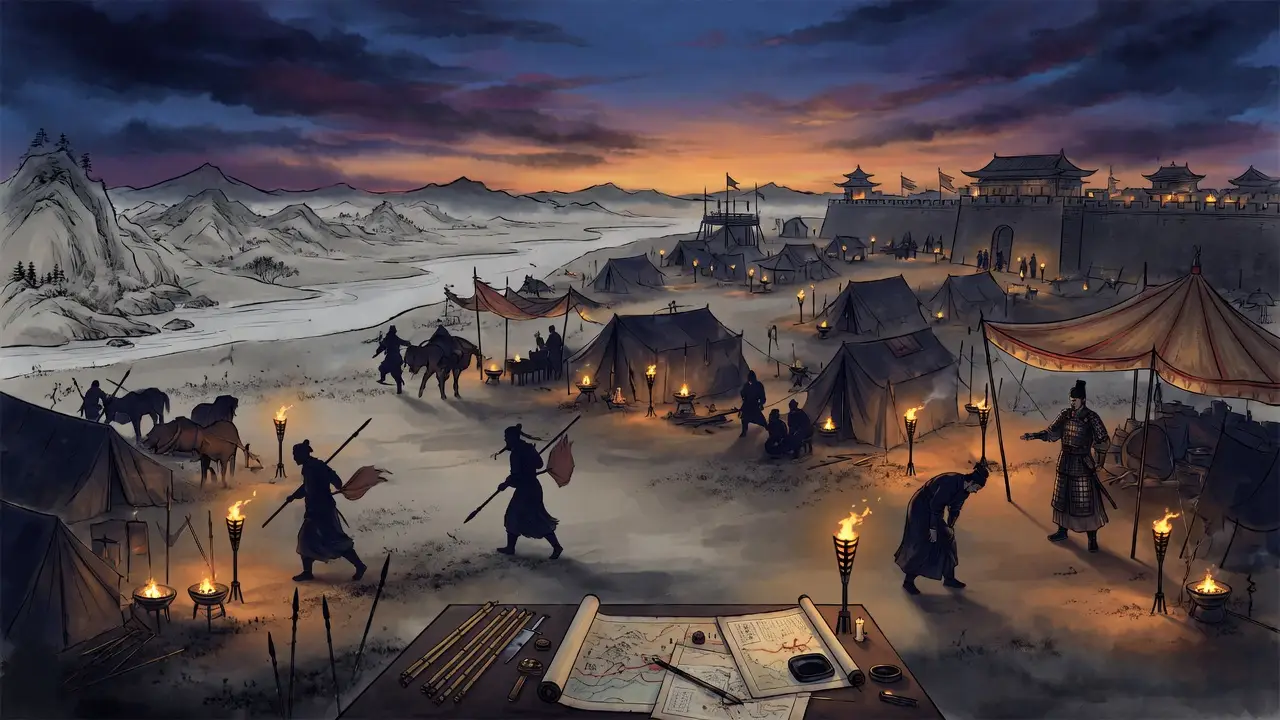
The Oldest Profession
Long before generals planned campaigns and kings raised armies, someone was already watching. Gathering. Lying. Reporting back.
Espionage is older than the written record. The Bible describes Moses sending twelve spies into Canaan to assess the land and its defenses. The Egyptian pharaohs employed agents across the ancient Mediterranean. The Assyrians built one of the ancient world’s most sophisticated information networks, funneling reports from across their empire into administrative centers where scribes catalogued everything from troop movements to grain prices.
Join The Archive Briefing
Weekly dispatches. The history they didn't teach you — sourced, subverted, delivered to your inbox.
But it was in China, around 500 BC, that someone sat down and turned the practice into philosophy.
“All warfare is based on deception.” – Art of War, Chapter 1
Sun Tzu devoted the final chapter of The Art of War entirely to intelligence. Not tactics. Not terrain. Not supply chains. Information. He wrote: “Knowledge of the enemy’s dispositions can only be obtained from other men.” He classified five categories of spies with the precision of a taxonomist: native agents (locals recruited within enemy territory), inside agents (officials bribed or coerced), double agents (enemy spies turned), expendable agents (those sent with false information to be captured), and living agents (those who return with what they’ve learned). The framework is remarkably modern. Intelligence agencies still organize their thinking along almost identical lines.
What Sun Tzu understood, and what most ancient commanders failed to grasp, was that war is fundamentally an information problem. Two armies meet on a field because someone, somewhere, failed to make the conflict unnecessary through superior knowledge. The best victory, he argued, was the one that never required a battle at all.
Philip of Macedon and the Art of Knowing Everything
Alexander the Great conquered half the known world, but the groundwork was laid by his father, Philip II of Macedon, a man who understood intelligence as strategy before he understood strategy as warfare.
Philip did not simply invade his neighbors. He studied them first. He maintained networks of informants across the Greek city-states, identifying internal divisions, tracking financial pressures, monitoring which politicians could be bought and which could not. Before he marched on a city, he frequently had already arranged its betrayal from within.
He was fond of saying that any fortress could be taken if he could get a mule loaded with gold inside it. This was not cynicism. It was a methodology.
When Philip wanted to take the city of Amphipolis, he did not lay siege for years and bleed his treasury. He identified the Athenians who had political reasons to abandon their allies, worked through intermediaries, and engineered a diplomatic isolation of the city before military pressure was ever applied. The city fell. The lesson stuck.
Alexander inherited both the empire and the instinct. During his campaigns in Persia, he used Persian nobles who had defected to him as intelligence sources, learning the internal politics of Darius’s court, the loyalties of local governors, the locations of hidden wealth. He did not conquer Persia so much as he peeled it apart from the inside.
Rome’s Quiet Watchers
The Romans were not, by nature, great innovators in espionage. They were, however, exceptional at borrowing good ideas and systematizing them at scale.
Julius Caesar kept what amounted to a personal intelligence staff during his campaigns in Gaul. He used local tribal informants extensively, understanding that the Gallic tribes were fractured by old rivalries that could be exploited. When he crossed the Rhine to intimidate the Germanic tribes, he knew in advance which ones were unified enough to fight back and which were not. The famous bridge he built across the Rhine, dismantled after eighteen days, was as much a message sent with intelligence about its psychological effect as it was a military maneuver.
Rome also developed the frumentarii, military officers officially tasked with logistics who operated in practice as an imperial spy network. They monitored provincial governors for signs of disloyalty, tracked movements of potential rivals, and reported directly to the emperor. The position was so feared that the population gave them a darker nickname: curiosi. The nosy ones.
“The enemy is within the gates; it is with our own luxury, our own folly, our own criminality that we have to contend.”
Cicero (63 BC, Catilinarian Conspiracy)
The late Republic’s great political battles, between Sulla and Marius, between Caesar and Pompey, between Augustus and Antony, were fought simultaneously in the streets and in the shadows. Cicero’s famous exposure of the Catilinarian conspiracy in 63 BC succeeded because he had turned one of the conspirators and obtained written confessions. He published them. He read them aloud in the Senate. The conspiracy collapsed not from military defeat but from the weaponization of information.
The Mongol Intelligence Machine
History remembers the Mongols for their cavalry, their speed, and the sheer scale of their destruction. It forgets that they were also brilliant intelligence operators.
Before the great Mongol armies swept into a new territory, information had already arrived. Merchants, diplomats, and travelers who had passed through Mongol territory were systematically debriefed. The Mongols understood that merchants crossed borders invisibly, were welcomed by both sides, and saw everything. They cultivated merchant networks across Eurasia, transforming the Silk Road into something that functioned partly as a commercial route and partly as an intelligence highway.
When Genghis Khan prepared to invade the Khwarazmian Empire, one of the wealthiest in the Islamic world, his agents had already mapped the major cities, assessed the garrison strengths, identified the political tensions between the Shah and his mother, and located the key mountain passes. The campaign that followed was devastating precisely because it was so precisely planned. The Mongols did not stumble into victories. They engineered them.
The Great Khan also understood psychological warfare, which is simply the weaponization of information in a different direction. Cities that surrendered early were treated relatively well. Cities that resisted faced annihilation. Word spread quickly. The reputation did half the work, and the reputation had been carefully constructed.

Walsingham and the Science of Secrets
Francis Walsingham came to espionage through fear. A committed Protestant who had watched the mass burning of Protestant martyrs under Queen Mary, he understood that the Catholic powers of Europe genuinely wished to destroy everything Elizabeth’s England represented. He took the threat personally.
When he became Principal Secretary in 1573, he built something England had never had: a professional intelligence service. He funded it largely from his own pocket, spending what would amount to millions in modern terms on a network of agents across France, Spain, the Italian states, and the Ottoman Empire. At its peak, he employed more than fifty agents and had informants inside some of the most sensitive positions in European courts.
His methods were not gentle. Walsingham understood that information extracted under duress was unreliable, but he also understood that the threat of the Tower of London had its own persuasive power. He used it strategically, not reflexively. His best intelligence came not from torture but from patient cultivation, from identifying men with grievances and giving them someone to report to.
“Knowledge is never too dear.” – Francis Walsingham
The Babington Plot was his masterpiece, but it was not unique. He had previously unraveled the Ridolfi Plot, the Throckmorton Plot, and several smaller conspiracies. He maintained a code-breaking operation run by a secretary named Thomas Phelippes, a small, pockmarked man described by contemporaries as having cold eyes and an extraordinary talent for numbers. Phelippes could crack almost any cipher of the era. He broke Mary’s.
What Walsingham created was not simply a spy network. It was a systematic approach to the protection of a state through information dominance. He proved that a small, well-run intelligence service could neutralize threats that no army could address. Elizabeth survived her reign, against formidable odds, largely because her enemies could never operate in secrecy for long.
She reportedly wept when he died in 1590. The tears were genuine. She knew what she had lost.
“I have a secret man who knows all secrets.”
Queen Elizabeth I (about Walsingham)
The Invisible Battlefield
Sun Tzu’s agents, Philip’s gold-laden mules, Caesar’s tribal informants, the Mongol merchants who reported from every market on the Silk Road, Walsingham’s network of desperate men motivated by faith or fear or money: they all understood something that battlefield commanders often did not. Superior information is not an advantage in war. It is the condition that makes every other advantage possible.
The history of intelligence is not a footnote to military history. In many cases, it is the main text.
Every modern intelligence agency, from the CIA to MI6 to Mossad, carries DNA from the men described here. The structures, the methods, the ethical compromises, the cold calculation about what information is worth and what price is acceptable to obtain it: none of this was invented in the twentieth century. It was refined there. The invention happened long before, in the courts and the shadows and the coded letters of a world that understood, on a very deep level, that knowing your enemy was not merely useful. It was everything.