From Julius Caesar’s Year of Confusion to the French Revolutionary Calendar and Stalin’s abolished Sunday, discover how rulers across history weaponized time itself to control religion, labor, identity, and revolt. The calendar was never just a way to count days.
- 1 The Day the Year Disappeared
- 2 Time Was Never Neutral
- 3 Rome’s Chaotic Gift
- 4 The Sun King and His Sacred Feast Days
- 5 Revolutionary Time
- 6 Stalin’s War on Sunday
- 7 The Lesser-Known Calendars of Control
- 8 When Time Becomes a Form of Resistance
- 9 Time’s Ongoing Politics
- 10 Whoever Owns the Clock Owns the Country
The Day the Year Disappeared
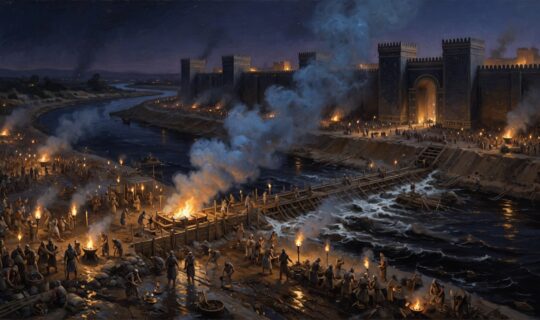
In September 1752, the British Empire went to sleep on the 2nd and woke up on the 14th. Eleven days simply ceased to exist. No births were recorded. No deaths. No taxes collected, no debts paid. Across the country, people rioted in the streets, shouting that the government had stolen their time. The phrase “Give us our eleven days!” echoed from London taverns to rural village squares.
They were not wrong to be angry. What had happened wasn’t merely an administrative correction. It was a demonstration of something rulers had understood for millennia: whoever controls the calendar controls everything that happens inside it.
Time Was Never Neutral
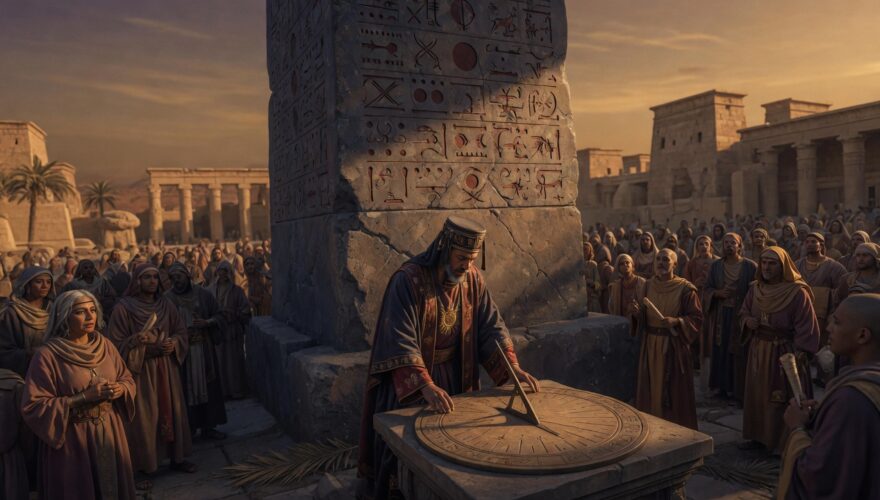
Long before atomic clocks and synchronized satellites, time was a political argument. Who decided when the year began? Who chose which days were sacred and which were for labor? Who declared a new era simply by seizing a throne?
The calendar was never a neutral tool. It was a declaration of authority, religious, imperial, and ideological. Every civilization that rose to power rewrote time in its own image, and every civilization that fell often found its calendar abolished along with its gods.
Rome’s Chaotic Gift
Julius Caesar inherited a Roman calendar so dysfunctional it had become a political weapon in its own right. By the first century BCE, the Roman republican calendar had drifted almost three months out of alignment with the solar year. Priests and magistrates, the men empowered to insert extra days and months to correct the drift, routinely manipulated this power to extend terms of office for allies or cut short the time opponents had to act. Time-keeping had become an instrument of corruption so naked that Cicero himself complained the Roman calendar was being “stretched or shrunk” to serve political convenience.
LESSER-KNOWN DETAILS
The French Revolutionary month Brumaire became infamous when Napoleon staged his coup on 18 Brumaire (November 9, 1799), seizing power on a date that now only existed because the Revolution had invented it.
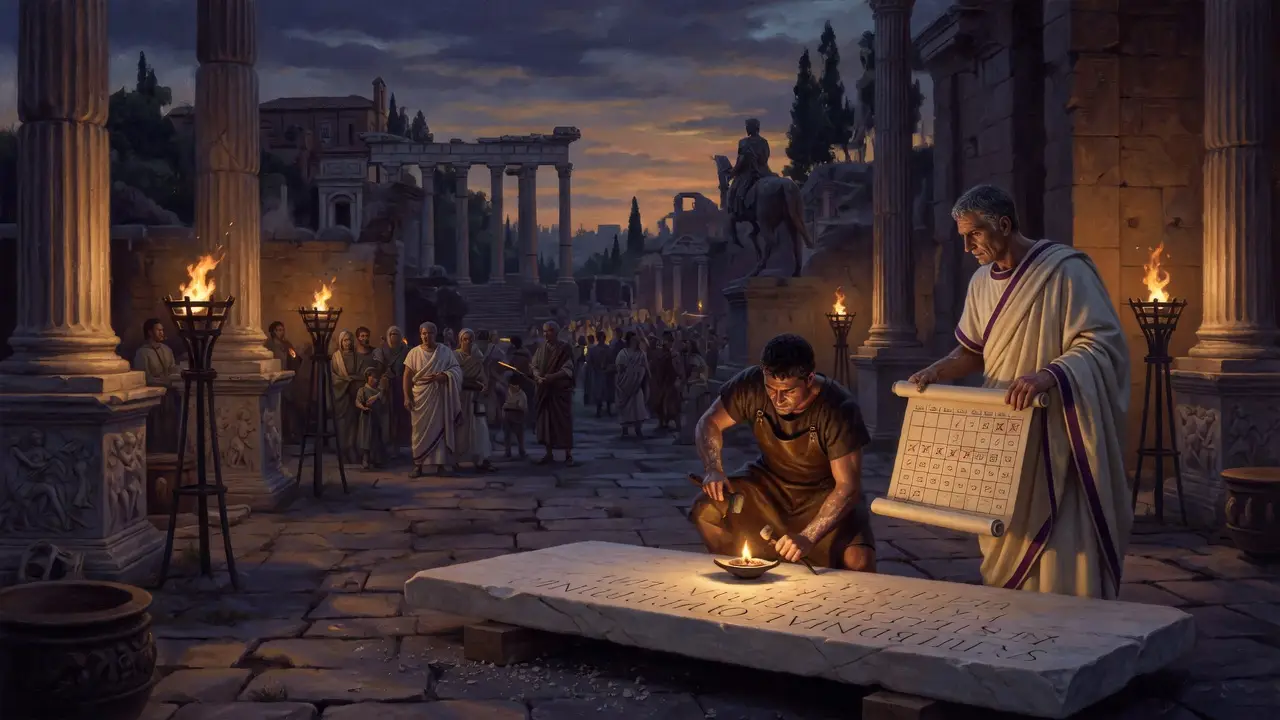
Caesar’s reform in 46 BCE was sweeping and brutal in its efficiency. He simply inserted 90 extra days into a single year, the so-called Year of Confusion, to drag the calendar back into alignment. Then he replaced the old lunar system with a solar one borrowed largely from Egypt, standardizing months and fixing a leap year cycle.
The effect was as political as it was astronomical. Caesar was not just correcting an accounting error. He was removing from the priesthood their power over time itself, centralizing it, as he centralized everything else, in his own hands. Within years, the month Quintilis was renamed Julius, July, after him. His successor Augustus claimed August. The calendar had become a monument.
“He called in the leading mathematicians and philosophers, and together they worked out and brought to completion the correction of the calendar, which the Romans had long wished to see done.”
Plutarch, Life of Caesar
Join The Archive Briefing
Weekly dispatches. The history they didn't teach you — sourced, subverted, delivered to your inbox.
The Sun King and His Sacred Feast Days
Medieval and early modern Europe operated on what historians sometimes call the liturgical calendar, a dense interlocking schedule of feast days, saints’ days, fasts, and holy seasons that governed far more than worship. It governed labor.
In 14th-century England, the number of mandatory religious holidays, days on which work was forbidden, ranged from 40 to over 80 per year depending on the region and the strictness of local clergy. Peasants who worked on a saint’s feast day risked not just fines but genuine social ostracism. The Church had effectively inserted itself into the economic machinery of every village, town, and city.
But the Church’s mastery of the calendar also meant it held leverage over kings. When Pope Gregory VII excommunicated Holy Roman Emperor Henry IV in 1076, one of the most devastating effects was calendrical: Henry was excluded from all Christian feast days and sacraments. The political fallout was so severe that Henry stood barefoot in the snow at Canossa for three days begging forgiveness, in what remains one of the most vivid displays of ecclesiastical power in European history.
“No man may receive the Eucharist, no marriage may be solemnized, no burial in consecrated ground permitted, in any territory under interdict.”
Papal Interdict formula, 12th century
Gregory XIII’s 1582 calendar reform reveals just how charged this territory remained. His Gregorian calendar corrected accumulated errors in the Julian system and was swiftly adopted by Catholic nations. Protestant England refused it for 170 years, not because English astronomers disagreed with the mathematics, but because accepting it meant conceding the Pope still held authority over the ordering of Christendom’s time. Those eleven days Britain finally surrendered in 1752 had been a point of religious stubbornness for nearly two centuries.
Revolutionary Time
The most audacious calendar seizure in history came not from a pope or a Caesar, but from a committee.
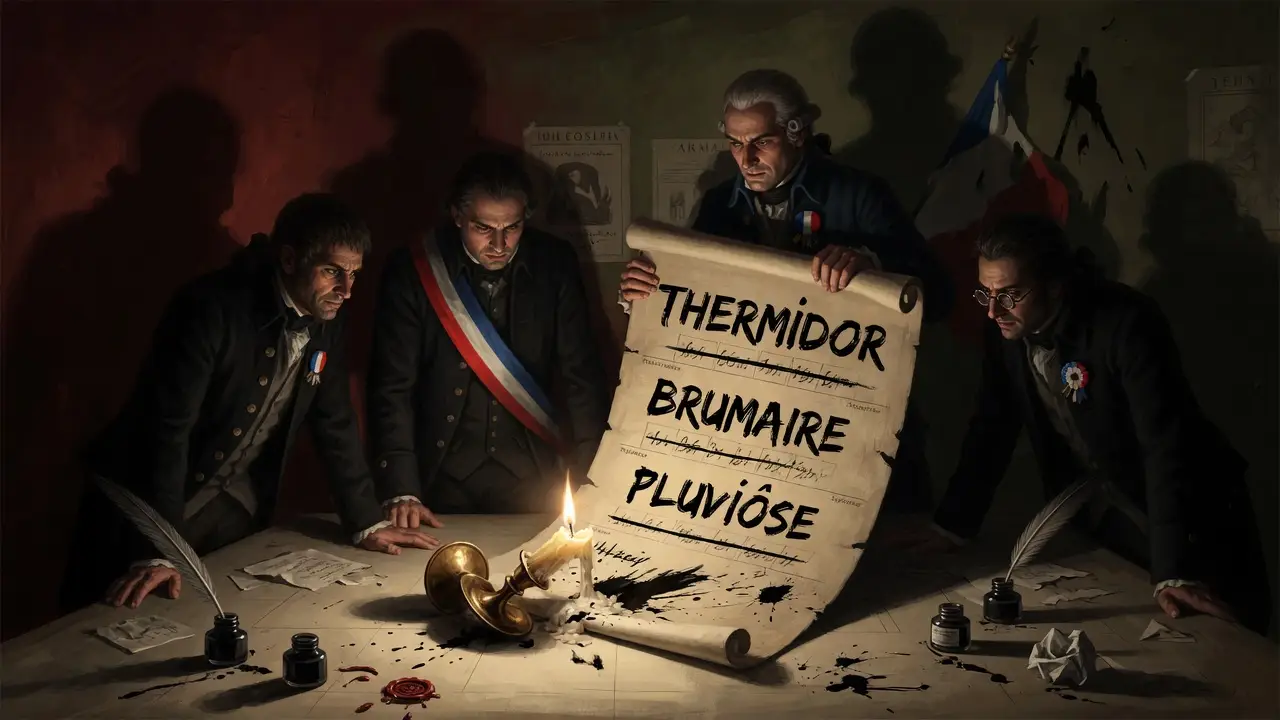
On 5 October 1793, the French National Convention abolished the Gregorian calendar entirely and replaced it with something designed from first principles to erase Christianity from French public life. The new Republican Calendar declared Year One as 1792, the year the Republic was proclaimed, effectively restarting time. Months were renamed after natural phenomena: Thermidor (heat), Pluviôse (rain), Brumaire (mist). Weeks were replaced by ten-day periods called décades, with one rest day every ten days instead of Sunday every seven.
That last detail was not incidental. It was the point. By destroying the seven-day week, the Revolution destroyed the Sabbath. Workers could not quietly observe Sunday if Sunday no longer existed as a concept in the official calendar. The aim was total: to dismantle not just the Church’s institutional power but the rhythmic structure of Christian time that had organized European life for more than a thousand years.
“Time is the medium in which power operates. To remake the calendar is to remake the world.”
Saint-Just, speech to the National Convention, 1793
The Revolutionary Calendar was not merely symbolic. Employers were required to use it. State documents used it. Correspondence that used the old calendar risked being flagged as counter-revolutionary. For thirteen years, France officially lived in a different temporal universe from the rest of Europe, a fact that complicated diplomacy, trade, and personal letters crossing borders in both directions.
Napoleon abolished it on January 1, 1806. The restored calendar announced, before a single army had moved, that the revolutionary experiment was over.
Stalin’s War on Sunday
The Soviet Union attempted something similar, and stranger, in 1929.
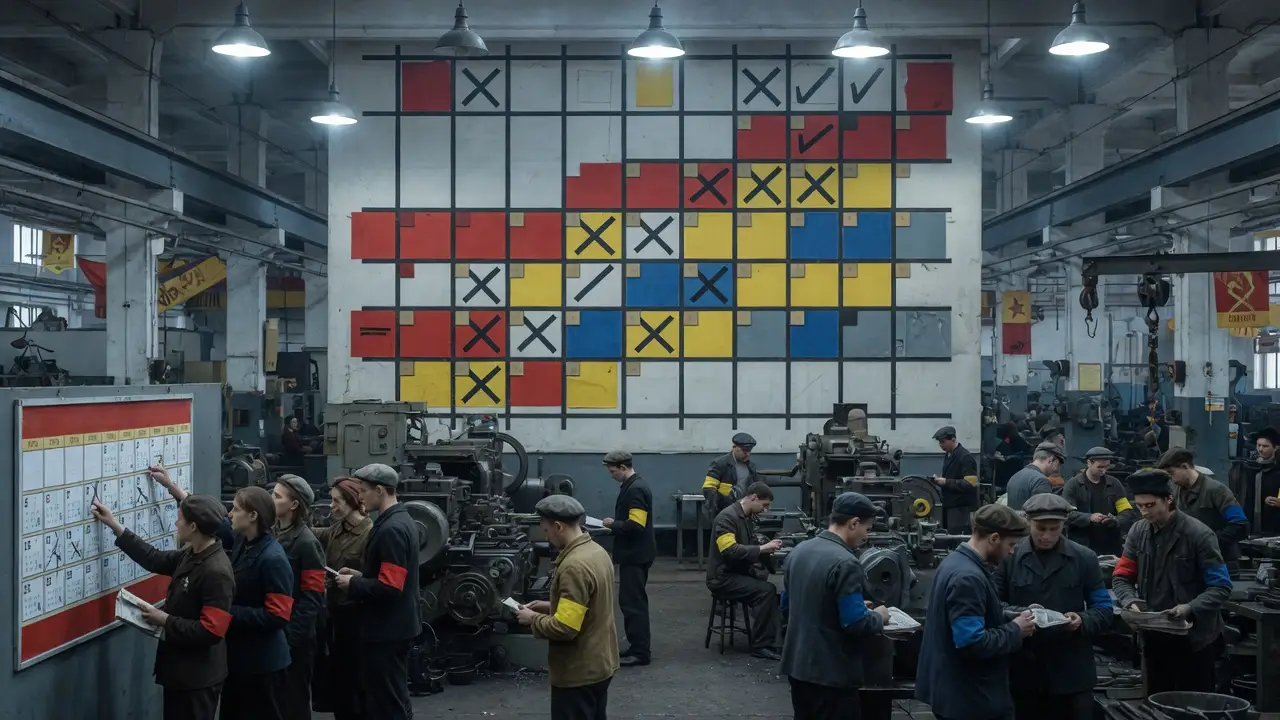
Stalin’s government introduced the Soviet Eternal Calendar, a five-day week with no Saturday and no Sunday. Instead, workers were divided into five color-coded groups, each assigned a different day off, staggered throughout the week. The practical goal was to keep factories running seven days a week without pause. The political goal was identical to France’s a century earlier: atomize the collective rest day that allowed churches to gather, families to worship together, and communities to resist.
LESSER-KNOWN DETAILS
In the Soviet five-day week, the color coding of workers meant husbands and wives were often assigned different rest days, deliberately or not, making family life structurally difficult.
A worker’s day off might fall on a Tuesday. Their spouse’s on a Thursday. Their neighbor’s on a Sunday, the old Sunday, now just another workday. Religious community required people to show up in the same place at the same time. The calendar made that functionally impossible.
Workers hated it. Machinery broke down from continuous use with no synchronized maintenance windows. Family life frayed. Even committed Communists found the system disorienting and demoralizing. By 1940, Stalin quietly abandoned it and restored a seven-day week, though the Soviet state remained officially atheist. The calendar had proven too blunt an instrument even for him.
“The struggle against religion is the struggle for socialism.”
Emelyan Yaroslavsky, head of the League of Militant Atheists, 1929
The Lesser-Known Calendars of Control
The headline reforms obscure a quieter history of smaller temporal seizures, no less revealing for their obscurity.
The Khmer Rouge declared Year Zero in 1975, abolishing not just the existing calendar but the entire concept of recorded time before the revolution. History itself was to begin again. Schools were closed, books burned, professionals executed. Year Zero was not a calendar reform. It was an announcement that the past no longer existed.
North Korea still operates on Juche calendar, introduced in 1997, which counts years from the birth of Kim Il-sung in 1912. In official North Korean documents, 2024 is Juche 113. The calendar does not replace the Gregorian system entirely, North Korea interacts with the wider world, but in domestic life it quietly insists that history’s meaningful axis runs through one man’s birth.
LESSER-KNOWN DETAILS
Julius Caesar’s Year of Confusion (46 BCE) lasted 445 days, the longest year in Roman history. Citizens living through it had no idea when it would end until the priests announced it.
Ethiopia operates on its own calendar, derived from the ancient Coptic system, which runs roughly seven years behind the Gregorian calendar. When the rest of the world celebrated the year 2000, Ethiopia celebrated its millennium in 2007. This is not a political imposition but a living inheritance, a calendar that has survived colonial pressure and continues to shape the country’s public rhythms, its holidays, its New Year celebrations falling in September.
Even the seemingly mundane question of which day begins the week carries ideological weight. Most of Europe places Monday as the first day, reflecting a post-Christian secular work-first orientation. The United States calendar traditionally starts on Sunday, reflecting older religious convention. The ISO standard says Monday. The argument has never fully ended.
When Time Becomes a Form of Resistance
Calendars have not only been wielded by the powerful. They have also been how the powerless held on.
Jewish communities scattered across Europe, the Middle East, and North Africa maintained the Hebrew calendar through centuries of diaspora as a form of collective identity no empire could fully seize. The same Passover, the same Yom Kippur, observed across thousands of miles, synchronized communities that had no political territory, no army, no institution the host nation was obliged to respect. Time-keeping became the architecture of survival.
Indigenous communities in the Americas preserved their own calendrical systems even after Spanish colonization imposed the Gregorian calendar by legal force. The Maya Long Count, the Aztec ritual calendar, the agricultural calendars of Andean communities, these survived in parallel, embedded in ceremony and memory, maintained by people who understood that to lose the calendar was to lose coherence as a people.
In colonial Africa, missionaries used the Christian calendar as an explicit tool of cultural transformation, displacing harvest festivals, ancestor commemorations, and seasonal rituals with Christmas, Easter, and the seven-day week. Independence movements in the 20th century sometimes reclaimed traditional calendars, or at least traditional feast days, as visible assertions of cultural continuity.
Time’s Ongoing Politics
Every calendar encodes a worldview. The Gregorian calendar that now dominates global commerce and administration was designed by a pope, refined by Catholic astronomers, and spread across the world partly by colonial power. Its BC/AD axis declares a particular theology to be the hinge of universal history. Even the secular BCE/CE replacement preserves the same year zero. The argument is just quieter.
LESSER-KNOWN DETAILS
Ethiopia’s calendar has 13 months: twelve of 30 days each and a thirteenth month of 5 or 6 days called Pagume, meaning “forgotten days” in Greek.
China uses the Gregorian calendar for civil purposes and a traditional lunisolar calendar for festivals. The Islamic world navigates between the Hijri calendar, which begins with the Prophet’s migration to Medina in 622 CE, and the Gregorian calendar required by international business. Israel maintains the Hebrew calendar for religious life alongside the Gregorian for state functions. In each case, the existence of two simultaneous calendars marks a negotiation between identity and power.
The week you just lived through was shaped by decisions made in Rome, Constantinople, Paris, Moscow, and Jerusalem over the past two thousand years. The day you call the weekend was someone’s political concession or someone else’s revolutionary demand.
Whoever Owns the Clock Owns the Country
The British rioters of 1752 were not being irrational. They grasped, viscerally if not intellectually, what every ruler from Caesar to Stalin understood: that controlling time means controlling behavior, memory, identity, and belief. A calendar tells you when to rest and when to work, when to mourn and when to celebrate, whose birth matters and whose history began.
To change the calendar is to claim that the old order is gone and the new one has arrived. It is the cheapest and most sweeping form of conquest imaginable.
The question worth sitting with is not why rulers kept reaching for the calendar as a tool of power. The question is why we so rarely notice they still do.