The monasteries were not trying to be heroes. They were trying to be obedient. The Rule told them to read. Reading required texts. Texts required copying. Copying, repeated across centuries and hundreds of institutions, became the most successful information redundancy project in human history.
The Night the World Started Forgetting
The monastery at Vivarium sat on the toe of the Italian boot, overlooking the Ionian Sea. The year was somewhere around 560 AD. Outside its walls, the Roman Empire had been dead for nearly a century. The roads that once stitched together thirty million people were growing over. The aqueducts were cracking. The cities that had made Latin the language of law, medicine, and philosophy were contracting into frightened villages.
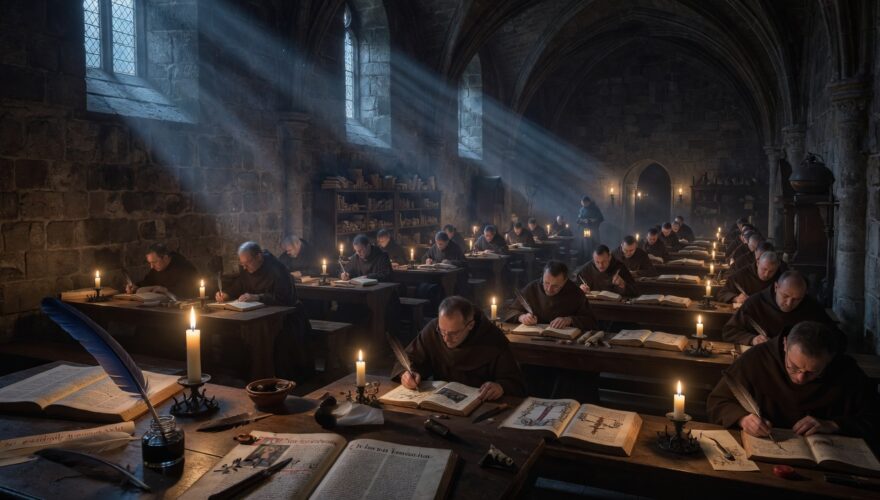
Inside, a group of monks bent over wooden desks by lamplight, copying manuscripts they did not fully understand, in a language some of them were only beginning to learn.
They were not trying to save civilization. They were trying to earn their prayers. What they actually did was keep the lights on for the entire Western world.
What Collapse Actually Looks Like
History books talk about the fall of Rome like it was an event. It wasn’t. It was a long, grinding unraveling that took generations and looked, to most people living through it, more like a slow deterioration in the quality of everything rather than a dramatic ending.
Roads stopped being repaired. Then they stopped being used. Trade routes that had moved grain from North Africa to Rome for five hundred years went quiet. Literacy rates, never high to begin with, collapsed further as the schools that depended on Roman municipal funding simply ceased to exist. By the 6th century, there were whole regions of what had been the Empire where no one was writing anything down at all.
“What soldier would not wish to please the king by his activity, when such labors as these benefit not only the individual but all posterity.”
Cassiodorus, Institutiones (c. 562 AD)
And when people stop writing things down, knowledge dies. Not dramatically. Quietly. A doctor who knew how to treat infection dies, and no one remembers his methods. A builder who understood Roman concrete techniques grows old, and his apprentice never quite grasps the recipe. A monk who copied Cicero passes on, and the book he copied from is used for kindling.
This is what real civilizational collapse looks like. Not fire. Forgetting.

Join The Archive Briefing
Weekly dispatches. The history they didn't teach you — sourced, subverted, delivered to your inbox.
The Accident That Changed Everything
The man most responsible for what happened next was not a king or a general. He was a Roman aristocrat named Cassiodorus who had spent decades working as a kind of chief secretary to Theodoric, the Ostrogothic king ruling Italy in Rome’s absence. He was a bureaucrat, a fixer, a man who wrote letters for a living.
When Theodoric’s kingdom itself began to collapse in the wars between the Goths and the Byzantine Empire, Cassiodorus did something that, at the time, probably seemed like personal retreat. He retired to his family estate in Calabria, founded a monastery he called Vivarium, and set his monks to work copying manuscripts.
LESSER-KNOWN DETAILS
Monks often worked in silence, communicating via hand signals. A complete sign language system was developed specifically for monastery use, with different signs for different books, food items, and tasks.
His reasoning was almost embarrassingly practical. He believed that monks needed to study scripture, that studying scripture required understanding the classical texts that had shaped Christian theology, and that those texts were disappearing. So he built a scriptorium, assembled a library, and began issuing instructions on how to copy books correctly, how to fix errors, how to check one manuscript against another.
He wrote a guide called Institutiones, which was essentially a curriculum. Read Virgil before Augustine. Understand mathematics before you try to grasp astronomy. Copy carefully. Check your work. He even gave instructions on how scribes should care for their eyes, recommending they work in rooms with good light and that they rest when tired.
This was not mysticism. This was project management.
The Scriptorium as Factory
What Cassiodorus started, Benedict of Nursia codified. The Rule of Saint Benedict, written around 530 AD, became the operating manual for monasteries across Europe. It divided the monk’s day into prayer, manual labor, and reading. The reading was not optional. The labor, in many monasteries, meant copying.
The scriptorium was not a peaceful room. It was loud, in its way. Senior monks called armarius dictated texts aloud while rows of copyists worked simultaneously, allowing multiple copies to be produced at once. The work was exhausting. Scribes developed repetitive strain injuries, complained of cold and bad light, and occasionally left notes in the margins of manuscripts that read, in the original Latin, as something close to desperate:
“New parchment, bad ink. I say nothing more.”
Or, from a monastery in Ireland, in what scholars believe is the oldest personal complaint preserved from the early medieval period: “I am very cold.”
These were not enlightened scholars passively tending a flame. They were workers, and the work was hard, monotonous, and endless. A single Bible required the skins of around 200 sheep. A major monastery might produce one or two complete Bibles per year. The entire effort ran on institutional discipline, and that discipline ran on the Rule.
LESSER-KNOWN DETAILS
Some medieval monks developed a technique called palimpsest: scraping the ink from an old parchment to reuse it, which destroyed some texts forever, but also accidentally preserved others underneath layers of newer writing. Modern X-ray and UV scanning has recovered lost texts from palimpsests as recently as 2012.
What the Rule created, accidentally and brilliantly, was an organization that did not depend on any single person’s memory, enthusiasm, or genius. It was a system. And systems survive where individuals don’t.
Ireland: Where the Books Went to Hide
When the 7th and 8th centuries brought new rounds of invasion and instability to continental Europe, something remarkable had already happened in a place that Rome had barely reached.
Ireland, which had never been part of the Empire proper, had converted to Christianity in the 5th century and taken to monastic life with a fervor that bordered on competitive. Irish monks built monasteries in places that seemed designed to be inaccessible: cliff edges, tiny islands, the windswept headlands of the Atlantic coast. Skellig Michael, a pair of rock spires rising out of the Atlantic eight miles from the Kerry coast, housed a community of monks who climbed 618 steps cut into the rock face to reach their beehive stone huts and their scriptorium.
“If one should wish to understand what is the fashion of this world, let him be prepared to love what the world hates.”
Columbanus (c. 600 AD), writing on the value of learning
These were not comfortable places. They were deliberately harsh. But harshness, it turned out, was excellent for preservation.
Irish monasteries became the primary safe houses for classical learning during the worst centuries of European instability. Monks at Clonmacnoise, Iona, and Lindisfarne copied not just scripture but grammar, medicine, philosophy, and poetry. They developed their own extraordinary illustrated style, producing manuscripts so visually complex and beautiful that scholars still debate whether the designs could have been made by human hands alone. The Book of Kells, produced somewhere in the Irish-Scottish monastic world around 800 AD, contains lettering so fine in places that it requires magnification to fully see.
They were also mobile. When Viking raids began targeting monasteries specifically for their accumulated wealth, Irish monks carried their books with them, traveling as missionaries across Scotland, northern England, and the Continent, seeding new monasteries as they went. Saint Columbanus founded over a hundred monasteries in France, Switzerland, and northern Italy before his death in 615 AD. Each one became a new node in an informal network of knowledge transmission.
The books moved with the monks. The knowledge moved with the books.

The Arab Detour
There is an uncomfortable fact that tends to get omitted from the European story of monastic preservation: much of what was eventually recovered in the West had survived precisely because it traveled east.
When Islamic scholars in Baghdad began their great translation movement in the 8th and 9th centuries, they were working partly from texts that Eastern Christian monasteries had preserved in Greek and Syriac. The works of Aristotle, Galen, Euclid, and Ptolemy survived not because the West kept them safe but because they were copied in Alexandria, translated in Persia, and studied in the libraries of Baghdad and Cordoba.
“I and Pangur Ban, my cat, ’tis a like task we are at. Hunting mice is his delight, hunting words I sit all night.”
An anonymous Irish scribe, 9th century
What the European monasteries did, beginning in earnest in the 11th and 12th centuries, was retrieve them. Scholars traveling to Spain, Sicily, and the Middle East found texts that had been lost in the Latin West for centuries and brought them back for translation. The monasteries then copied these recovered texts alongside the ones they had never lost.
This is the full picture: preservation was not a single-institution achievement. It was a relay race, passed between cultures across centuries, with monasteries as one critical leg of a much longer run.
Climax: The Moment It Almost Didn’t Work
In 1204, Crusaders sacked Constantinople. The city that had preserved the largest library in the Greek-speaking world was looted, burned, and politically dismembered. The Library of the Patriarchate, which had housed an extraordinary collection of classical texts, was partly destroyed.
For a moment, the thread became dangerously thin.
LESSER-KNOWN DETAILS
Viking raiders who targeted monasteries for their wealth inadvertently spread manuscript culture. Monks fleeing raids carried books with them, and several texts are only known to have survived because they were moved during Viking threats.
What saved it, in part, was that Byzantine scholars had already been sending copies of critical texts westward for decades, partly in the hope of strengthening political ties with Rome. Some of these texts landed in Italian monasteries. Some found their way to the new universities forming in Paris, Bologna, and Oxford. The redundancy that Cassiodorus had built into his copying system, and that every scriptorium after him had replicated by accident simply by making multiple copies, meant that the destruction of any single collection was survivable.
No one had planned this. No one had designed a distributed backup system for human knowledge. It had emerged, slowly and accidentally, from the simple monastic habit of copying everything twice.
What Came After
By the 13th century, the monopoly was breaking. Universities were attracting scholars who wanted to discuss texts, not just preserve them. The mendicant orders, the Franciscans and Dominicans, were producing philosophers and scientists who operated outside the traditional monastic structure. And the printing press, arriving in Europe in the mid-15th century, finally solved the problem the monks had been laboring over for nine hundred years.
“Idleness is the enemy of the soul; and therefore, at fixed times, the brothers ought to be occupied in manual labor, and again at fixed times, in sacred reading.”
Benedict of Nursia, The Rule of Saint Benedict (c. 530 AD)
You could now copy a book in days rather than months. You could print five hundred copies at once. The scriptorium became obsolete almost overnight.
But the printing press printed what was available to print. And what was available existed almost entirely because of what those cold, tired, marginalia-writing monks had refused to let go of.
Gutenberg’s first Bible was printed from texts that had passed through monastic hands. The Latin grammar books that gave Europe a common scholarly language had been copied in Irish scriptoriums. The Aristotle that would eventually drive the Scientific Revolution had traveled from Baghdad to Toledo to Canterbury to Paris, touching monastic libraries at nearly every stop.
Why the Story Hasn’t Finished
We face a version of this question right now. Digital information is simultaneously everywhere and nowhere. Server farms burn. Companies collapse. File formats go obsolete. The websites of a decade ago are already gone, archived imperfectly or not at all. We have created more information than any civilization before us, and we are arguably worse at preserving it than a freezing monk on a rock in the Atlantic.
LESSER-KNOWN DETAILS
Charlemagne, who was likely never fully literate himself, commissioned the standardization of Latin handwriting across his empire in the 8th century. The script developed by monks at his court, Carolingian minuscule, became the direct ancestor of modern lowercase letters. Every time you read a lowercase letter, you are reading a script designed in a monastery.
The question those monks answered without being asked was simple: who is responsible for making sure this survives? They answered it by showing up every morning, picking up the quill, and doing the work.