
How did ancient civilizations handle serial killers before criminal psychology or forensics existed? From Rome’s mass poisoning trials of 331 BC to the Greek concept of miasma and the Germanic declaration of the nithing, this is the story of how ancient communities confronted systematic killing with nothing but pattern recognition, theology, and raw fear, and what their blind spots reveal about ours.
Rome, 331 BC. The Men Kept Dying.
Not in battle. Not from plague. Not from famine. They died in their homes, at their tables, with food in their mouths and wine in their cups. Strong men. Healthy men. Magistrates and soldiers, senators and craftsmen. They woke one morning and were dead by nightfall. Rome watched this happen for weeks and had absolutely no language for what it was seeing.
The city called it pestilence. It had to be. What else struck without warning, claimed the vigorous as easily as the weak, and refused to follow any pattern a rational mind could trace? Roman priests consulted the auguries. Sacrifices were made. Temples filled with desperate crowds. And still the men died.
Then a slave woman spoke up.
She said the deaths weren’t divine. She said she had seen things. And what followed became the first documented mass investigation in Western history into what we would now recognize as coordinated serial killing carried out by people with a method, a motive, and enough intelligence to hide both.
The Romans caught 170 women. They executed every one.
A World With No Framework for the Unthinkable
To understand how ancient civilizations responded to serial killers, you first have to understand how alien the very concept would have been to them.
Modern criminology rests on a simple foundational idea: that a single human being can kill repeatedly, deliberately, and in a pattern driven by internal psychology. That idea is surprisingly recent. For most of recorded history, if people died in sequence, communities reached for explanations that had nothing to do with individual human pathology. They looked upward, toward gods and demons. They looked outward, toward enemies and curses. They looked inward at themselves, asking what collective sin had drawn such punishment.
The possibility that one of their neighbors was simply choosing to kill people, one by one, for reasons that lived entirely inside that person’s head, that was a thought the ancient world was not built to think.
Join The Archive Briefing
Weekly dispatches. The history they didn't teach you — sourced, subverted, delivered to your inbox.
Which made the killer’s position, in many cases, devastatingly secure.
The Roman Poisoning Trials and the Problem of the Invisible Crime
The 331 BC crisis is remarkable not just for its scale but for what it reveals about how a sophisticated civilization stumbles when reality outpaces its conceptual vocabulary.
Rome in the mid-fourth century BC was not a naive society. It had courts, magistrates, lawyers, and a legal tradition that would eventually become the backbone of Western law. It understood murder. It prosecuted it routinely. But the murders it understood were the ones it could see: the stab wound, the strangled throat, the bludgeoned skull. Roman law was built on visible evidence in a world that had not yet reckoned with the invisible.
Poison changed that equation completely.
When the slave woman brought her accusation to the curule aedile Quintus Fabius, she claimed that prominent Roman women were deliberately brewing and distributing toxic compounds. She led investigators to a house where they found women gathered around what appeared to be medicinal preparations. The women insisted these were medicines. One of the investigators demanded they drink their own preparations on the spot to prove it.
Several women drank immediately and died.
What the Romans were witnessing, though they had no term for it, was a network of coordinated killers operating through social structures that Roman law had never thought to police: the domestic sphere, the kitchen, the trusted hands of wives and household servants. The killers had exploited the oldest blind spot in the ancient world. Violence that came from outside the home was comprehensible. Violence that originated within it was not merely criminal. It was cosmically wrong, a rupture in the natural order so severe that Rome’s first instinct was to classify it as supernatural.
The legal proceedings that followed were improvised, unprecedented, and brutal. Livy, writing centuries later, would record the episode with evident unease, noting that whether the women acted from criminal intent or deluded belief, neither possibility was entirely comforting.
“So great was the multitude of accused that the Senate at last resolved the matter must be treated not as private crime but as public catastrophe.”
Livy, Ab Urbe Condita, Book VIII
That line is worth sitting with. A public catastrophe. Not a crime wave. Not a serial murder investigation. A catastrophe, the same word Romans used for floods, famines, and military defeats.
The Greek Answer: The Land Itself Is Sick
While Rome reached for courtrooms, ancient Greece reached for theology.
The Greek concept of miasma roughly translatable as “pollution” or “spiritual contamination”, served as the civilization’s primary explanatory framework when deaths accumulated in ways that defied ordinary understanding. Miasma was the idea that certain acts, particularly acts of bloodshed, released a kind of invisible corruption into the world. This corruption spread. It clung to people, to places, to entire communities. Left uncleansed, it would draw further death toward it like a wound drawing infection.
When a Greek community found itself confronting a pattern of deaths it couldn’t explain, the instinct was not to search for a human perpetrator but to search for the source of the pollution. Who had committed an impurity? What unresolved wrong had been left festering in the community’s spiritual body? The killer, in this framework, wasn’t a psychology. The killer was a cosmic imbalance that needed correction.
This framework had one particularly dangerous consequence. It meant that an actual human being committing repeated killings could continue operating for quite some time while the community directed its investigative energy skyward rather than inward. Oracles were consulted. Ritual purifications were performed. Animals were sacrificed at crossroads to placate Hecate. And the killings, if they were indeed being carried out by a person rather than the gods, continued.
But the Greeks were not entirely blind. The same tradition that gave us miasma also produced the earliest recorded attempts to think systematically about repeated human evil.
Plato, in his later works, grappled seriously with the question of the person who commits wrong not from ignorance but from a corrupted soul that has inverted its natural orientation toward good. He called such a person someone in whom the logistikon, the rational faculty, had been overrun by the appetites. He did not have a clinical term for what we would call psychopathy. But he understood that the disorder was internal, persistent, and resistant to ordinary social correction.
“The soul that is diseased and lacks self-control we must not leave unpunished, but rather compel it to endure that which will make it better.”
Plato, Laws, Book IX
That’s not a criminologist speaking. But it’s also not someone who thinks the problem is supernatural.

Mesopotamia and the Cunning of the Wrongdoer
In ancient Babylon and Assyria, legal codes like that of Hammurabi dealt extensively with violence and compensation. But what happened when the violence repeated? When the same person appeared at the center of multiple deaths?
Mesopotamian legal thinking had a concept that edges surprisingly close to what we might call recidivism awareness. The Code of Hammurabi distinguishes between a man who kills once in a dispute and a man who becomes known as one who kills — the latter warranting not just punishment but a kind of communal declaration that the person had placed themselves outside the protection and obligation of ordinary society.
What’s striking is the Mesopotamian emphasis on reputation as evidence. In a world without forensics, the consistent observation by multiple witnesses that a particular person was present at multiple deaths carried genuine legal weight. This was not considered mere gossip. In the absence of physical evidence linking killer to crime, the pattern itself was the evidence.
LESSER-KNOWN DETAILS
Locusta of Gaul, Rome’s most documented serial poisoner (active under Claudius and Nero, 1st century AD), was kept alive for years by Emperor Nero specifically because her skill was useful to him. She was eventually executed by Galba in 69 AD, reportedly forced to walk through Rome’s streets before her death, a ritual of public humiliation that served as communal exorcism as much as punishment.
Assyrian communities also maintained something unusual for the ancient world: community watchers, appointed individuals whose role was partly spiritual but partly what we would recognize as neighborhood surveillance. When deaths clustered, these watchers were expected to map the pattern who was present, who benefited, whose movements were unusual. They didn’t call this criminal investigation. They called it protecting the community from malevolent forces. The methodology was closer to the truth than the theology.
When the Gods Stopped Being a Convenient Explanation
There is a fascinating moment in many ancient cultures’ histories when the theological explanation for repeated death begins to crack under the weight of the evidence. It happens in different places, at different times, through different intellectual traditions. But the crack always appears for the same reason: pattern recognition is a deeply human skill, and eventually, people notice that the deaths follow a person rather than a place.
In ancient China, communities dealing with what they understood as gui (malevolent spirits responsible for successive deaths) developed a parallel investigative tradition almost despite themselves. Taoist ritual specialists called in to identify and cleanse a haunted location would often, in the course of their investigation, begin asking very practical questions. Who had access to the deceased? Who was present at multiple deaths? What did these deaths have in common beyond their location?
“Qui venenum fecit, capite puniatur.” (“He who makes poison shall be punished by death.”)
Twelve Tables of Roman Law, c. 450 BC
The spiritual framework remained intact. The methodology beneath it was, without anyone acknowledging it, becoming empirical.
One lesser-known detail from Tang dynasty court records describes a case where a village called for a ritual exorcism after three successive deaths in the same household. The specialist sent to perform the ritual spent three days questioning neighbors before concluding that the spirit in question appeared to have a physical form, walk upright, and own a particular kind of knife. The person identified was a member of the household. The case was transferred to civil magistrates.
LESSER-KNOWN DETAILS
Tang dynasty China maintained a system called jimi in criminal courts, which roughly translates to “accumulation of suspicion” , a legal mechanism by which a person consistently present at multiple unexplained deaths could be formally investigated even without direct evidence. This is arguably the earliest documented legal framework for what modern criminology calls linkage analysis.
The exorcist had, functionally, conducted a murder investigation.
The Germanic Concept of the Nithing: Being Cast Out of Humanity Itself
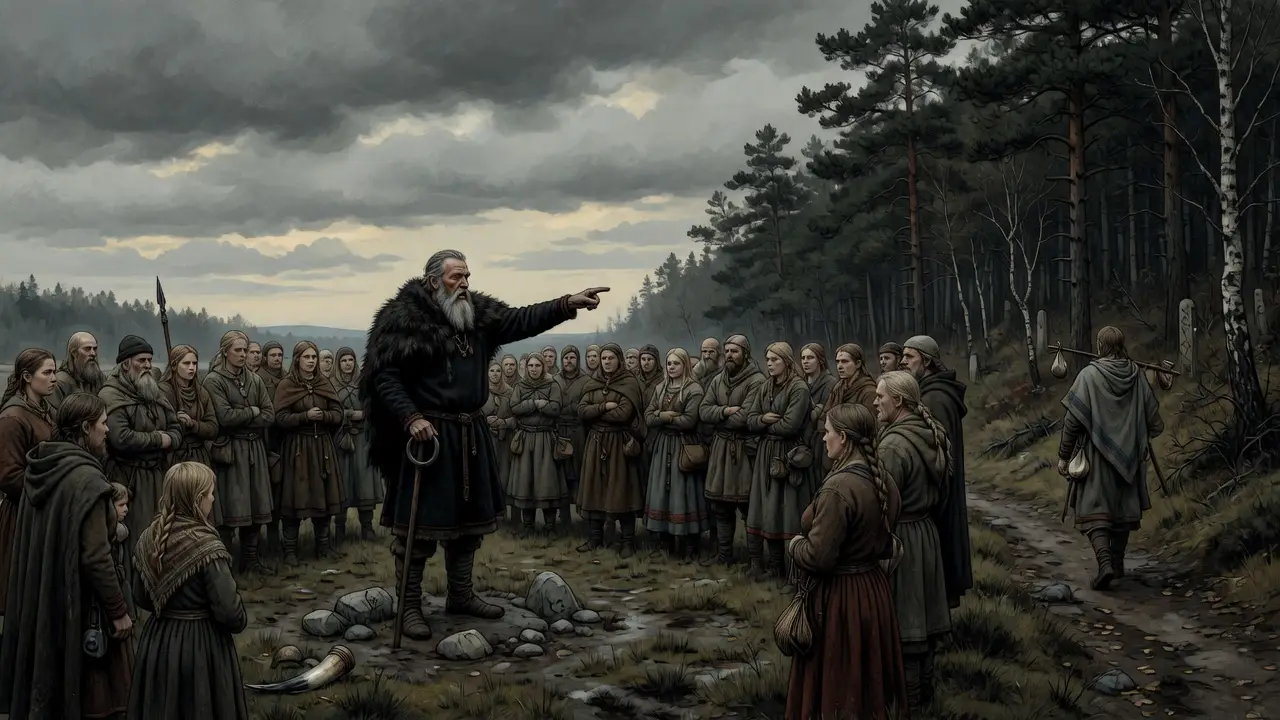
Perhaps the most viscerally extreme ancient response to a person identified as a repeat killer came from early Germanic and Norse cultures, where such a person could be declared a níðingr, a nithing, a word that means something closer to “non-person” than “criminal.”
The declaration was communal, public, and total. A nithing had no legal standing, no right to protection under the community’s social compact, no claim on anyone’s loyalty or mercy. Any person could kill a nithing without legal consequence. They were, in the formal language of the culture, a vargr, a wolf, a creature that operated outside the boundaries of human society and could therefore be treated as one treats a predatory animal.
LESSER-KNOWN DETAILS
Ancient Greek cities sometimes employed kathartai, ritual purifiers, who functioned as a kind of spiritual forensics unit. When called to cleanse a location of miasma, the more sophisticated practitioners would ask detailed questions about the nature and timing of deaths before beginning any ritual, creating de facto crime scene protocols within a religious framework.
What’s striking about the nithing concept is what it implies about the community’s understanding of the person they were declaring it against. The vargr was not considered possessed. They were not considered cursed or polluted in the Greek sense. The Germanic framework understood, at some level, that this was a person who had chosen to operate by different rules, who had, in essence, declared war on the social order. The community’s response was to simply agree that the war was on.
This is arguably closer to a modern understanding of serial violence than either the Roman legal scramble or the Greek theological response. The Germanic declaration of the nithing acknowledged something the others were reluctant to: that the problem was fundamentally about a human being who had decided the rules didn’t apply to them.
“Let him be wolf in the forest and adder in the field, and feared by all.”
Anglo-Saxon legal formula for the declaration of outlawry, recorded in the laws of Æthelstan, 10th century
What Happened When They Finally Found the Person
Resolution, in the ancient world, rarely looked like justice in any sense we would recognize.
The Roman women executed in 331 BC were given no trial in the modern sense. The speed of the proceedings suggests that once the community had identified a perpetrator, the urgency was not to deliberate but to cleanse. The executions were themselves partly punitive and partly ritualistic. Rome needed to cauterize something, and it did.
In ancient Near Eastern contexts, documented executions of identified repeat killers were often carried out with deliberate public ceremony that went beyond what was necessary for mere punishment. The body might be displayed at a crossroads. Specific imprecatory rituals were performed to sever the perpetrator’s link to the community’s spiritual body. The goal was not punishment alone but severance, making absolutely certain that whatever had made this person dangerous could not linger.
LESSER-KNOWN DETAILS
The Aztec concept of the tlacatecolotl (literally “owl-man”) described a person who had entirely surrendered their humanity to darkness. Unlike European werewolf mythology, the tlacatecolotl was understood to be fully human and fully responsible for their actions, the transformation was moral, not physical. This made Aztec handling of suspected tlacatecolotl cases notably more focused on human perpetrators than many Old World equivalents.
What almost never appears in ancient accounts is anything resembling a serious inquiry into why. The question of motivation, what made this particular person capable of this particular pattern of violence, was essentially unanswerable within the frameworks available, and most ancient cultures didn’t attempt it. They found the person. They ended the person. They cleansed the place. They moved on.
The why would wait another two thousand years.
The Echo That Never Quite Faded
There is something instructive in watching ancient civilizations lurch toward an understanding they couldn’t quite reach. They had the pattern recognition. They had, in some cases, the investigative methodology. They had communal memory and oral traditions that preserved warnings: avoid this house, distrust this person, remember what happened when these deaths occurred. What they lacked was a conceptual category that could hold all of it together.
That gap, between seeing the pattern and having the language to name what the pattern meant, is where most of their failures lived.
And it raises an uncomfortable question for us. Not about ancient civilizations, but about ourselves. Every era believes it has finally found the complete conceptual vocabulary for the worst of human behavior. Every era is wrong. The ancient Romans looked at coordinated poisoning and saw pestilence. The ancient Greeks looked at a serial killer and saw miasma. The Germanic peoples came closest of all, perhaps, when they stopped looking for supernatural explanations and simply said: this person has placed themselves outside humanity.
What they all understood, in their different ways, was that the most dangerous thing a community can do when confronted with systematic killing is to assume the explanation lies somewhere other than in the choices of an ordinary person. The monster is always more comfortable to believe in than the neighbor.
Ancient civilizations reached for the monster because the neighbor was unbearable.
We still do it. Just with better vocabulary for the reaching.