
Walk through London in the autumn of 1574 wearing the wrong sleeve, and you could be arrested before you reached the market square. Not for theft. Not for violence. For fabric.
A merchant’s wife steps out in a gown trimmed with sable. A young gentleman’s son fastens a doublet of crimson velvet. A servant pads his stockings to look fuller in the leg, chasing a fashionable silhouette he has no legal right to wear. All three have broken the law. All three can be fined, jailed, or stripped of the offending garment on the spot, because in Elizabethan England, clothing was not just clothing. It was a document. And like any document, it could be forged.
This was the world of sumptuary laws: the original fashion police, and one of history’s strangest experiments in legislating taste, money, and morality through what people put on their bodies.
- 1 What Sumptuary Laws Actually Were
- 2 When Fabric Became a Political Problem
- 3 England: The Law of Who Could Wear Purple, Gold, and Sable
- 4 Renaissance Italy: Fashion, Women, and the Loopholes
- 5 China: Imperial Yellow and the Color of Authority
- 6 Japan: Merchants With Money But Not Status
- 7 Why Rulers Cared So Much
- 8 Why the Laws Failed
What Sumptuary Laws Actually Were
Strip away the lace and the legalese, and sumptuary laws were simple in purpose. They were rules, sometimes royal decrees, sometimes full acts of parliament, that dictated who could wear what. Rank decided your fabric. Income decided your trim. Gender decided how much of your body you were permitted to display, and in what colors. Even religion and morality could decide your wardrobe, down to whether you were allowed a fur collar or a jeweled ring.
The logic behind them was consistent across centuries and continents: Luxury needed limits, because excess was seen as a moral failing, not a personal choice. Class boundaries needed to stay visible, because a society built on inherited rank could not survive if rank became invisible. Commoners and newly wealthy merchants needed to be stopped from dressing like nobility, because clothing was the easiest, fastest way to fake belonging to a world you weren’t born into. And women, more than men, bore the weight of these laws, because a woman’s appearance was tangled up with her family’s honor, her marriageability, and her perceived virtue in a way men’s clothing rarely was.
None of this was unique to Europe. China regulated the color yellow with the force of treason law. Japan’s shoguns issued edict after edict trying to keep wealthy merchants from outdressing the warrior class. Ancient Rome capped how much gold a woman could wear before the Republic was even a century into its laws. Different empires, different centuries, same fear: that clothing was getting away from them.

When Fabric Became a Political Problem
Here is the detail that makes all of this make sense: for most of human history, there was no national ID card, no passport photo, no driver’s license. There was only the body, and what covered it.
A person walking down a street in 1450, or 1600, or 1750, was read instantly. A wide ruff and a fur-lined cloak said merchant or noble. A coarse wool tunic said laborer. A widow’s black said exactly what it claimed to say. A courtesan’s striped hood, mandated in parts of medieval Europe, announced her profession before she said a word. Clothing did the job that paperwork does today. It told you, at a glance, who you were dealing with.
That system worked beautifully for rulers, right up until money started moving faster than bloodlines.
By the late medieval period, a new kind of person was walking the streets of London, Florence, and Antwerp: a wool merchant, a banker, a trader in silk and spice, who had never held a noble title and never would, but who had more disposable income than half the aristocracy. He could afford the same velvet. He could afford the same fur. He could walk into church on Sunday dressed, for all anyone could tell, exactly like a baron.
That was the problem. Not the velvet itself, but what the velvet implied: that birth no longer mattered as much as money did. A sumptuary law was a ruler’s attempt to freeze that idea before it spread. If a tailor could sew a commoner into a nobleman’s silhouette, then the entire architecture of inherited status was built on something as flimsy as a bolt of cloth, and that was a thought no monarchy wanted its subjects having too loudly.
Join The Archive Briefing
Weekly dispatches. The history they didn't teach you — sourced, subverted, delivered to your inbox.
England: The Law of Who Could Wear Purple, Gold, and Sable
No country regulated clothing with quite the obsessive precision of Tudor and Elizabethan England, and no monarch pursued it harder than Elizabeth I, who issued nine separate Acts of Apparel during her reign alone.
The most famous of these statutes, issued at Greenwich on the 15th of June, 1574, opened with language that reads less like a fashion code and more like a national emergency:
“The excess of apparel and the superfluity of unnecessary foreign wares thereto belonging now of late years is grown by sufferance to such an extremity that the manifest decay of the whole realm generally is like to follow.”
Translated out of Tudor legalese: too many people are spending too much money on clothes they cannot afford, and it’s going to bankrupt the country.
The statute then laid out, with almost comic specificity, exactly who could wear what. Silk of the color purple, cloth of gold, and fur of sable were reserved for the king, queen, and their immediate family, full stop, with narrow exceptions carved out for duchesses, marquises, and countesses. Outside the royal family, no woman could wear cloth of gold or sables unless she held the rank of duchess, marquise, or countess.
Crimson velvet belonged to earls and above. Satin and damask were forbidden to anyone earning under a hundred pounds a year. Even sword length was rationed by rank, and a servant caught with stockings padded beyond a yard and three-quarters of stuffing could be hauled in for impersonating a gentleman’s calves.
These were not symbolic gestures. The penalty in Elizabethan England for excessive apparel was a fine of two hundred marks, and tailors who made the offending garments could be fined as well, sometimes losing the right to practice their trade entirely.
In 1565, a man named Richard Walweyn was actually detained for wearing what court records called “a very monsterous and outraygous greate payre of hose”, hose scholars now believe were padded to chase a trendy, shapelier leg he had no legal right to flaunt. England kept laws like this on the books until 1604, nearly a century after the first Tudor apparel statute, and royal proclamations on dress had been issued in some form since the reign of Edward III in the 1300s.
Renaissance Italy: Fashion, Women, and the Loopholes
If England shows how thoroughly a government could try to legislate fabric, Renaissance Italy shows how spectacularly that effort could collapse against human vanity.
Florence and Venice were, in some ways, the worst possible places to enforce sumptuary law, because they were also the best places in Europe to get rich on textiles. These were cities built on trade, on silk workshops and dye houses and merchant fortunes, where beauty and display were practically civic religion. Telling a Florentine banker’s wife she couldn’t wear silk was like telling a fish it couldn’t swim near water.
So the laws came anyway, dozens of them across the fourteenth, fifteenth, and sixteenth centuries, often aimed squarely at women. Necklines were capped. Sleeve widths were regulated to the inch. In Bologna and Milan, lawmakers even went after zibellini, the small sable pelts wealthy women carried as accessories, complete with jeweled heads and gilded feet, because apparently even a dead animal’s face could be too aristocratic for a merchant’s daughter to carry.
And then came the loopholes, dozens of them, each one a small act of quiet rebellion.
Women hid forbidden silk in the lining of an otherwise legal gown, where an inspector’s eye would never reach. They shifted shades by a few degrees, technically avoiding a banned color while wearing something close enough to fool anyone at a distance. They borrowed garments for the night and returned them by morning. Wealthy families simply treated fines as a cost of doing business, a kind of luxury tax they were happy to pay for the privilege of being seen.
The sixteenth-century essayist Michel de Montaigne mocked the entire premise of these laws with a line that still lands four centuries later, observing that telling ordinary people they could never eat turbot or wear gold lace did nothing but make turbot and gold lace more desirable than ever.
China: Imperial Yellow and the Color of Authority
Move east, and the stakes of wearing the wrong color only get higher.
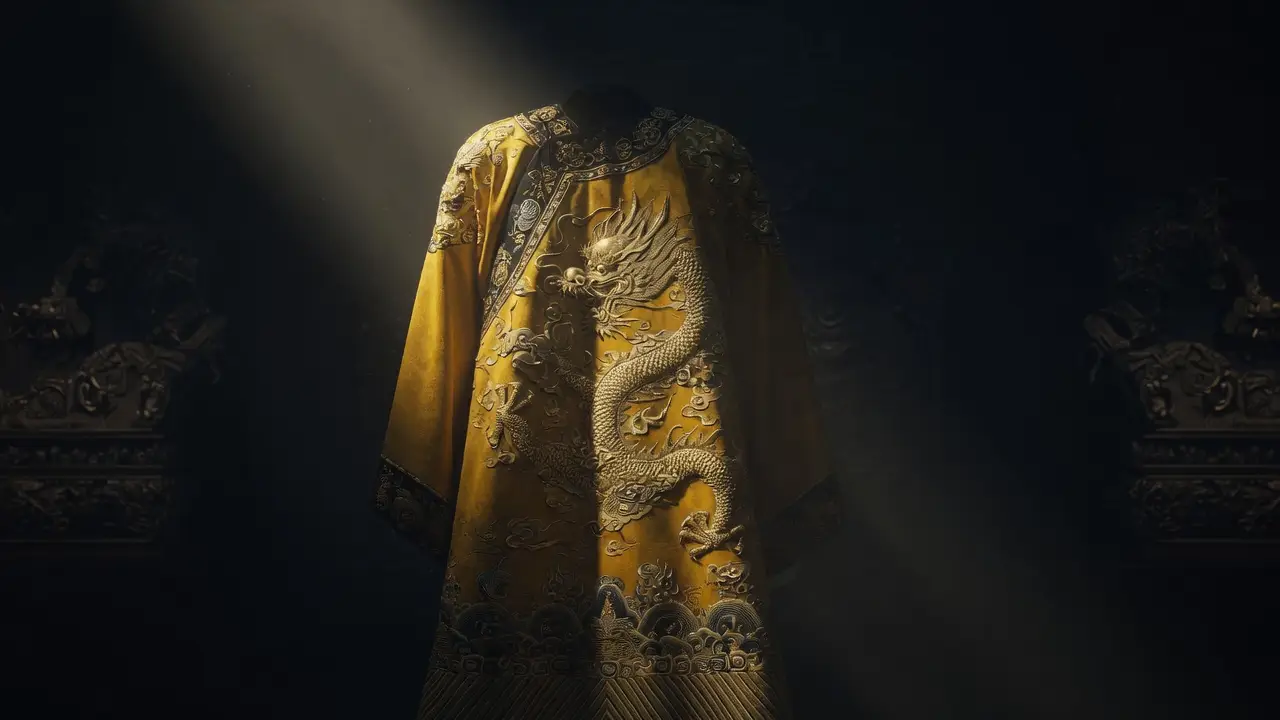
In Qing dynasty China, color was not decoration. It was law, cosmology, and bloodline stitched into a single robe. Bright yellow, in particular, was the most powerful color in the empire, reserved for the emperor and his closest family. Step outside that circle, and the rules cascaded downward with extraordinary precision. A bright, “minghuang” yellow could be worn only by the emperor and empress, while the crown prince was permitted an apricot shade, and other imperial princes and consorts wore a separate golden yellow, so that even within the same family, a glance at someone’s robe told you exactly where they stood in the line of succession.
This system reached its most exacting form under the Qianlong Emperor, who in 1748 ordered a full review of court dress. After a decade of work, the resulting regulations, the Qinding huangchao liqi tushi, were formally completed in 1759, codifying not just color but the number of claws on an embroidered dragon. Five-clawed dragons were restricted entirely to the imperial family, while officials, no matter how senior, were limited to four-clawed creatures called mang, identical in nearly every way except the single claw that separated emperor from subject.
In Qing China, robes survive in museum collections today bearing five-clawed dragons worn by officials who weren’t supposed to have them, physical evidence the law was broken in real time.
Even the symbols stitched into a robe were rationed by rank. Only the emperor, the dowager empress, the empress, the first concubine, and the heir apparent were permitted to wear the true dragon robe at all, and the famous twelve symbols of cosmic authority, the sun, moon, stars, and mountains among them, were reserved exclusively for the emperor’s own robes after 1759. Wearing the wrong shade of yellow in Qing China wasn’t a fashion mistake. It was a visible claim to a rank you didn’t hold, and in an empire this obsessed with hierarchy, that claim could be read as something close to treason.
Japan: Merchants With Money But Not Status
Tokugawa Japan tells perhaps the most human version of this story, because here the conflict wasn’t abstract. It played out in real time, in a single neighborhood, between two classes who despised and depended on each other in equal measure.
By the eighteenth century, Japan’s official social order placed samurai at the top and merchants, the chonin, near the bottom, officially beneath farmers and artisans because they were considered to produce nothing of real value. In practice, the chonin had become extraordinarily wealthy, often far wealthier than the samurai they were supposed to defer to, and the shogunate watched this inversion with open alarm.
The response was a long, almost relentless stream of sumptuary edicts, known as ken’yakurei, restricting what commoners could wear, build, or display. Restrictions on gold and silver ornamentation on the clothing of courtesans appear in edicts as early as 1617, and over the following decades the bans widened: gold thread, certain elaborate dyeing techniques, even specific tie-dye patterns were banned for house-owning chonin by the 1680s, simply because they had become too visibly luxurious for a class that wasn’t supposed to outdress its supposed betters.
Edo-period merchants got around dress restrictions by lining plain, legal kimono with hidden luxury silk on the inside, and by building two-story shops that looked like one story from the street.
And just like in Renaissance Italy, the rules collided immediately with human ingenuity. Commoners subverted the restrictions by lining plain, legal kimono with luxurious silk hidden on the inside, or by designing shopfronts that looked like a single modest story from the street while concealing a second floor above. Nowhere was the rebellion more visible than in the Yoshiwara pleasure district, where courtesans openly defied the dress codes, wearing gold hairpieces and brilliant red kimono that flouted the very laws meant to contain them, becoming, in effect, walking advertisements for the idea that the rules simply didn’t apply if you had enough style and enough clientele willing to look the other way.

Why Rulers Cared So Much
It’s tempting to read all of this as vanity, kings and emperors obsessing over hemlines for no good reason. But underneath the lace and the dragon claws, four very real fears were doing the work.
Class control. The oldest and simplest motive. A society organized around inherited rank needs that rank to be visible, or the entire structure starts to feel optional.
Moral control. Luxury was treated, almost universally, as a gateway to sin. Vanity, lust, greed, and the slow rot of public virtue were all blamed on too much silk and too much gold, and lawmakers across England, Italy, and Japan wrote about excess in language that sounds closer to a sermon than a statute.
Economic control. Imported silk, foreign dyes, and luxury textiles drained a country’s wealth abroad. Elizabeth’s own 1574 proclamation worried openly about treasure being “yearly conveyed out of the realm” to pay for foreign superfluities, a concern that would sound entirely familiar to any modern finance minister.
Political control. This was the sharpest fear of all. Clothing could imitate authority. If a wealthy merchant, a courtesan, or an ambitious commoner could dress convincingly as a noble, an emperor, or a person of rank they hadn’t earned, then the ruler’s own image, the visual language that justified their power in the first place, started to lose its meaning. A throne surrounded by people dressed like kings is a throne that suddenly looks a great deal less special.
Why the Laws Failed
Here is the part of the story that should feel familiar to anyone who has ever wanted something they were told they couldn’t have: sumptuary laws were almost never able to hold the line for long, and the reasons why are deeply, stubbornly human.
Fashion is slippery by nature. The moment a law banned one fabric, tailors found another that wasn’t yet illegal. The moment a color was restricted, dyers shifted the shade by a few degrees and called it something new. Wealthy violators often simply paid the fine and kept wearing the gown, treating punishment as a transaction rather than a deterrent. Enforcement, almost everywhere these laws existed, was wildly inconsistent: a servant might be hauled in for padded stockings while a well-connected gentleman wearing far more extravagant dress walked past the same officials untouched.
Even the people writing the laws kept breaking them. Elizabeth I, who fined her subjects for excessive apparel, spent staggering sums on her own wardrobe and is remembered today as much for her extraordinary dress as for her politics. In Qing China, officials caught wearing five-clawed dragons reserved for the imperial family were a recurring enough problem that surviving robes in museum collections today still bear the forbidden claw count, proof that the rule existed mostly on paper.
And underneath all of it sat the simplest explanation of all. People wanted to look like more than they were. Merchants wanted the recognition their money had earned them, even if their birth hadn’t. Nobles wanted to stay visibly distinct from the merchants nipping at their heels. Tailors and dye-makers wanted customers, and customers wanted exactly the thing the law had just told them they couldn’t have. Fashion became a quiet, ongoing act of coded rebellion, one hidden lining, one borrowed gown, one shifted shade at a time, and no statute, however detailed, could out-maneuver an entire population that simply refused to stop wanting.
Sumptuary laws disappeared centuries ago, but the impulse behind them never really did. We don’t have statutes dictating who can wear silk anymore, but we still read class, taste, and status off each other’s bodies in an instant, through a logo, a brand, a watch, a pair of shoes. The mechanism changed. The instinct to judge rank by appearance, and the equally human instinct to dress above your station anyway, never went anywhere at all.