In November 1898, armed white supremacists burned a Black-owned newspaper, forced elected officials to resign at gunpoint, and installed their own leader as mayor of Wilmington, North Carolina. This is the story of the only successful coup d’état in United States history… planned, executed, and covered up for generations.
They came with rifles. They came with lists. And by nightfall on November 10, 1898, they had overthrown the elected government of a thriving American city, and gotten away with it.
What happened in Wilmington, North Carolina was not a riot that spun out of control. It was not a spontaneous eruption of racial tension. It was a planned, orchestrated, and deliberate overthrow of a functioning multiracial democracy, the only successful coup d’état in United States history.
The men who executed it were not fringe agitators. They were respected politicians, newspaper editors, and businessmen. They planned it for months. They told people what they were going to do. And when it was over, they held a ceremony.
- 1 A City That Had No Business Being Attacked
- 2 Power Was the Prize. Race Was the Weapon.
- 3 The Editorial That Burned a City
- 4 Election Day: The Coup Began With Ballots
- 5 Why This Was a Coup and Not a Riot
- 6 The World They Built on Bones
- 7 How They Buried What They Did
- 8 What History Doesn’t Let You Forget
A City That Had No Business Being Attacked
To understand why Wilmington was targeted, you have to first understand what it was: a city that worked.
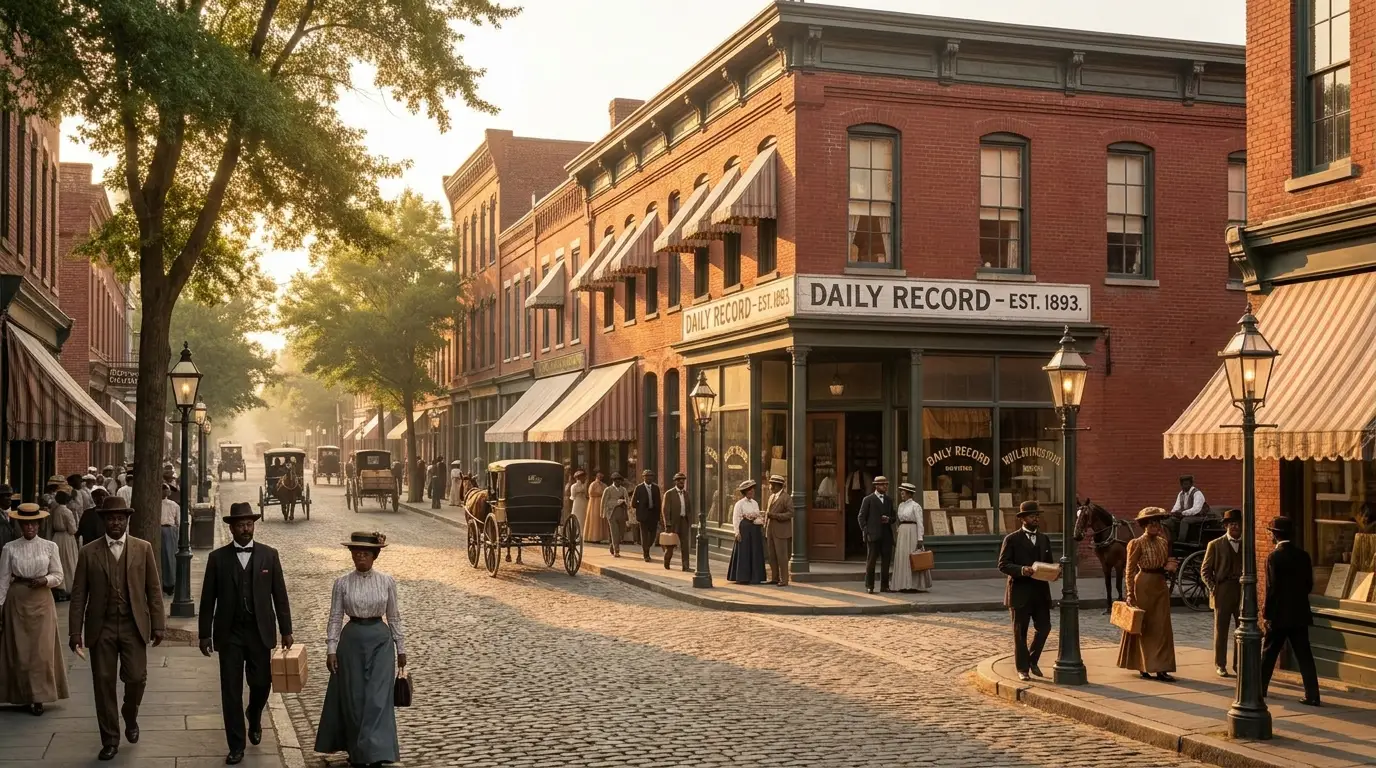
In the 1890s, Wilmington was North Carolina’s largest city, a thriving Atlantic port with a functioning economy, a visible professional class, and a Black majority population that exercised real political power. Roughly 56 percent of its residents were Black, and they were not passive observers of civic life. They were participants. Black men held positions as policemen, magistrates, and health inspectors. They owned businesses on the main commercial streets. They ran newspapers. They voted, and their votes counted.
The Fusionist coalition that governed the city was itself a remarkable thing. Black Republicans and white Populists, two groups that the Democratic establishment had always assumed could be kept apart, had found common cause. Together, they won elections. Together, they ran the city. The Board of Aldermen was multiracial. Elected officials answered to a genuinely diverse electorate.
“We will not live under the domination of the negro. We will have the city of Wilmington if we have to choke the Cape Fear with carcasses.”
Alfred Moore Waddell (before the coup, at a rally, October 1898)
This was the threat. Not crime. Not disorder. The threat was that a Black-majority city was governing itself, and doing so competently.
The white Democratic elite of North Carolina looked at Wilmington and saw everything they had spent decades preventing. Black officeholders held real authority. Black professionals competed in the same economy as white ones. And a cross-racial political alliance was holding power that, by all rights, the old guard believed belonged to them.
Join The Archive Briefing
Weekly dispatches. The history they didn't teach you — sourced, subverted, delivered to your inbox.
None of this could be allowed to continue.
Power Was the Prize. Race Was the Weapon.
The architects of what was coming were not ordinary racists. They were strategic ones.
Starting in 1897, North Carolina’s Democratic Party launched a coordinated statewide campaign centered on a single, deliberately inflammatory phrase: “Negro rule.” The idea was fictional, Black citizens held local offices, not statewide ones, and the Fusionist coalition was majority white, but the propaganda didn’t need to be accurate. It needed to be effective.
Democratic newspapers ran cartoons depicting Black officeholders as grotesque caricatures. Speakers traveled the state warning white audiences that Black men were seizing control, despoiling institutions, corrupting public life. The message was carefully constructed to produce fear, and fear was the point.
“The subjection of the negro, politically, and the separation of the negro and white races socially are…essential to the welfare of both races and to the right ordering of society.”
Josephus Daniels, editor of the Raleigh News & Observer
The target was not Black political power in the abstract. The target was the Fusionist coalition, the alliance between poor white farmers and Black Republicans that had proven electorally unbeatable. If that alliance could be broken, if white Populists could be terrified back into the Democratic fold, then the old power structure could be restored without the inconvenience of actually winning a fair election.
To do that, they needed a villain. They found one… or rather, they manufactured one.
The Editorial That Burned a City
Alex Manly was thirty years old and ran the Daily Record, the only Black-owned daily newspaper in the United States at the time. He was educated, articulate, and, as events would prove, politically courageous in ways that cost him everything.
In August 1898, Manly wrote an editorial responding to a prominent Georgia woman named Rebecca Felton, who had argued that lynching was justified as protection for white women against Black men. Manly’s response was pointed and direct: many of the relationships between Black men and white women that were being characterized as assault were, in fact, consensual. White Southern men, he argued, had little room to claim the role of protector when they had spent generations assaulting Black women with impunity.
LESSER-KNOWN DETAIL
Before the coup, coup leaders drafted and publicly read aloud a document they called the “White Man’s Declaration of Independence.” It demanded that the Daily Record cease publication, that Alex Manly leave the city, and that white men control all local employment. They presented it to a committee of Black Wilmington leaders and gave them until the next morning to respond. When the response (a telegraphed reply accepting the terms) arrived after the deadline through no fault of the recipients, the coup leaders used the “failure to respond” as their justification for proceeding.
It was a challenge to the foundational myth of Southern white supremacy, and the Democratic press weaponized it immediately.
Manly’s editorial was reprinted across the state, stripped of context, twisted into a declaration that Black men intended to pursue white women. Democratic newspapers ran it as proof that Black political power led directly to sexual threat. The language was deliberate and designed to trigger the most primal fears white Southern readers had been conditioned to feel.
By the time the election approached, the Daily Record and its editor had become the symbol around which an entire campaign of terror was organized. Manly didn’t know it yet, but he was already being used as the justification for what was coming.
Election Day: The Coup Began With Ballots
November 8, 1898 was not a free election. Not in Wilmington. Not across much of North Carolina.
Red Shirts, white supremacist paramilitary groups modeled on the terror organizations of Reconstruction, rode through Black communities in the days before the election. They broke up political meetings. They issued warnings. Armed men stationed themselves near polling places. Black voters who tried to exercise their rights were threatened, turned away, or simply convinced that voting was not worth the risk to their lives.
When returns came in from precincts that had historically voted heavily Black and Fusionist and showed Democratic victories, the irregularities were obvious to anyone paying attention. Election officials favorable to the Democrats controlled the count.
LESSER-KNOWN DETAIL
Armed groups deployed a Gatling gun during the coup, a weapon of military-grade firepower used on a civilian population in an American city in peacetime.
The Democrats won the state legislature. On the surface, it looked like a political victory. But the men who had orchestrated this campaign were not done. Winning an election was not enough. What they wanted was not a change in the vote count. What they wanted was unconditional control over Wilmington’s city government, which was not up for election on November 8th.
That problem required a different kind of solution.
The Morning of the Coup
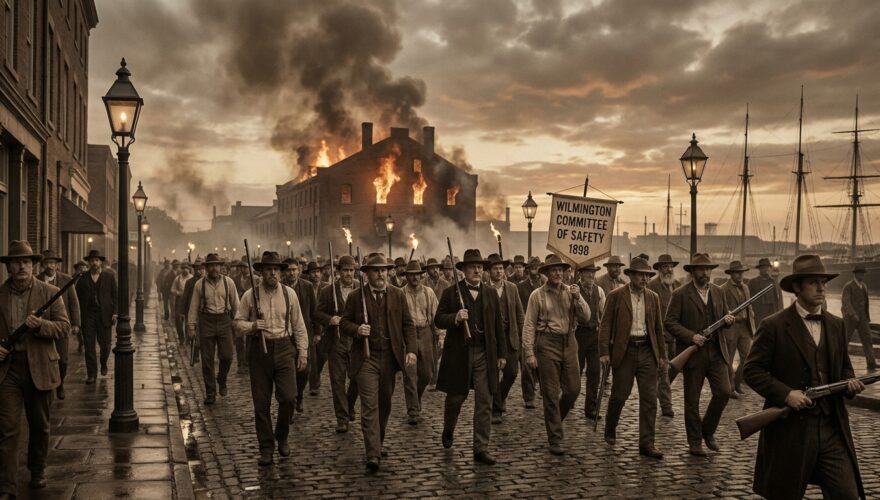
They gathered on the morning of November 10th in the basement of the Wilmington Light Infantry armory, more than 400 armed white men, organized and ready.
Alfred Moore Waddell had been the public face of the white supremacy campaign in Wilmington. He was a former congressman, a Confederate veteran, a man of standing in the community. At a rally weeks earlier, he had made his intentions plain: if necessary, he said, they would “choke the Cape Fear River with the bodies” of their opponents.
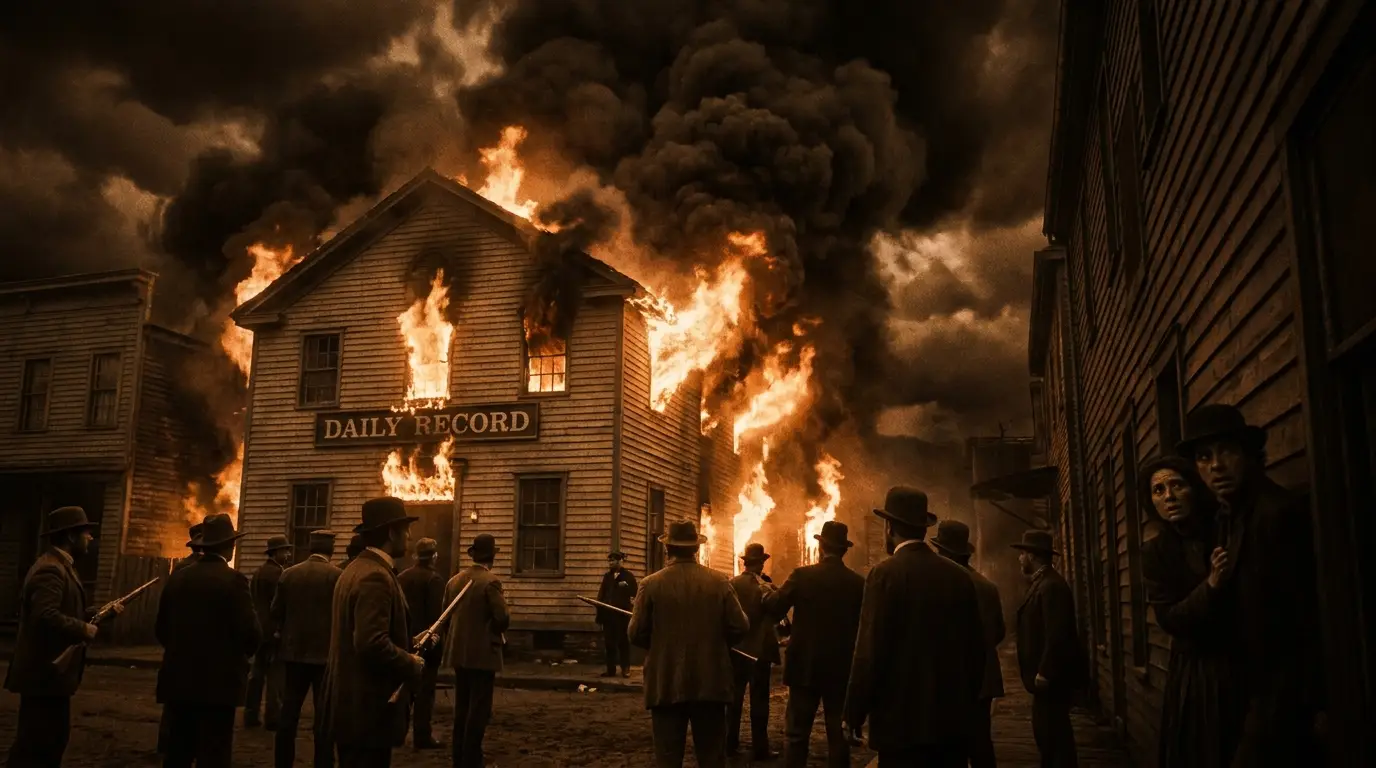
The men’s first target was the Daily Record.
They marched to the newspaper office on Seventh Street. They set it on fire. Alex Manly had already fled the city, warned in time to escape, so the mob burned an empty building. But the building was not the point. The message was.
From there, violence spread into Black neighborhoods. Black residents who were seen on the streets were shot. An unknown number were killed. Bodies disappeared before any accurate count could be taken. The official coroner’s report listed 14 dead; the state’s own 2006 investigation concluded “as many as sixty” may have been killed, and some accounts from the time suggested the number was far higher. Every confirmed victim was Black.
Meanwhile, the political machinery was moving.
LESSER-KNOWN DETAIL
Alex Manly was the grandson of North Carolina Governor Charles Manly, a white man. Manly’s heritage was known in Wilmington and was part of what made his editorial on the sexual politics of the South so personally uncomfortable for the white elite who read it.
A delegation appeared at City Hall and presented the sitting mayor, Silas Wright, and members of the city government with a document — essentially a demand for their immediate resignation. The men were given no real choice. Under the guns of a mob that had already killed people that morning, they signed.
Alfred Moore Waddell was installed as mayor by the very men who had organized the violence. White supremacist leaders filled the vacant offices. The Fusionist government of Wilmington was gone. It had taken a single morning.
Why This Was a Coup and Not a Riot
The word “riot” implies chaos, a situation that escalates beyond anyone’s control, a collective act of passion rather than plan. What happened in Wilmington was none of these things.
The men who executed it had targets. They had a list of people to be banished from the city, Black leaders and white Fusionist allies who were tracked down and forced to leave North Carolina at gunpoint. They had a line of succession already planned, with Waddell named in advance. They had a propaganda campaign that had run for over a year to prepare the public narrative. They had weapons, organizations, and coordination across the state government.
A riot leaves no new political order. Wilmington ended with an installed mayor, a purged city government, and a new power structure that would last for decades.
This is precisely what historians have come to call it: a white supremacist massacre and coup d’état. North Carolina’s own government, through a 2006 commission report, reached the same conclusion. The framing as a “race riot” or, as some apologists of the era called it, a “revolution,” was always euphemism, a way of describing organized political violence in language that made it sound like something less calculated.
The World They Built on Bones
The men who staged the coup were not punished. They were celebrated.
Waddell served as mayor. Other coup leaders rose in state politics. The Fusionist coalition was destroyed as a political force, not by persuasion, not by policy, but by terror. And with that coalition gone, the Democratic legislature moved quickly to ensure it could never return.
Disenfranchisement laws stripped Black men of the vote through poll taxes, literacy tests, and grandfather clauses. The numbers tell the story in cold terms. Black voter registration in North Carolina stood at approximately 126,000 in 1896. By 1902, it had fallen to around 6,100. That collapse was not demographic. It was engineered.
LESSER-KNOWN DETAIL
In the months and years following the coup, Black-owned properties in Wilmington were acquired at dramatically below-market prices or simply abandoned after their owners fled. The economic destruction was not incidental to the coup, it was part of the intended outcome.
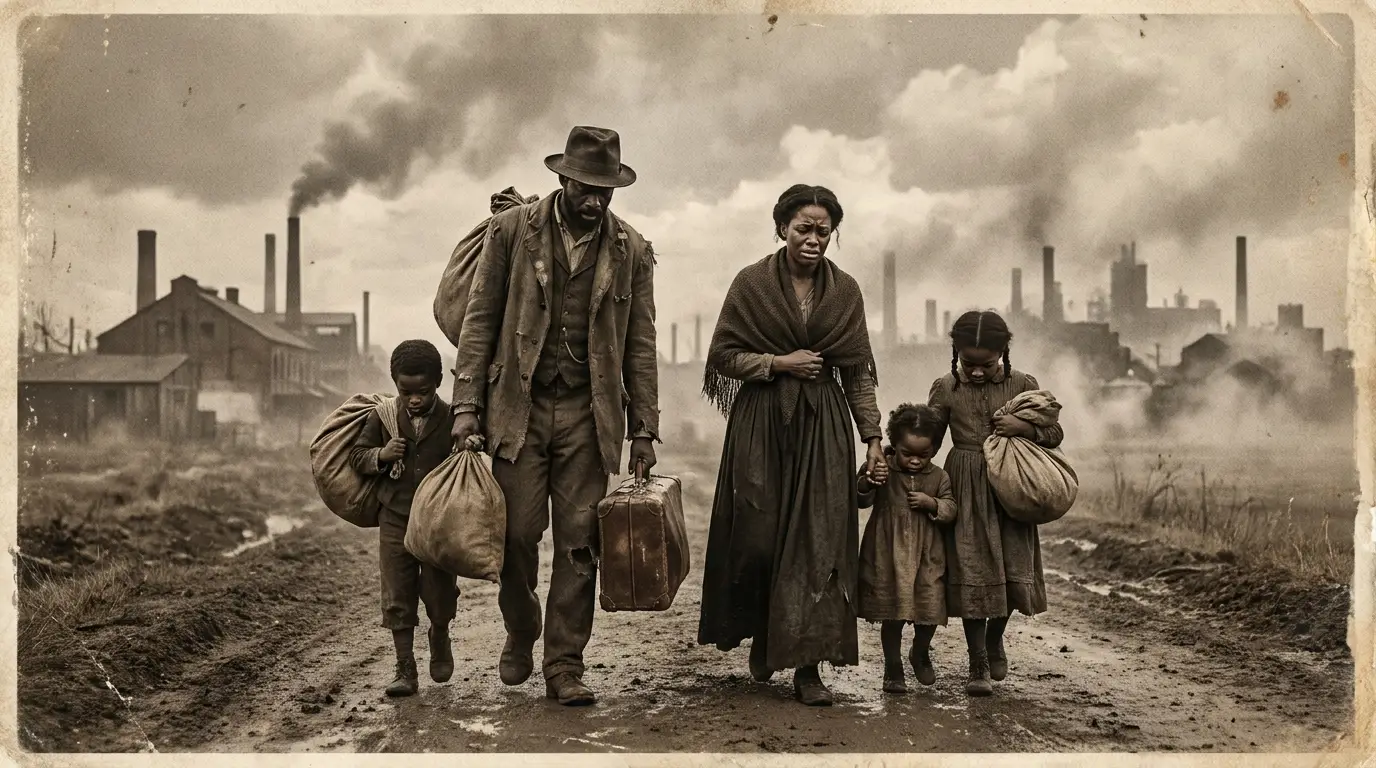
Black families fled Wilmington in the thousands. Businesses were abandoned or sold for nothing. The professionals, the officeholders, the newspaper editor, the people who had made the city what it was, scattered across the country. Their property, their investments, and the wealth they had built over generations was lost.
The Wilmington that emerged from the massacre was a different city. Whiter in its power structure, not because Black people had left, but because they had been made politically invisible. Jim Crow did not arrive in Wilmington gradually. It arrived in a single morning, announced by gunfire, and ratified by resignation letters signed under coercion.
The city would not elect another Black candidate to political office until 1972… that will be 74 years later.
How They Buried What They Did
For most of the twentieth century, the story told about November 10, 1898 was not the one that happened.
Contemporary newspapers, many of them aligned with the same Democratic political machine that had planned the coup, described it as a “race riot” that had been triggered by Black aggression. Some called it a “revolution,” framing the violent removal of an elected government as an act of civic restoration. The men who burned a newspaper and shot their neighbors were depicted as defenders of civilization.
Textbooks in North Carolina schools followed the same line for generations. The coup was obscured, mischaracterized, or omitted entirely. The men responsible were remembered as leaders, not criminals.
It was not until the late twentieth century that serious historical reconsideration began, and not until 2006 that the state of North Carolina formally confronted what had actually happened, through a commission report that gathered testimony, reviewed the documentary record, and named what it found: a massacre and a coup, planned and executed by white supremacists who faced no legal consequences and who installed themselves in power over an elected government.
LESSER-KNOWN DETAIL
President William McKinley, himself a Republican whose party’s voters and officeholders had just been violently removed from power, did not respond. No federal troops were sent. No prosecutions were initiated. The federal government’s silence was its own form of consent.
The Daily Record building that was burned on November 10, 1898 was never rebuilt. Alex Manly spent the rest of his life in exile from the state where he was born.
What was built in its place, the political order of segregated, disfranchised, violently enforced white supremacy in North Carolina, lasted for most of the twentieth century.
The winners wrote the history. They usually do. And for a long time, the rest of the country let them.
What History Doesn’t Let You Forget
There is a reason historians and civil rights scholars return to Wilmington: it is the cleanest example in American history of how democracy fails. Not through foreign invasion, not through constitutional collapse, but through organized violence wielded by people who understood exactly what they were doing.
The leaders of the Wilmington coup did not act in passion. They acted in calculation. They built a propaganda machine, terrified an electorate, suppressed a vote, and then, when that wasn’t enough, sent armed men to remove a government they could not legally displace.
They won.
And the lesson they demonstrated, that organized violence, backed by political power and protected by social sanction, can destroy a functioning democracy without consequence — did not stay in Wilmington. It spread across the South and shaped American political life for generations.
Recognizing it for what it was is not a political act. It is an act of accuracy.
The coup of 1898 happened. It was planned. It was executed. And the city that once had Black mayors, Black policemen, Black newspaper editors, and Black voters exercising real power watched all of it disappear in a morning.
What was lost in Wilmington was not just lives. It was a version of America that was possible… and was deliberately destroyed by men who could not tolerate the sight of it.