Ask anyone where democracy was born, and the answer comes fast: ancient Athens, fifth century BC, Cleisthenes, the people’s assembly, the golden age of Pericles. The story lands clean and satisfying, a civilization dragging itself out of tyranny and toward something like justice.
That story is true. It’s also profoundly incomplete.
Athenian democracy was a genuine revolution in human governance. It was also built on the backs of people who had no say in it whatsoever, defended by the sword, and structured from the start to protect the interests of a small, property-owning male elite. What the Greeks invented wasn’t quite democracy as we use the word. It was something stranger, more brutal, and far more interesting.
The Day Athens Voted to Banish Its Own Hero
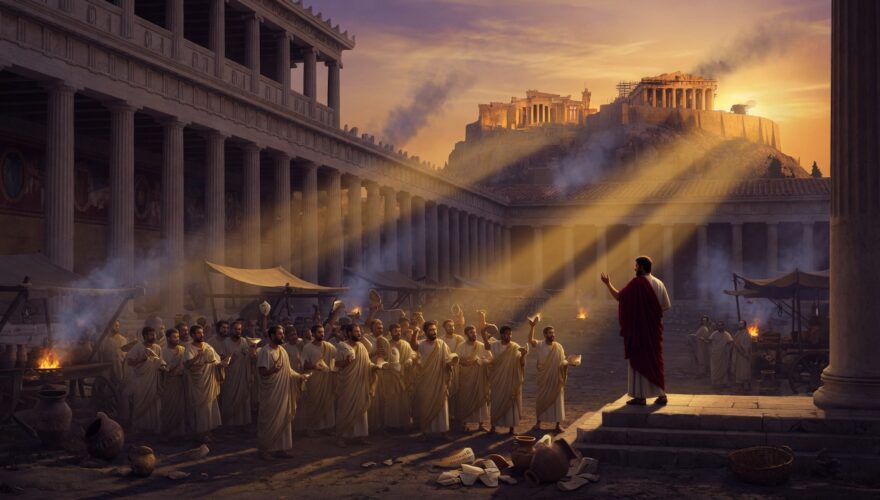
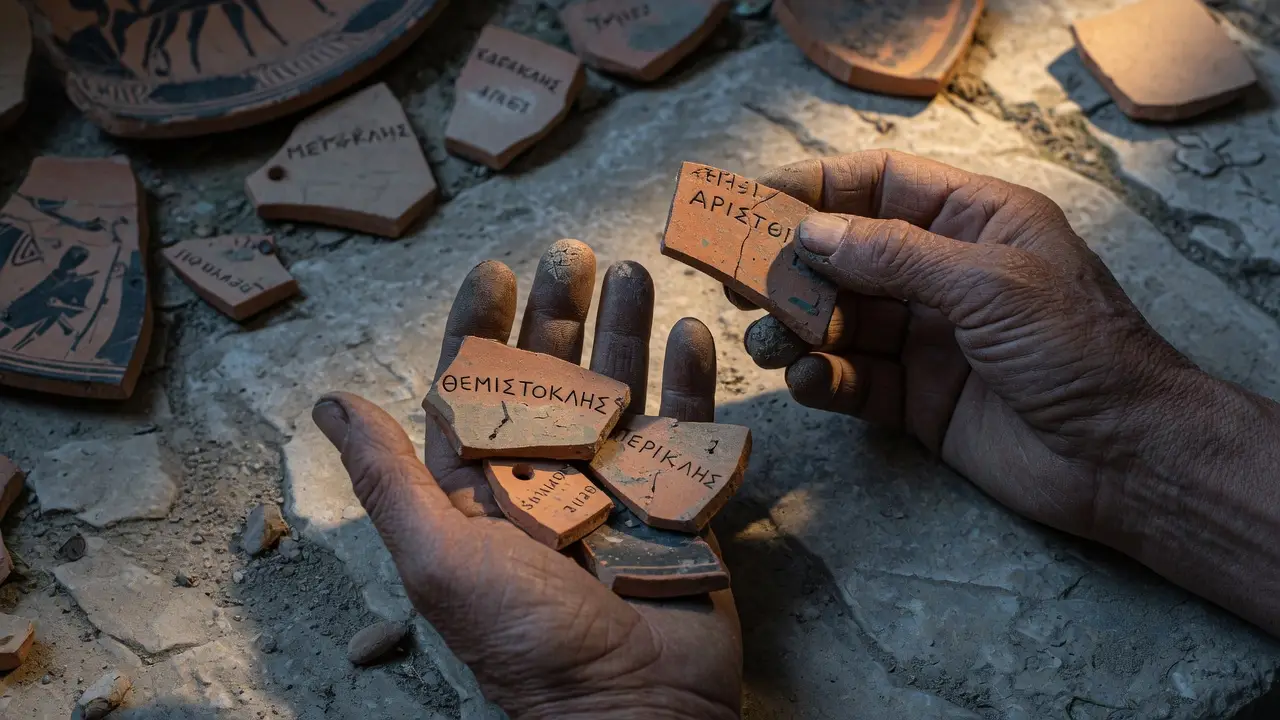
The year was 482 BC. Themistocles, the architect of Athens’ greatest military victory, the man who crushed the Persian fleet at Salamis and arguably saved Western civilization, stood in the agora while his fellow citizens scratched his name into pottery shards. No charges. No trial. No crime. Just enough votes, and he’d be gone for ten years.
He lost. He was exiled.
LESSER-KNOWN FACTS
Cleisthenes, credited as the father of Athenian democracy, introduced his reforms partly to outmaneuver his aristocratic rivals. The people’s assembly was, at its inception, a political weapon in an elite power struggle.
The birthplace of democracy destroyed one of its finest minds through a process specifically designed to remove anyone who’d gotten too powerful, too beloved, or simply too inconvenient. They called it ostrakismos. We get the word “ostracize” from it. And it tells you almost everything you need to know about what Athenian democracy actually was beneath the marble and mythology.
Who Actually Got to Vote
Athens at its democratic peak had a population of roughly 250,000 to 300,000 people. Of those, somewhere between 30,000 and 50,000 were adult male citizens, the only ones with any political rights at all. Women, regardless of birth or wealth, were legally invisible in the public sphere. Metics, the free foreigners who often ran Athens’ most successful businesses and paid taxes like everyone else, had no vote. Slaves, who numbered somewhere between 80,000 and 110,000 depending on which historians you trust, existed entirely outside the system.
“We are called a democracy, for the administration is in the hands of the many and not of the few.”
Pericles (from Thucydides’ History of the Peloponnesian War, Book II)
Do the math. At its most generous estimate, Athenian “democracy” extended political rights to about 15 to 20 percent of the population. The rest labored, paid, fought, and had no voice.
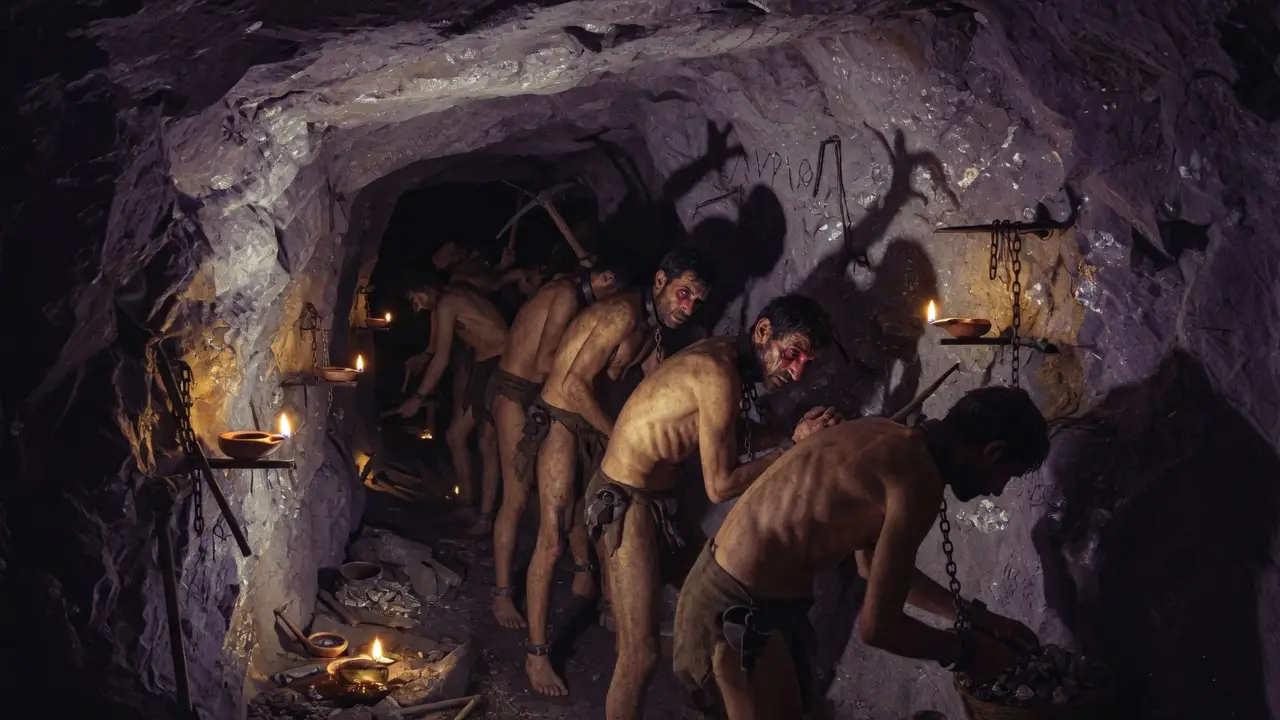
And the slave economy wasn’t incidental to Athenian democracy. It was the engine underneath it. Wealthy Athenian citizens had the time to attend the assembly, debate philosophy, and run for office precisely because enslaved people were doing the farming, mining the silver at Laurion in conditions that killed men young, and running households. The leisure that produced Socrates and Pericles and the Parthenon was purchased with human suffering that almost nobody talked about, because it was simply the water they swam in.
Join The Archive Briefing
Weekly dispatches. The history they didn't teach you — sourced, subverted, delivered to your inbox.
The Mines of Laurion
Here’s a detail that rarely makes it into the textbooks.
The Athenian navy that defeated Persia at Salamis, the fleet Themistocles built and that cemented Athens as a Mediterranean power, was funded almost entirely by a massive silver strike at the Laurion mines in 483 BC. The assembly voted to use that windfall to build 200 warships. Good decision. It arguably saved Greece.
Those mines were worked almost exclusively by slaves, often chained, working in tunnels barely wide enough to crawl through, in air thick with dust and lead fumes. Life expectancy underground was not something ancient accountants bothered to record, but the conditions were so brutal that slaves fled to Sparta in the tens of thousands when they got the chance during the Peloponnesian War. The Athenians noted this with alarm. Nobody proposed a solution that involved treating people like human beings.
Pericles’ famous Funeral Oration, that gleaming monument to democratic ideals, was delivered in a city where human beings were property. “We are called a democracy,” he said, “for the administration is in the hands of the many and not of the few.” He wasn’t wrong. He just had a very specific idea of who counted as many.
Oligarchs in Democratic Clothing
The Athenian assembly was open to all citizens, in theory. In practice, attending required free time, which required money, which meant the loudest voices almost always belonged to men of property. The strategoi, the ten generals elected annually who held real executive power, were consistently drawn from wealthy, established families. Pericles himself served as strategos for over thirty consecutive years.
Leadership rotated among a tight network of aristocratic clans who’d learned to speak the language of the people. They competed fiercely with each other, used the assembly as a battleground, and genuinely feared popular opinion. But the system, over time, consistently elevated the same social class to its highest positions.
“The strong do what they can and the weak suffer what they must.”
Thucydides
The philosopher Plato, who watched Athenian democracy execute his mentor Socrates, called it flatly “the tyranny of the majority.” He wasn’t defending oligarchy so much as pointing out that popular rule without wisdom was just mob rule with better branding. His student Aristotle was more measured, but ultimately agreed that direct democracy had a dangerous tendency to let passion overrule reason.
Two of the ancient world’s greatest thinkers lived inside Athenian democracy and concluded it was fundamentally broken. History tends to remember their ideas and quietly forget that verdict.
The Weapon They Built to Destroy Themselves
Ostracism is worth dwelling on, because it reveals the psychological anxiety at the core of the whole project.
Once a year, citizens could vote to exile a man for ten years, no charges required, no defense permitted, just names on broken pottery. Six thousand votes were needed for a result. It was originally designed to prevent the return of tyrants, to cut down anyone who might accumulate enough personal power to topple the democracy.
What it became was something messier. Politicians weaponized it against rivals. Factions organized voting drives. In 482 BC, when Themistocles was pushing for the naval buildup against Persia, his main political opponent Aristides “the Just” was ostracized, partly for opposing him. The story goes that an illiterate farmer approached Aristides in the agora on ostracism day and asked him to write a name on his shard. The name he wanted written was Aristides. The man didn’t recognize him.
“Has Aristides done you any wrong?” Aristides asked.
“None,” said the farmer. “I’m just sick of hearing him called the Just.”
Aristides wrote his own name on the shard and handed it back.
“Tyranny naturally arises out of democracy.”
Plato (Republic, Book VIII)
Even by Athenian standards, there’s something remarkable about a system so paranoid of excellence that it banished the man called the Just for being too virtuous. It exiled Themistocles, who saved them. It would eventually execute Socrates, who questioned them. Athenian democracy had a consistent habit of turning on its greatest minds, and the mechanism it used to do so was democratic to the letter.
What Collapsed It
Athenian democracy survived, stumbled, was overthrown twice by oligarchic coups (411 BC and 404 BC), restored both times, and finally ended for good not by internal failure but by Macedonian conquest. Philip II and then Alexander dismantled Greek city-state independence from the outside. The last gasp of Athenian resistance came with the Lamian War in 323 BC, after Alexander’s death. It failed. Greek freedom as the Athenians had understood it was over.
By then, the democracy had already spent decades exhausting itself. The disastrous Sicilian Expedition of 415 BC, where Athens voted to invade Sicily, lost nearly 200 ships and perhaps 50,000 men, remains one of history’s most spectacular examples of democratic decision-making producing catastrophic results. The assembly voted for it enthusiastically, based on incomplete intelligence and the charisma of Alcibiades, a brilliant, reckless opportunist who abandoned them to Sparta when it suited him.
Thucydides, who watched all of it unfold, wrote something that still cuts: “The cause of all these evils was the lust for power arising from greed and ambition.” He wrote that about the civil conflicts tearing Greek cities apart. He could have been writing about the whole democratic experiment.
The Uncomfortable Inheritance
We trace our political DNA to Athens. Every time a politician invokes “the will of the people” or “rule of law” or “civic duty,” they’re reaching back to vocabulary the Athenians invented. The words are real. The debt is real. So is the erasure.
The Athens we inherited in Western political tradition is the Athens of Pericles’ Funeral Oration, sanitized, marble-columned, philosophically elevated. It’s not the Athens of the Laurion mines, or the women locked out of public life entirely, or the 30,000 slaves who had no name in the historical record because nobody thought to write them down.
“A democracy is a government in the hands of men of low birth, no property, and vulgar employments.”
Aristotle
The Greeks gave us democracy the way a flawed, brilliant, morally compromised human being might give you a gift: sincerely, partially, and with significant strings attached.
The most honest thing we can say about Athens is this: they built something genuinely new, something worth building on, and they built it on foundations they never fully examined. The question that hangs over the whole story isn’t whether Athenian democracy was real. It was real enough. The question is who it was real for.
And on that question, Athens was never particularly honest with itself. Neither, perhaps, are we.