The candle had nearly burned down by the time they sent for him.
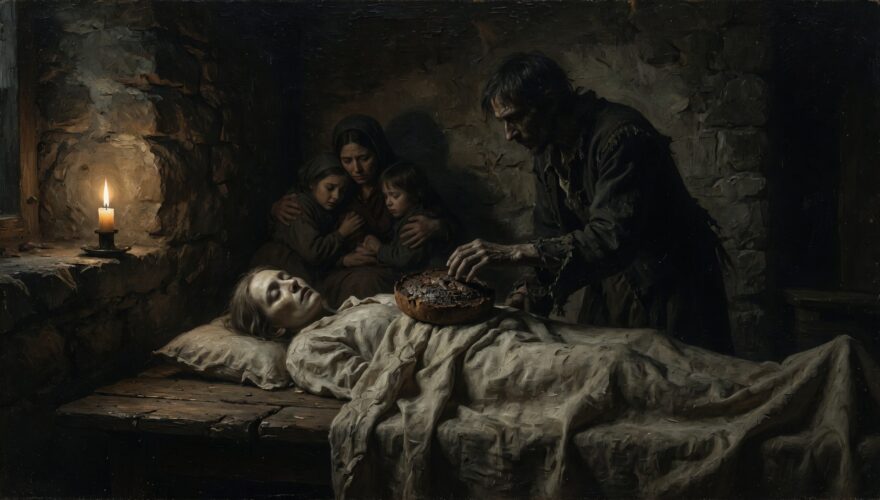
Outside, rain hammered the thatch of a cottage somewhere in the hill country along the Welsh border. Inside, a body lay on a wooden table, washed, dressed, and ready for the grave. On its chest sat a single piece of bread, dark with crust, soaking up something the family in the room refused to name out loud.
Nobody stood close to the corpse. Not from fear of the sickness that had taken him. From fear of what was still attached to him.
Then the door opened, and a man stepped in that nobody in the village had spoken to in years. He didn’t look at the widow. He didn’t look at the children pressed against the wall. He crossed the room, picked the bread off the dead man’s chest, and ate it.
He drank down a bowl of ale in one long pull, took the coin pressed into his palm without a word, and walked back out into the rain. Behind him, the family let out a breath they didn’t know they’d been holding. The dead man’s sins, every one of them, now belonged to someone else.
The Hunger of the Soul
What you’ve just watched has a name: sin-eating. For several centuries, it was as ordinary a part of a rural funeral in parts of England and Wales as the coffin itself, even though almost nobody who took part in it would have admitted to believing in it out loud.
The man doing the eating occupied a role with no modern equivalent. He wasn’t clergy. He wasn’t medicine. He wasn’t even, in any social sense, a mourner. He was something closer to a drain, a person whose entire function in the community was to take in what nobody else could hold.
To understand why a family would do this, you need to understand what death actually meant to them. In the worldview of seventeenth and eighteenth century rural England, heaven and hell were real, but most people didn’t expect to arrive at either one directly. They expected purgatory, a kind of spiritual holding cell where the soul burned off whatever unconfessed sin it had carried out of the world. The heavier your conscience, the longer your stay.
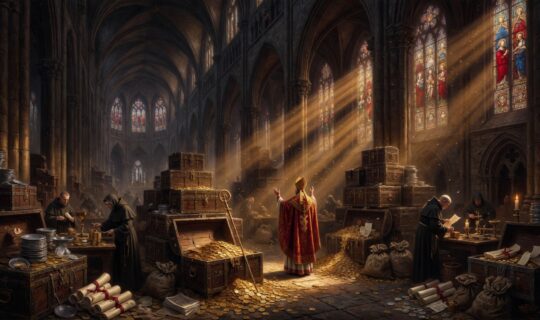
If you had money, you had options. You could pay for masses in your name, endow a chantry chapel, buy prayers from priests for years after your death. The wealthy could, quite literally, purchase a shorter sentence.
Join The Archive Briefing
Weekly dispatches. The history they didn't teach you — sourced, subverted, delivered to your inbox.
If you didn’t have money, especially after the Reformation tore down most of those Catholic mechanisms in England, you had a problem. No priest’s prayers waiting for you. No chantry. Just whatever sin you’d accumulated, riding along into the dark with nothing to lighten it.
“Man that is born of a woman hath but a short time to live, and is full of misery.”
The Book of Common Prayer, burial service (1662)
And the idea that this problem needed a human solution wasn’t new, even then. Long before any of this, the Hebrew Bible describes a ritual where the sins of an entire community were loaded onto a goat and driven out into the wilderness, the origin of the word scapegoat. Ancient cities sometimes expelled a single person during a plague or famine, convinced that person now carried the city’s misfortune away with them. Sin-eating wasn’t a new invention. It was an old idea wearing a very specific local costume: a crust of bread, a bowl of ale, and a cottage somewhere in Herefordshire.
This is the gap the sin eater filled. Not with the church’s blessing, in most places clergy condemned the practice outright, but quietly, in back rooms, families found their own insurance policy. For the cost of a loaf, a drink, and a few coins, somebody else would carry the weight out the door.
The Mechanics of Damnation
The ritual itself was almost insultingly plain, and that plainness is part of what makes it so unsettling. No incantations. No ceremony. No clergy required. Just bread, ale, and proximity to a body.
The clearest account of how it worked comes from the seventeenth century English antiquarian John Aubrey, who recorded the custom around 1686 in notes later published as Remaines of Gentilisme and Judaisme. Aubrey described how families in Herefordshire would hire poor men to “take upon them all the sins of the party deceased.” When the body was laid out, a piece of bread was passed across the corpse and handed to the hired man, along with a wooden bowl of ale. He ate. He drank. And the moment the bread touched his lips, by the logic that paid for the whole arrangement, the dead person’s sins moved into him.
Some versions of the custom layered in salt as well, placed directly on the corpse’s chest before the bread went on top of it, a detail that ties sin-eating to a much older European habit of using salt to keep a body from spoiling or “rising” before burial. Other accounts insist the items had to be passed literally over the body rather than handed around it, turning the corpse itself into the conduit, a bridge between the dead and the living mouth about to swallow what was left behind.
“Dies irae, dies illa, solvet saeclum in favilla” (“Day of wrath, that day, will dissolve the world into ashes.”)
Dies Irae, medieval Requiem hymn
Theologically, this was not a small claim. The sin eater wasn’t performing a symbolic gesture, the way someone today might light a candle for a person they’ve lost. In the belief system underwriting this transaction, the transfer was real. Physical. Whatever the dead person had done and never confessed, the lies, the cruelties, the violence behind closed doors that the whole parish half-knew about and never spoke of, now belonged to the man standing by the door with crumbs on his lips and a coin closed in his fist.
And here’s the detail worth sitting with: nobody believed this erased anything. The sin didn’t vanish. It moved. One soul’s ledger closed. Another soul, already running on empty, got a little heavier.
So who agreed to carry that kind of debt, funeral after funeral, for the price of a meal?
The Architecture of Isolation
The families hiring a sin eater weren’t usually wealthy by any normal measure. Most were cottagers and laborers who’d scraped together a sixpence with real effort. But next to the man they were hiring, they were rich in the one currency that actually mattered in a small village: belonging.
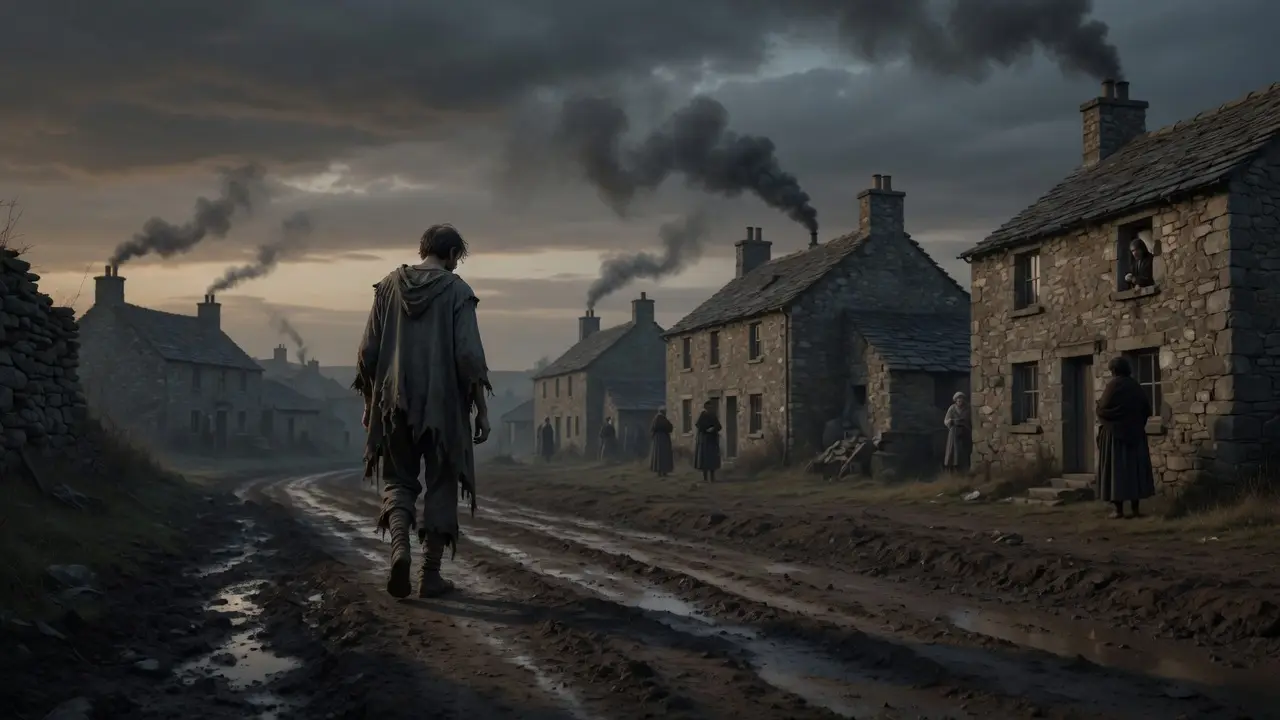
Sin eaters were drawn from the very bottom of rural society. Vagrants. Beggars. Men with no land, no trade, and no family willing to claim them, the kind of person already living on the edge of a parish before anyone ever handed him a piece of bread off a corpse. In some districts, there might be one such man known to everyone, as familiar a fixture as the miller or the blacksmith, except that nobody wanted to be caught standing near him.
The rules around his behavior bordered on the inhuman. Accounts describe sin eaters forbidden from making eye contact with the family, required to enter by a back door rather than the front, and expected to leave the instant the bread was eaten, before the funeral feast, before the prayers, before anyone had to look at him a moment longer than necessary. He wasn’t treated as a guest. He was closer to a tool that happened to be shaped like a man, used once and put away.
And here’s the cruelest part, and nobody needed to write it down for it to work. Every time the sin eater performed the ritual, he became, in the eyes of his neighbors, a little more contaminated. A little less safe to trade with, to sit beside in church, to let your children walk past without crossing the road. Which meant the only work available to him, the only way he could feed himself, was more sin-eating. The very thing that made him untouchable was the only thing that kept him alive.
That’s a closed loop, and the village built it without ever holding a meeting to design it. Fear of contamination created a man nobody would hire for anything else. That same fear made his one remaining job the very thing deepening the contamination. There was no road out of this life. There was only the next death.
The Price of Eternal Debt
What do you imagine that felt like, not for one funeral, but for years? For decades, in some recorded cases?
Every death in the parish meant another deposit into your own soul’s account, except this account only ever grew. The affairs nobody discussed. The beatings behind closed doors. The small, grinding cruelties that never made it into a church register but that everyone in a village that size half-knew about anyway. If you believed the theology, and most sin eaters very likely did, you were walking around as a kind of living archive of your neighbors’ worst nights. Not as a metaphor. As a literal weight on a soul that was, by every account, already running short on credit of its own.
And there’s a question buried in here that almost nobody at the time seems to have asked out loud. When the sin eater himself died, who took it from him?
Some folklore from the period suggests the answer was nobody, that a man who had spent his life absorbing other people’s sins was, by the end, too saturated with them to be buried in consecrated ground at all. If that’s true, it means the sin eater’s reward for a lifetime of service was to die with no service rendered in return. The drain had no drain of its own.
The most documented case of a real sin eater comes from a man named Richard Munslow, who lived in the small Shropshire village of Ratlinghope and died in 1906, often cited as the last person in England to perform the role. For decades his grave sat unmarked in the churchyard of St Margaret’s, slowly losing its shape to weather and neglect, a quiet end for a man local memory still talked about.
Here’s the detail that complicates the whole story. Munslow doesn’t appear to have been the kind of desperate outcast the role usually demanded. Local accounts suggest he took on the role after his own children died of scarlet fever, a tragedy some historians read less as a man falling into poverty and more as a man already carrying an unbearable loss choosing, deliberately, to carry other people’s losses too. Whether that’s the literal truth or the story a village told itself afterward to make sense of an unusual man, nobody can say for certain anymore.
But it adds something the simple “poor outcast” version of this history doesn’t capture. Sometimes the role wasn’t only forced onto someone from the outside. Sometimes it was a way of processing grief that the church’s official channels had no room for at all.
Munslow’s grave was eventually restored by local historians, more than a century after his death, a quiet correction to decades spent simply not remembering him. Which is, in its own way, a fitting end for a man whose entire job had been making sure other people didn’t have to remember things either.

The Modern Shadow of the Sin Eater
Officially, sin-eating died out. The last documented cases trail off in the early twentieth century, and by the time folklorists got around to writing serious studies on it, most people treated the whole thing as a quaint, slightly grim curiosity, the kind of fact you’d read on a museum placard and forget by lunch.
But strip away the bread, the ale, and the theology, and ask a simpler question. Does a society like ours still need someone to absorb the things it can’t bear to look at directly? And if it does, who’s doing that job now?
Think about content moderators working for the platforms most of us use every day, often based far from company headquarters, often on contracts that pay a fraction of what the engineers down the hall earn. Their job, for hours at a stretch, is to look at the worst material people upload, violence, abuse, cruelty in every form, so the rest of us never have to see it in our feeds. They take it in so we don’t. Many leave that job with the kind of psychological injuries once associated almost exclusively with combat veterans.
Or think about the wider gig economy. Delivery drivers taking on the physical risk of traffic and weather so a meal can show up in thirty minutes. Warehouse workers absorbing repetitive injuries and impossible quotas so a package can arrive the next morning. Customer service workers soaking up hours of someone else’s anger so a company’s public face stays calm and pleasant. None of these people would describe their job as carrying anyone’s sins. But the shape of the arrangement is uncomfortably familiar: something unpleasant has to land somewhere, and it reliably lands on whoever has the least power to say no.
The sin eater’s village paid him in bread, ale, and a sixpence, and in return, everyone else got to walk away from the body feeling lighter. We’ve gotten more sophisticated about the payment. There are wages now, sometimes benefits, occasionally a non-disclosure agreement. But the basic shape of the transaction hasn’t changed nearly as much as we’d like to believe. We’ve just stopped calling it what it is.
The cottage is gone, and the candle burned out centuries ago. But somewhere tonight, someone is still swallowing what the rest of us refuse to look at. We just stopped calling it sin.