In 1892, Wyoming’s cattle barons hired fifty gunmen and rode north with a death list. The Johnson County War was never really about rustling.
When wealthy Wyoming cattlemen hired Texas gunfighters and invaded Johnson County in 1892, they called it a war on rustlers. The people in their path called it something else entirely. Discover the real story behind one of the American West’s most revealing conflicts, and what Nate Champion’s final diary entries exposed about power, class, and the myth of the open range.
The Men Who Came With a List
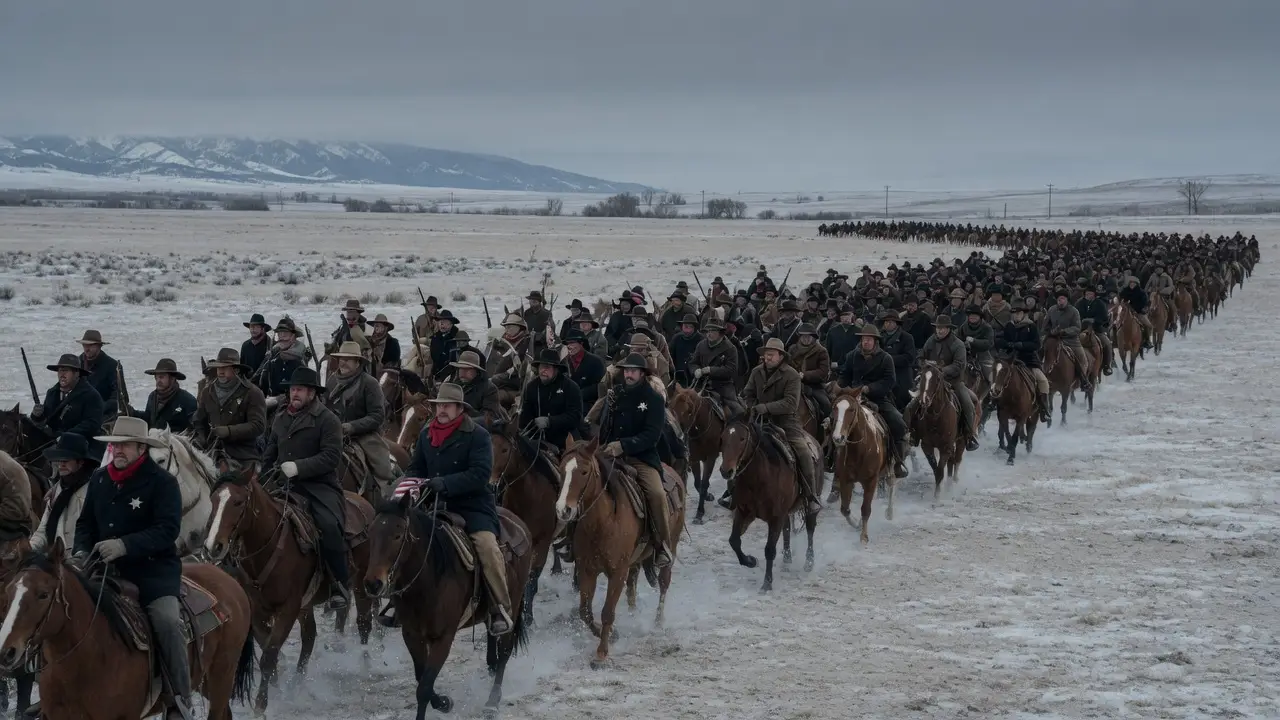
In the first days of April 1892, a private train pulled out of Cheyenne carrying roughly fifty men. Some were Texas gunfighters, hired at five dollars a day plus expenses. Others were members of the Wyoming Stock Growers Association, men who had built fortunes on the open range and were not about to watch those fortunes erode without a fight. They had rifles, provisions, a dynamite bomb, and a list.
The list contained the names of men targeted for death.
They called it a cattle-protection operation. They called the men on that list rustlers. Johnson County, Wyoming, would call it an invasion.
What unfolded over the next two weeks stripped away every romantic notion about the American frontier and revealed something uglier underneath: a class war fought on horseback, bankrolled by some of the wealthiest men in the territory, and eventually stopped not by justice but by politics.
Wyoming Before the War: The Myth of the Open Range
To understand what happened in Johnson County, you have to understand what Wyoming was before it happened, and how quickly that world collapsed.
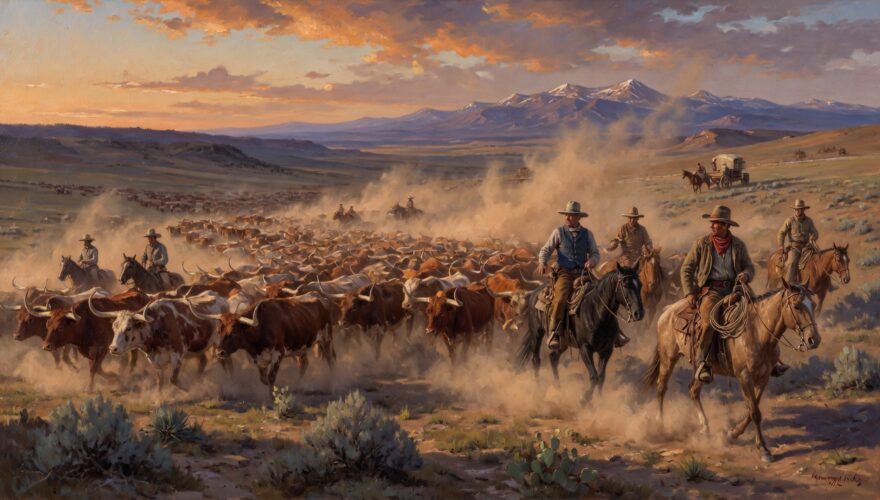
Through the 1870s and into the early 1880s, cattle ranching in Wyoming operated on a vast and loosely governed commons. The open range was federal land that the big outfits grazed freely, treating public property as though it were private by virtue of sheer size and intimidation. The Wyoming Stock Growers Association, formed in 1873, became the de facto government of that range. It set roundup rules. It maintained a brand registry. It lobbied Congress. When its members spoke in Cheyenne, governors listened.
Join The Archive Briefing
Weekly dispatches. The history they didn't teach you — sourced, subverted, delivered to your inbox.
The wealth was real. In the early 1880s, beef prices were high, eastern capital was flooding in, and British investors sent money across the Atlantic to stake claims in the Wyoming cattle boom. Outfits were capitalized in the millions. Men who had arrived with nothing ran cattle in the hundreds of thousands.
“These men went up there to protect their property.”
Senator Joseph M. Carey (Stock Growers Association ally), defending the invaders
Then nature and the market both broke.
The winter of 1886 to 1887 became known as the Great Die-Up. Temperatures across the northern plains dropped to fifty below zero. Snow buried the grass under crusted ice. Cattle drifted into ravines and froze standing. When spring arrived, cowboys found the range littered with carcasses. Some outfits lost seventy, eighty, even ninety percent of their herds. A rancher named Granville Stuart, who had once called the open range the finest cattle country on earth, looked across his range in the spring thaw and said the losses beggared description.
At the same time, beef prices were sliding. By the late 1880s, the market was glutted. The era of easy profit was finished.
The big outfits needed someone to blame. They found a candidate in the homesteader.
Small settlers had been filing claims across northern Wyoming throughout the decade, particularly in Johnson County. Some were ex-cowboys who knew the range and saw a chance to start small herds of their own. Others were farmers looking for a foothold. A few were genuinely acquiring cattle by means that ranged from gray to outright illegal. But the cattle barons did not distinguish much. To the Wyoming Stock Growers Association, any small operator building a herd was a potential threat, and the word “rustler” became a tool of elimination as much as a legal category.
The Word “Rustler” Became a Weapon
The cattle industry’s definition of rustling in the late 1880s was elastic. At its most literal, it meant stealing cattle. In practice, it came to mean competing with the big outfits on terms they hadn’t approved.
Maverick laws illustrated the dynamic clearly. Under Wyoming statute, unbranded calves found on the range belonged to the stock growers’ general pool, not to whoever found them. Cowboys working roundups were forbidden from branding mavericks for themselves. When small ranchers or poor cowboys did so anyway, they were declared rustlers. When the big outfits branded questionable stock during the same roundups, no one used that word.
“The law has been set aside and the hired assassin substituted.”
Buffalo Bulletin, April 1892
The Association also banned any man suspected of rustling from working the spring roundup, effectively cutting accused men off from their livelihoods before any trial took place. There was no jury, no hearing. The Association made the accusation, and the accusation was the verdict.
By 1889, this logic had turned murderous. Ella Watson and James Averell, a homesteading couple near Sweetwater River, were accused of accepting stolen cattle as payment for goods and services. On July 20, a group of prominent cattlemen rode to their property and lynched them both from a nearby tree. Watson, also known as Cattle Kate in sensationalist newspaper coverage, was the first woman lynched in Wyoming Territory. None of the men who killed her were ever convicted. Key witnesses disappeared or recanted. The grand jury declined to indict.
“An insurrection exists in Johnson County, Wyoming, in the immediate vicinity of Fort McKinney against the government of said state.”
Governor Amos Barber, telegram to President Harrison, April 1892
This was the context in which Johnson County became a target. Local juries had acquitted several accused rustlers. The county sheriff, Red Angus, was seen as sympathetic to small settlers. From Cheyenne’s perspective, the justice system in the north had been captured by the enemy. From Johnson County’s perspective, the system was simply working as intended: hearing evidence, weighing testimony, and finding it insufficient.
The cattlemen decided to replace the court system with hired guns.
The Invasion
The Regulators, as the invading force styled themselves, crossed into Johnson County on April 6, 1892. Their plan was to move quickly to Buffalo, the county seat, kill the sheriff and a dozen other men on their list, and establish control before any resistance could organize.
They never got to Buffalo.
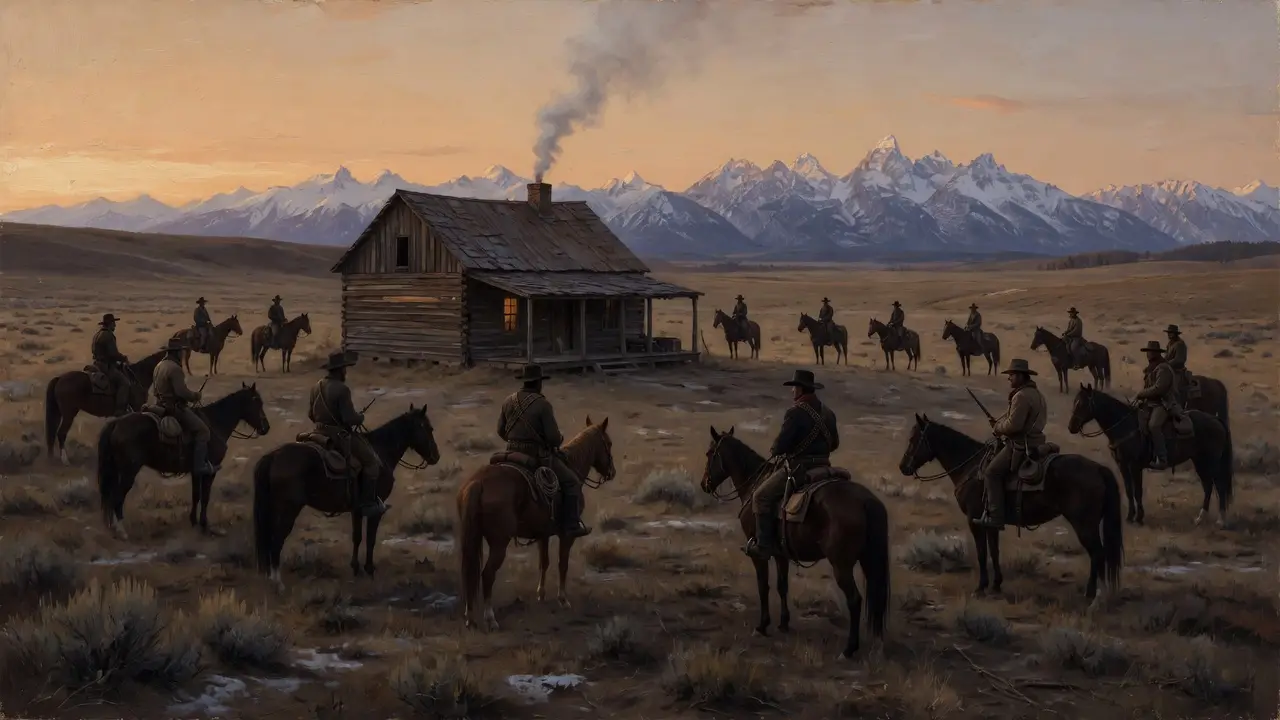
A scout reported that two men on the list were sheltering at the KC Ranch, about fifty miles south of town. The decision was made to stop and deal with them first.
One of those men was Nate Champion.
Nate Champion: The Man Who Became a Symbol
If the Johnson County War has a moral center, it is Champion. A Texas-born cowboy who had worked for some of the big outfits before striking out on his own, he had been accused of rustling without conviction and had survived at least one previous assassination attempt. He was thirty years old in 1892, known on the range as a cool-headed and exceptionally capable man with a gun. He was not a criminal in any sense that a jury had established. He was a small rancher trying to build something.
LESSER-KNOWN DETAILS
The Johnson County conflict directly influenced the political career of Willis Van Devanter, a Wyoming lawyer who defended the Stock Growers Association and later became a U.S. Supreme Court Justice appointed by William Howard Taft.
On the morning of April 9, the Regulators surrounded the KC Ranch cabin. Champion was inside with three companions. Two of those companions, a trapper and a teamster, were captured immediately when they stepped outside to fetch water. The third, a man named Nick Ray, was shot down in the yard.
“Boys, there is bullets coming in like hail. Them fellows is in such shape I can’t get at them. Boys, I don’t know what they have done with them two fellows that staid here last night.”
Nate Champion’s diary, April 9, 1892
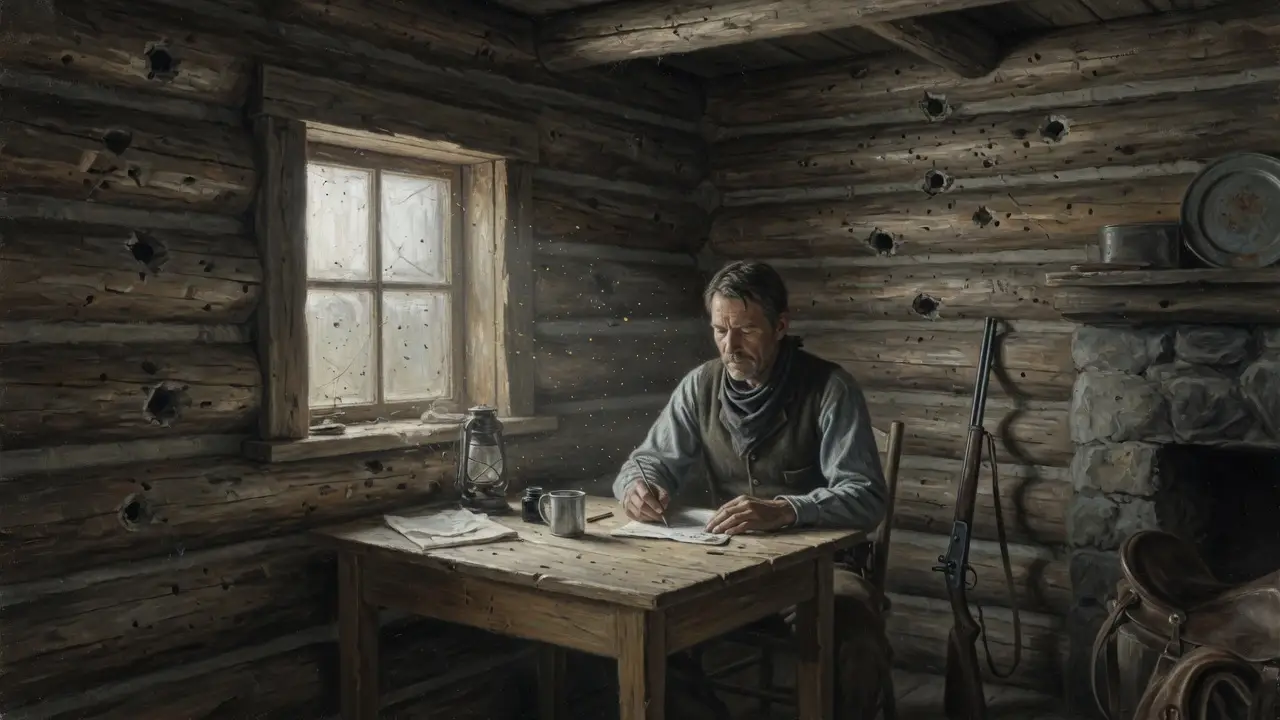
Champion dragged Ray back inside. For the next several hours, while Ray lay dying and the Regulators fired into the cabin from surrounding positions, Champion did something extraordinary. He kept a diary.
The entries are spare and unadorned, written in pencil during the lulls between gunfire.
“Me and Nick was getting breakfast when the attack took place. Two men here with us. Boys, there is bullets coming in like hail.”
Later: “Shooting again. I think they will fire the house this time. Nick is still alive but cannot last long.”
And near the end: “Well, they have got me, boys. I feel pretty lonesome just now.”
When the Regulators pushed a burning wagon against the cabin wall, Champion ran for it. He was cut down within yards of the door. His body was found with a note pinned to it: “Cattle thieves, beware.”
The diary survived. A reporter named Sam Clover, who had been embedded with the Regulators, carried a copy out. It was published across the country. The nation read Champion’s words and formed its own conclusions about who the rustlers really were.
Johnson County Fights Back
The two-day siege at the KC Ranch cost the Regulators something they could not afford: time. Word had reached Buffalo. Sheriff Red Angus deputized men by the hundreds. A posse of somewhere between two hundred and three hundred Johnson County residents rode south and surrounded the Regulators at a ranch called the TA, where they had taken cover.
LESSER-KNOWN DETAILS
The Regulators traveled to Wyoming on a special chartered train that was kept off official railroad manifests. The Wyoming Stock Growers Association had enough political pull to arrange this with the Union Pacific.
The posse had rifles, numbers, and fury. They also had dynamite, loaded into a wagon to use as a bomb. They were, by most accounts, close to overrunning the position.
Then the cavalry arrived.
Wyoming’s Governor Amos Barber, who had been informed of the invasion and had done nothing to stop it, sent telegrams to Washington. Senator Joseph Carey and Senator Francis Warren, both deeply tied to the stock growers, contacted President Benjamin Harrison directly. On April 13, three troops of the Sixth Cavalry rode in from Fort McKinney and took the Regulators into custody.
LESSER-KNOWN DETAILS
Several of the men on the cattlemen’s death list went on to serve as elected officials in Wyoming. The accused rustlers, in other words, became the government.
They did not take them to Johnson County jail. The Army held them at Fort McKinney. The legal proceedings that followed were deliberately prolonged until Johnson County ran out of money to continue the prosecution. The witnesses scattered. The charges were eventually dropped. Not a single Regulator was convicted.
The men who had planned a massacre walked away clean.
What the Dust Left Behind
The immediate outcome was a victory for the cattle barons in the narrowest sense: they survived. But the war cost them everything else.
Public opinion had shifted. The national press coverage of Nate Champion’s diary had done what no court could: it put the moral weight of the conflict in plain view. The Wyoming Stock Growers Association, which had functioned as an unquestioned power for two decades, never fully recovered its political dominance. Johnson County voters swept the Association’s allies from local office. The era of the cattle king as civic ruler was ending.
LESSER-KNOWN DETAILS
A journalist named Sam Clover from the Chicago Herald embedded himself with the invasion force. His first dispatches were sympathetic to the cattlemen. After Champion’s diary surfaced, coverage shifted dramatically.
The homesteaders stayed. The small ranchers stayed. The range that the big outfits had treated as their private property continued to be settled, cut up by barbed wire, and converted into the kind of mixed-use country that the cattle barons had gone to war to prevent.
The cowboys who had made all of that wealth possible, and then been branded criminals for wanting a piece of it, kept their places in the folk memory of the region in ways that the men who hired the Texans did not.
And Nate Champion’s diary kept circulating. His words, written in pencil while a cabin burned around him, outlasted the men who lit the fire.
The Ground Beneath the Myth
The Johnson County War matters because it is one of the rare moments when the machinery behind the frontier myth was left running in public, visible to everyone who cared to look.
The cowboy of popular imagination was a free spirit on an open range, beholden to no one. The reality, as Johnson County demonstrated, was a man who owned nothing, answered to men who owned everything, and could be labeled a criminal the moment he tried to change that arrangement. The open range was never truly open. It was controlled by capital, policed by private associations, and defended when necessary with hired violence.
LESSER-KNOWN DETAILS
After the war, many of the Texas gunfighters quietly returned south and were never publicly identified. The Association protected their anonymity as part of the arrangement.
When the cattle barons sent fifty gunmen north with a death list, they expected the machinery to hold. They had always operated outside the normal constraints of law, and the law had always accommodated them. What they did not expect was that this time someone would be keeping notes.
History rarely delivers that kind of clarity. Johnson County, Wyoming, in the spring of 1892, was one of the exceptions.