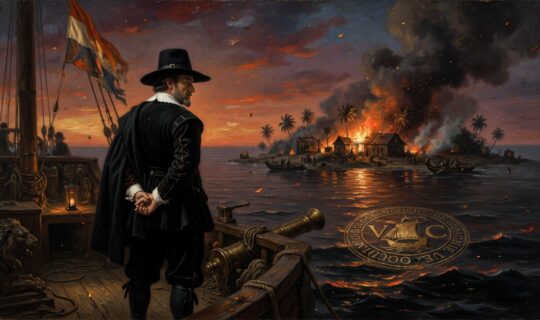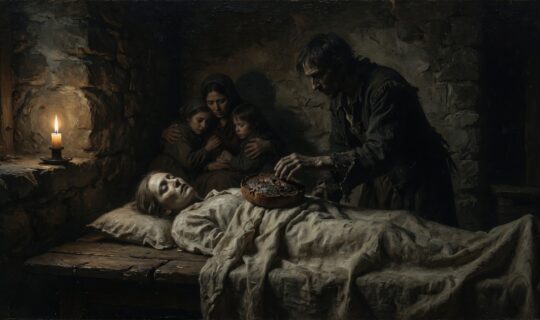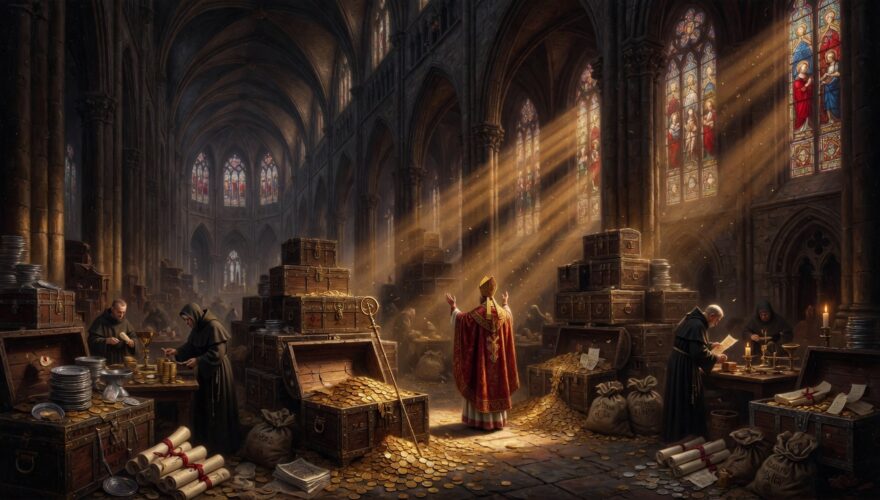
The Medieval church was richer than any king in history. Wanna know how they did it?
Tithes, indulgences, land seizures, inheritance manipulation. The Vatican didn’t just accumulate wealth, it engineered a system so sophisticated that no monarch could match it.
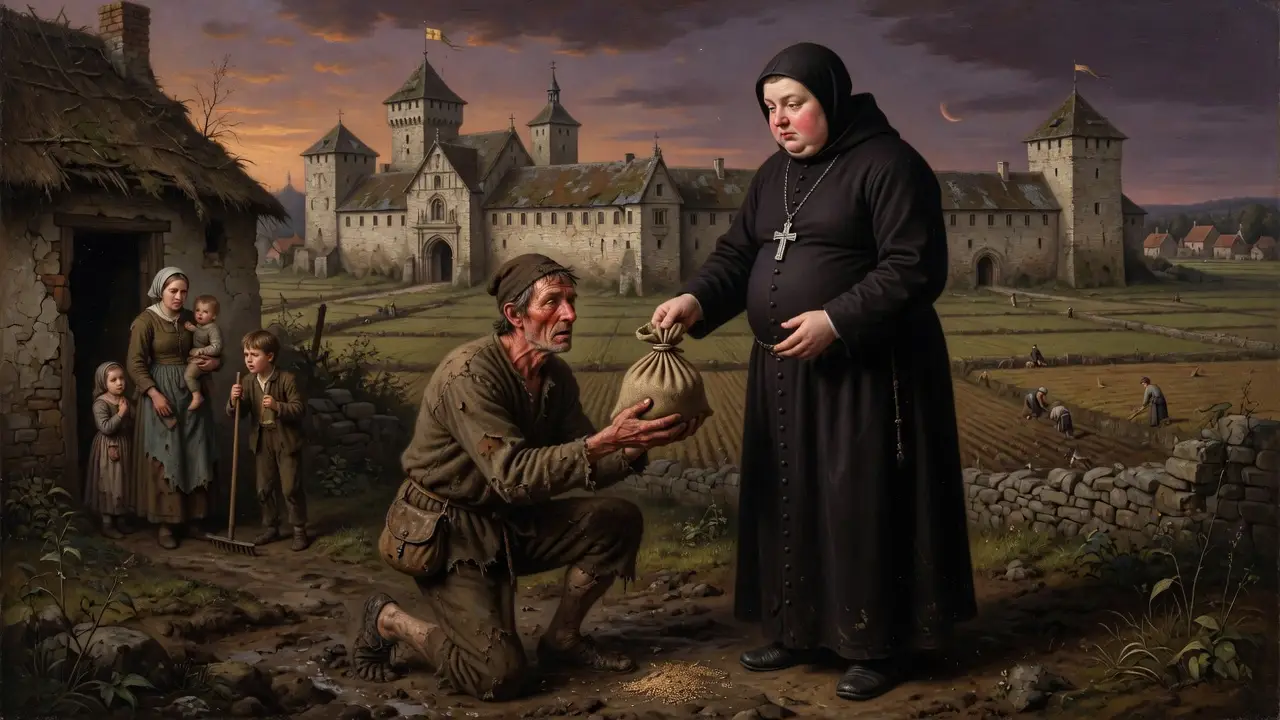
Picture a farmer in 13th-century France. He rises before dawn, works a strip of land he’ll never own, eats what’s left after the lord’s share is taken, and then, before winter comes, he hands over one tenth of everything he’s grown to his local priest. Not because he wants to. Because God said so. Or at least, that’s what the priest told him.
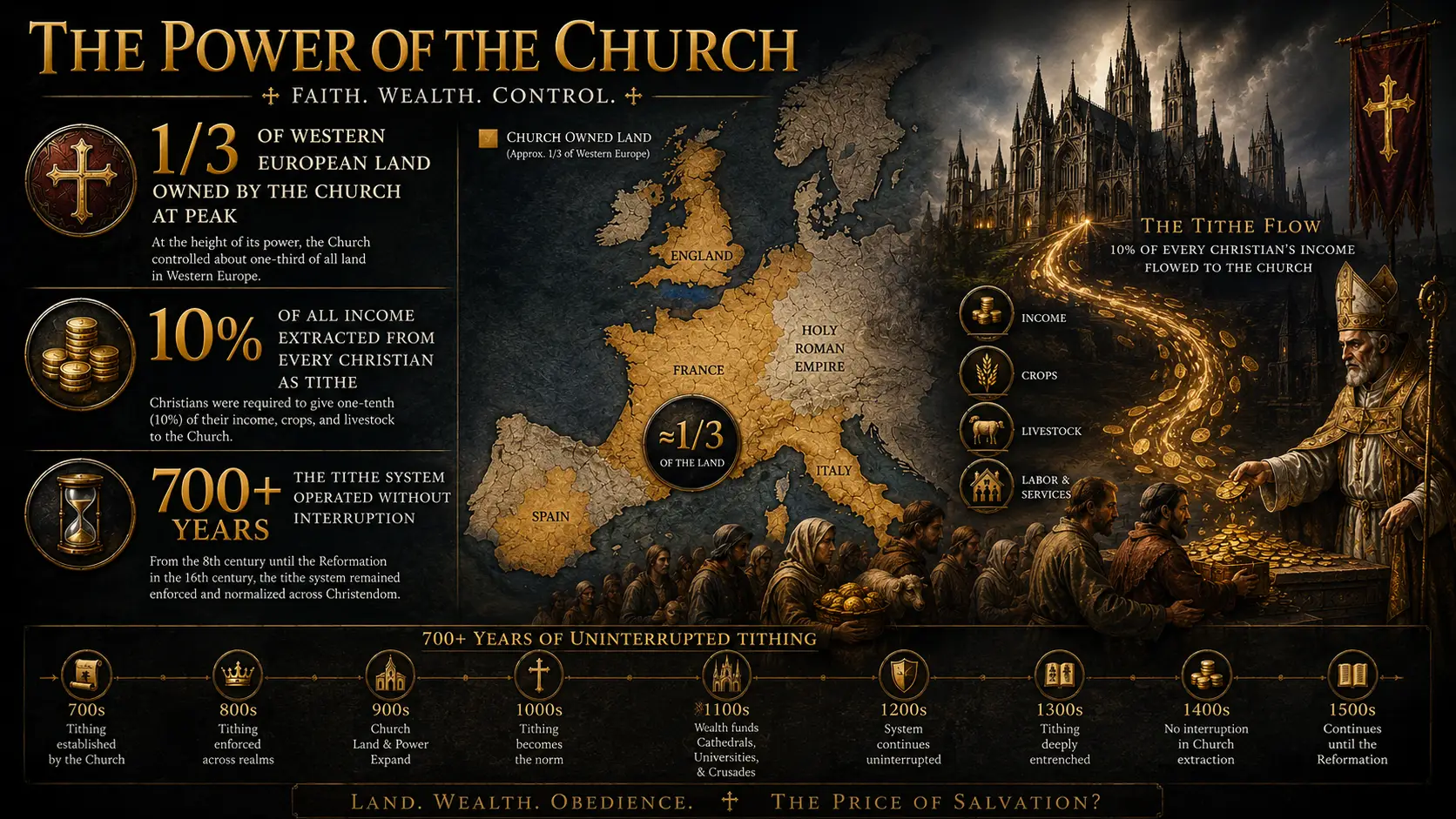
That farmer had no way of knowing that his meager grain contribution was flowing upward through one of the most sophisticated financial systems the Western world had ever seen. No monarchy built anything like it. No merchant republic came close. At its peak, the Catholic Church controlled somewhere between a quarter and a third of all the land in Western Europe. Popes moved sums that would stagger modern economists. And unlike kings, whose wealth evaporated in war and succession crises, the Church never died. It never had heirs to squabble over its holdings. It simply accumulated, for century upon century, quietly and ruthlessly.
The Tax Nobody Could Refuse
The tithe was medieval Europe’s most elegant shakedown. Ten percent of every harvest, every litter of piglets, every beehive’s honey. The word comes from the Old English for “tenth,” but for most peasants it functioned as something closer to a divine surcharge on the act of being alive. Miss your payment and you weren’t just in debt to your priest. You were, technically, in debt to God.
The Church had embedded this obligation so deeply into canonical law by the ninth century that secular rulers couldn’t touch it. The Fourth Lateran Council of 1215 codified it across all of Christendom, removing any ambiguity about who owed what to whom. Bishops competed for collection rights in wealthy parishes the way dukes competed for castles. In England alone, the tithe system brought in revenues that rivaled the crown’s income from direct taxation. And unlike royal taxes, which required expensive enforcement and constant political negotiation, the tithe collected itself. Fear of damnation is a remarkably efficient revenue mechanism.
The Price of Paradise
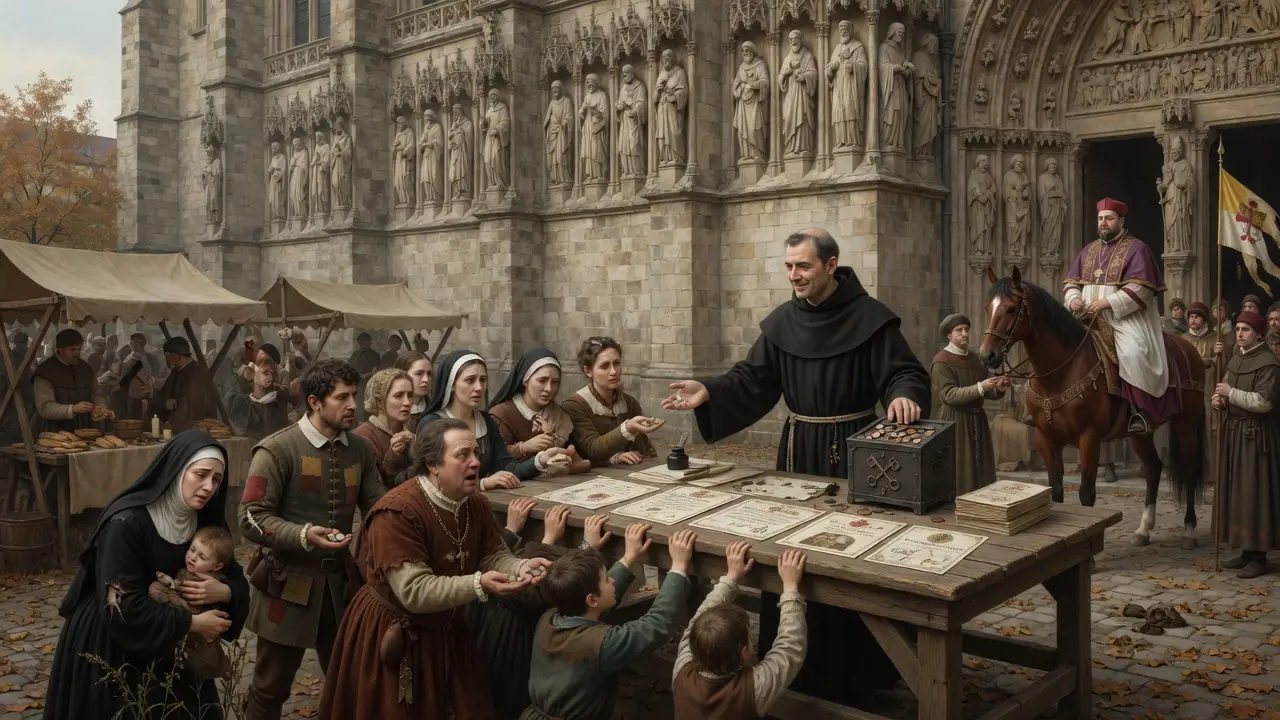
If the tithe was the Church’s baseline revenue, indulgences were its premium product. The theology was, on paper, coherent: since Christ and the saints had accumulated a “Treasury of Merit” through their perfect lives, the Church could draw on this surplus grace and apply it to a sinner’s account in purgatory, reducing the time their soul spent burning before ascending to heaven. What made this theologically interesting and financially catastrophic was what happened next: the Church started selling access to that treasury.
By the 12th century, crusade indulgences were being offered to anyone who funded a military campaign east, even if they couldn’t fight themselves. By the 14th century, the practice had expanded into something resembling a spiritual commodities market. Pope Sixtus IV extended indulgences to cover souls already in purgatory, meaning a family could buy their dead grandmother out of suffering. The German banker Johann Tetzel, selling papal indulgences in the early 1500s, allegedly used a jingle that translated roughly as: “As soon as the coin in the coffer rings, the soul from purgatory springs.”
“As soon as the coin in the coffer rings, the soul from purgatory springs.”
Johann Tetzel, Dominican friar and indulgence preacher, c. 1517
Land, Forever
The tithe bought influence. Indulgences bought short-term cash. But land was the real play.
Join The Archive Briefing
Weekly dispatches. The history they didn't teach you — sourced, subverted, delivered to your inbox.
The Church accumulated territory through a combination of donation, purchase, inheritance seizure, and what might politely be called opportunistic legal interpretation. Kings and nobles on their deathbeds, suddenly very interested in their eternal prospects, gifted enormous estates to monasteries and cathedral chapters. The Church accepted every acre gratefully. What it never did was give any of it back.
Here’s where the institutional genius really shows. In medieval law, land passing between individuals triggered feudal obligations, inheritance taxes, and all manner of transfer fees that fed the royal coffers. But the Church was a perpetual legal entity, what lawyers call a corporation sole. It didn’t die. It didn’t inherit in the normal sense. Land given to the Church entered a state of legal permanence known as mortmain, literally “dead hand,” meaning it was locked in the Church’s grip for eternity. No transfer taxes. No inheritance disputes. No heirs to buy off. Just ownership, accruing quietly through the centuries.
Kings hated this. Edward I of England passed the Statute of Mortmain in 1279 specifically to stop the hemorrhage of taxable land into Church hands. France tried similar measures. It didn’t much matter. The Church found workarounds, used its canon law courts to sidestep secular statutes, and kept acquiring. By the late medieval period, the phrase “dead hand of the Church” had entered common usage as a complaint, a recognition that enormous tracts of productive land had been effectively removed from the economic and political system that everyone else had to navigate.
The Inheritance Game
What the Church couldn’t acquire through donation, it sometimes arranged to receive through the careful management of dying people’s last wishes. This is where the history gets genuinely uncomfortable.
Priests administered last rites. They sat with the dying. They heard final confessions. And they were, not coincidentally, often present when a will was being drafted or altered. Church courts had jurisdiction over probate across most of medieval Europe, meaning that disputes over wills were heard by ecclesiastical judges who had a natural institutional sympathy for bequests to religious foundations. The system wasn’t always corrupt in a direct sense. But it created conditions where a wealthy merchant who died without direct heirs, or a widow with no children, could easily find their estate flowing toward the Church in ways their living relatives could do very little about.
Monasteries were particularly skilled at this. A pattern emerged across England, France, and the German territories: a monastery would provide care for elderly nobles or wealthy widows in their final years, in exchange for their estates upon death. It was, functionally, a medieval insurance product with the Church as both insurer and beneficiary. The transaction was framed in spiritual terms, a gift to God in exchange for prayers. The economic reality was more transactional than that.
“The Church never died. It never had heirs to squabble over its holdings. It simply accumulated, for century upon century.”
The Original Corporation
What made all of this sustainable wasn’t just wealth but organizational structure. The Catholic Church in the high medieval period was, in a meaningful sense, the first true multinational corporation in Western history. It had a centralized hierarchy with the Pope as chief executive. It had a legal system, canon law, that operated across political borders and that its own courts enforced. It had standardized administrative procedures that allowed it to function consistently from Ireland to Jerusalem. It had a system of internal audit, imperfect but real, through its synods and councils. And it had a monopoly on a product, salvation, for which demand was structurally infinite.
No king had any of this. A medieval monarch’s wealth was personal, tied to his body, his family, his military fortune. When he died, it fragmented. When he lost a war, it evaporated. The Church’s wealth was institutional. It belonged to the office, not the man holding it. A corrupt pope could loot the treasury, yes, and several did. But the institution itself persisted, rebuilt, kept collecting.
The Vatican’s financial architecture also pioneered instruments that modern banking would later formalize. The Church ran its own banking operations through institutions like the Knights Templar, who functioned as an early international wire transfer system: deposit gold in London, collect a note redeemable in Jerusalem. It issued debt. It speculated in grain futures. Italian banking families grew rich serving as the Church’s financial intermediaries, and in doing so invented the mechanisms that would later power the Renaissance and eventually capitalism itself. The Medicis, the Bardis, the Peruzzis: their fortunes were built, in no small part, on managing papal money.
When the System Broke
The machine eventually hit its limits. Not through any single catastrophe but through accumulated rot.
By the 14th century, the Church’s wealth had begun to visibly corrupt its mission. Bishops who never visited their dioceses collected revenues from them anyway. Popes who built pleasure palaces in Avignon while Europe burned with plague and war. Parish priests who extracted tithes from starving villages while living in modest comfort that still looked obscene against the backdrop of famine. The Babylonian Captivity of the Papacy, from 1309 to 1377, when the papacy relocated to Avignon under French political pressure, revealed how thoroughly the institution had been captured by secular wealth interests. Then came the Great Schism, two competing popes simultaneously excommunicating each other, both claiming the full treasury. The faithful watched, aghast, as the spiritual heart of Christendom argued about money in public.
Luther’s revolt in 1517 was the theological explosion, but the gunpowder had been accumulating for two hundred years. When Protestant princes in Germany and England began seizing Church lands in the 16th century, the legal and moral frameworks that had protected those holdings for centuries simply collapsed under the weight of their own visible contradiction. Henry VIII dissolved England’s monasteries between 1536 and 1541 and transferred their estates to the crown. Decades of accumulated wealth, libraries, farmland, livestock, plate silver, were liquidated in less than a decade.
What followed was, among many other things, the first great asset transfer in modern European history. The Church’s dead hand opened, reluctantly and under force, and the land that had sat in mortmain for generations flowed back into secular markets. A new class of English landowners, the gentry, emerged almost overnight. The economic structure of an entire country rewrote itself around a single institution’s financial collapse.
The medieval Church’s wealth machine is not ancient history in any comfortable sense. Its basic mechanics, the capture of legal systems, the monopoly on existential products, the use of perpetual institutional identity to accumulate assets beyond what any individual could hold, remain perfectly legible in the modern world. Religions still receive favorable tax treatment in most democracies. Perpetual trusts and foundations still shield assets from the inheritance taxes that individuals pay. Corporations still use legal permanence to do what no person can: own things forever.
The Vatican still holds assets measured in tens of billions of dollars, the precise figure deliberately obscured by accounting practices the Church pioneered in the 13th century. The first audit of Vatican finances in any modern sense only happened in 2019. The results shocked even insiders.