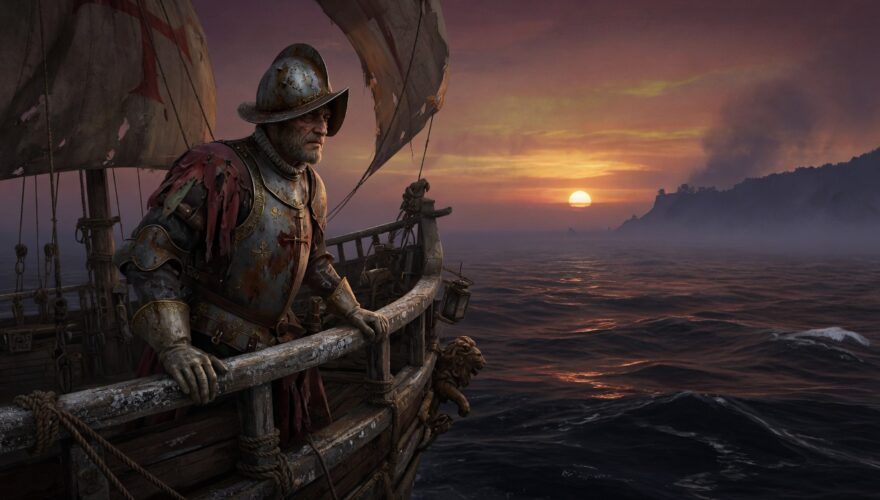
The ship had been at sea for weeks. The crew was hungry, sunburned, and quietly discussing whether to throw their captain overboard.
When Christopher Columbus finally spotted land on October 12, 1492, it wasn’t the triumphant moment you learned about in school. It was the desperate end of a near-mutiny. And what happened next, on that quiet Caribbean shore, would set a template for centuries of violence dressed up as discovery.
We were taught their names like prayers. Columbus. Magellan. Cortés. Vasco da Gama. Men of vision. Men of courage. The ones who drew the edges of the world and filled in the blank spaces on the map.
But maps, by design, only show you what the mapmaker wants you to see.
The Business of Discovery
None of these men set sail out of curiosity. They were contractors.
Columbus pitched his voyage to the Spanish crown as a trade route investment. He negotiated a ten percent cut of all wealth found in any new territory, plus the title of “Admiral of the Ocean Sea” and governorship of any lands he claimed. He was, in modern terms, a startup founder looking for venture capital, and the product he was selling was conquest.
When he arrived in the Bahamas and encountered the Taíno people, he wrote in his journal that they were “well-built, with good bodies and handsome features.” He also noted, almost in the same breath, that they would make excellent servants and could be taken back to Spain with ease.
He wasn’t discovering a new world. He was scouting real estate.
The Governor of Hispaniola
Columbus made four voyages to the Americas. What the statue-builders don’t celebrate is what he did between them.
Join The Archive Briefing
Weekly dispatches. The history they didn't teach you — sourced, subverted, delivered to your inbox.
As Governor of Hispaniola, he instituted a tribute system that required every Taíno adult to deliver a hawk’s bell full of gold dust every three months. Those who failed had their hands cut off. Those who resisted were hunted with dogs. Within two years, thousands had died, not all from violence. The psychological weight of total subjugation, forced labor, and starvation did the rest.
A Spanish priest named Bartolomé de las Casas, who witnessed the occupation firsthand, wrote that the Taíno were treated “not as beasts, for beasts are treated sometimes with some respect, but like the excrement in a public square.” He had sailed to the New World as a supporter of colonization. What he saw turned him into its most vocal critic.
Columbus was eventually arrested, not for what he did to the indigenous population, but for how brutally he governed Spanish settlers. He was shipped back to Spain in chains in 1500. The crown stripped him of his governorship but let him keep his money.
He died comfortable. Most of the Taíno did not survive the century.
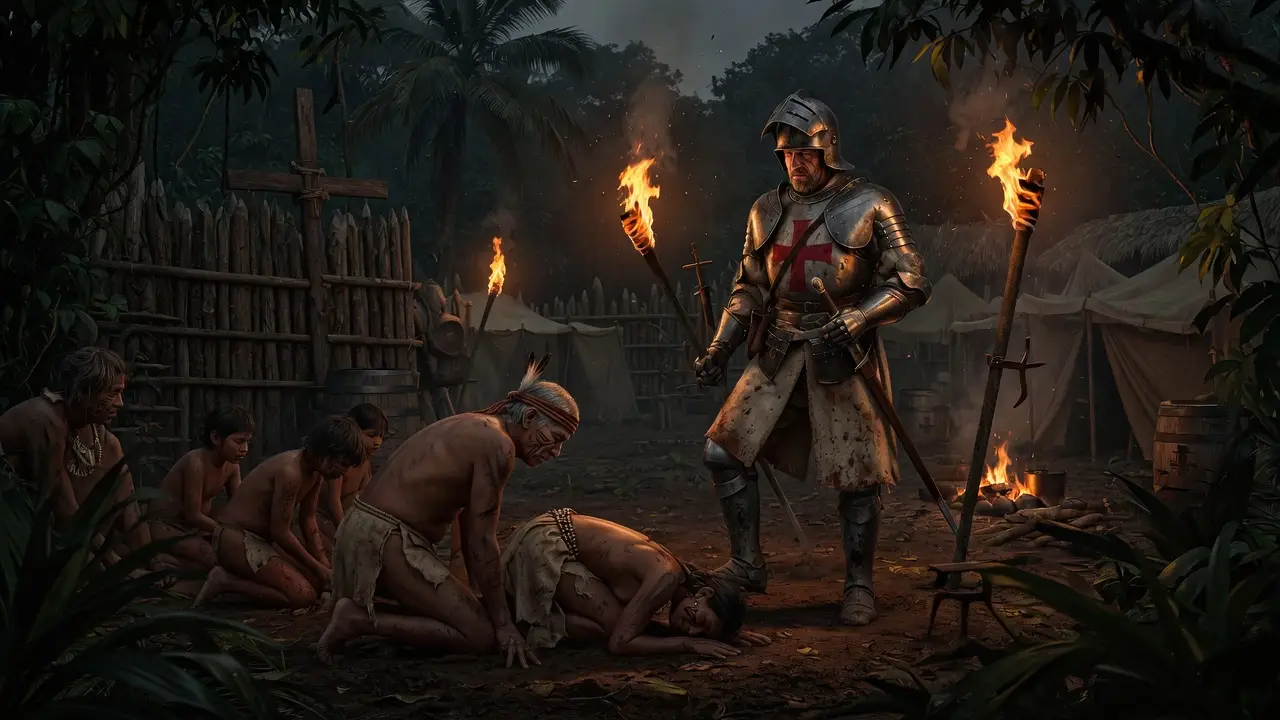
Cortés and the Art of Calculated Betrayal
Hernán Cortés arrived in Mexico in 1519 with 600 men and immediately did something audacious: he burned his own ships.
It’s the part of the story that gets told as bold leadership. No retreat. Total commitment. What gets left out is the context. Cortés had sailed without authorization from the Governor of Cuba, who was already sending forces to arrest him. Burning the ships wasn’t inspiration. It was coercion. His men had nowhere to go but forward.
What followed was less a conquest and more a political exploitation. The Aztec Empire was not a unified, peaceful civilization waiting to be toppled. It was a superpower held together by fear, tribute, and the constant threat of ritual sacrifice. Cortés found entire city-states that despised the Aztec rulers, and he built a coalition army of tens of thousands of indigenous fighters who saw the Spanish as a useful weapon against their oppressors.
He was right. They were useful. And when Tenochtitlán fell, those same allies found themselves under a new empire that was even less interested in their survival.
Cortés had promised freedom. He delivered encomiendas, a system of forced indigenous labor that would define Mexican society for generations.
Magellan’s Fatal Arrogance
Ferdinand Magellan died because he picked a fight that wasn’t his to pick.
In 1521, his fleet reached the Philippines after an extraordinary crossing of the Pacific. Magellan had converted several local chiefs to Christianity and genuinely saw himself as doing God’s work alongside the crown’s. When one chief named Lapu-Lapu refused to submit, Magellan decided to make an example of him.
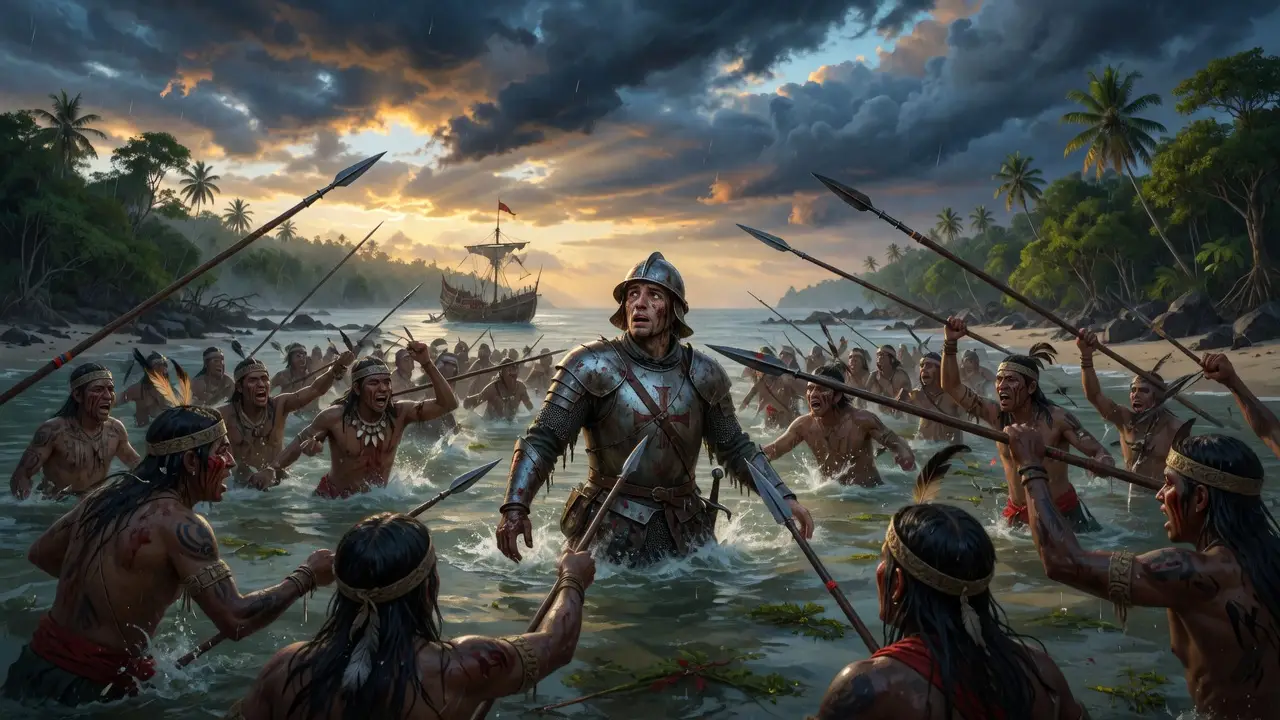
He attacked with sixty men. Against over a thousand warriors on terrain they knew intimately. His own allied chiefs offered their armies, and Magellan refused them. He wanted the glory of a small, decisive European force defeating a native rebellion.
Instead, he was surrounded in the shallows of Mactan Island, cut off from his ships, and killed. He was 41 years old.
The first circumnavigation of the globe was completed, but Magellan wasn’t on the ship that finished it. His ego had run out of ocean before he did.
You might wonder how men with these records became the heroes of children’s textbooks.
The answer is straightforward: empires write their own histories, and explorers were the sharp edge of empire. Celebrating Columbus meant celebrating Spain. Celebrating Magellan meant celebrating the audacity of European expansion. To question the explorer was to question the entire moral architecture of colonialism, and for a very long time, the people in power weren’t interested in that conversation.
Statues went up. Holidays were named. School curricula were shaped by governments with a stake in the mythology.
It wasn’t ignorance. It was a decision.
None of this means the voyages weren’t extraordinary. Crossing an unknown ocean in a wooden ship, with no GPS and no guarantee of return, required something close to madness. The seamanship was real. The navigation was genuine. The courage, in a narrow technical sense, was undeniable.
But courage and decency are not the same thing, and we’ve spent centuries confusing them.
The Taíno are gone. The Aztec Empire was dismantled, its temples torn down and used as building material for a Spanish cathedral that still stands in Mexico City today. The indigenous peoples of the Philippines remember Lapu-Lapu as a national hero, the man who killed the colonizer before the colonization could fully begin.
History is always told by someone with something to gain from the telling.
The question worth asking now is not whether these men were brave. They were. The question is: brave in service of what, and at whose expense?
The answer is carved into the silence where entire civilizations used to be.