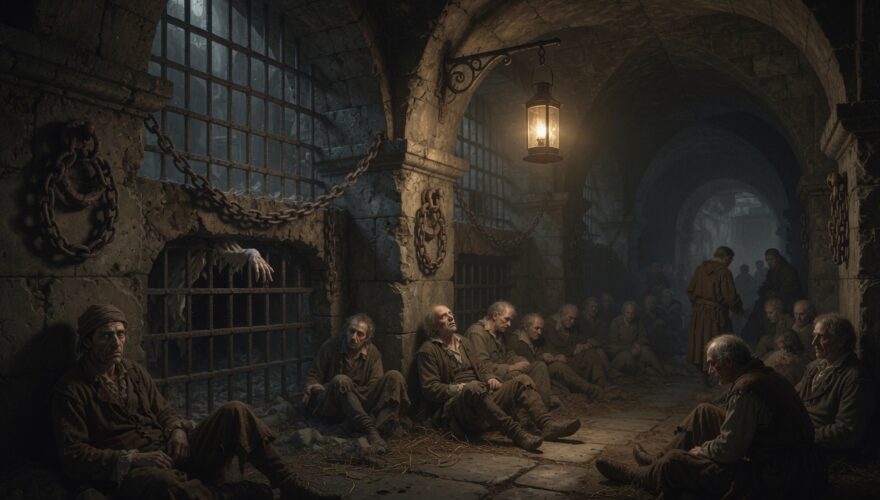
Poverty wasn’t misfortune in the 18th century. It was a crime. Discover the brutal, predatory machinery of debtor’s prisons, where men were locked away for missed payments, charged rent to sleep on stone floors, and legally prevented from ever earning their way out. History Plus+ dissects the system built to destroy the poor.
A Man Walks into Prison for Owing a Shilling
In the winter of 1729, a Parliamentary committee descended into the Marshalsea Prison in Southwark to document what they found there. What greeted them was not a place of punishment in any recognizable sense. It was a slow execution. Hundreds of men, women, and children crowded into a space built for dozens. The floors were slick with filth. The air was thick enough to taste. And in the common ward, where the poorest debtors were kept, people were dying not from any sentence handed down by a judge, but from hunger, disease, and the quiet violence of a system that had locked them away for the crime of running out of money.
The committee chairman, James Oglethorpe, later wrote that he had seen things inside those walls that no honest man could defend. He was right. But the system endured anyway, for another century.
This is how it worked. And why it was designed to destroy you.

When Owing Money Became a Sin Against the State
The philosophical architecture of English debt law in the eighteenth century rested on a single, convenient fiction: that a man who failed to repay his creditors had committed a moral transgression, not merely suffered a financial misfortune. Insolvency was not treated as the consequence of bad luck, bad harvests, or bad markets. It was treated as a character defect, and character defects, in the legal language of the era, required punishment.
This was not accidental. The merchant class that had risen to dominate English commerce needed a mechanism to enforce contracts, and the courts obliged. The result was a legal environment in which the creditor held almost absolute power over the debtor’s body.
“The law is not blind. It squints. It sees the rich man’s debt as an inconvenience and the poor man’s as a felony.”
William Hogarth
The instrument of that power was a document called the Writ of Capias. It required no trial, no verdict, no proof of guilt. A creditor who believed a debt was owed could apply for this writ and have a man arrested the same afternoon. Not after a hearing. Not after due process. Before any of that. The accused could be hauled from his place of business, his family, his life, and deposited into custody while the legal proceedings that might exonerate him hadn’t even been scheduled yet. Guilt was assumed. Incarceration was immediate. The burden of proof, such as it was, fell on the man rotting in a cell trying to prove he’d already paid.
For men of middling status, the shock was compounded by what contemporaries called the “gilded cage” effect. One day you were a tradesman with a shop, a reputation, and a name that meant something on your street. The next, a bailiff appeared at your door holding a piece of paper, and every social credential you’d spent decades building evaporated on the spot. Neighbors watched. Word traveled. Your credit, the lifeblood of commerce at a time when almost every transaction ran on trust and reputation, collapsed before you’d even left for the prison gate.
Join The Archive Briefing
Weekly dispatches. The history they didn't teach you — sourced, subverted, delivered to your inbox.
LESSER-KNOWN DETAIL
The Fleet Prison had a street running through it called “Fleet Market Lane” where vendors sold goods. Some prisoners became small merchants within the walls, creating a micro-economy of poverty.
The Reverend William Dodd, executed in 1777 for the forgery of a bond (a debt-related crime), wrote from his cell: “The law does not merely punish the guilty; it obliterates the man.” He was writing about himself, but he could have been describing thousands.
The Brutal Fee That Never Ended
The Fleet Prison and the Marshalsea were not, technically, government institutions in the way a modern person would understand. They were closer to privately operated tollbooths on the road to ruin. The Crown licensed the wardenship, and the wardens ran the institutions as personal revenue streams, extracting money from prisoners at every conceivable stage of their incarceration.
When a debtor arrived, he paid an entry fee called “garnish.” If he couldn’t produce it, his clothes were taken instead. The other prisoners enforced the custom themselves, because the alternative was the wardens doing it violently. Once inside, if he wanted a bed rather than the bare stone floor, he paid rent. If he wanted food beyond the occasional loaf of stale bread that the prison grudgingly provided, he paid for it from outside vendors who had purchased the exclusive right to sell within the walls.
“The prison is not a place of correction. It is a place of infection, where the vices of the wretched are multiplied upon themselves until nothing human survives.”
John Howard, The State of the Prisons (1777)
The “chummage” system was perhaps the most nakedly predatory arrangement. Prisoners with any remaining money rented space in cells to those who had none. This wasn’t charity. The floor of a six-by-eight cell shared with four other men cost money. The man in the corner by the window, marginally more protected from the draft, paid a premium. The man nearest the bucket used as a toilet paid less, but he still paid. Poverty within the prison had its own internal economy, and at every level of it, someone with slightly more power extracted something from someone with slightly less.
The wardens set the rates, changed them at will, and faced essentially no oversight. A 1729 report to Parliament found that one warden at the Marshalsea, William Acton, had been torturing prisoners who couldn’t pay: pressing them with iron weights, chaining them in positions designed to cause maximum suffering, confining them in a room called the “Strong Room” where the walls ran wet with moisture and the floor never dried. Acton was eventually prosecuted. He was fined and walked free. The system that had empowered him remained untouched.
Two Prisons Within One Prison
Walk through the gates of the Fleet Prison in 1740 and you did not enter a single institution. You entered a society, stratified with all the cruelty of the one outside its walls.
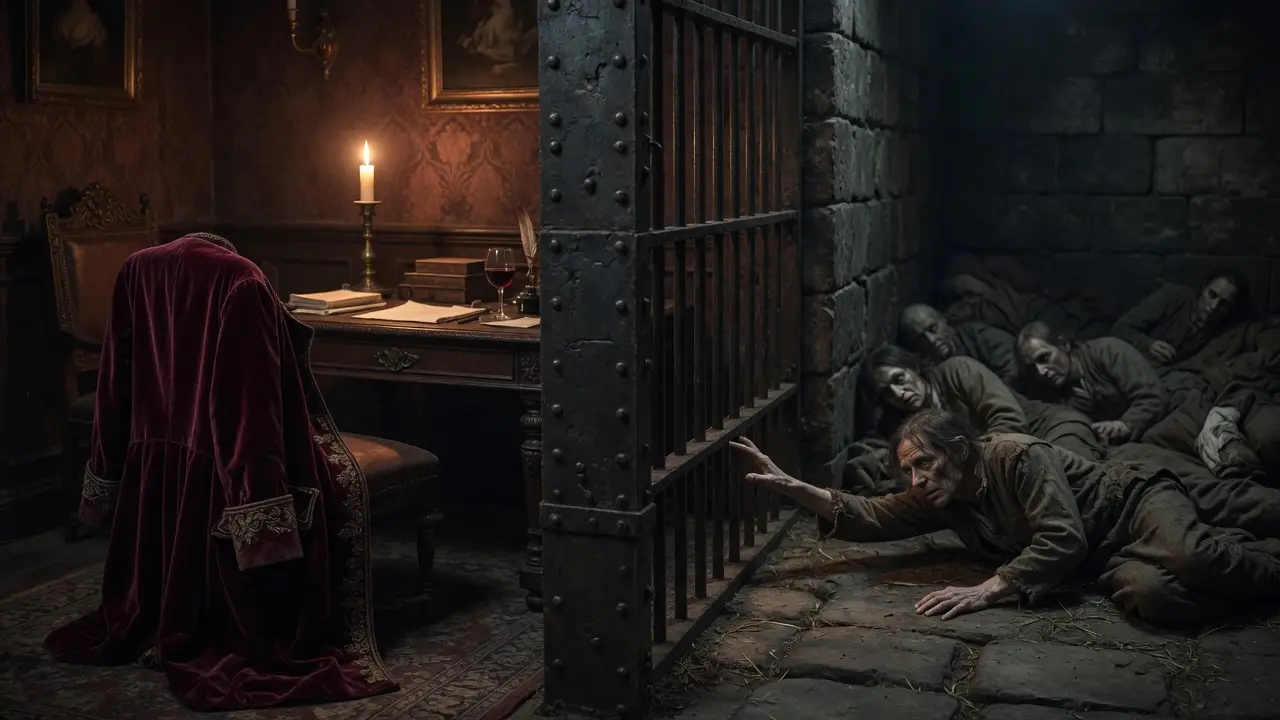
On the Master’s Side, wealthy debtors lived in something approaching comfort. They had private rooms, sometimes several. They could receive visitors freely. They could order food and wine from outside. Some kept servants. Some ran businesses from their cells, dictating letters and receiving payments through trusted intermediaries. For a man of sufficient means, the Fleet was less a prison than an enforced sabbatical with inconvenient paperwork. The philosopher and political theorist Edmund Burke, who observed these conditions, noted with bitter irony that the rich man’s debt imprisonment was “an inconvenience,” while the poor man’s was “a death sentence written in slow ink.”
“We have in this nation made poverty itself a kind of crime, and then wondered why the poor grow desperate.”
Henry Fielding, An Enquiry into the Causes of the Late Increase of Robbers (1751)
On the Common Side, the reality bore no resemblance to any of that.
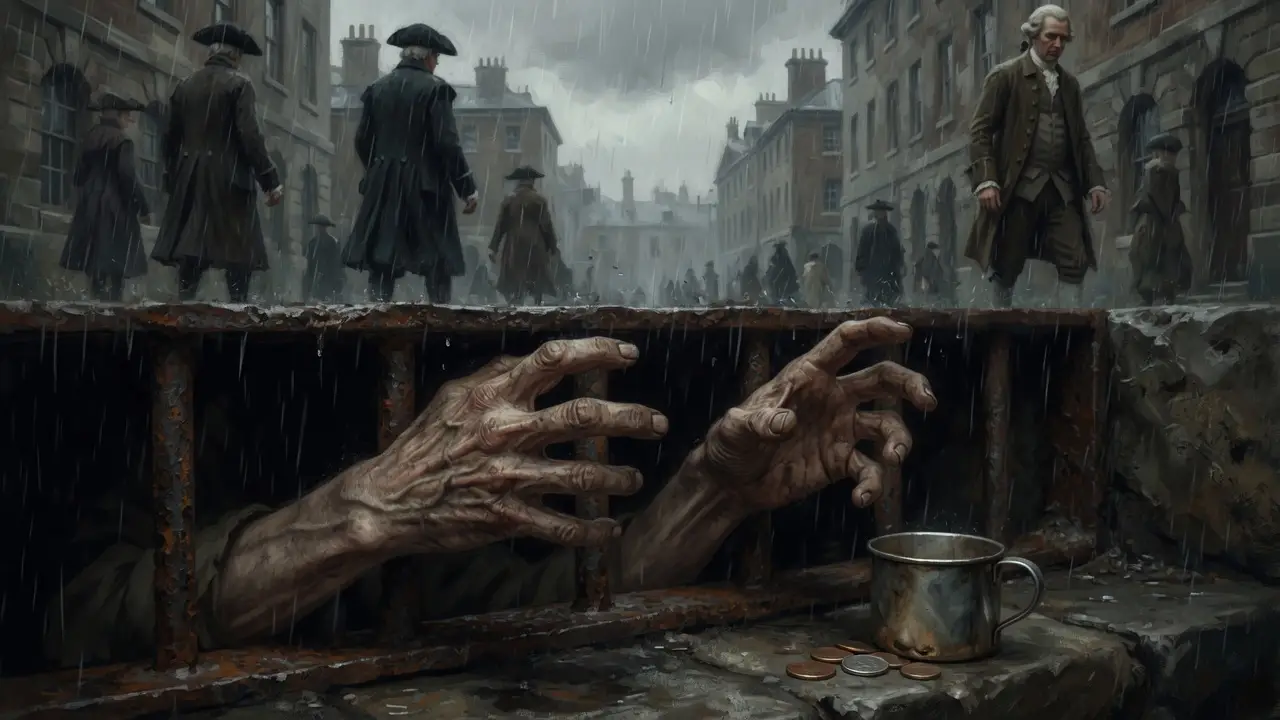
The Common Side had no private rooms. It had no rooms at all, in the residential sense. It had a series of collective spaces in which anywhere from twenty to sixty people slept, ate, and slowly deteriorated together. The begging grates were a fixture of Common Side life: iron-barred openings at street level through which prisoners extended their hands and thin tin cups toward passersby, crying out for alms. A prisoner who could collect enough coins through the grate might buy food. One who couldn’t, frequently didn’t eat that day.
The phrase most commonly used in parliamentary testimony to describe the Common Side was “beyond description.” Witnesses who tried to describe it anyway reached for words like “pestilential,” “infernal,” and, most precisely, “a place where men are sent to disappear.”
LESSER-KNOWN DETAIL
A prisoner at the Marshalsea could be released on “the Rules,” a form of day-pass parole allowing him to live within a defined zone around the prison, if he paid a bond to the warden. The bond was often larger than the original debt.
They weren’t far wrong. Gaol fever, which we now recognize as epidemic typhus, moved through the overcrowded wards with the efficiency of a scythe. In 1750, an outbreak from Newgate Prison spread into the Old Bailey courtroom during a trial, killing the Lord Mayor of London, two judges, a number of barristers, and dozens of spectators. The prisoners themselves, long since immunized by repeated exposure or simply dead, barely rated a mention in the subsequent reports.
The Machine That Prevented Its Own Solution
Here is the part of the system that deserves a particular kind of contempt: it was constructed so that the people trapped inside it could not, under any foreseeable circumstances, get out.
A debtor was imprisoned because he owed money. To get out of prison, he needed to pay the money. To pay the money, he needed to earn it. To earn it, he needed to work. To work, he needed to be outside the prison. The law did not permit this. There were limited exceptions, narrow and rarely granted, but as a structural matter, imprisonment for debt was designed in a way that made the debt essentially unpayable from inside. The creditor, meanwhile, sat outside accumulating interest on the original sum, which continued to grow while the debtor sat in the dark getting poorer.
LESSER-KNOWN DETAIL
Wardens auctioned off the right to operate certain areas of the prison. The beer concession, the food stall rights, the mattress rental: all purchased by private entrepreneurs who then squeezed prisoners to recoup their investment.
Before a man even reached the prison gates, there was one more extraction point waiting for him. Sponging houses were private detention facilities operated by bailiffs as commercial enterprises, holding debtors in a kind of legal limbo between arrest and formal imprisonment. They were more comfortable than the prisons, and the bailiffs used that relative comfort as leverage. The message was plain: pay us now, whatever we ask, and you avoid the Marshalsea. If you can’t pay, your family can.
Bailiffs were known to approach the wives and parents and siblings of the detained, presenting inflated figures, suggesting that a little more than originally owed might smooth the process considerably. Some families were stripped bare in the sponging house and watched their relative go to prison anyway.
“The Marshalsea had been in existence many years before Amy Dorrit was born. It is gone now, and the world is none the worse without it.”
Charles Dickens, Little Dorrit (1857)
The families then often followed. Because prison rules in many institutions permitted wives and children to live inside with the debtor, some families chose this rather than face homelessness outside. The children of the Fleet and Marshalsea grew up within those walls. They learned to beg through the grates. Some of them never left.
Charles Dickens knew this firsthand. His father, John Dickens, was committed to the Marshalsea in 1824 for a debt of forty pounds. The twelve-year-old Charles was sent to work in a blacking factory. He later wrote the experience into Little Dorrit, whose opening pages describe the Marshalsea with the precision of a man remembering a nightmare he never fully woke from. Amy Dorrit, the novel’s heroine, was born inside the prison. She had never known anything else.
“I have never been outside,” Dickens wrote for her. “This is the only world I know.”
The Wound That Doesn’t Heal Clean
The reformers who eventually dismantled the worst of this system, people like Oglethorpe, John Howard (whose 1777 book The State of the Prisons shocked the reading public into action), and later the Insolvent Debtors Acts of the early nineteenth century, understood that they were not correcting an aberration. They were trying to dismantle something that had been deliberately engineered. The debt prison was not a broken system. It was a functioning one. It functioned to transfer wealth upward, to discipline the poor into compliance, and to remove from polite society anyone who had failed to keep pace with its economic demands.
LESSER-KNOWN DETAIL
The 1729 Parliamentary inquiry found one prisoner who had been in the Fleet for over thirty years, his original debt long since legally voided, but with accumulated prison fees that now exceeded any sum he could ever realistically raise.
The formal abolition of imprisonment for debt in England came in 1869. But the logic did not disappear with the law.
The modern credit score is, at its structural core, a system that assigns numerical criminality to financial misfortune. Miss two payments during a period of unemployment and the algorithm closes doors for years. Predatory lending, payday loan structures designed to ensure perpetual partial repayment, “pay-to-stay” jail fees charged to people who cannot afford bail, the endless bureaucratic cost of being poor in a society that charges fees to access the institutions meant to help you: these are not new inventions. They are the chummage system running on servers instead of stone floors.
“A man who is imprisoned for debt is punished, not for what he has done, but for what he cannot do.”
Samuel Johnson
The distance between a bailiff at a sponging house in 1745 demanding a family’s last savings and a debt collection agency calling at six in the morning is mostly a matter of architecture. The premise is the same: that the failure to have money is itself an offense, that the person who owes is morally inferior to the person who is owed, and that this moral inferiority justifies the extraction of whatever remains.
Oglethorpe walked out of the Marshalsea in 1729 deeply changed by what he’d seen. He wrote that the men inside were not criminals. They were simply men who had run out of options in a world that offered them very few to begin with.