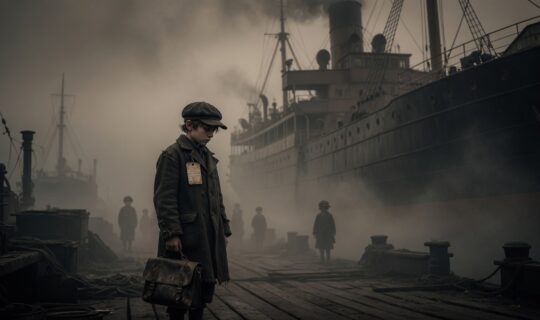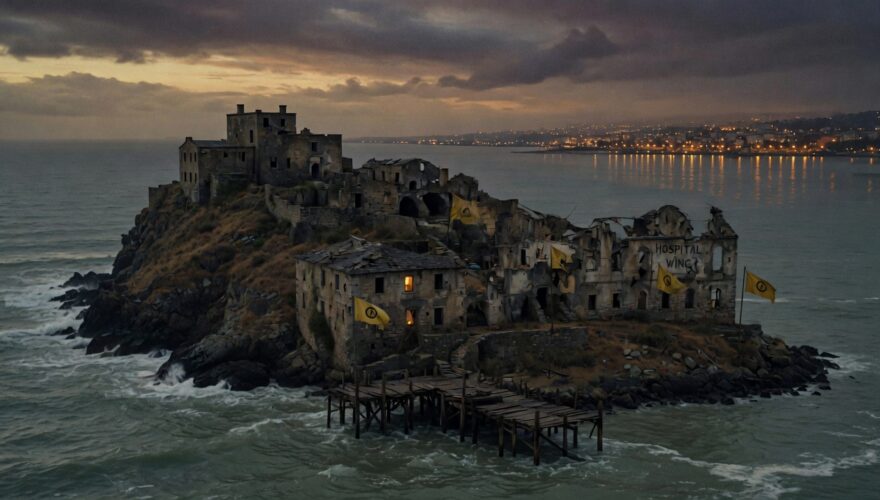
Inside the history of quarantine islands like Venice’s lazarettos, Grosse Île’s mass graves, and the brutal bargain that saved cities by stranding the people who arrived in them.
The ship had been at sea for forty days. The sailors were exhausted, sun-darkened, and desperate to get off the water. They could see the city from the deck. They could see the lights at night. They could see other ships moving freely in and out of the harbor.
But they could not land.
A small boat came out to meet them, not to welcome them, but to explain the terms. They were to anchor at the island. They were to stay there. If they were healthy, they would prove it by waiting. If they were sick, they would be treated. If they died, they would be buried on the island. The city wished them well. The city would not be coming any closer.
This was quarantine. Not the word, which came later. The practice, which had existed since cities decided that survival mattered more than mercy.
- 1 Before Germs Had Names
- 2 Venice and the Architecture of Survival
- 3 Why Islands Were Perfect, and Why That Should Trouble You
- 4 The People Left Behind
- 5 Grosse Île: Where the River Became a Graveyard
- 6 New York: Islands at the Edge of Everything
- 7 The Woman Who Became a Precedent
- 8 What These Places Looked Like
- 9 Cargo and Class
- 10 Did It Work?
- 11 The Language of Suspicion
- 12 The Bargain the Cities Made
- 13 What the Islands Left Behind
Before Germs Had Names
Medieval physicians had no concept of bacteria. Viruses were centuries from being understood. What they did understand was sequence: ships arrived, strangers walked ashore, bodies appeared in the streets. They could not explain it. They could recognize it.
The city of Ragusa, the thriving Adriatic republic now known as Dubrovnik, made one of the earliest attempts to formalize that recognition. In 1377, city authorities issued a decree requiring travelers from plague-affected regions to wait outside the city before entering. The original measure prescribed thirty days of isolation, a period called the trentina. Later, as fear deepened and the logic of isolation spread, the period was extended to forty days. The Italian word for forty, quaranta, gave us the name that still defines public health crises today.
Ragusa was not operating on science. It was operating on the oldest logic available: if the danger arrives by ship, you stop the ships.
Venice and the Architecture of Survival
No city had more reason to be terrified of plague than Venice.
Join The Archive Briefing
Weekly dispatches. The history they didn't teach you — sourced, subverted, delivered to your inbox.
Venice was one of the wealthiest trading cities in the world, and that wealth moved through ships. Goods came from the eastern Mediterranean, from the Levant, from ports where plague was already burning. Every bale of cloth, every crew member, every merchant was a potential carrier. To close the harbor was to starve. To leave it open was to die. The city needed a third option.
So they built a system.
“When plague comes, a wise city suffers small harms to prevent great ones.”
Venetian public health statutes, 15th century
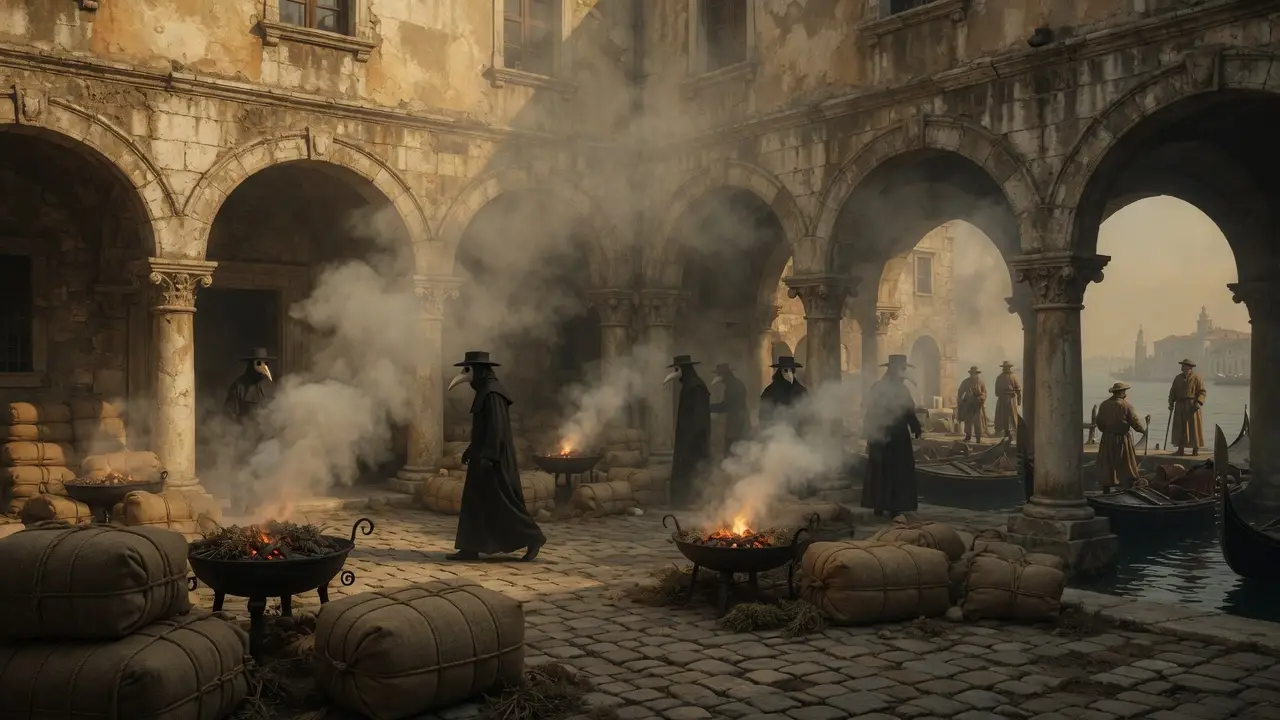
In 1423, Venice established a dedicated quarantine island, converting a small island called Santa Maria di Nazareth, quickly nicknamed Lazzaretto Vecchio, into a place where sick people and suspicious cargo could be held offshore. Decades later, a second island, Lazzaretto Nuovo, was added to handle travelers who were not yet sick but had come from infected regions. The distinction mattered. One island was a hospital. The other was a waiting room with guards.
LESSER-KNOWN DETAILS
Venice kept meticulous plague records from the 15th century onward, making it one of the earliest examples of systematic epidemiological data collection in history. Officials recorded deaths by neighborhood, age, and suspected cause, centuries before the germ theory of disease.
Ships arriving under suspicion were required to anchor offshore and display a yellow flag. Passengers disembarked onto the island. Cargo was unloaded, spread across the ground, and exposed to the open air for days. Some goods were fumigated with burning herbs and sulfur. Others were submerged in seawater. Officials inspected everything and reported back to the city. Only after this process was complete, and the waiting period satisfied, would anyone or anything be permitted to enter Venice.
The city had built a filter. The island was the mesh.
Why Islands Were Perfect, and Why That Should Trouble You
The logic of using islands for quarantine was, from a public health perspective, nearly flawless.
Water made enforcement effortless. You did not need walls when the sea itself was your barrier. Guards could watch from boats rather than patrol long perimeters. Ships could be observed from a distance before anyone came near them. The island could hold warehouses for goods, barracks for the healthy, wards for the sick, and burial grounds for the dead, all without placing any of that infrastructure inside the city itself.
LESSER-KNOWN DETAILS
On Lazzaretto Vecchio, excavations found the bones of victims buried with stones or bricks in their mouths. This was a documented practice intended to prevent the dead from rising and spreading plague further. It reflects how thoroughly fear of contagion had fused with older supernatural anxieties.
But there was a second logic operating alongside the practical one, and it was darker.
Islands made suffering invisible. Once the ships were anchored offshore and the passengers were landed on the quarantine island, the city could return to its business. The merchants, the priests, the senators, the doge in his palace: none of them had to watch. None of them had to hear. The island absorbed the fear so the city did not have to carry it.
Out of sight, out of politics. The people on the island were not citizens in that moment. They were a category. A risk. A cargo.
The People Left Behind
The sailors arrived sick, or they arrived healthy and became sick waiting beside those who were. Merchants watched their goods deteriorate in the salt air, the silks rotting, the spices losing value by the day, while city officials debated whether the quarantine period needed to be extended. Families who had traveled together were separated on arrival, the visibly ill taken to one ward, the seemingly healthy to another, children sometimes placed apart from parents because administrators needed to process bodies, not relationships.
“The lazaretto is a place where men are neither well nor dead, but something between the two, and this betweenness is the price the city pays for its survival.”
From a health official’s account, Venice, 1576
Irish migrants fleeing the famine in 1847 arrived at quarantine stations so weakened by starvation that the typhus burning through their ships found almost no resistance. They had survived the Atlantic crossing, they could see the river and the land beyond it, and then they were taken to an island to wait out a disease that many of them had not yet contracted but would.
The healthy shared quarters with the dying because they had shared a ship. That was enough.
No one asked whether this was just. The city asked only whether it was safe.
Grosse Île: Where the River Became a Graveyard
The St. Lawrence River narrows enough, about fifty kilometers from Québec City, that a small island in its current could function as a gate. Canada understood this and established Grosse Île as a quarantine station in 1832, initially to manage cholera arriving with European immigrants.
It held that function for decades. Then 1847 arrived.
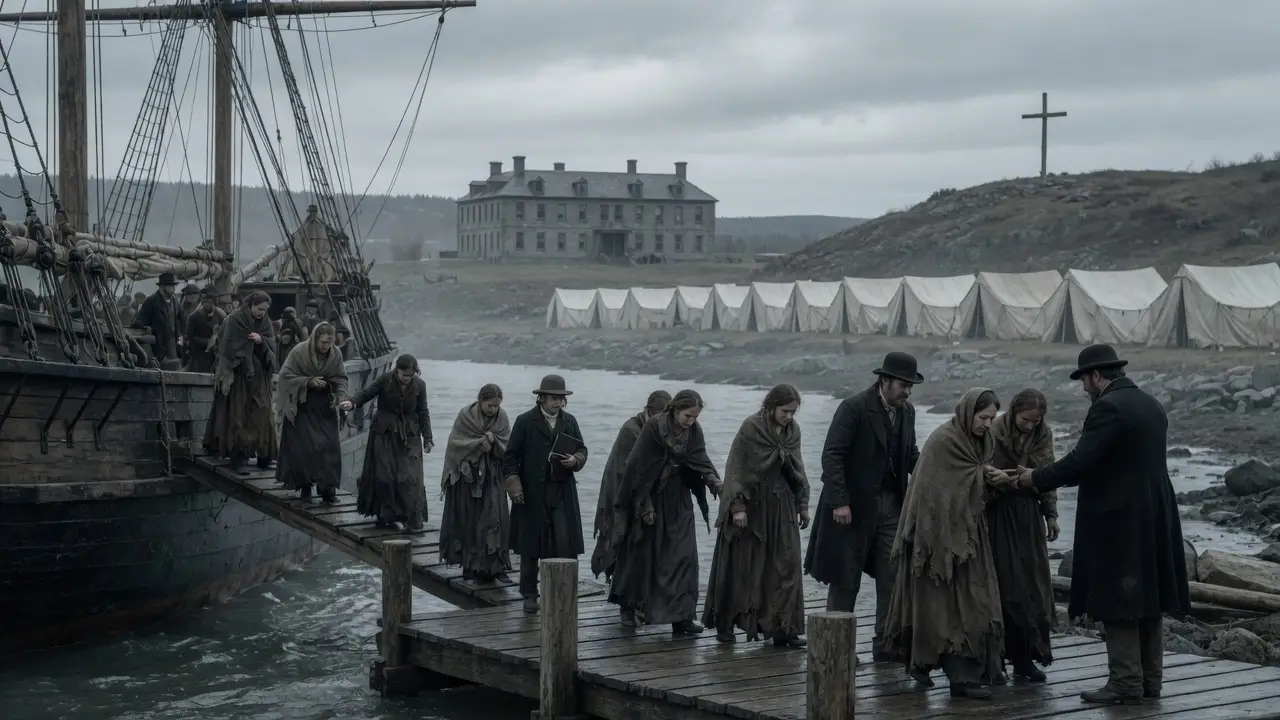
The Irish Famine was producing an exodus. People were leaving in such numbers, on such desperate ships, in such physical states that the quarantine system at Grosse Île encountered something it was not designed to manage. The ships backed up on the river, dozens of them, patients dying in the holds while they waited for space at the island’s facilities. Doctors moved from ship to ship in small boats. Priests followed in their own. The island’s hospitals overflowed. Tents went up. The tents filled.
“We came so far. We came across the ocean with nothing left. And then they put us on another island and told us to wait.”
From an Irish survivor’s account, Grosse Île, 1847
More than 5,000 people were buried on Grosse Île that year. Many of them had survived the ocean. They did not survive the waiting.
A Celtic cross was erected on the island in 1909, its inscription written in Irish, English, and French. The Irish text, composed by Dr. Robert Murray, calls the island a grave for thousands of Irish. It does not call it a quarantine station. The people who put the words there understood the difference.
New York: Islands at the Edge of Everything
New York Harbor was the entry point for generations of immigrants, and the city was not naive about what that meant for disease. Quarantine facilities operated near Staten Island for much of the nineteenth century, managing yellow fever, cholera, and smallpox arriving on ships from ports around the Atlantic world.
The presence of quarantine infrastructure on Staten Island was not welcomed by locals. In 1858, a crowd destroyed the quarantine facilities there. Fear of disease and resentment of the institution it generated had reached a breaking point. The city responded by moving operations further out into the harbor.
LESSER-KNOWN DETAILS
On Grosse Île in 1847, the ratio of doctors to patients at peak crisis was so extreme that some ships waited more than two weeks before a physician boarded to conduct an inspection. People died during the wait.
Hoffman and Swinburne Islands, artificial islands built in the Lower Bay in the 1870s, became New York’s quarantine stations for the following decades. Hoffman received the suspected cases. Swinburne held the confirmed sick. The design was deliberate: the city’s anxiety about contagion was managed, literally, at sea level, out of view of the streets and neighborhoods that produced the anxiety.
Immigrants arriving at Ellis Island and found to be ill could find themselves transferred to these facilities, their journey paused at the very last moment. Some recovered and eventually reached the mainland. Some did not.
The Woman Who Became a Precedent
Mary Mallon cooked professionally and never felt sick. She also, without knowing it, carried Salmonella typhi in her body, and the typhoid fever that followed her from household to household was traced, eventually, to her.
When New York health officials found her in 1907, they did not ask for her cooperation first. They took her to North Brother Island, a quarantine facility in the East River, and held her there against her will. She had committed no crime. She had not acted negligently by the standards of her time, because asymptomatic carriers were not yet a widely understood concept. She simply existed in a body that was dangerous to others.
She was eventually released after three years, given conditions she was required to follow, and was found later working as a cook again, using a different name. Officials returned her to North Brother Island, where she remained for the rest of her life, a total of approximately twenty-six years in quarantine.
“She was a prisoner who had never been tried for any offense.”
George Soper, sanitary engineer who first investigated Mallon’s case
The public called her Typhoid Mary. The newspapers printed cartoons of her cracking skulls into a skillet. She died in 1938, on the island, without ever having been charged with a crime or given a meaningful legal process to challenge her detention.
Her case established something important: the state could imprison a person indefinitely for what they might do to others, even if they never intended any harm and were not themselves suffering. The question of where individual rights end and public safety begins had an answer, in New York in 1907, and it was blunt.
What These Places Looked Like
Quarantine islands were not improvised. The serious ones, the Venetian lazarettos, Grosse Île, Swinburne Island, had architectures of purpose.
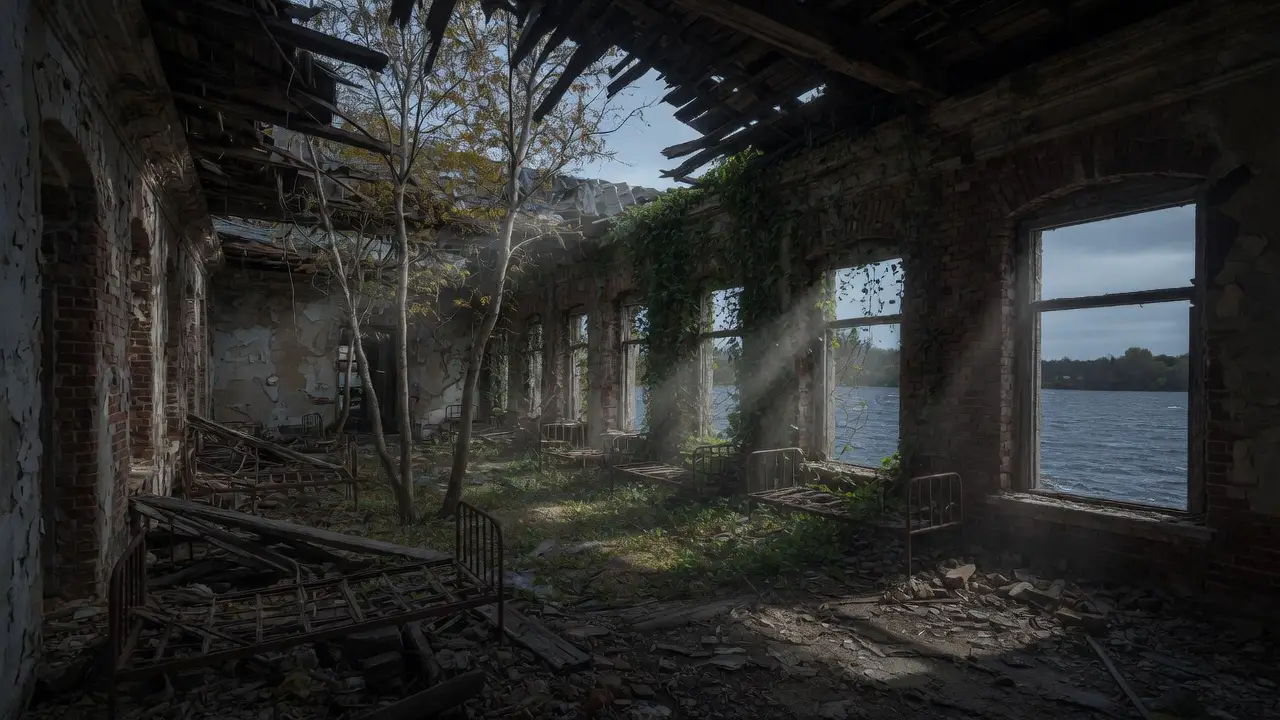
There were warehouses where cargo was stored and aired. Sleeping barracks divided by status, when there was space and organization enough to maintain it. Hospital wards with cots arranged in rows. Guard quarters near the docks, because the dock was the only point of entry or exit. Disinfection chambers where clothing was fumigated. Chapels, because people died and they wanted last rites if the priest would come. Burial grounds at the edges of the islands, away from the active facilities, unmarked in many cases, because the people buried there had arrived without records and left without witnesses.
LESSER-KNOWN DETAILS
Swinburne Island in New York was built artificially from landfill, specifically to serve as a quarantine facility. It has no other history. It was designed from scratch to hold sick people away from the city, which means it is one of the few places in the world whose entire existence was the quarantine function.
In some of the worse periods, there were mass graves. At Grosse Île, bodies were buried in long trenches during the worst weeks of 1847 when individual burial became impossible to manage.
The architecture said everything about the function. These were not healing places first. They were filtering places. Healing was secondary, even optional. The primary purpose was to ensure that whatever danger arrived from outside remained outside until the city was satisfied.
Cargo and Class
Wealthy passengers on quarantine ships had options. Private cabins, letters of recommendation, connections to officials, money to pay for better conditions on the island, physicians who could be persuaded that a patient was well enough. They might serve their quarantine in a dedicated room rather than a shared barracks. Their goods received more careful handling. The period might be interpreted generously.
Poorer passengers had none of this. They arrived in steerage, which meant they had already been living in the conditions most conducive to spreading disease before the quarantine officials boarded to inspect. They were processed in groups. Their goods were inspected cursorily or simply destroyed. They went to the shared wards.
In Venice, health officials developed careful procedures for fumigating bolts of silk and barrels of spice, understanding that these goods represented significant wealth and their destruction would be a financial loss. The procedures for handling poor migrants were less codified. The goods got the science. The people got the prayers.
Did It Work?
The uncomfortable answer is: sometimes, and it is difficult to be certain when.
Quarantine could slow the spread of disease by delaying infected individuals from reaching dense urban populations. During plague outbreaks in the fourteenth through seventeenth centuries, cities with rigorous quarantine systems experienced some epidemics at lower intensity than cities without them. Venice documented this in the records it kept, which were meticulous because the city understood that information was part of the survival system.
But quarantine was also frequently circumvented, badly administered, or applied inconsistently. Rich passengers bribed their way through it. Ships reported sick passengers overboard rather than trigger a quarantine delay. Goods were smuggled. Infected people walked through checkpoints while officials looked at documents rather than at faces.
And quarantine islands could not stop airborne transmission, could not identify asymptomatic carriers before the germ theory era, and could not account for disease already inside the city when the ship arrived. The system caught what it could catch and called that a success.
When cholera arrived in Europe in the 1830s, it moved through cities that had quarantine systems in place and killed regardless. Some historians have argued that the economic disruption caused by quarantine was more reliably measurable than the epidemiological benefit. That argument is contested, but it is not dismissed.
What is not contested: people on quarantine islands died because of the conditions on the islands. Crowding, inadequate food, poor sanitation in the early periods, proximity to the genuinely sick. The island saved some people in the city. It killed some people who would otherwise have survived.
The Language of Suspicion
Words did specific work in this system.
“Suspected” was not a medical diagnosis. It meant you had come from a place associated with disease, or your ship had been at a port where cases were reported, or an official decided you looked unwell. Suspected was enough to land you on the island.
“Unclean” carried moral weight alongside its practical meaning. The people being quarantined were not simply sick; the language positioned them as compromised, as something to be managed and contained rather than helped and trusted. This framing made the isolation easier to accept politically and harder to challenge legally.
LESSER-KNOWN DETAILS
Mary Mallon filed a legal challenge to her detention in 1909. The New York Supreme Court ruled against her. The judge’s reasoning centered on the city’s right to protect public health, with essentially no consideration of her right to liberty. The ruling was upheld on appeal.
“Carrier” arrived later in the vocabulary, after germ theory changed how disease was understood. But it brought its own cruelty, because it described a person whose danger was invisible and permanent. A carrier could never fully prove innocence. The status followed them.
The language of disease control has always been partly the language of fear management, applied to human beings, and the islands were where that language was made physical.
The Bargain the Cities Made
The quarantine island was a public health tool and a political instrument at the same time, and these two functions were never fully separable.
Cities needed their citizens to believe that something was being done. An island full of quarantined ships was visible from the shore. It was evidence of action. Officials could point to it. Newspapers could write about it. Citizens who feared plague or cholera could look out at the harbor and see that the city was not simply waiting to die.
The theater of quarantine mattered as much as its mechanics. Maybe more, in the periods when the mechanics did not work particularly well.
What was not visible from the shore was the inside of the island. The crowded wards. The rotting food. The families separated by the width of a corridor and bureaucratic categories. The graves at the edge of the ground. The merchants whose goods had been confiscated and were not going to be returned. The sailors who had done nothing wrong except take a job on a ship that stopped at the wrong port.
They were safe in the harbor, useful as a symbol, and invisible as human beings. The city looked at the ships anchored offshore and saw protection. The people on the ships looked at the city and saw a door that was not opening.
What the Islands Left Behind
Most of the lazarettos are gone. Venice’s Lazzaretto Vecchio was excavated in the early 2000s, and archaeologists found mass graves beneath the ground, the bones of plague victims from five centuries ago. Lazzaretto Nuovo still stands, and it has been partially restored as a historical site.
Grosse Île is a national historic site in Canada. You can visit it by ferry from the south shore of the St. Lawrence. The hospital buildings are still there. So are the Celtic cross and the burial grounds.
North Brother Island in New York has been closed to the public for decades. It is a bird sanctuary now. The buildings are collapsing, being absorbed slowly by the trees and vines that have grown through them since the last patients left. Mary Mallon is buried in a cemetery in the Bronx, not on the island. She was allowed off for that.
These places are not just ruins. They are the physical evidence of a calculation that every society in the grip of epidemic fear has made: how much can we ask of individuals for the sake of the collective? How much loss is acceptable if it is the loss of people who are not us, who arrived from somewhere else, who carry something we cannot see?
The cities that built these islands survived their plagues. Many of the people on the islands did not survive the islands.
That is the bargain. It was never hidden. Nobody pretended otherwise. They just made sure you had to be offshore to see the terms clearly.