Following the money behind WWI and WWII reveals a quiet class of financiers for whom national allegiance was a sentiment, not a strategy. They won either way.
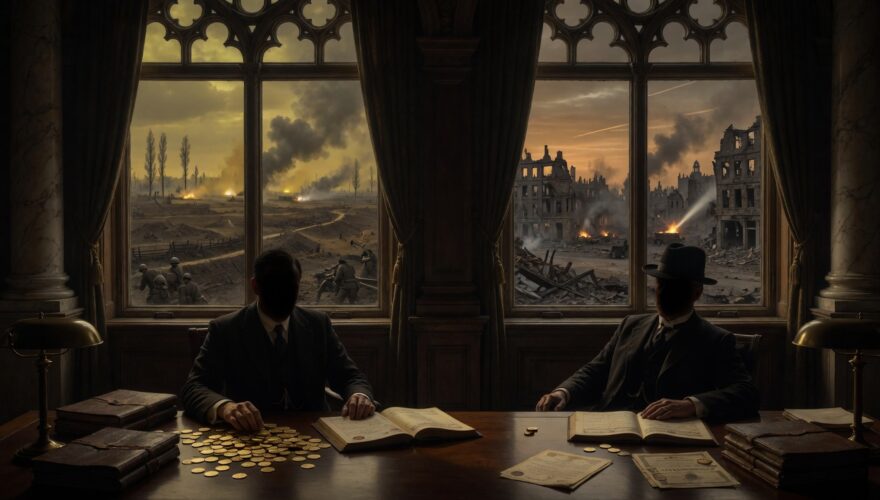
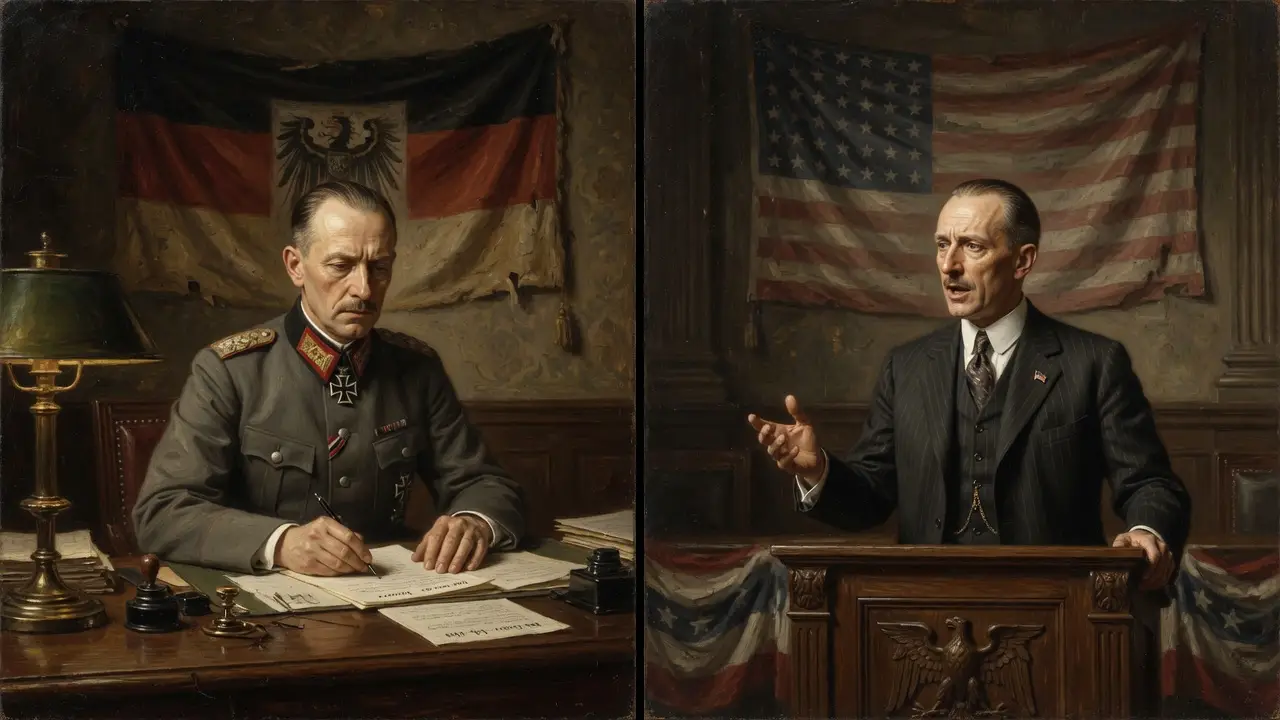
In the autumn of 1914, two brothers sat on opposite sides of a war that was consuming Europe. Paul Warburg was in New York, helping to design the United States Federal Reserve, the new spine of American finance. His brother Max was in Hamburg, serving as a senior adviser to Kaiser Wilhelm II and helping to fund the German war machine. They were not enemies. They were Warburgs. And the Warburgs, like a handful of other dynasties who moved through the gilded corridors of early twentieth-century banking, understood something the soldiers dying in the trenches did not: wars were not just fought with rifles. They were bought.
This is not a conspiracy theory. The paper trails are real, the banking records have been archived, and the congressional investigations are a matter of public history. What the evidence reveals is something stranger and more disturbing than any fiction: a world where the men financing civilization’s most catastrophic self-destructions often had more in common with each other than with the nations whose flags they nominally served.
The Warburg Paradox
The Warburg family banking house, M.M. Warburg and Co., had operated out of Hamburg since 1798. By 1914 it was one of the most influential financial institutions in the German-speaking world. Max Warburg, who ran it, was a man of enormous intelligence and social grace, a friend of the Kaiser, a confidant of statesmen. He helped Germany finance its war through bond issuance and credit arrangements that stretched deep into the neutral world.
Meanwhile, Paul Warburg, who had moved to America in 1902 after marrying into the Kuhn, Loeb banking dynasty, was the principal architect of the Federal Reserve Act of 1913. When war broke out, Paul found himself under intense scrutiny, accused by some senators of being a German spy simply for having a brother in Hamburg. He resigned from the Federal Reserve board in 1918. But neither brother had done anything illegal. They had simply been doing what their family had always done: working the financial levers of power, wherever those levers happened to be installed.
Lesser-known detailAt the Paris Peace Conference in 1919, both Max Warburg and Paul Warburg attended as representatives of their respective governments — Germany and the United States. Two brothers, from the same banking house, negotiating across a table that had cost forty million lives.
The Basel Arrangement: Business as Usual
If the Warburg paradox was a curiosity of WWI, the Bank for International Settlements took dual-allegiance banking to a level that still produces astonishment when examined closely. Founded in 1930 in Basel, Switzerland, the BIS was designed as a clearing house for international war reparations. By the time WWII began, it had evolved into something far more peculiar: a financial institution whose board of directors simultaneously included bankers from Britain, the United States, Nazi Germany, and occupied France. And it kept operating straight through the war.
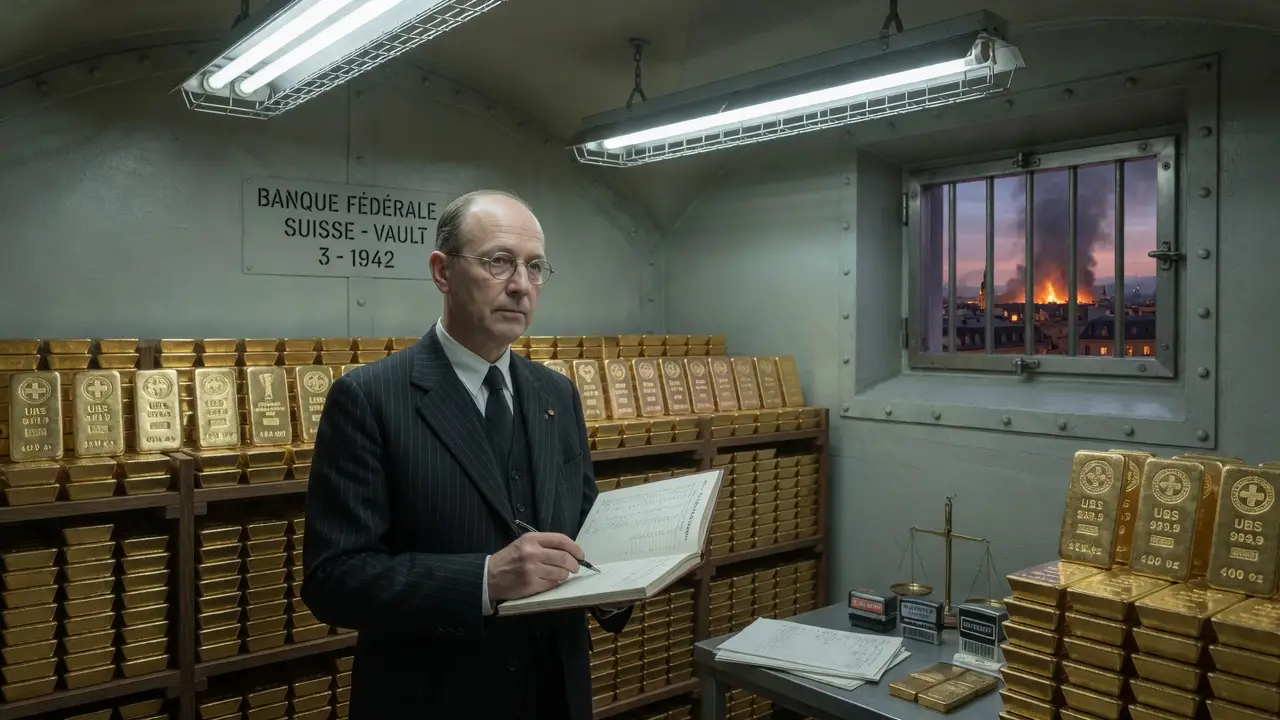
Thomas McKittrick, an American, served as president of the BIS from 1940 to 1946. He socialized with Nazi officials in Basel. He oversaw transactions that, at minimum, provided Germany with hard currency at a moment when the Wehrmacht was marching across Europe. The BIS accepted looted gold from the Nazis, gold that had been stripped from the central banks of occupied nations and, according to post-war investigations, from the victims of the death camps themselves.
“The BIS was, in essence, neutral territory for money. Flags stopped at the door. Gold did not.”
Adam LeBor, “Tower of Basel,” 2013
When U.S. Treasury official Harry Dexter White proposed abolishing the BIS at the Bretton Woods Conference in 1944, arguing it had become a vehicle for Nazi finance, the motion was passed. Then quietly buried. The BIS survived the war without serious consequence and today remains the central bank for central banks, headquartered in the same Swiss city where it once processed gold that should never have left the ground.
Join The Archive Briefing
Weekly dispatches. The history they didn't teach you — sourced, subverted, delivered to your inbox.
Prescott Bush and the Nazi Banking Connection
The name Bush carries a particular weight in American political history. Less discussed is the fact that Prescott Bush, grandfather of one president and father of another, had his assets seized by the U.S. government in 1942 under the Trading with the Enemy Act. The institution in question was the Union Banking Corporation of New York, a firm with direct financial ties to Fritz Thyssen, the German industrialist who had been among Hitler’s earliest and most important corporate backers.
Thyssen’s money had flowed into the Nazi Party throughout the late 1920s and early 1930s, at precisely the moment when Hitler was transitioning from a fringe agitator into a credible political force. Without that early financing, the machinery of the Third Reich might never have achieved ignition. Prescott Bush was not a Nazi. But he was a director of a bank that served as an American conduit for a man who absolutely was, and he continued in that role for years after the nature of the Nazi regime had become entirely clear to the world.
The government seized the assets in October 1942. The records were quietly released to Bush in 1951. He went on to become a U.S. senator from Connecticut. His son became director of the CIA. His grandson became president. The seizure itself is sometimes acknowledged in biographies. What it represented is rarely followed to its conclusion.
Standard Oil and the Fuel That Kept Fascism Moving
Armies in the twentieth century ran on petroleum. This is not a metaphor. Without fuel, tanks stopped. Planes stayed grounded. Supply chains collapsed. The Wehrmacht understood this, which is why Germany’s access to aviation fuel and synthetic oil became one of the central strategic questions of WWII.
Standard Oil of New Jersey, which later became Exxon, had entered a cartel agreement with I.G. Farben, the German chemical conglomerate, in 1929. The arrangement included a patent-sharing deal that gave I.G. Farben access to Standard’s hydrogenation technology, which allowed the conversion of coal into synthetic oil. It was precisely this technology that would allow Germany to sustain its war machine even after the Allied naval blockade cut off natural oil imports.
Standard Oil continued to supply the Germans through neutral intermediaries well into the war years. Senator Harry Truman, then heading a Senate committee investigating wartime fraud, called the arrangement “treason.” Standard’s chairman, William Farish, eventually died of a heart attack in 1942 amid the congressional pressure. The company paid a nominal fine. The patents remained in German hands throughout the war. And the fuel kept flowing.
The Ford dimensionHenry Ford received the Grand Cross of the German Eagle in 1938, the highest civilian honor Nazi Germany could award a foreigner. Hitler kept a portrait of Ford on his office wall in Munich. Ford’s anti-Semitic writings had been translated and distributed in Germany through the 1920s, and Ford’s Cologne plant continued producing vehicles, including military trucks, for the German war effort well into the conflict.
The Climax: The Nuremberg Omissions
When the Nuremberg trials convened in 1945, they were rightly celebrated as a landmark of international justice. Twenty-four senior Nazi officials faced prosecution. The architects of the Final Solution were called to account. But the trials were also, in certain careful and deliberate ways, incomplete.
The American and British lawyers who structured the prosecution had a problem. Following the financial networks back to their sources would have meant indicting firms, banks, and family names with continuing influence on the other side of the Atlantic. I.G. Farben was prosecuted at a secondary trial in 1947 and 1948, and thirteen of its directors received prison sentences. Most were out within three years. The broader financial network that had sustained German rearmament throughout the 1930s, the American banks, the British insurance houses, the Swiss clearing institutions, was never seriously examined.
John Foster Dulles, who helped negotiate the peace terms and would become Secretary of State under Eisenhower, had been a lawyer for several of those German industrial clients before the war. His brother Allen, who had run wartime intelligence operations in Switzerland and later became CIA director, had developed his own set of arrangements with German industrialists during the war years that historians are still untangling. The men who won the peace were often the same men who had quietly profited from both sides of the war. They were careful enough to ensure that the trials stopped at the door of the counting house.
Resolution: The Architecture of Impunity
What emerges from all of this is not a single conspiracy but a structural reality. The men who financed the first half of the twentieth century’s catastrophes operated in a world without the international sanctions regimes, asset-freezing mechanisms, and financial transparency laws that exist today, imperfectly, but exist. They moved money across borders through neutral countries, they maintained personal relationships that transcended national loyalty, and they believed, with a confidence born of long experience, that capital would always be permitted to survive whatever the soldiers did to each other.
In most cases, they were right. The Warburg bank survived both world wars. The BIS survived. Standard Oil became one of the largest companies in human history. The Bush family entered politics. The Dulles brothers ran American foreign policy for a decade. None of them stood in a dock at Nuremberg.
Some of these arrangements were legal under the laws of their time. Some were not. What they shared was a logic: that money is not patriotic, that capital does not mourn, and that those who control its flow are, in a very practical sense, above the conflicts that destroy everyone else.
The specific names and institutions of WWI and WWII are historical. The logic is not. Every major armed conflict of the past century has produced its own version of the same story: financial interests that span the divide, corporate arrangements that survive the bombing, banking institutions that continue processing transactions while governments collapse and populations flee.
Understanding that history’s greatest wars were not simply ideological or territorial contests but also enormous financial events, with investors on both sides hedging accordingly, does not make the suffering of those wars any less real. It makes it more complicated. And it raises a question that has never been satisfactorily answered: if the financiers knew the cost of these wars before they began, and profited from them regardless of outcome, then who, exactly, were these wars fought for?
The soldiers had nations. The bankers had accounts. Only one of those things crosses borders without a visa.