He was supposed to hang. Instead he became a legend. The real Billy the Kid, who was born Henry McCarty, orphaned at fifteen, dead at twenty-one was nothing like the movies claim. Here’s the complicated, violent, deeply human truth.
The real Billy the Kid was a drifter, a hired gun, and a pawn in New Mexico’s Lincoln County War. Here’s the story behind the myth.
The Myth Arrives First
The legend says Billy the Kid killed one man for every year of his life. Twenty-one victims. Twenty-one years. A neat, brutal symmetry that made for perfect newspaper copy and even better dime novels. It was the kind of number that stuck to a man like a brand, and America loved it.
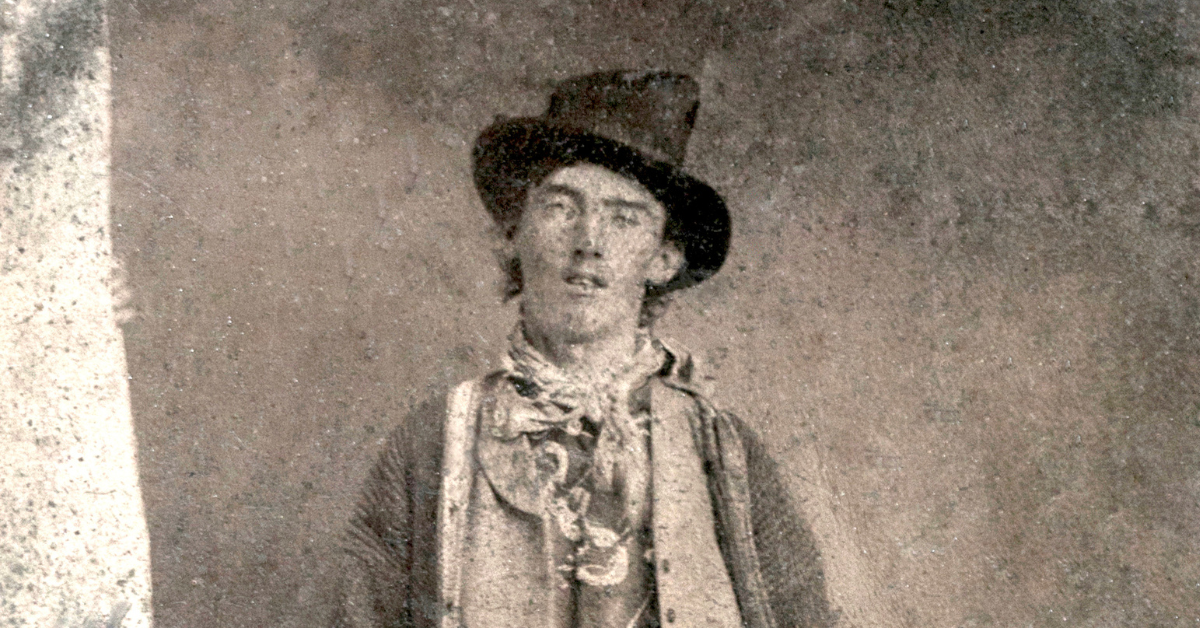
The truth was considerably less cinematic. The real figure was probably somewhere below ten. The real Billy was a skinny, buck-toothed teenager with large hands, a high laugh, and no family to speak of. He was not a criminal mastermind. He was not an unstoppable killing machine. He was an orphaned drifter who got pulled into somebody else’s war, shot his way through it, and died in a dark room in New Mexico before he was old enough to shave consistently. Then the newspapers got hold of him, and he became something else entirely.
That transformation from desperate kid to immortal outlaw, is the real story worth telling.
A Boy Named Henry
He was probably born Henry McCarty, somewhere around 1859, in a city that records are frustratingly vague about. New York is the most common guess. His father is essentially unknown, a biographical gap that shaped everything that followed.
His mother, Catherine McCarty, was the fixed point of his early world. She was tough, resourceful, and sick,tuberculosis was already working on her lungs by the time she moved the family west in search of drier air and a better situation. She married a man named William Antrim in Santa Fe in 1873, and for a while young Henry went by Henry Antrim, taking his stepfather’s name the way children do when they’re hoping a new name might mean a new life.
It didn’t. Catherine died in Silver City, New Mexico, in September 1874. Henry was fifteen, give or take. William Antrim, by all accounts, was not a man built for fatherhood under the best of circumstances, and these were not the best of circumstances. He drifted away from the boys, Henry and his older brother Joseph, without much ceremony or guilt. Henry moved into a boarding house. He was on his own.
Join The Archive Briefing
Weekly dispatches. The history they didn't teach you — sourced, subverted, delivered to your inbox.
“He was the peer of any foe… the most daring of outlaws, the most dreaded of New Mexico’s desperadoes.”
Pat Garrett, from The Authentic Life of Billy the Kid (1882)
There are boys who lose everything at fifteen and find a way through. And there are boys who lose everything at fifteen and find something else instead. Henry McCarty found the frontier, which in 1874 was not a romantic place. It was hungry, violent, and indifferent to orphans.
The First Arrest, The First Story
His early crimes were small. In September 1875 in Silver City, Henry was arrested not for murder or robbery or anything the dime novels would later invent, but for helping conceal stolen laundry, clothes taken by a local man named George Schaefer. It was a petty, stupid crime. The sheriff locked him up.
He escaped within two days. Climbed out through a chimney, by most accounts.
LESSER-KNOWN DETAIL
Multiple contemporary accounts from Fort Sumner describe Billy as a regular at local dances, well-liked by the Hispanic community there, and surprisingly graceful. He spoke Spanish fluently, which helped him move through communities that Anglo lawmen often couldn’t penetrate.
The local newspaper, the Silver City Herald, ran a small notice. It was the first time Henry McCarty’s name appeared in print in any context that might be called newsworthy. The escape was modest. The crime was minor. But the pattern was already forming: Billy’s legend was built on publicity almost from the beginning, and publicity in the frontier West had a habit of inflating whatever it touched.
He headed to Arizona. He worked as a ranch hand, gambled when he could, and drifted through the territory looking for something to attach himself to. In August 1877, at a camp in Arizona, he killed a man named Frank “Windy” Cahill, a blacksmith who had a habit of bullying the smaller, younger men around him. Cahill had thrown Henry to the ground and was sitting on him when Henry pulled a gun. The subsequent inquest ruled it “criminal.” Henry ran back to New Mexico.
He was eighteen years old and already wanted for murder. He needed work, and he needed somewhere that might not look too hard at his past.
He found both in Lincoln County.
The War Nobody Agrees On
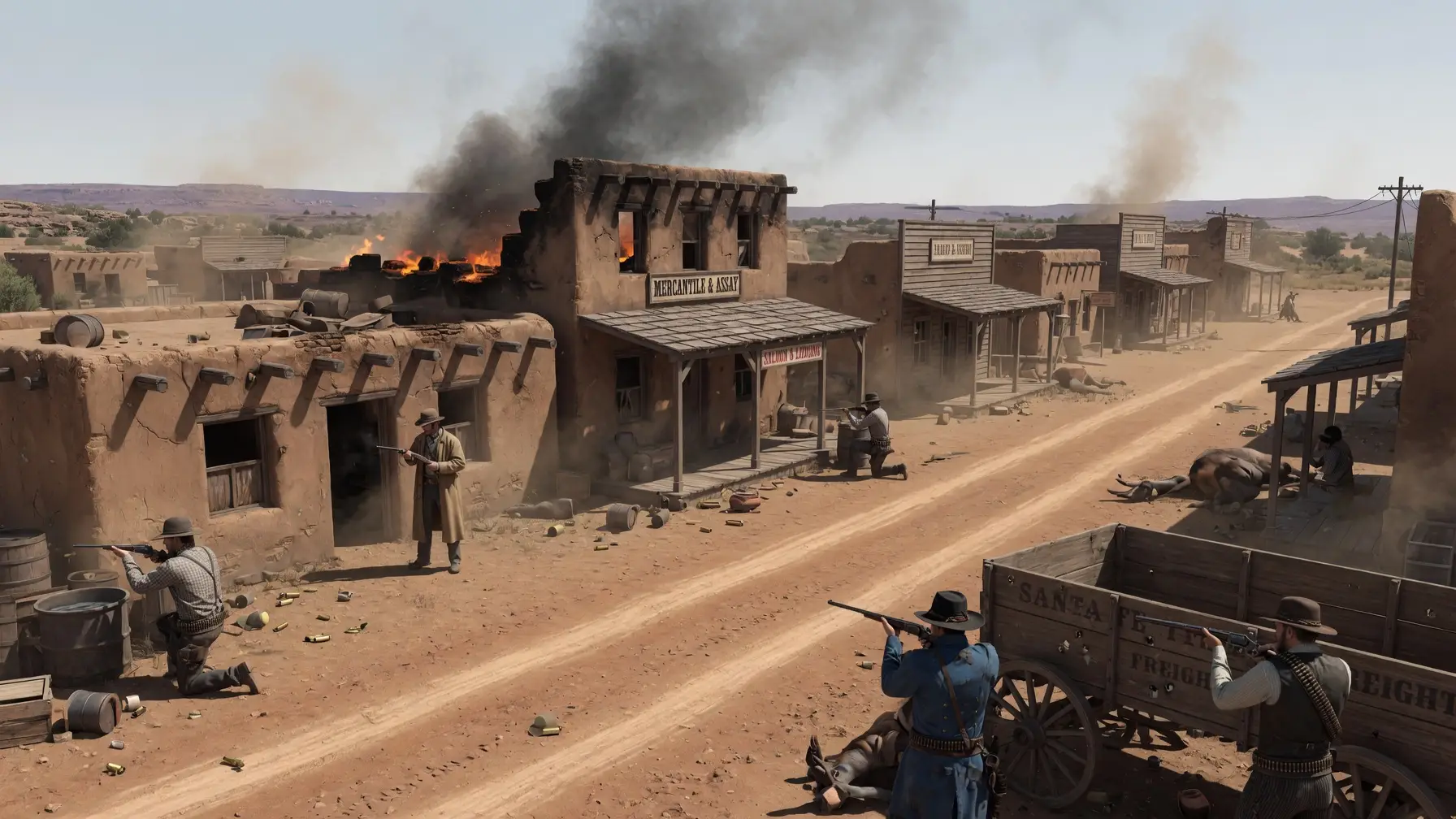
Lincoln County in 1878 was not a place. It was a condition. Stretched across a significant chunk of southeastern New Mexico Territory, it was remote enough that law was more suggestion than reality, and rich enough, in cattle, government contracts, and land, that powerful men were willing to kill for it.
The power structure was dominated by a group known as “the House,” formally the firm of L.G. Murphy and Company and later James Dolan and associates. They controlled credit, supply, and political connections in the county with the kind of suffocating monopoly that made them either very rich or very dangerous to cross, depending on which side of the ledger you were on.
A young man whom every calculation would have consigned to a desperate end.”
Lew Wallace, after meeting Billy
Into this walked John Henry Tunstall, a young English cattleman with money behind him and ambitions to break the House’s grip. He partnered with a lawyer named Alexander McSween and set up a competing store and cattle operation. The House viewed this as a declaration of war. In the frontier economy, that’s essentially what it was.
Billy, who by now had drifted into the orbit of Tunstall’s operation and was working as a ranch hand on his spread, would later describe Tunstall as the first man who had ever treated him with genuine kindness. Whether that’s entirely true or partially romanticized by time, it mattered. For a kid who had been functionally abandoned by every adult with any responsibility for him, the attachment was real.
On February 18, 1878, a posse riding under the authority of the Dolan faction caught Tunstall alone on a road outside Lincoln. They shot him off his horse and then shot his horse. Then one of them walked up and shot Tunstall again, in the head, with Tunstall’s own rifle.
The Lincoln County War had its martyr.
The Regulators
What happened next was dressed in the language of law, but it was revenge. A group of men who had worked for or supported Tunstall organized themselves into what they called the Regulators, claiming a kind of irregular legal authority to pursue Tunstall’s killers. Billy was among them, and unlike some of the older, more politically motivated men in the group, his motives were probably the simplest: he wanted to kill the men who had killed Tunstall.
They did. Over the following weeks, several of the men believed responsible for Tunstall’s murder were hunted down and shot, some while allegedly trying to escape, a frontier legal fiction that fooled no one. In April 1878, the Regulators ambushed Lincoln County Sheriff William Brady and his deputy George Hindman on the main street of Lincoln, killing both. Brady had been a Dolan ally and had signed the paperwork that enabled the posse that killed Tunstall. In Billy’s accounting, that made him legitimate prey. In the territory’s legal accounting, it made Billy a murderer.
The distinction mattered less than it might have. Law in Lincoln County was not impartial. It was owned.
“I have done everything that I promised Lew Wallace to do and he has done nothing that he promised me.”
Billy the Kid (from a surviving letter to Lew Wallace, 1881)
The violence escalated through the summer. The climax came in July 1878 during what became known as the Five-Day Battle, when a group of McSween supporters including Billy were pinned inside Alexander McSween’s house in Lincoln by a Dolan faction force backed by U.S. Army soldiers. The house was eventually set on fire. McSween was killed trying to escape. Billy, in an account that became central to his mythology, ran through the flames and gunfire and got away.
The National Park Service describes the conflict as an armed struggle that left Lincoln itself as a kind of open wound, and the territorial government recognized that something had gone badly wrong. President Rutherford Hayes removed the territorial governor and replaced him with Lew Wallace, the author who was simultaneously working on a novel called Ben-Hur while trying to impose order on a territory that had essentially dissolved into private warfare.
The Governor’s Promise
Wallace met with Billy in March 1879. The meeting is one of the stranger footnotes of the era: a future literary celebrity sitting across from a wanted teenage gunman in a candle-lit room, negotiating what amounted to a plea arrangement.
Billy offered to testify against certain figures involved in the Lincoln County violence, specifically in the murder of a lawyer named Huston Chapman. In exchange, he understood, or believed he understood, that a pardon would follow.
He testified. He waited. He wrote letters.
“It was not a war about right and wrong. It was a war about money and who would run the county.”
Susan McSween (witness to the Lincoln County War, interviewed years later)
“I have done everything that I promised Lew Wallace to do,” Billy reportedly wrote in one of the surviving letters, “and he has done nothing that he promised me.”
The pardon never came. The political will to extend mercy to a known outlaw was limited, and Wallace had other concerns. Billy eventually stopped waiting and went back to what he knew: cattle, some of which he didn’t own, a card game when he could find one, and the company of men whose futures were equally unclear.
By 1880 he was living in and around Fort Sumner, running with a loose network of rustlers and drifters. He had picked up another name by this point: William H. Bonney. Nobody has ever satisfactorily explained where it came from. He may have borrowed it, invented it, or inherited it through connections that are now untraceable. What mattered was that the newspapers, which had been printing stories about the Lincoln County chaos for two years, now had a name for their villain. Billy the Kid appeared in headlines. The legend, already growing, now had a fixed point to grow around.
The Escape That Built the Myth
Pat Garrett was elected sheriff of Lincoln County in November 1880, largely on the platform of catching Billy. He was good at his job. By December he had captured Billy and several of his associates at Stinking Springs, New Mexico, in a confrontation that killed one of Billy’s companions.
Billy was tried, convicted of the murder of Sheriff Brady, and sentenced to death by hanging. He was transported to Lincoln and held on the second floor of the old Murphy-Dolan store, which had been converted into a courthouse and jail.
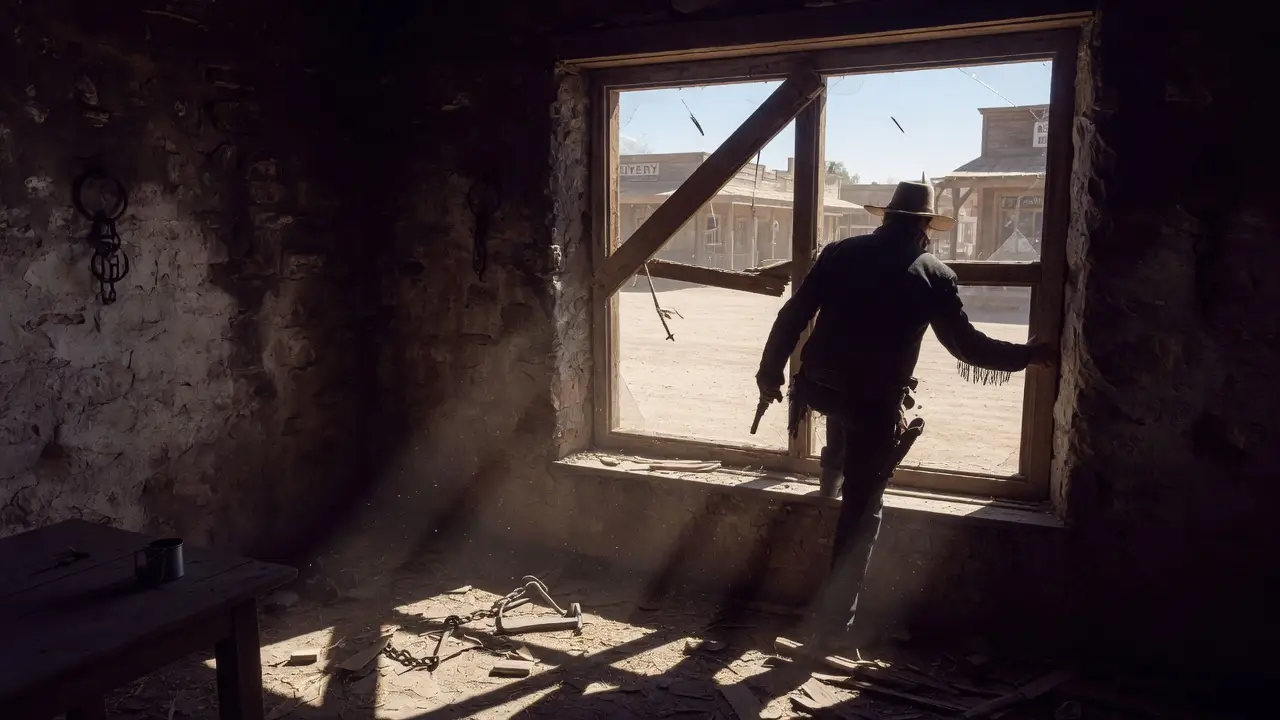
On April 28, 1881, while Garrett was out of town, Billy asked Deputy Bob Olinger’s permission to use the outhouse. The other deputy, James Bell, escorted him. Exactly what happened next is disputed, Billy may have gotten a hidden gun, or he may have gotten Bell’s gun during a struggle, but the outcome was not: Bell was shot dead on the courthouse stairs. Billy then got Olinger’s shotgun, a ten-gauge loaded with buckshot, and waited at the upstairs window.
“He was not the bloodthirsty killer he has been painted. He was young, hunted, and without friends who could really help him.”
Miguel Otero, New Mexico Governor
Olinger heard the shot and came running across the street from the hotel where he’d been eating lunch.
Billy shot him from above. Then, according to witnesses standing in the street below, he broke the shotgun over the windowsill, threw the pieces down at Olinger’s body, and said something to the effect that Olinger had been his enemy and was now a dead man.
He then called down to a man in the yard and asked him to bring an ax to cut the leg irons. It took Billy about an hour to get his shackles off, during which time he chatted with people gathering below, apparently in a fine mood. Then he rode out of Lincoln.
Every person who witnessed it told someone else. The story grew. Newspapers ran versions of it within days. It was the kind of escape that seemed almost theatrical, and in the retelling, it became more so with each iteration.
A Dark Room in Fort Sumner
Garrett tracked him through the early summer of 1881. Billy had gone back to Fort Sumner, which made a certain ruined logic: it was where his friends were, where he was comfortable, where he had relationships he didn’t want to leave behind. It was also the last place a man with any strategic sense would go if he knew a determined sheriff was looking for him.
Whether Billy knew Garrett was close is one of the questions that has never been fully settled.
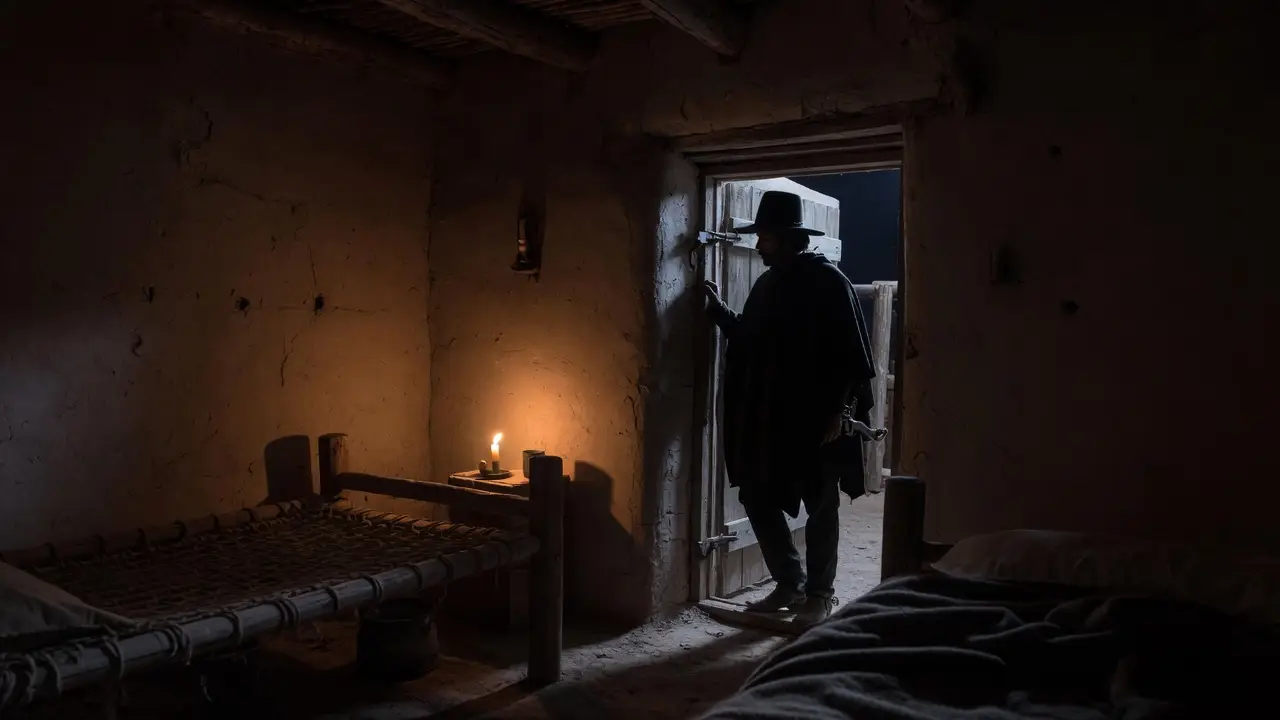
On the night of July 14, 1881, Garrett was at the house of Pete Maxwell in Fort Sumner, sitting in Maxwell’s darkened bedroom, asking questions about Billy’s whereabouts. Billy came in from outside — he had been cutting meat from a hanging carcass in the yard and came inside for something, accounts differ on what. He walked into the dark room, sensed someone there, asked “Quién es?” — who is it — and Garrett shot him twice.
The first shot hit him in the chest, just above the heart. He was dead within minutes.
He was twenty-one years old. He had been famous for less than two years.
The coroner’s jury ruled it a justifiable shooting. Garrett published a book about it the following year, with considerable embellishment, that helped fix the basic shape of the Billy the Kid story in American memory: dangerous outlaw, relentless lawman, inevitable ending.
LESSER-KNOWN DETAIL
John Tunstall wrote home to his parents in England about Billy, describing him as one of the best workers on the ranch. Those letters survive. They give the relationship between Tunstall and Billy a documentary weight that movies have generally ignored.
What the book couldn’t quite account for was the darkness of the room, the uncertainty of that moment, the rumor that circulated almost immediately that Garrett had shot the wrong man, that Billy had escaped again, that he was alive somewhere in Mexico, in Texas, in old age under another name. The myth was hungry and it fed on uncertainty.
The Machine That Made the Monster
Billy had barely been in the ground before the manufacturing began.
Dime novels who were cheap, sensationalist fiction that was the mass entertainment of the era, turned him into a superhuman. The Authentic Life of Billy the Kid, published under Garrett’s name in 1882 but likely ghostwritten in significant part, established a narrative template that was more useful to publishers than to history. The kill count was inflated. The escapes became more impossible. The personality, which by all surviving accounts was actually charming, funny, and occasionally disarming, was flattened into something purely menacing.
Then came the movies. Then came television. Then came the tourist industry, which discovered that Lincoln County and Fort Sumner and the name “Billy the Kid” were worth more as attraction than as history. The gravesite at Fort Sumner has been vandalized, relocated, and protected by iron cages at different points in its history, because people kept stealing the headstone.
New Mexico and Arizona both claim him. Counties dispute him. Men have come forward in recent decades claiming to be Billy the Kid grown old, including a man from Texas named Brushy Bill Roberts who presented his case to a New Mexico governor in 1950 and was denied. DNA testing has been proposed and contested for decades.
The point is not whether any of these claims are true. The point is that America built a legend so durable that it generates these arguments more than 140 years later. Billy the Kid was a teenage orphan caught in a corrupt local conflict who died in the dark at twenty-one. He was not the hero of movies. He was not the monster of dime novels. He was something the myth machine couldn’t tolerate: complicated, young, and ultimately human.
The legend needed him to be more than that. So it made him more. It’s still making him more, and probably always will.