Francesco de’ Pazzi threw his arm around Giuliano de’ Medici’s shoulder as they walked toward the cathedral together, laughing, teasing his old acquaintance about the illness that had kept him housebound for days. It looked like affection. It was actually a pat-down. Francesco’s arm wasn’t checking on his friend’s health. It was feeling for the hard edge of armor plating under the fine wool doublet. He found nothing. Giuliano de’ Medici had come to Easter Mass unarmed, unguarded, and roughly twenty minutes from death.
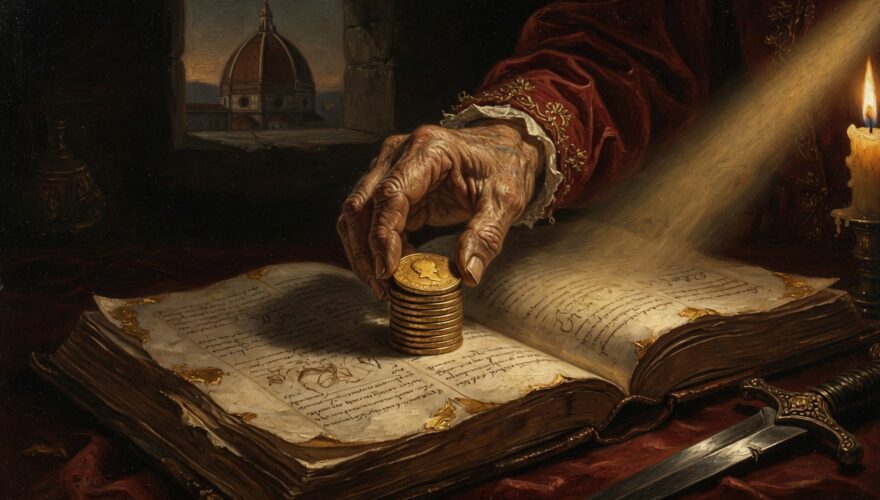
Inside Florence’s cathedral, beneath Brunelleschi’s dome, the brothers who ran the most powerful family in the city took their places for High Mass like they had a hundred times before. Nobody in the congregation could have guessed this Sunday was different. Two of Florence’s oldest banking dynasties hated each other. A pope in Rome wanted the Medici gone. And hidden under the robes of men standing calmly among the worshippers were knives meant for both brothers’ throats.
What happened in the next few minutes would leave a Medici dead on his own cathedral floor, drag Florence into open war with the papacy, and rip the curtain back on the financial machine that had quietly built the most celebrated cultural explosion in European history. To understand how a family ended up fighting for its life inside a church, you have to go back almost a century, to a wool merchant’s son and an uncomfortable problem he had with his new career. According to the Catholic Church, what he did for a living was a one-way ticket to hell.
A Sin With Excellent Returns
In 1397, Giovanni di Bicci de’ Medici broke away from his family’s existing banking business in Rome and opened his own shop in Florence. It looked like an unremarkable career move. It wasn’t. Medieval theology treated lending money at interest as usury, and usury was a mortal sin, full stop. Canon lawyers had a tidy phrase for it: Quidquid sorti accedit, usura est. Whatever exceeds the principal is usury. Preachers told their congregations that unrepentant bankers went to hell with their moneybags still hanging around their necks.
Giovanni’s genius, inherited by three generations of Medici after him, was finding a technically legal path around a rule his richest customers desperately wanted broken. The instrument was the bill of exchange. Lend florins in Florence, collect pounds in London, and let the currency conversion quietly swallow what was, in every practical sense, interest. No usury on paper. Plenty of profit in the ledger. When a client was too important to risk even the appearance of a loan, the bank found other doors, like overcharging the pope for silk, jewels, and brocade instead of simply billing him in cash.
LESSER-KNOWN DETAIL
A coded letter sitting unread in a noble family’s private archive wasn’t decrypted until 2004. It revealed that Federico da Montefeltro, the Duke of Urbino, was far more directly involved in planning the conspiracy than historians had assumed for five centuries. The plot is still being pieced together in this decade, not just the Renaissance.
That detail matters, because the Medici’s best client, the one who turned a modest Florentine bank into the most powerful financial house in Europe, was the Catholic Church itself. The same institution that damned usurers to hell needed somebody to move its gold, collect its taxes, and manage its accounts across a fractured continent. The Medici got the job, and the pope’s ledgers became the foundation stone of a dynasty that would go on to bankroll Botticelli, Michelangelo, and the golden decades of the Florentine Renaissance.
The Man Who Bought a City Without a Throne
Giovanni’s son Cosimo inherited the bank in 1429 and turned financial muscle into something far more dangerous: political control. Florence was, on paper, a republic proud of its elected councils and its suspicion of tyrants. Cosimo never wore a crown or claimed a hereditary title, and he rarely held office himself. He didn’t need to. He decided who received loans, who got elected, and who got crushed under Florence’s brutal new wealth tax, the catasto, which he aimed at rival families with surgical precision.
It worked almost too well. In 1433 the rival Albizzi faction had Cosimo arrested and exiled. It should have finished him. A year later, Florence’s political winds shifted, and Cosimo came home to a hero’s welcome, more powerful than before. Machiavelli later observed that almost nobody of consequence in Florence had escaped receiving Cosimo’s money at one point or another, a debt of gratitude worth more than any private army.
Pope Pius II, who watched Cosimo operate at close range, put it more bluntly than any Florentine dared to.
Join The Archive Briefing
Weekly dispatches. The history they didn't teach you — sourced, subverted, delivered to your inbox.
Political questions are settled in his house. He it is who decides peace and war. He is king in all but name.
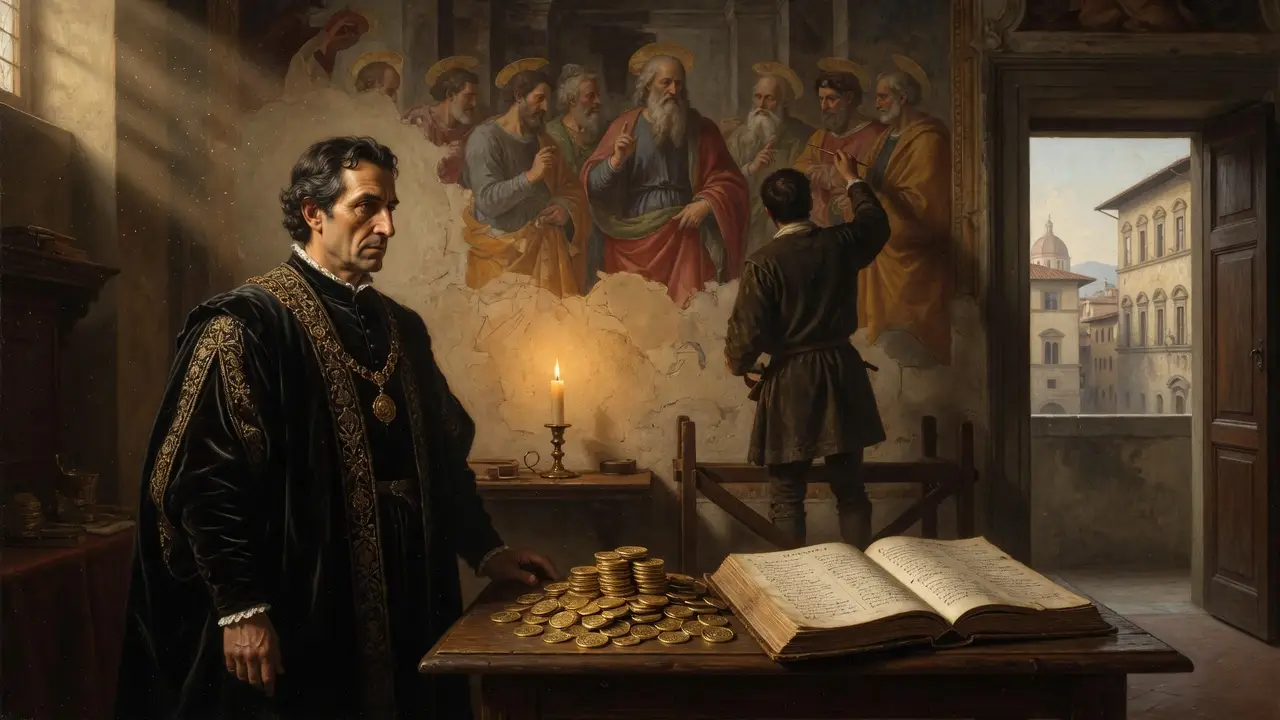
A king in all but name still needs a story people will believe, and this is where the art comes in. Cosimo poured staggering sums into rebuilding churches, funding monasteries, and commissioning work from Donatello and Fra Angelico. He was unusually candid about his motives when he wasn’t performing for an audience.
They are not only for the honor of God, but are likewise for my own remembrance.
Redemption and branding, purchased in a single transaction. Every fresco doubled as a receipt for absolution. Every altarpiece was proof that a fortune built on a sin the Church itself condemned was now serving God, the city, and the family name all at once.
The family’s leverage over the papacy deepened further in the early 1460s, after a prospector named Giovanni da Castro found massive deposits of alum in the hills of Tolfa, north of Rome. Alum wasn’t glamorous. It was a mineral needed to fix dye into wool, and Europe’s entire textile industry depended on it. Before Tolfa, most of the supply came from Ottoman territory, meaning Christian Europe was paying its enemies to keep its clothing colorfast.
LESSER-KNOWN DETAIL
Botticelli, one of the family’s own star painters, was paid to depict the hanged conspirators on the walls of a government building as a form of public shaming, a Renaissance tradition called pittura infamante. He also painted a quiet memorial portrait of the murdered Giuliano, coded with a half-open window and a mourning dove, both recognized symbols of death.
Da Castro reportedly wrote to Pope Pius II in triumph, claiming he’d found alum deposits nigh sufficient for seven worlds. The pope handed the Medici exclusive rights to sell it across Europe. Now the family didn’t just bank the pope’s money. It controlled a resource the continent’s wool trade couldn’t function without, with Rome’s blessing and a cut flowing straight back to the Vatican treasury.
A Debt the Medici Refused to Pay
By 1469, leadership had passed to Cosimo’s grandson Lorenzo, twenty years old and ruling jointly with his younger brother Giuliano. History would remember Lorenzo as “Il Magnifico” for the brilliance of his court. Lorenzo himself, writing privately in his diary, put it in far blunter terms:
One cannot live in wealth in Florence without the state.
Money and government, in his own words, were the same thing. That belief nearly got him killed.
The Pazzi were everything the Medici weren’t: an older, more aristocratic banking family, wealthy in their own right, and increasingly furious at watching a family of upstart wool traders run the city and the papacy’s finances. The breaking point arrived over a small town called Imola. Pope Sixtus IV wanted to buy it for his nephew, Girolamo Riario, and expected the Medici bank to finance the deal. Lorenzo refused, unwilling to help the pope expand territory that could someday threaten Florence’s own borders. Sixtus didn’t forgive the insult. He pulled the papal account from the Medici and handed it to the Pazzi instead, along with his favor, and eventually, something considerably darker than his favor.
A personal grudge sharpened the financial one. Lorenzo had blocked Sixtus’s preferred candidate from becoming Archbishop of Florence, forcing the pope to settle for giving the man the lesser post of Pisa instead. That sidelined cleric, Francesco Salviati, would become one of the plot’s ringleaders. By the summer of 1477, Riario, Salviati, and Francesco de’ Pazzi were meeting in Rome to plan the murder of both Medici brothers. When they asked the pope for his blessing, Sixtus gave an answer historians still argue over. He wanted the Medici removed from power, he said, but he didn’t want blood spilled to achieve it. Then he offered them the full resources of the papacy to help them succeed anyway.
LESSER-KNOWN DETAIL
The origin of the Medici coat of arms, the red balls that Florentines were chanting in the streets that Easter morning, is still genuinely disputed by historians. Theories include Byzantine coins, apothecary pills (medici being Italian for doctors), and a pawnbroker’s trade sign. Nobody has ever settled it for certain.
The plot nearly fell apart before it began. The mercenary captain originally hired to kill Lorenzo, a professional soldier named Giovan Battista da Montesecco, walked away when he learned the killing was meant to happen inside a church. Murder in the street was one thing. Murder during Mass, even to a man who killed for a living, felt like a line he wouldn’t cross. The conspirators simply found men with fewer scruples: two priests, apparently untroubled by the setting, agreed to finish what the soldier wouldn’t start.
Twenty Minutes to Die
The conspirators had hoped to catch both brothers together somewhere private, away from witnesses. Giuliano’s illness kept ruining the plan. They rescheduled around his sickbed more than once, until they simply ran out of patience. On the morning of April 26, 1478, Francesco de’ Pazzi and Bernardo Bandini Baroncelli walked to the Medici palace themselves and coaxed Giuliano out of bed, insisting he couldn’t miss High Mass. Francesco slung a friendly arm around him on the walk over, checking, unnoticed, for the armor Giuliano wasn’t wearing.
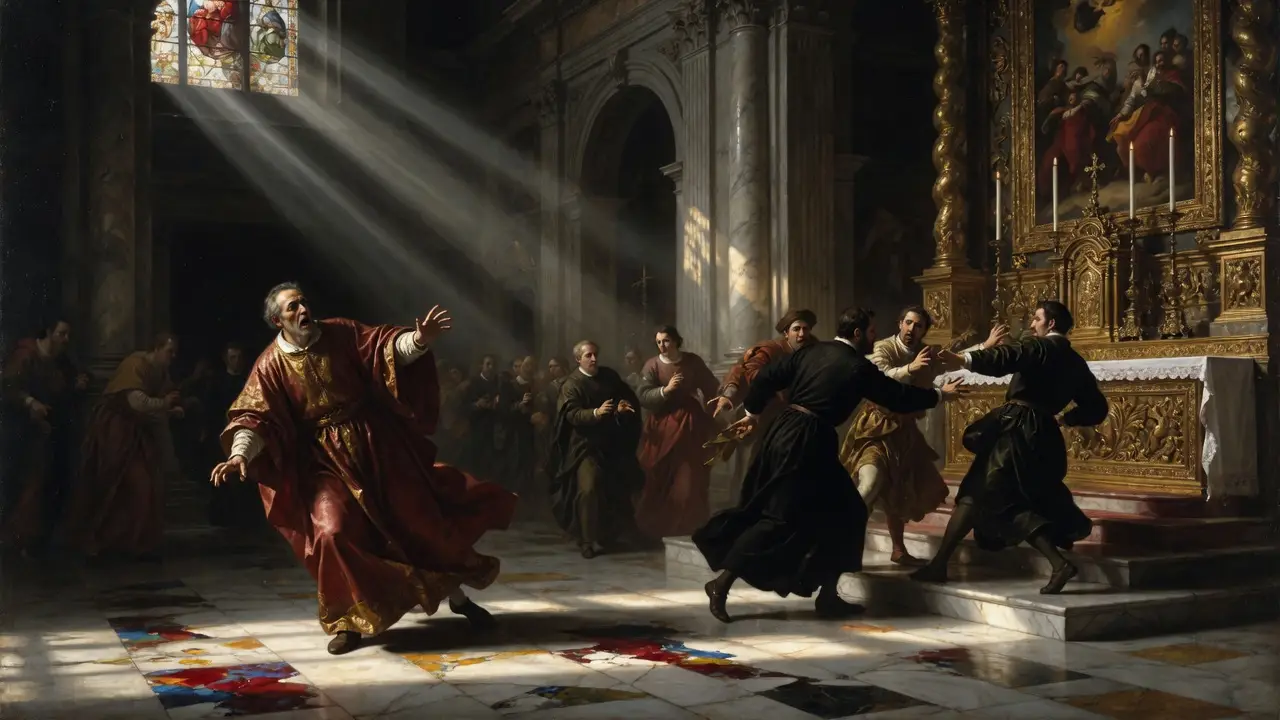
Inside the cathedral, the brothers took their places apart from each other, Lorenzo near the choir screen, Giuliano drifting closer to the high altar. At the moment the priest raised the host and a small bell rang out across the nave, the signal came due. Bandini spun and drove his dagger into Giuliano’s chest. Francesco de’ Pazzi followed, stabbing so wildly in his frenzy that he sliced open his own thigh. By the time the two men stopped, Giuliano de’ Medici had nineteen wounds in his body and was dying on the marble floor his own family had helped pay to lay.
A few feet away, the two priests lunged at Lorenzo. One managed only to graze his neck before Lorenzo’s friends, including the scholar Angelo Poliziano and a banker named Francesco Nori, closed ranks around him. Nori died holding off the attackers. The rest dragged Lorenzo into the sacristy and bolted the heavy bronze doors, and someone, fearing the blade had been poisoned, pressed his mouth to the wound on Lorenzo’s neck and sucked the blood out before spitting it onto the floor.
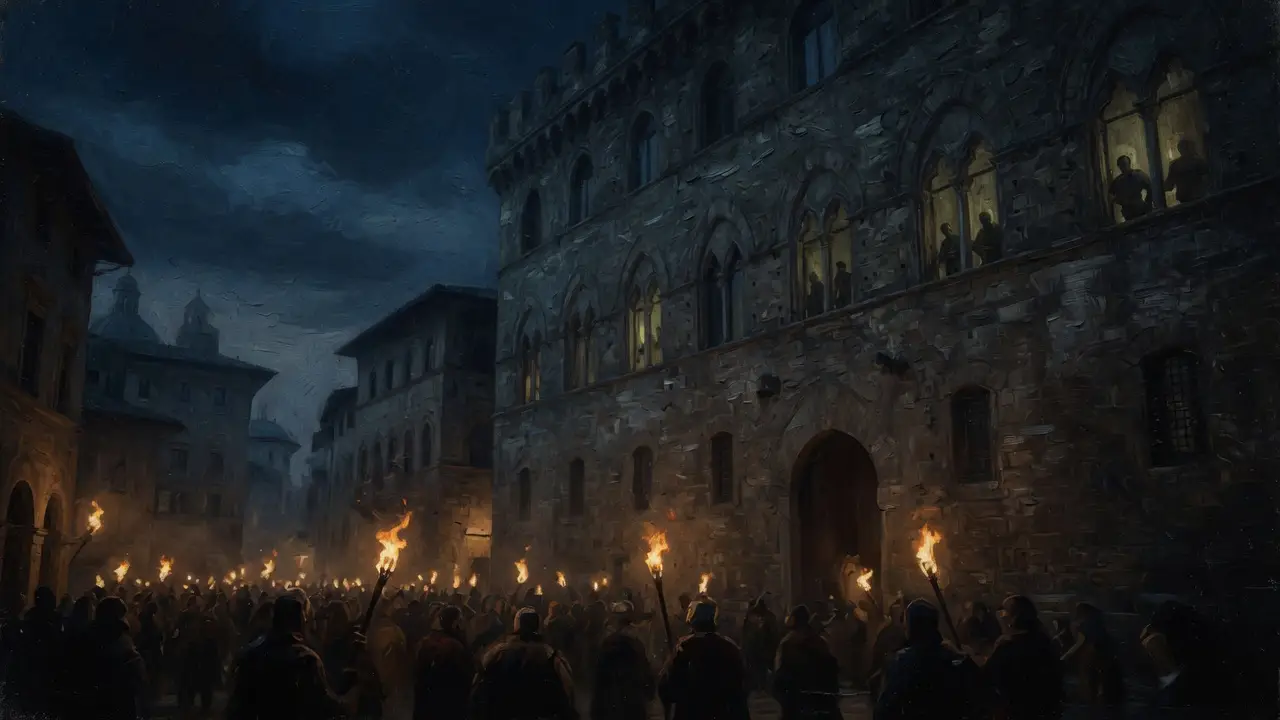
Across the city, at almost the same moment, Archbishop Salviati led armed men into the Palazzo della Signoria, the seat of Florence’s government, intending to seize control while the Medici brothers died in the cathedral. The city’s chief magistrate, Cesare Petrucci, grew suspicious fast enough to trap Salviati’s men inside a chancery room and raise the alarm. Outside, Jacopo de’ Pazzi, the elderly head of the family, rode through the streets with armed followers, shouting for the crowd to rise up.
Popolo e libertà!
People and liberty. Florence answered with silence, then with a different chant entirely.
Palle, palle!
The word for the balls on the Medici coat of arms. The city that was supposed to rise against its rulers had chosen a side, and it wasn’t the Pazzi’s.
Florence Answers in Blood
What followed was less a trial than an execution spree. Archbishop Salviati and Francesco de’ Pazzi were hanged that same afternoon from the windows of the Palazzo della Signoria. Jacopo de’ Pazzi tried to flee into the mountains and was dragged back to the city, tortured, and killed days later. Even that wasn’t the end of it. His body was dug up from its grave, hauled through the streets, and propped against the door of his own family’s palace, where it was used as a grim doorknocker before being thrown into the Arno. Children fished it out, whipped it, and threw it back in.
Between the day of the attack and that October, roughly eighty people were executed for their part in the plot or their suspected sympathy for it. Bernardo Bandini Baroncelli escaped the initial bloodbath entirely, fleeing across the Mediterranean to Constantinople. It didn’t save him. Florence had trade relationships with the Ottoman court, and at Lorenzo’s request the sultan had Bandini arrested and shipped home in chains.
He was hanged in Florence on December 29, 1479, still wearing the Turkish robes he’d been captured in. A young, still largely unknown painter named Leonardo da Vinci sketched the body swinging from the window and jotted a description of the dead man’s outfit beside the drawing, right down to the fur lining on his coat, evidence of the same obsessive eye for detail he would later turn on faces, machines, and anatomy.
Lorenzo made sure to save one life in the middle of all the killing. Cardinal Raffaele Riario, the pope’s other nephew, had been present in the cathedral and was almost certainly an unwitting pawn of the conspiracy rather than a willing participant. Lorenzo had him protected rather than torn apart by the mob, a small act of calculated mercy that did his reputation across Italy no harm at all.
A Pope’s Revenge and a Banker’s Gamble
Sixtus IV did not take the slaughter of his allies quietly. On the first of June, 1478, he excommunicated Lorenzo, his supporters, and the entire sitting government of Florence. Three weeks later he placed the whole city under interdict, banning Mass and communion across Florentine territory, an extraordinary spiritual punishment that isolated Florence from the rest of Catholic Europe. By summer, troops from Naples and Urbino were attacking Florentine land, and what had started as a botched assassination had become a real war.
LESSER-KNOWN DETAIL
When Florence arranged Bernardo Bandini Baroncelli’s extradition from Constantinople, the surviving correspondence specifically thanks the Ottoman sultan for his cooperation, a reminder that Christian Florence and the Muslim Ottoman court had a warm, functioning trade relationship in the middle of an era we tend to remember as pure religious conflict.
Lorenzo’s answer was audacious even by his own standards. In the winter of 1479, he sailed to Naples alone, effectively surrendering himself into the hands of King Ferrante, the very monarch whose army was invading his territory. It was a staggering gamble. It worked. Ferrante was won over, the Neapolitan threat evaporated, and within roughly two years the war that had nearly toppled Florence was over. Lorenzo came home not as a man who had barely survived a knife attack in his own cathedral, but as the cunning statesman who had personally talked a king out of destroying his city. The nickname “Il Magnifico” stuck for good after that.
What the Frescoes Don’t Tell You
Here’s the part the golden light of the Uffizi doesn’t advertise. The bank that survived a coup attempt did not survive its own arithmetic. Lorenzo was, by his own family’s later admission, a mediocre banker, more interested in poetry, diplomacy, and spectacle than in the tedious business of managing risk across a dozen European branches. Bad loans to foreign monarchs who never paid them back drained the bank for decades.
When the shortfalls became impossible to hide, Lorenzo started raiding public money to plug the gap, including funds from the Monte delle doti, a state-run dowry fund that ordinary Florentine families depended on to marry off their daughters. The family that had spent a century laundering its fortune into moral respectability was, by the end, quietly stealing from the same city it claimed to be protecting.
By 1494, two years after Lorenzo’s death, his son Piero surrendered Florence to an invading French army without a real fight, earning himself the nickname “the Unfortunate.” A mob sacked the Medici palace, the bank collapsed for good, and most of its financial records were destroyed in the chaos, which is part of why historians still argue over exactly how deep the damage went.
Money alone didn’t keep the family relevant after that. Bloodline did. Giulio, the illegitimate son Giuliano had left behind after his murder in the cathedral, grew up inside the Medici household and eventually became Pope Clement VII, the same office his father’s killers had once conspired with. Lorenzo’s own son Giovanni became Pope Leo X. A granddaughter, Catherine de’ Medici, married into the French royal family in 1533 and became one of the most powerful queens in European history.
A dynasty that started with a wool merchant’s son doing math the Church called sinful ended up with popes wearing its name and queens carrying its blood, all of it seeded by a fortune the family spent generations trying to make look clean.
None of this is ancient history dressed up in new clothes. Every time a fortune quietly buys political access, launders its reputation through museums and universities, or gets treated as too important to the system to fail, it’s running a version of the same playbook the Medici perfected six hundred years ago. The tools have changed. Bills of exchange became derivatives. Church indulgences became tax write-offs. The instinct underneath it, turning money into power and power into a legacy nobody wants to look at too closely, hasn’t changed at all.
Every dome, every altarpiece, every gilded Madonna that tourists photograph in Florence today was bought with a fortune the Church once called a sin, defended with knives inside a cathedral, and eventually funded in part with money that wasn’t the family’s to spend. The Renaissance had a price tag. The Medici just made sure their name was the only one on the receipt.