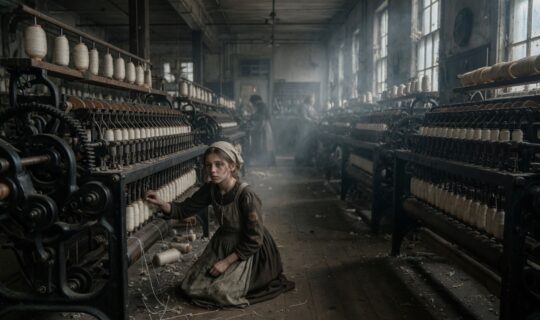
Behind the language of rescue, charity, and opportunity lay one of history’s most systematic abuses: children with no power, no money, and often no dead parents, handed to farms, factories, and households across Britain, Canada, Australia, and America as a near-free labor supply. The full, disturbing story of the Home Children, the Orphan Trains, and the institutions that turned poverty into profit.
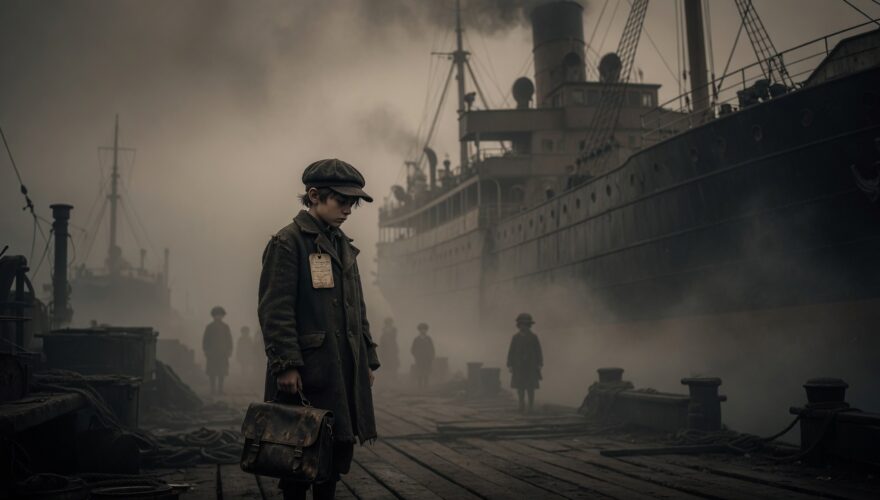
A child of eight, maybe nine, stands on a dock in Liverpool in the winter of 1912. He has a tag pinned to his coat with his name written on it, the way you might label luggage. He does not know where Canada is. He has been told it is better. He has been told he will have a family. He has been told this is a rescue.
He is one of more than 100,000 children who crossed the Atlantic between 1869 and 1948 as part of the British Home Children movement. Many of them would spend the next decade waking before dawn on farms they did not own, in provinces they had never heard of, doing work that grown men were paid to do. Some were beaten. Some ran away. Most simply disappeared into the silence that systems create around inconvenient truths.
They were not rescued. They were redistributed.
- 1 The Language of Salvation
- 2 Not All Orphans Were Orphans
- 3 Canada Needed Hands, Not Just Children
- 4 Australia and the Architecture of Empire
- 5 The Orphan Trains of America
- 6 Girls, Kitchens, and the Other Labor
- 7 The Workhouse Connection
- 8 After Placement, Silence
- 9 What the Records Left Behind
- 10 The Quiet Accounting
The Language of Salvation
To understand how this happened, you have to understand the vocabulary used to justify it. The word “rescue” did enormous work in the nineteenth and early twentieth centuries. So did “training,” “placement,” “apprenticeship,” and “opportunity.” These words allowed governments, charities, and religious institutions to describe child labor pipelines in the same breath as moral duty.
British philanthropist Annie Macpherson, one of the earliest architects of the Home Children scheme, wrote in 1870: “We who labor here are tired of relieving misery from hand to mouth, and we now propose to take these children and transplant them to a land where work is plentiful and food sufficient.” She believed it. So did many who came after her. That is partly what made it so effective, and so difficult to challenge. The cruelty was wrapped in genuine conviction.
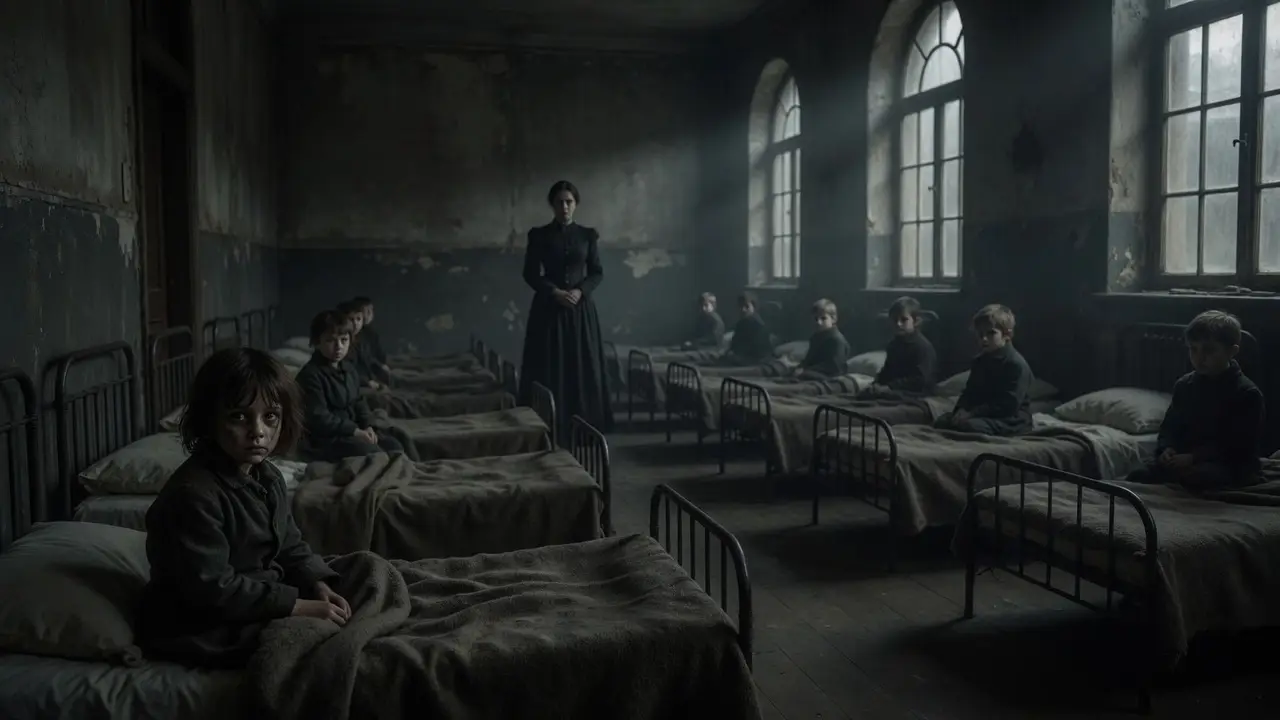
Institutions across Britain, the United States, Canada, and Australia advertised themselves as moral enterprises. They promised food, discipline, scripture, and a future. Photographs showed clean dormitories, smiling matrons, children learning to read. What the photographs did not show was the contract waiting at the end of the journey: work, unpaid or near-unpaid, for a stranger, in a country you had never chosen.
Not All Orphans Were Orphans
Many of the children fed into these systems were not orphans at all. They had mothers. Some had fathers. What they had lost was not family, but the economic conditions that make family survival possible. Poverty, illness, illegitimacy, widowhood, seasonal unemployment, a father’s death in a factory accident or a war, these were the real engines of the system. Institutions stepped in not because children were abandoned, but because families had cracked under pressure that no individual family could withstand alone.
Poor Law officials in Britain had wide authority to remove children from homes deemed unfit, which often meant homes that were simply poor. A mother working seventy hours a week in a laundry could be judged incapable of providing adequate supervision. Her child could be taken. That child could then be shipped to Canada as an orphan, listed in the records as “abandoned,” while his mother spent years writing letters to addresses she was never given.
Join The Archive Briefing
Weekly dispatches. The history they didn't teach you — sourced, subverted, delivered to your inbox.
“The child placed in a good Christian home in the West is more fortunate than the child left to the streets of New York.”
Charles Loring Brace, founder of the Children’s Aid Society, 1872
The empire did not only use children without families. In many cases, it manufactured the separation.
There is a letter that survives from a Scottish woman named Janet Williamson, written sometime in the 1900s, addressed to a child welfare authority: “I did not give up my son. I was told he would be cared for while I was ill. When I recovered, I was told he had sailed.” The letter received no reply, or none that has survived.
Canada Needed Hands, Not Just Children
The flow of British Home Children to Canada ran across nearly eight decades, and it was not consistent. It accelerated during specific moments of economic need on the Canadian side. After World War I, when thousands of young Canadian farm workers had died in the trenches or come home broken, rural labor shortages became severe. The stream of child migrants resumed in the early 1920s.
A British parliamentary inquiry later acknowledged what Canadian farmers had known for years: these children were valuable because they were cheap. The report noted plainly that many child migrants were destined for menial occupations and represented “very cheap or free labour.” This was not a side effect. It was a feature.
LESSER-KNOWN DETAILS
Some children sent to Canada on the Home Children scheme were given false surnames to prevent their biological families from ever locating them. This was not accidental. It was, in at least some cases, deliberate policy.
Children placed with farm families rarely had enforceable contracts. They had guardians, not employers. Guardians did not have to pay wages. They had to provide room, board, and some form of education, terms that were loosely defined and rarely inspected. A twelve-year-old boy who rose at five to milk cows, feed livestock, mend fences, and haul grain had no union, no ombudsman, and no way to leave. If he complained, he was ungrateful. If he ran, he was a criminal.
Dr. Barnardo’s Homes, one of the largest operators in the movement, processed tens of thousands of children through its system. Thomas Barnardo himself described the children in his care as “the dangerous classes,” a phrase that reveals as much about his worldview as it does about the children. The dangerous classes needed to be made useful. Usefulness required discipline. Discipline required labor.
Australia and the Architecture of Empire
Australia offers a parallel story with its own particular darkness. From approximately 1912 through the late 1960s, roughly 7,000 child migrants were sent to Australian institutions. The stated rationale shifted over time. Before the Second World War, it was about relieving overcrowded British welfare institutions and training children in farm and domestic skills. After the war, the language changed. Now it was about “Empire settlement,” bolstering Australia’s British-born population against the perceived threat of demographic decline.
Children were sent to institutions run by religious organizations, some Catholic, some Protestant, many in remote areas of Western Australia. What they found was not the schoolrooms and green pastures shown in the promotional literature. They found hard physical labor, poor food, inadequate schooling, and in some institutions, systematic abuse.
“These boys are worth more here than they are in the old country. A good boy is as good as a hired man on the farm.”
Canadian farmer quoted in an 1890s Barnardo’s inspection report
The Child Migrants Trust, which began investigating these cases in the 1980s and 1990s, documented testimony from hundreds of former child migrants. One recurring theme: many of these children were told their parents were dead. Some were told no one wanted them. This was a lie, told to children, to prevent them from ever looking back.
In 2010, Australian Prime Minister Kevin Rudd issued a formal apology to child migrants and their families. He said the children had been “innocent victims” of a scheme that “robbed them of their childhoods.” British Prime Minister Gordon Brown offered a similar apology the same year. Both apologies came roughly half a century after the last children were sent.
The Orphan Trains of America
The American version of this story lacks the colonial framework but not the underlying logic. Between 1854 and 1929, an estimated 200,000 children were transported from the overcrowded tenements and orphanages of New York and other Eastern cities to towns and farms across the continental United States, primarily in the Midwest and West. The program was organized largely by Charles Loring Brace and the Children’s Aid Society, which Brace founded in 1853.
Brace believed, sincerely, that city streets were destroying children and that rural families and fresh air would save them. He was also convinced that the poor immigrant children crowding New York were a social danger if left unaddressed. These two beliefs, the humanitarian and the fearful, ran side by side in everything the program did.
LESSER-KNOWN DETAILS
In Australia, some child migrants were told they were being taken on a trip or a holiday. They arrived to find institutions, not homes. Several reported that their belongings, including letters and photographs from family, were confiscated on arrival.
The trains stopped in small towns. Children were lined up on platforms or in church halls. Local families walked the rows, looking them over. Some were chosen for their apparent strength. Some were chosen for their looks. Younger children were adopted genuinely and sometimes fared well. Older boys and girls were frequently taken as farm hands or domestic workers and given nothing resembling an education or a family.
Critics at the time were not quiet about this. Social reformers accused the Society of running a trafficking operation barely distinguishable from indentured servitude. One journalist writing in the 1870s described the selection process as “a market, with children as the goods.” Complaints about abusive placements and complete absence of follow-up were documented from the program’s earliest years. The Society’s response, generally, was to note that conditions in New York were worse.
That may have been true. It was not the point.

Girls, Kitchens, and the Other Labor
Most accounts of these systems focus on boys working fields. The girls require their own reckoning.
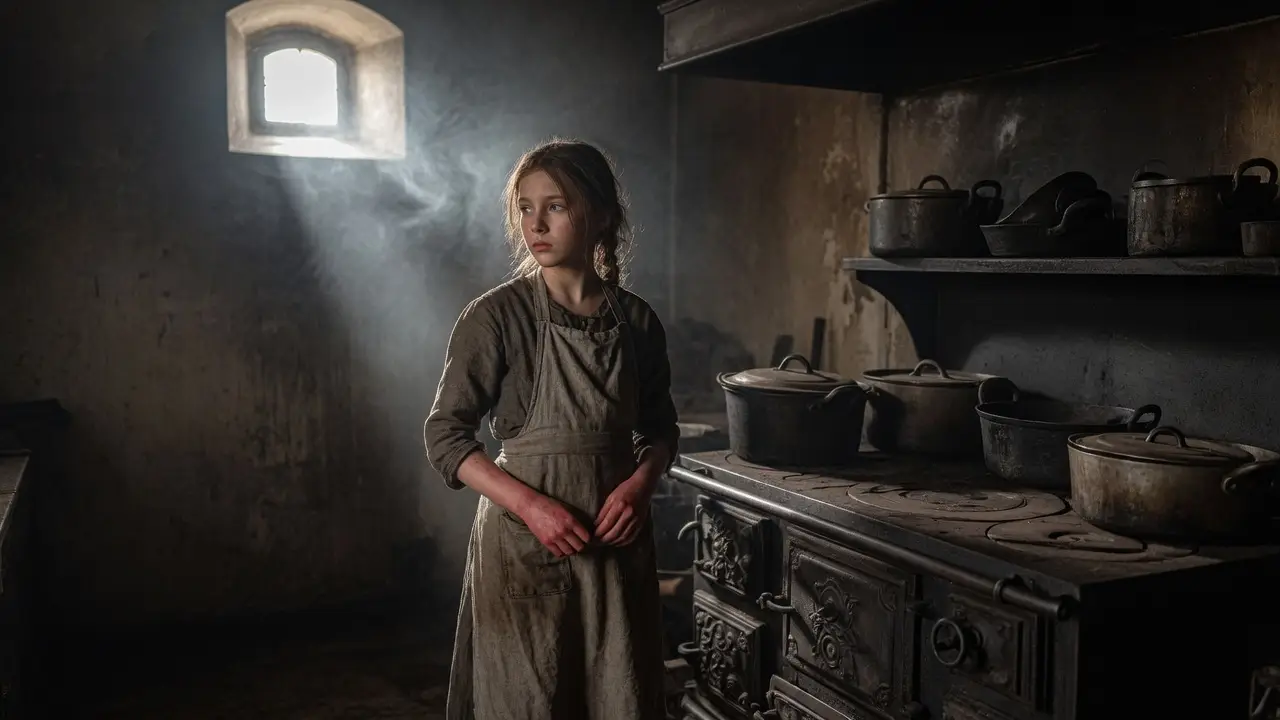
Girls removed from British workhouses, orphanages, and poorhouses were channeled into domestic service with a consistency that amounted to policy. They were trained, from young ages, in cooking, cleaning, laundry, childcare, and household management. When they were placed with families in Canada, Australia, or within Britain itself, they entered households as servants, not daughters.
The domestic labor they performed was invisible in the same way that domestic labor has always been invisible: it was necessary, constant, and uncompensated beyond room and board. A girl of fourteen managing a household in rural Ontario was doing the work of an adult woman. She was not being educated. She was not building savings. She was learning, through daily practice, to occupy a subordinate position in every household she would ever enter.
“No one asked if I had a mother. They asked if I could work.”
Unnamed British Home Child, quoted in a 1930s oral history collection
Some girls aged out of these placements with nowhere to go and no resources. They had no family to return to, no skills the economy formally recognized, and no legal protections. They fell into poverty, or into institutions again. The cycle had a terrible circular efficiency.
The Workhouse Connection
The older logic beneath all of this stretches back further than the Home Children or the Orphan Trains. It lives in the Poor Laws of England, in the workhouse system that institutionalized poverty as a moral failure to be corrected through supervised labor. Children in workhouses were not simply sheltered. They were sorted into usefulness.
British Boards of Guardians, the local authorities responsible for poor relief and workhouse administration, sent approximately 10,000 workhouse children to Canada alone between the late 1880s and 1916. These were not charity schemes operating outside the official system. They were functions of government. Taxpayers funded the removal of poor children from public rolls and delivered them to private households and farms as labor at reduced public cost.
The mathematics were presented openly in committee reports. Keeping a child in a workhouse cost money. Sending a child to Canada cost a one-time transport fee. Canada then assumed responsibility, which in practice meant a farmer assumed possession. The balance sheet worked. The child did not figure into it as a person.
After Placement, Silence
One of the most damning features of all these systems was what happened after a child was placed. In most cases: nothing. No inspection. No follow-up letters. No assigned advocate. The child vanished into private life, which meant private power, and no institution felt responsible for what occurred there.
Complaints about the orphan trains documented poor follow-up, legal uncertainty about the children’s status, and consistent reports of children being treated as free labor rather than family members. The language of adoption and fostering was used freely, but the legal protections those words imply were rarely in place. A farmer who worked a placed child fourteen hours a day and fed him poorly was not easily accused of anything. He was providing a home.
LESSER-KNOWN DETAILS
The Children’s Aid Society, which ran the American Orphan Trains, kept almost no records of outcomes for children placed before 1910. When reformers demanded follow-up inspections, the Society’s leadership argued that the privacy of receiving families had to be protected.
Dr. Barnardo’s organization eventually established a network of visiting inspectors in Canada to check on Home Children. The inspectors were overworked, underfunded, and dependent on the cooperation of the very farmers they were meant to evaluate. Their reports tended toward optimism. The children they interviewed were rarely alone when they answered questions.
What the Records Left Behind
The surviving records are fragmentary because fragmentary records served the interests of the institutions creating them. Case files were lost, destroyed, sealed, or never kept. Children were given new names. Sibling groups were separated and sent to different provinces, different states, different continents, ensuring that even shared memory could not be pooled.
“The boarding out of pauper children is not charity. It is economy.”
British Board of Guardians internal report, c. 1895
Many descendants of Home Children and Orphan Train riders did not discover their histories until they were middle-aged or older, when archives began to open and researchers began to look. In Canada, a significant advocacy movement eventually produced formal recognition. In 2009, the Canadian government formally apologized to British Home Children and their descendants, acknowledging that many had been exploited rather than rescued. The apology was largely symbolic. The people most affected by it had been dead for decades.
The Quiet Accounting
There is no clean endpoint to this history. The British Home Children scheme ended officially in 1948. The Australian child migration program wound down by the late 1960s. The American Orphan Trains stopped running in 1929. The workhouse system was abolished after World War II.
But the logic that powered these systems, the idea that poor children owe the world their labor in exchange for being kept alive, did not end. It migrated into new forms, new geographies, new vocabularies. Child domestic labor in private households remains widespread globally. Institutional systems for displaced children continue to face accusations of exploitation and abuse. The orphanage industry in developing countries has been documented by researchers as frequently harmful, driven more by donor funding and local economics than by genuine child welfare.
LESSER-KNOWN DETAILS
During the height of the Home Children movement, some Canadian municipalities actively lobbied the British government for more child migrants, citing labor shortages. Children were, in some documented cases, specifically requested by age and gender based on the work available.
A child with no family and no money is still, in much of the world, a child with no power. That has not changed enough.
The boy on the Liverpool dock with the tag pinned to his coat, standing in the winter cold, being told this is a rescue: he never stopped existing in one form or another. The institution changes. The tag remains.