Hired swords, broken thrones: the mercenary curse that no empire could escape. From Carthage’s Truceless War to the Wagner mutiny, history’s greatest empires all made the same mistake with mercenaries. This is the real history of mercenaries and why every empire that hired them eventually regretted it.
The Night Carthage Nearly Burned Itself Down
In 241 BC, a Carthaginian general named Hanno rode out to meet his own soldiers in what should have been a straightforward negotiation. The army waiting for him was made up of men who had fought brilliantly for Carthage in the First Punic War. Libyans, Iberians, Gauls, men who had bled on Carthage’s behalf for years. What they wanted was simple: the back pay they had been promised. What Hanno offered instead was a fraction of it, then stalling, then excuses. What they gave him in return was war.
The conflict that followed, known to history as the Truceless War, was so brutal that even the Romans watched from a distance, quietly horrified. Mercenaries crucified their Carthaginian officers. Carthage responded by trampling prisoners under war elephants. Entire garrisons switched sides based on which direction the wind of payment was blowing. Polybius, who had seen plenty of military ugliness, called it “a war surpassing all others in cruelty.” It lasted three and a half years and nearly destroyed one of the ancient world’s most powerful civilizations before a single Roman soldier had to lift a finger.
“There is no blood so noble that it becomes ignoble when joined to mercenary purpose.”
Polybius, Histories, Book I (on the Truceless War)
Carthage had not lost to an enemy. It had nearly been consumed by the army it had built to protect itself.
This was not a fluke.
The Logic That Always Fails
The appeal of mercenaries is seductive, and it has been since human beings first figured out that violence could be a profession. Why drain your own population into an army, train them for years, pay for their equipment, feed their families, and then watch them develop political opinions, when you can simply purchase soldiers already made? It is warfare reduced to a procurement problem. Clean. Efficient. Transactional.
Except it never stays transactional for long.
LESSER-KNOWN DETAILS
At his peak, Wallenstein’s army was so large and self-sustaining that it was extracting more tax revenue from occupied German territories than many actual German princes. He was functionally a sovereign power with no territory of his own.
The problem is not that mercenaries are disloyal by nature. The problem is structural. A professional soldier fights for whoever controls his pay. The moment that control becomes uncertain, the entire relationship inverts. And in the ancient world, pay was almost always uncertain. Supply lines broke down. Treasuries ran dry after expensive wars. Promises made by a general on the field were not always honored by the bureaucrats back home. When an empire discovered it couldn’t afford its mercenaries anymore, it was already too late. The dangerous men were already inside the gates.
Greece Rents Its Finest Export
The Greek mercenary market was, by the fifth century BC, essentially a global economy. Greek city-states exported their surplus warriors the way modern nations export oil. Sparta rented out its officers. Athens sold its fleet expertise. And the Persian Empire, which possessed enormous wealth and territorial ambitions that outpaced its ability to field loyal armies, became the best customer.
Join The Archive Briefing
Weekly dispatches. The history they didn't teach you — sourced, subverted, delivered to your inbox.
The Ten Thousand is the story everyone knows, mostly because Xenophon, one of their commanders, wrote a gripping account that reads more like an adventure novel than military history. Ten thousand Greek mercenaries marched deep into Persia to help Cyrus the Younger overthrow his brother Artaxerxes II. Cyrus died in the battle that was supposed to make him king. His Greek commanders were then invited to a negotiation and killed. What happened next should have been a disaster: leaderless, surrounded, thousands of miles from home, with a hostile empire on all sides.
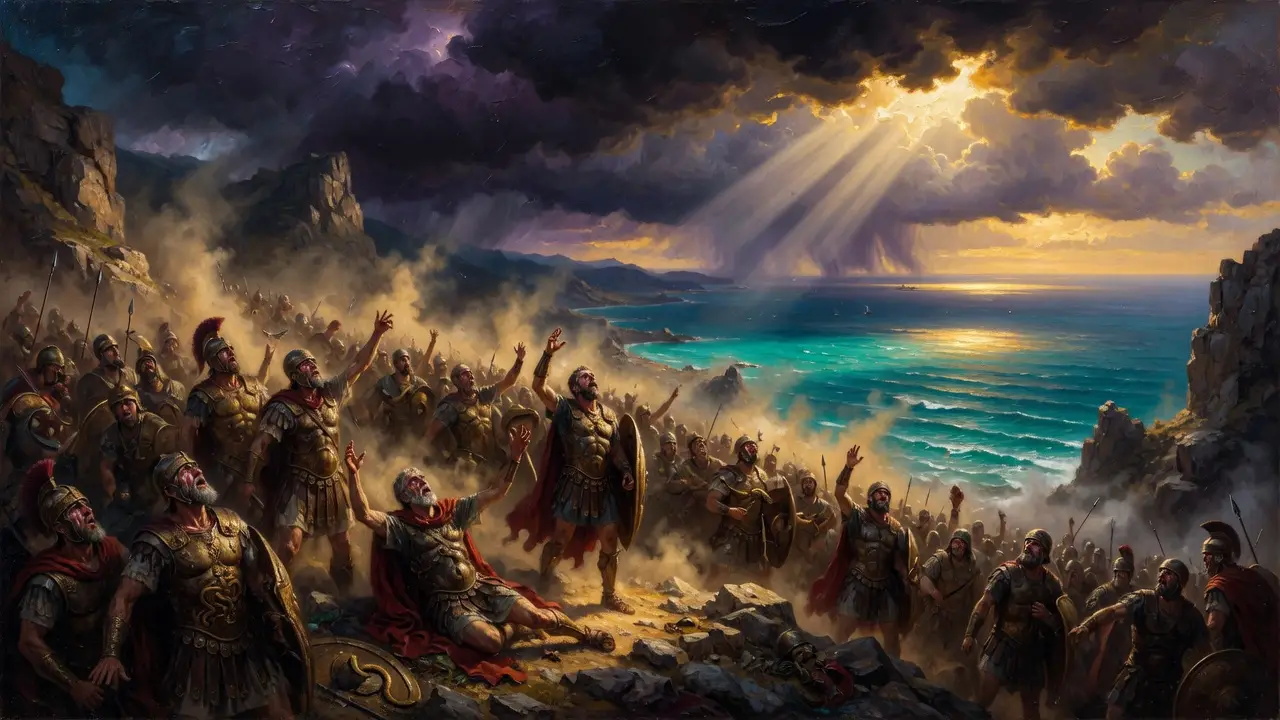
Instead, the Ten Thousand elected new commanders, Xenophon among them, and simply walked out. Through mountain passes, through winter storms, through ambushes and starvation, they made it to the Black Sea over the course of several months. When they finally spotted the water, the famous cry went up: “Thalatta! Thalatta!” The sea. The sea. A ragged army of private soldiers had walked through the heart of the Persian Empire and survived by sheer discipline.
“We came, we saw the sea, we wept.”
Xenophon, Anabasis, on the moment the Ten Thousand reached the Black Sea
The lesson Persia should have drawn: don’t hire men you cannot control. The lesson Persia actually drew: we need more Greek mercenaries.
Rome’s Oldest Mistake
Rome spent centuries congratulating itself on the virtue of the citizen-soldier. The legionnaire was a farmer who set down his plow when the republic called, fought with patriotic fury, and returned to his fields when the campaign was done. It was a romantic idea. It was also, as Rome’s borders expanded, increasingly impractical.
By the late republic, the army had professionalized out of necessity. Soldiers swore loyalty not to Rome but to their general, who paid them, fed them, and promised them land upon discharge. This was not quite mercenary warfare, but it was the same logic dressed in patriotic clothing. When Caesar crossed the Rubicon in 49 BC, the army that followed him did so because it was his army, built on years of shared campaign and personal loyalty. The republic that Rome had theoretically been defending died in the process.
“An army of lions commanded by a deer will never be an army of lions.”
Attributed to various Roman military writings
The late empire moved further still toward outright mercenary dependency. Foederati, Germanic warriors fighting under Roman contract, made up an increasingly large portion of frontier forces. They were effective soldiers. They were also importing, generation by generation, leaders who would eventually look at Rome’s hollowed-out institutions and decide they could run things better themselves. Alaric, the Visigoth king who sacked Rome in 410 AD, had previously served as a Roman military commander. He knew every weakness of the city he would eventually ransack, because Rome had taught them to him.
The Swiss Exception That Proves the Rule
No mercenary tradition in history was more consistently respected, or more carefully cultivated, than the Swiss. From the late medieval period onward, Swiss infantry was the gold standard of European warfare. The cantons maintained a tight, almost corporate control over which contracts their men could take, rejecting clients they considered dishonorable or unable to pay. Swiss pikemen did not simply fight for money; they fought within a system that enforced accountability on both sides of the contract.
The result was a mercenary relationship that functioned without the usual catastrophic collapse, but only because the Swiss had essentially solved the structural problem. They were not desperate. They had leverage. They had alternatives. They could walk away.
The Pope understood this. The Swiss Guard, established in 1506 by Julius II, remains in service today, a ceremonial holdover from an era when having Swiss soldiers at your door meant something specific: expensive, professional, and reliably paid. Their distinctive striped uniforms were designed by Michelangelo, allegedly, which speaks to how much prestige the Vatican attached to having the right soldiers standing outside its walls.
“Gold is the soul of war; without money an army is nothing.”
Philip of Macedon
But even the Swiss could be pushed past their limits. After the Sack of Rome in 1527, when Emperor Charles V’s unpaid troops stormed the city, the 189 Swiss Guards on duty died nearly to the last man protecting Pope Clement VII’s escape. The 42 who survived fought a rearguard action through St. Peter’s Basilica itself. They had been paid. They held. This is the difference between mercenaries who receive what was promised and mercenaries who don’t. The math is always the same.
The Mamluks: A Case Study in Getting Too Good at the Job
In the ninth century, Abbasid caliphs began purchasing enslaved soldiers from Central Asia, primarily Turkic peoples from the steppe, training them as elite military units called ghulam or, eventually, Mamluks. The theory was elegant: soldiers with no ties of tribe or family to local power structures would be loyally dependent on the caliph alone. They had no homeland to return to, no faction to protect. Pure soldiers. Total control.
The Mamluks were phenomenal. They stopped the Mongols at Ain Jalut in 1260, one of the decisive military reversals in medieval history, the first significant defeat the Mongols had suffered in open battle. They were, by any military metric, extraordinary.
LESSER-KNOWN DETAILS
Mamluk soldiers were expected to study Islamic law, mathematics, and often poetry alongside military training. Some of the finest Arabic literature of the medieval period was written by men who spent their afternoons practicing mounted archery.
They also, eventually, took Egypt for themselves. By 1250 they had deposed the Ayyubid sultan, installed their own commanders as rulers, and founded a dynasty that would govern Egypt for two and a half centuries. The soldiers purchased to ensure a ruler’s survival had decided they were better suited to rule than whoever was writing their checks. They were probably right.
What History Keeps Trying to Tell Us
The pattern repeats with a consistency that stops being coincidental somewhere around the fifteenth time. Renaissance Italy’s condottieri, mercenary captains who rented armies to city-states, routinely prolonged wars that could have ended quickly because prolonged wars meant prolonged income. Some historians have argued that certain battles of the Italian Wars were fought with almost theatrical reluctance, opponents maneuvering cautiously to avoid the heavy casualties that might reduce their marketability. War as performance. Violence as career maintenance.
The Thirty Years War brought mercenary armies to a scale Europe had never seen and left a trail of devastation that depopulated entire German regions. Wallenstein, the greatest mercenary commander of the era, built an army of 100,000 men that functioned as a state within the Holy Roman Empire, extracting taxes, administering territory, and pursuing its own foreign policy. He was assassinated on the Emperor’s orders in 1634 when it became clear that Wallenstein’s army was beginning to feel more like Wallenstein’s army than the Emperor’s.
Today the word “mercenary” has been replaced with cleaner language. Private military contractors. Security consultants. Force multipliers. The Wagner Group conducted campaigns across Syria, Libya, Mali, Sudan, and Ukraine while technically maintaining plausible deniability from the Russian state. In June 2023, Wagner’s commander Yevgeny Prigozhin turned his convoy toward Moscow in what the Kremlin called a mutiny and what Prigozhin called a “march for justice.” He was dead within two months, in a plane crash the world immediately understood was not an accident.
Different century. Same arithmetic.
The Bill Always Comes Due
There is something almost Greek about the tragedy of mercenary dependence. The power that hires private soldiers is always trying to solve a problem: not enough loyal troops, not enough time to train them, not enough political will to conscript citizens who might eventually vote against you. Mercenaries are the shortcut. They are fast, experienced, and available.
And they work, right up until the moment they don’t.
What Carthage, Rome, the Abbasid Caliphate, the Italian city-states, and the Russian state all discovered at their respective moments of reckoning is the same thing: the loyalty of a hired sword is a lease, not a deed. You do not own it. You rent it. And at some point, the landlord changes the terms.
The men who know how to fight are always, ultimately, the most powerful people in any room. Empires tend to forget this for exactly as long as the payments are arriving on time.
“The mercenary captain is either a mediocre man or not. If he is mediocre, you cannot trust him; if he is capable, you cannot trust him either, because he will always be working for his own glory.”
Niccolò Machiavelli, The Prince, 1532