Picture a city of 80,000 people. Wider streets than anything Rome would build for another thousand years. Indoor plumbing. Grain storage. A standardized system of weights and measures. Art. Culture. Probably music, though none of it survived.
Now picture that city empty.
Not burned. Not buried under ash like Pompeii. Not conquered, not plague-ridden, not obviously anything. Just… quiet. Doors left open, maybe. Food still in the pantry of history. And then, over the course of a generation or two, no one.
Three times in human history, something like this happened. Three civilizations reached genuine sophistication, built cities and traded across continents and developed systems of governance complex enough to make your head spin, and then folded inward like a closing hand. The Indus Valley. The Minoans. The Mississippians. Each one left behind a silence so profound that archaeologists have spent careers listening to it, trying to hear what it means.
What they’ve found is stranger than any collapse.
The First Disappearance: Mohenjo-daro and the City That Refused to Fight
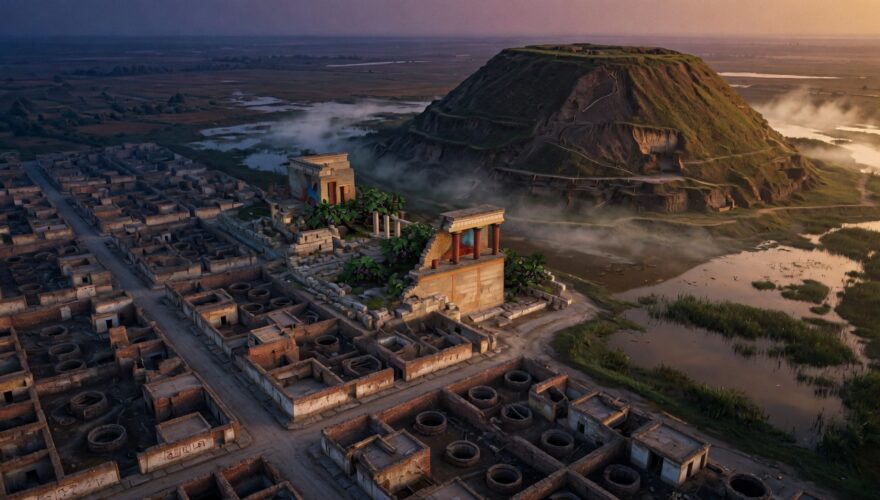
Around 2600 BCE, the Indus Valley Civilization was the largest urban culture on Earth. It stretched across what is now Pakistan and northwest India, covering an area bigger than ancient Egypt and Mesopotamia combined. Its two great cities, Mohenjo-daro and Harappa, were engineered with a precision that still baffles engineers today.
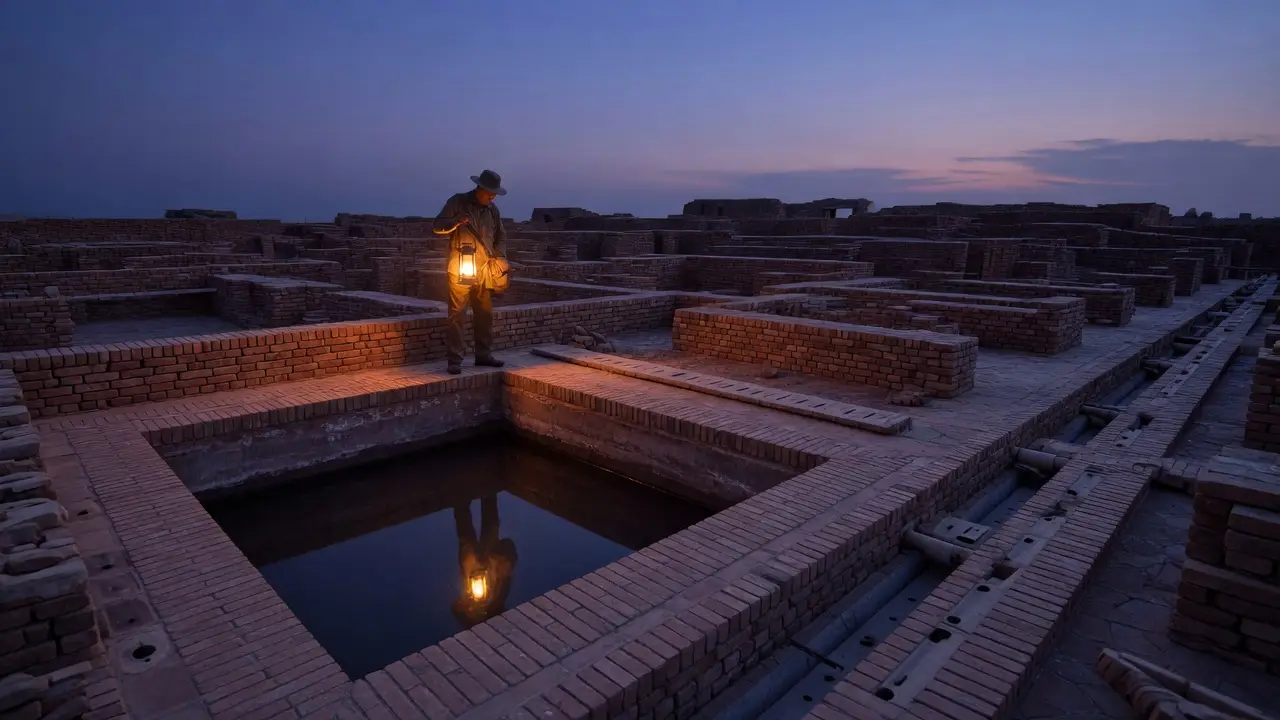
The streets ran on a grid. A grid. Thousands of years before anyone in Europe had thought to organize a city that way, Indus Valley planners were laying out blocks with the geometric confidence of someone who had done this before. Waste water moved through covered drains beneath the streets. Each neighborhood had access to public wells. The Great Bath at Mohenjo-daro, a massive, watertight pool, may have served ritual purposes, but it also speaks to a society that understood hydraulics well enough to build a structure that hasn’t leaked in four millennia.
And here’s the detail that quietly rewrites everything you thought you knew about ancient power: archaeologists have found almost no weapons in the Indus Valley. No depictions of battle. No monuments to kings. No mass graves. No fortifications designed to repel armies. Whatever held this civilization together, it wasn’t the threat of violence. The Indus Valley seems to have functioned, impossibly, without the machinery of war.
Then, somewhere around 1900 BCE, it stopped.
Join The Archive Briefing
Weekly dispatches. The history they didn't teach you — sourced, subverted, delivered to your inbox.
Not explosively. That’s the unsettling part. The decline happened across centuries, a long exhalation rather than a sudden stop. Trade networks frayed. Cities shrank. People migrated east and south. And the script, the Indus script that appears on thousands of small carved seals, has never been deciphered. We have their words, etched in stone, and we cannot read a single one.
The leading theory today involves climate. Monsoon patterns shifted. The Ghaggar-Hakra river system, which once fed the civilization’s agricultural heart, began to dry up. Without water, farming falters. Without farming, cities starve. People left not because they were driven out but because staying made no sense. The civilization didn’t fall. It dispersed.
But that explanation, while probably correct in outline, doesn’t account for everything. It doesn’t explain why no one came back. It doesn’t explain the silence of the script. And it doesn’t explain why a culture so sophisticated, one that had clearly solved enormous organizational problems, couldn’t solve the problem of drought the same way it had solved everything else.
Something broke that we haven’t named yet.
The Second Disappearance: Crete and the Sea That Swallowed Everything
The Minoans didn’t call themselves Minoans. That name was invented by Arthur Evans, the British archaeologist who excavated Knossos in the early twentieth century and decided to name the culture after the mythological King Minos. The actual people who lived in the palace complexes of Crete, who painted dolphins on their walls and worshipped a bull-leaping goddess and sailed trade routes across the entire eastern Mediterranean, left no record of what they called themselves.
They were extraordinary. Their palace at Knossos covered five acres and rose several stories. Its plumbing rivaled anything built before the modern era. The art they left behind, frescoes of acrobats vaulting over bull horns, women in elaborate flounced skirts gathered in what look like social rituals, blue monkeys scaling painted cliffs, radiates a joy that feels genuinely human. These were not people who seemed burdened by their civilization. They seemed to love it.
Sometime around 1450 BCE, almost everything on Crete was destroyed.
The Thera eruption, the volcanic explosion on the island now called Santorini roughly 70 miles north of Crete, is the dramatic candidate. It was one of the largest volcanic events in recorded human prehistory. The explosion would have sent tsunamis crashing into Cretan harbors and blotted out the sun for months. Evans initially blamed it for the collapse of Minoan civilization.
The problem is the timing. The eruption now appears to have occurred around 1620 BCE, more than a century before Knossos fell. A civilization capable of building five-acre palaces didn’t spend a hundred years dying from a natural disaster. They rebuilt.
What happened around 1450 BCE looks more like invasion. The Mycenaeans, the warlike Greek culture from the mainland, appear to have moved into the power vacuum left by Minoan weakening, however that weakening began. Linear B script, a Mycenaean Greek language, replaced the older Linear A that still hasn’t been decoded. The palace at Knossos continued functioning, but under new management.
And yet the Minoans, as a distinct cultural identity, vanished. Their religion disappeared. Their art style transformed. Their language went silent. What was it about Minoan culture that couldn’t survive contact with the Mycenaeans? Why did their identity dissolve so completely, when other conquered cultures maintained their distinctiveness for centuries?
The answer might lie in the sea. The Minoans were a maritime civilization, defined by trade and openness. Their power came not from armies but from networks, relationships, the flow of goods across water. When those networks broke, either through the eruption’s economic disruption or through Mycenaean military pressure, the Minoans had nothing to retreat to. They had built a civilization without walls, and walls, in the end, were what mattered.
The Third Disappearance: Cahokia and the City America Forgot
Of the three, this one should feel the most urgent. Because it happened on the continent where many of you are reading this.
At its peak, around 1100 CE, Cahokia was the largest city north of Mexico. Located near present-day St. Louis, Illinois, it held somewhere between 10,000 and 20,000 people, making it larger than London at the time. It was the center of what archaeologists call the Mississippian culture, a sophisticated network of chiefdoms and trade routes that stretched from the Gulf of Mexico to the Great Lakes.
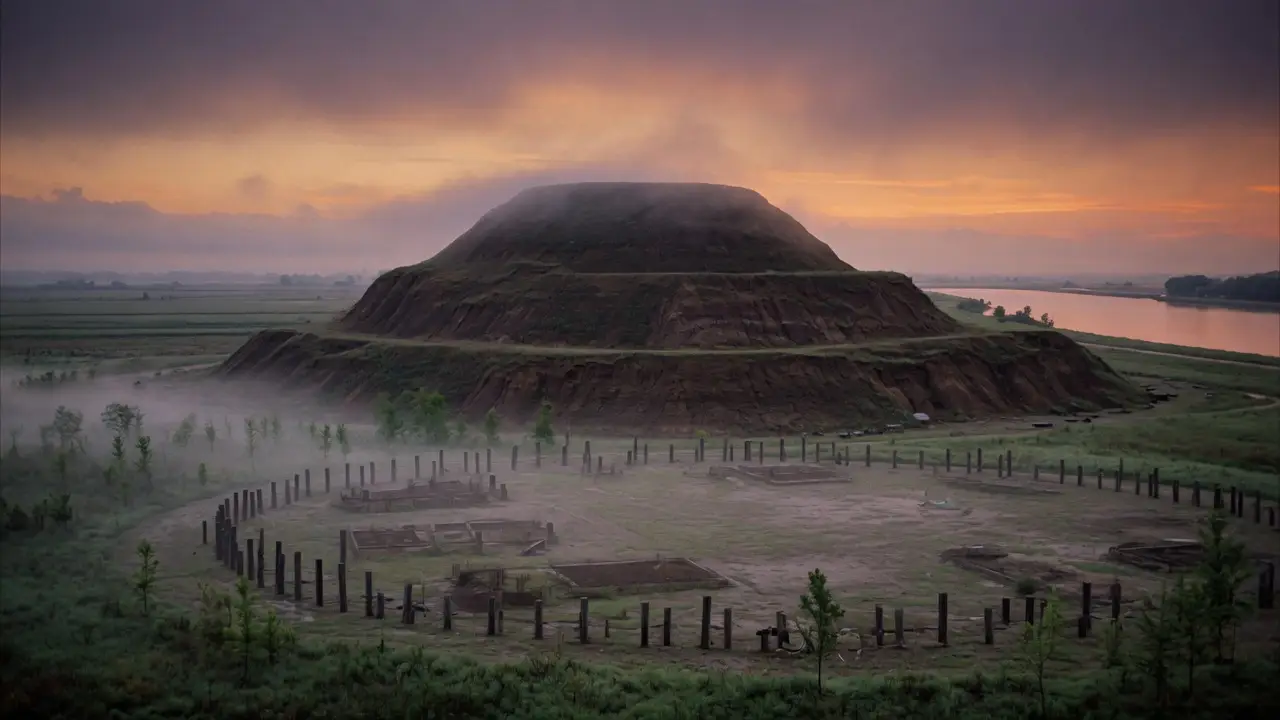
Monks Mound, the central earthwork at Cahokia, covers fourteen acres at its base and rises a hundred feet. It contains more dirt than the Great Pyramid of Giza. It was built with baskets. Tens of millions of baskets of earth, carried by hand, over generations, to create an artificial mountain at the center of a planned city.
The city was also deeply strange. Cahokia practiced human sacrifice, as evidenced by “Mound 72,” where archaeologists found over 250 bodies, mostly young women, buried in mass graves alongside a powerful figure laid out on a bed of 20,000 shell beads. The society that built this city was not one you’d want to have been powerless within.
And then, by around 1350 CE, Cahokia was empty.
The Mississippian culture didn’t collapse entirely. Descendants of its people continued living across the Southeast and Midwest. But the city itself was abandoned. Squirrels nested in Monks Mound. Trees grew where the central plaza had been maintained at enormous human cost.
Why? Several theories compete. Deforestation had stripped the surrounding region bare to feed the city’s building projects and cooking fires. The soil may have been exhausted. A catastrophic flood around 1200 CE, evidence of which survives in soil layers, may have contaminated the city’s water supply and broken the religious legitimacy of the ruling elite. When people believe their leaders are chosen by the cosmos, and the cosmos sends a flood that submerges the central plaza, the authority of those leaders gets complicated.
What makes Cahokia’s disappearance particularly haunting is how thoroughly it was forgotten. By the time European explorers arrived in the region, the local peoples didn’t claim Cahokia as ancestral. Some may have deliberately distanced themselves from its memory. A city of 20,000, gone not just from the landscape but from living tradition.
That kind of forgetting isn’t accidental. It’s a choice. And choices like that are made when a place has become associated with something people need to leave behind.
What the Silence Actually Says
Look at these three civilizations together and a pattern emerges, though it resists simple summary.
None of them collapsed in the Hollywood sense. No final battle. No last king. No burning archive. They thinned. They dispersed. They were absorbed or transformed or walked away from. And in each case, the civilization’s defining strength became, in the end, part of its vulnerability.
The Indus Valley’s peaceable, distributed character meant there was no central authority to coordinate a response to environmental pressure. The Minoans’ openness meant that when the networks broke, so did the culture. Cahokia’s religious centralization meant that when the divine mandate seemed to crack, the entire social order cracked with it.
Historians used to talk about collapse as something that happened to civilizations. A blow from outside. A sudden break. The newer thinking is quieter and more troubling: most civilizations don’t fall. They fade. They make a thousand small decisions, each individually rational, that accumulate into abandonment.
We are not outside this pattern. We are inside it.
There is a particular kind of intellectual humility that comes from standing in front of the Indus script and knowing you cannot read it. An entire civilization’s inner life, its laws, its prayers, its arguments and its poetry, encoded in symbols no living person can decode. The Minoans left us their art but not their language. Cahokia left us its mounds but not its name for itself.
Civilizations are not permanent. They are, at best, agreements, sustained by shared belief in their own continuation. When that belief stops, the city empties. The script falls silent. The mound fills with trees.
And someone, a thousand years later, stands at the edge of it and wonders what happened.
The most unsettling thing about Mohenjo-daro isn’t that it fell. It’s that it was once full of people who assumed it wouldn’t.