The messenger arrived before dawn. His horse was lathered, his face pale with something worse than exhaustion. The news he carried would not simply lose a battle. It would erase an empire.
History has a dark sense of humor. The most powerful armies in the world, commanding the finest soldiers, the best weapons, and the strategic advantage, have destroyed themselves not through cowardice or weakness, but through catastrophic overconfidence. Through one wrong order given on a morning that felt ordinary. Through commanders who refused to see what their own scouts were screaming at them.
These are not stories of bad luck. They are stories of choices. Human choices, made by brilliant, arrogant, exhausted men who bet everything on a single assumption and lost civilizations as a result.
The Persian King Who Drowned His Chances
In 480 BC, Xerxes I stood at the edge of the Greek coast and watched his thousand-ship fleet fill the horizon. He had brought somewhere between 100,000 and 300,000 men to crush a collection of fractious city-states that couldn’t even agree on whether to resist him. He was the king of kings. The outcome felt inevitable.
What happened at Salamis that September was not a battle. It was a trap.
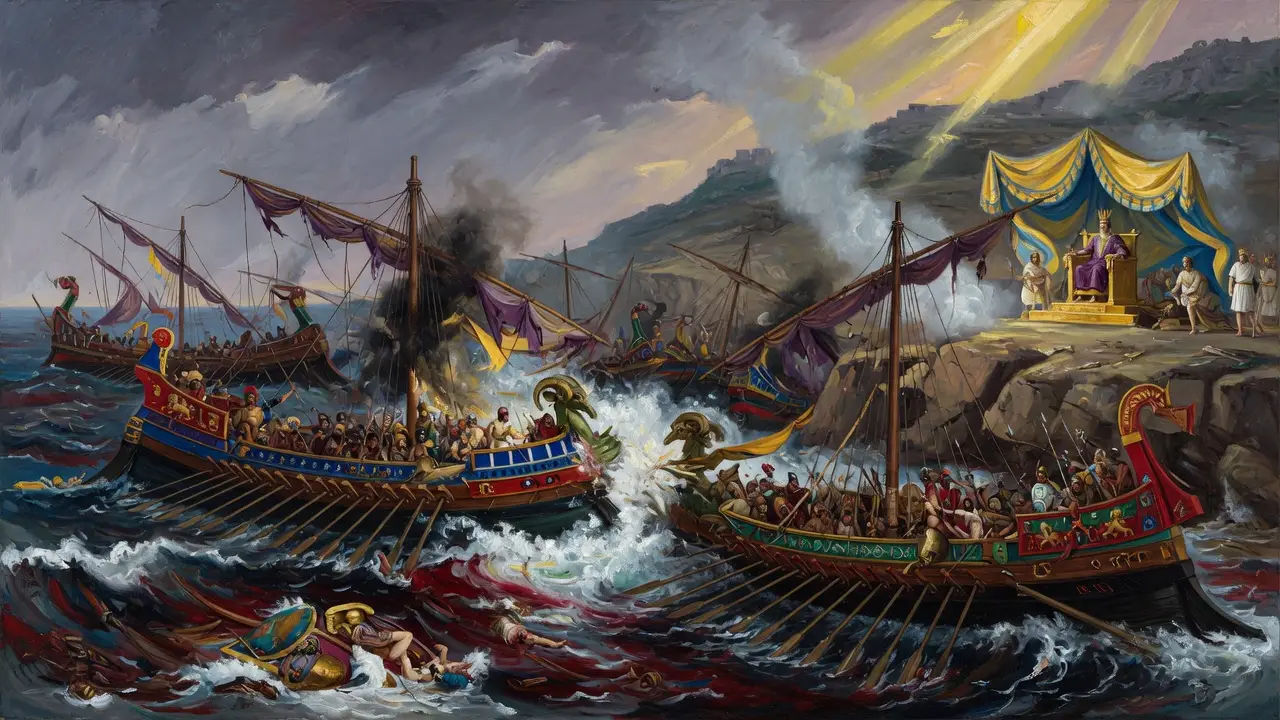
The Athenian general Themistocles had spent months manipulating both sides into exactly this moment. He lured the Persian fleet into the Strait of Salamis, a channel so narrow that Xerxes’ numerical advantage became a liability overnight. The Persian ships crowded each other, unable to maneuver, ramming their own vessels as the lighter, faster Greek triremes carved through the chaos at close range. The Persian fleet didn’t just lose. It was systematically dismantled in water so confined that the men on shore could watch.
Xerxes sat on a golden throne on the hillside and witnessed every moment of it.
He had refused counsel to avoid the strait. His advisors, including the Spartan queen Artemisia, had warned him directly: don’t fight in narrow water. Don’t give up the open sea. He listened politely and proceeded anyway, because the war felt already won. That psychological certainty, victory assumed before it was secured, is the rot at the center of almost every catastrophic military failure in history.
“Spare your ships and do not fight at sea. Their men are as superior to yours at sea as men are to women.”
Artemisia warning Xerxes before the battle (recorded by Herodotus, The Histories, Book 8)
The Persian withdrawal from Greece was never truly reversed. The empire survived, but the dream of westward expansion died in that narrow channel. Greek civilization, and everything that followed from it, including the philosophical and democratic foundations that still shape modern governance, owed its survival to one commander’s hubris and another’s patience.
Join The Archive Briefing
Weekly dispatches. The history they didn't teach you — sourced, subverted, delivered to your inbox.
Napoleon’s Slow Suicide in the Snow
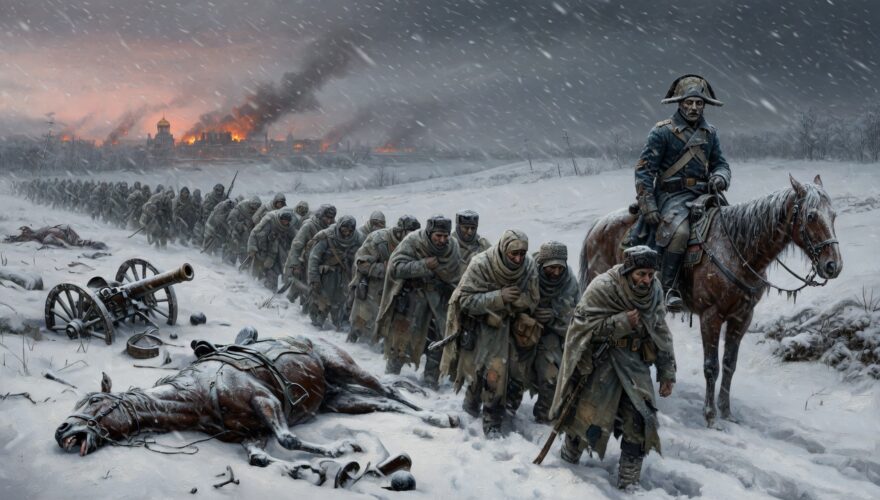
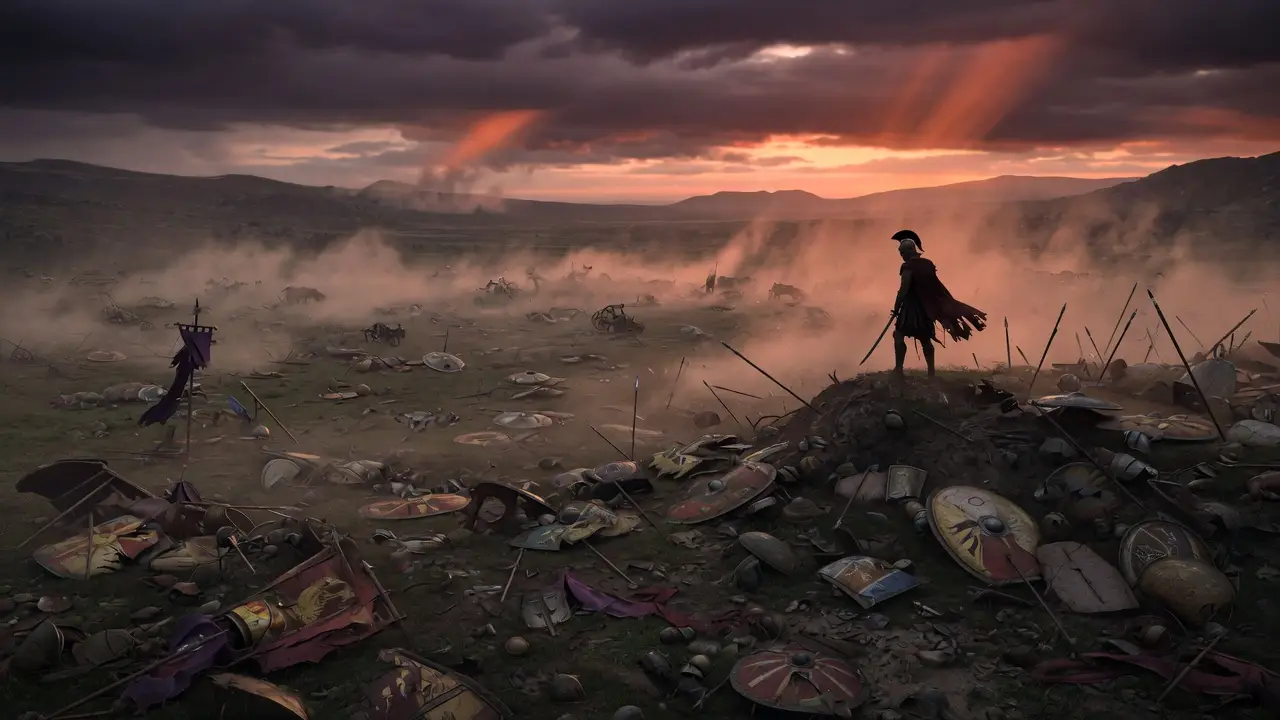
In June 1812, Napoleon Bonaparte crossed into Russia with the Grande Armée, roughly 680,000 men, the largest invasion force Europe had ever assembled. By December, fewer than 100,000 of them returned. Most didn’t die in battle. They froze, starved, or were hunted down in the retreat through the Russian winter.
The blunder here was not a single tactical error. It was a cascade of willful ignorance compounded over six months.
Napoleon had been warned about the Russian winter. He had been warned about Russian supply tactics, the deliberate scorched-earth strategy that would deny him food, shelter, and forage for his horses. He understood these dangers intellectually and chose to believe speed would make them irrelevant. He expected Russia to fight, to mass its forces and meet him in a decisive engagement that would end the campaign in weeks. Instead, the Russians retreated, and retreated, and retreated, pulling him deeper into a country too vast to conquer and too empty to sustain his army.
The Battle of Borodino in September was the closest thing to the decisive confrontation Napoleon craved. It cost both sides staggering casualties and resolved nothing. Napoleon occupied Moscow to find it nearly deserted, with fires already burning. He waited five weeks for a Russian surrender that was never coming, precious weeks in which the temperature dropped and his horses began dying.
“From the sublime to the ridiculous is but a step.”
Napoleon to his ambassador Abbé de Pradt
The retreat began in October. Within weeks it became a catastrophe. Soldiers ate their own horses, then the saddles. Men froze to death overnight. The Cossacks harassed the columns endlessly, picking off stragglers. One of the most famous paintings of the campaign, by Vasily Vereshchagin, shows a pyramid of human skulls against a grey sky. Napoleon didn’t commission it. He didn’t need to.
The Grande Armée that crossed the Niemen River in June never existed again. Napoleon’s invincibility, the core of his political power, died with it. Within three years he was exiled, and the European order he had demolished was rebuilt around the explicit goal of never allowing one man that kind of unchecked dominance again.
The Byzantine Emperor Who Opened the Gate
On the night of May 28, 1453, Constantine XI Palaiologos knew his city was going to fall. He had known it for weeks. What he didn’t know was that someone had already made the decision for him.
Constantinople had held for over a thousand years. Its walls, the Theodosian Walls built in the fifth century, were among the most sophisticated defensive structures in the world, a triple-layered system of moats, outer ramparts, and inner walls that had turned back Avars, Arabs, Bulgars, and Vikings. The city had survived sieges the way mountains survive storms: by simply still being there when they ended.
Mehmed II, twenty-one years old and hungry in a way that frightened even his own advisors, had brought somewhere between 80,000 and 100,000 men to the walls of Constantinople in April 1453. He had also brought something the walls had never faced: enormous bronze cannons, including one so large it required sixty oxen to transport, capable of hurling stone balls weighing over 500 kilograms. The walls cracked. The Byzantines repaired them at night. The cannons fired again by morning.
For fifty-three days, this held. The Byzantines were outnumbered perhaps thirty to one, but the walls kept the equation from mattering.
Then someone left the Kerkoporta gate open.
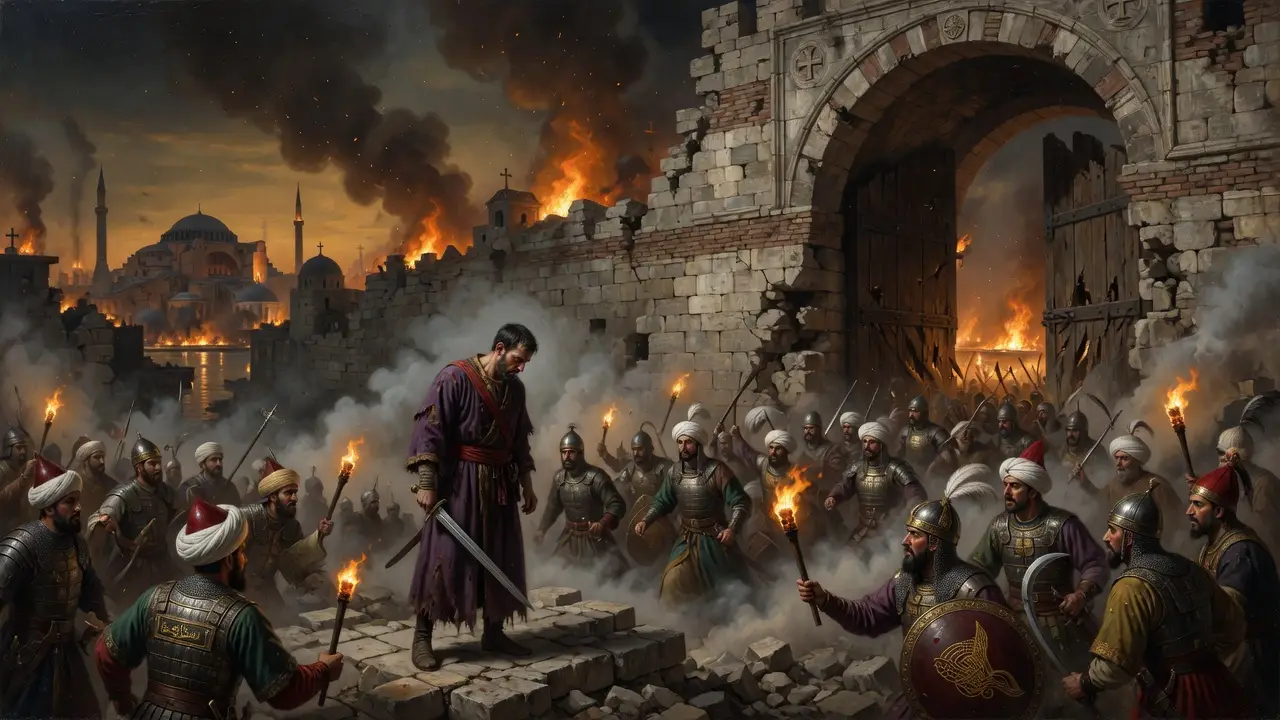
The exact circumstances are still debated. It may have been a small postern door used for a sortie that wasn’t properly secured in the chaos of the final assault. It may have been negligence. Some historians have suggested treachery, though the evidence is thin. What is not debated is what happened next: a group of Ottoman soldiers discovered the unlatched gate, slipped through, and appeared behind the defenders on the walls. The cry went up that the Turks were inside the city. The Byzantine defensive line, already exhausted, broke.
Constantine XI reportedly tore off his imperial insignia and charged into the fighting on foot. His body was never definitively identified.
By morning, Constantinople was Istanbul. The Eastern Roman Empire, a continuation of Rome itself stretching back to Augustus, was over. The date, May 29, 1453, is still marked in Greek Orthodox churches around the world. One unlatched gate ended a civilization that had outlasted everything else in the ancient world.
The General Who Trusted a Telegram
On August 26, 1914, the German First and Second Armies were advancing through Belgium and northern France with a speed that suggested the war might genuinely be over by Christmas. The Schlieffen Plan, Germany’s meticulously designed blueprint for avoiding a two-front war, was working. The French were reeling. The British Expeditionary Force was retreating.
Then General Alexander von Kluck made a decision that gave France back the war in three days.
The original plan called for the German right wing, von Kluck’s First Army, to sweep wide west of Paris, enveloping the French capital and rolling up the entire French line from behind. It was a bold, sweeping maneuver that required precise coordination, enormous supply lines, and the discipline to keep moving even when exhaustion set in.
Von Kluck, reading the tactical situation in front of him, decided to improvise. His scouts reported the French Fifth Army retreating southeast rather than southwest. An opportunity appeared to cut them off, to destroy them in the open field before they could regroup. He turned his army inward, northeast of Paris instead of southwest of it, abandoning the wide encirclement for the more immediately tempting pursuit.
It seemed logical. It was catastrophic.
The turn created a gap between the German First and Second Armies that French aerial reconnaissance spotted almost immediately. The French commander Joffre, who had been quietly relieving failed generals and reorganizing his forces during the retreat, recognized the opening. Six hundred Paris taxi cabs famously shuttled reserve troops to the front, though historians have since pointed out that the taxis carried only a fraction of the reinforcements needed. The symbolism mattered more than the numbers.
The Battle of the Marne in early September pushed the Germans back to the Aisne River. They dug in. The French dug in. Within weeks, the war of sweeping movement that both sides had planned for had calcified into trenches that would stretch from Switzerland to the English Channel.
Von Kluck’s pivot northeast of Paris is the moment the First World War became the war we know. Not a quick campaign but four years of industrialized slaughter, 20 million dead, the collapse of four empires, and a peace treaty so punitive it functioned as a timer on the next war. All of it traces back to one general who saw an easier target and reached for it.
The Fleet That Sailed into a Joke
In October 1904, the Russian Baltic Fleet set out from St. Petersburg on a journey of nearly 18,000 miles to relieve the besieged Russian forces in the Pacific. The voyage would take seven months. By the time it arrived, there would be nothing left to relieve.
The journey itself was a compendium of disasters. The fleet’s commander, Admiral Rozhestvensky, was sailing ships that were poorly maintained, crewed by men with minimal combat experience, and loaded with supplies calculated so tightly that running short was a question of when rather than if. The ships were already obsolete against the modern Japanese fleet waiting at the end of the voyage.
But nothing in the entire disastrous enterprise quite matches the Dogger Bank Incident.
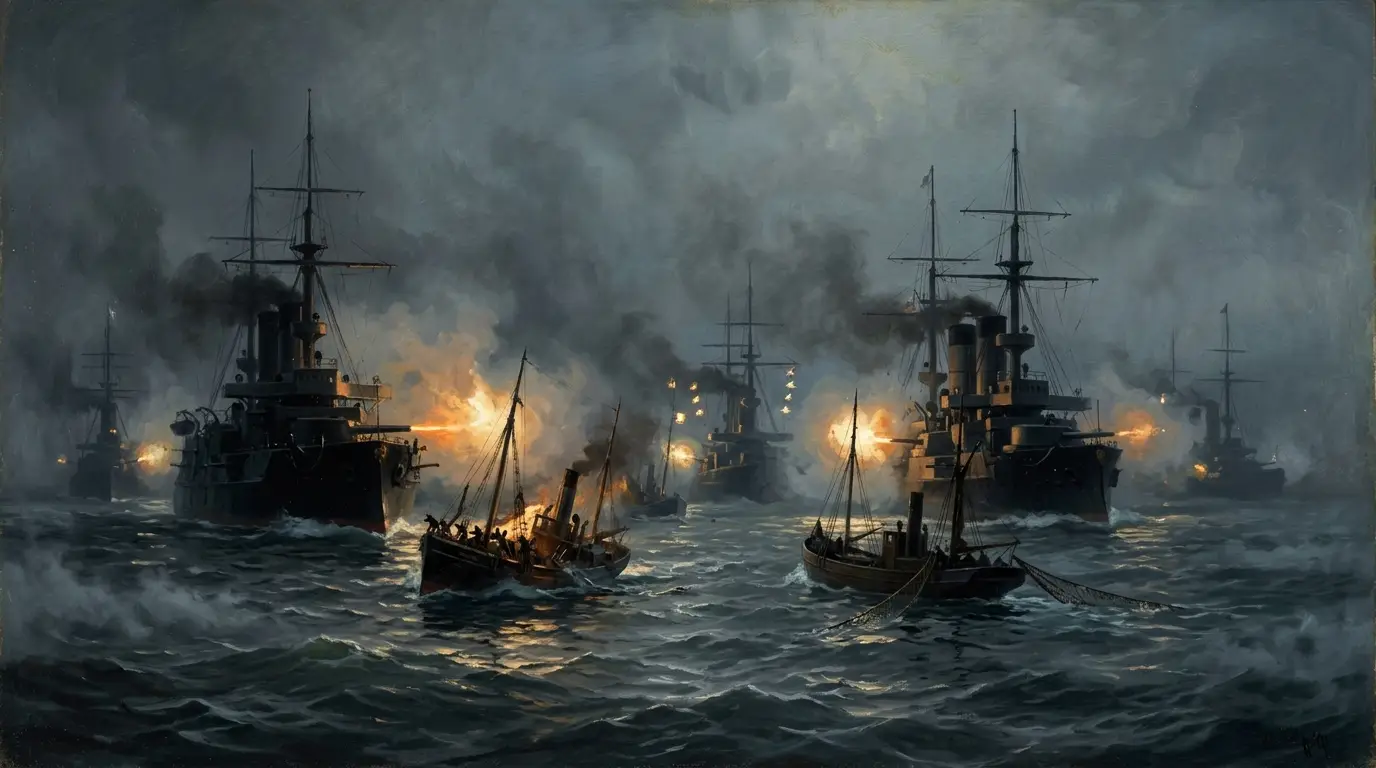
In October 1904, steaming through the North Sea in thick fog, the Russian fleet encountered a group of British fishing trawlers from Hull working the Dogger Bank. Somehow, inexplicably, officers on the Russian warships became convinced the trawlers were Japanese torpedo boats. In the North Sea. Four thousand miles from Japan.
They opened fire. The Russian ships blasted away at the fishing fleet for twenty minutes. They also fired on each other; two Russian vessels were damaged by friendly fire. One trawler was sunk, several were damaged, two British fishermen were killed, and a Russian Orthodox chaplain on one of the cruisers was wounded. Not a single Japanese torpedo boat was involved, because there were no Japanese torpedo boats in the North Sea.
Britain nearly declared war. Only an emergency diplomatic settlement and Russian apologies pulled the two countries back from the edge.
The fleet continued its voyage. When it finally arrived at the Tsushima Strait in May 1905, Admiral Tōgō Heihachirō was waiting with a modernized Japanese navy that had spent the intervening months preparing for exactly this engagement. The resulting Battle of Tsushima lasted less than two days. Of the 38 Russian ships that entered the strait, 21 were sunk, 7 were captured, and 6 were interned in neutral ports. Only 3 reached the intended destination of Vladivostok.
The defeat accelerated the Russian Revolution of 1905, which czar Nicholas II barely survived by making constitutional concessions he resented and planned to reverse. The humiliation fed directly into the political instability that would consume the Romanov dynasty twelve years later. Russia’s entire Pacific imperial ambition collapsed. Japan announced itself as the first non-Western power to defeat a major European empire in a modern naval engagement, a fact that reverberated through every colonized nation on earth.
The fishing trawlers of Hull got a settlement of £65,000.
The Charge Nobody Ordered Correctly
On October 25, 1854, at Balaclava in Crimea, 670 British cavalry received an order so garbled, so catastrophically misread, that they rode straight into a valley fortified on three sides with Russian artillery.
The Light Brigade was supposed to pursue retreating Russian forces and recapture guns at the far end of the valley. Instead, through a combination of miscommunication, assumed knowledge, and the kind of stiff aristocratic pride that refused to ask for clarification, they rode toward a completely different set of guns. Fortified ones. Waiting ones.
Lord Raglan, watching from high ground where he could see the full tactical picture, sent an order through a messenger who could see nothing of what Raglan could see. The messenger, Captain Nolan, gestured vaguely toward the valley when the brigade’s commander Lord Lucan asked for clarification. Nolan was killed in the opening volley before he could correct anything.
They rode for about a mile and a quarter into a corridor of fire. Guns ahead, guns to the left, guns to the right. The survivors who reached the Russian battery at the far end briefly captured it, then had to ride back through the same gauntlet.
Of the 670 who charged, roughly 110 were killed, and nearly as many wounded. The brigade was effectively destroyed in twenty minutes.
The bitter irony was that the charge actually impressed the Russians so thoroughly that they briefly hesitated, uncertain whether men who rode into that kind of fire could really be defeated by normal means. A French marshal watching from the heights reportedly said, “It is magnificent, but it is not war.”
He was right. It wasn’t war. It was a catastrophic breakdown in communication dressed up in lances and plumes. And yet it entered British cultural mythology as a moment of glorious sacrifice, largely through Tennyson’s poem written within weeks of the event, before the full investigation into who exactly was responsible was complete.
The Crimean War itself reshaped the map of the Black Sea region, weakened Russian imperial confidence, and contributed directly to the political pressures that would eventually produce the 1917 revolution. It also, less dramatically but perhaps more durably, transformed how armies thought about communication, command structure, and the difference between bravery and clarity.
Hitler’s Two-Front Fantasy
By the summer of 1941, Germany controlled most of Europe. Britain was battered but unbeaten. And Adolf Hitler, in what military historians still debate as perhaps the single most consequential strategic error of the 20th century, invaded the Soviet Union.
Operation Barbarossa launched on June 22, 1941, with three million German soldiers crossing into Soviet territory along a front stretching nearly 3,000 kilometers. The initial advances were stunning. The Wehrmacht encircled and destroyed entire Soviet armies in the first weeks. Hundreds of thousands of prisoners were taken. The Soviet military seemed on the verge of collapse.
It wasn’t.
The German high command had planned for a campaign of roughly ten weeks. They had not prepared their forces for a Russian winter. They had not accounted for the sheer geographic depth of the Soviet Union, the fact that every advance simply revealed more territory to be held. They had not anticipated Soviet industrial capacity or the speed with which Stalin would relocate entire factories east of the Ural Mountains, beyond German reach.
And critically, Hitler could not stop redirecting resources. When Army Group Center was within striking distance of Moscow in August, he diverted its armored strength to the south for the encirclement at Kiev. Kiev was a tactical success of almost absurd scale, capturing over 600,000 Soviet soldiers. It was also the decision that cost Germany the autumn window to take Moscow before winter arrived.
When the push toward Moscow finally resumed in October, the autumn rains had turned Russian roads into mud so deep that vehicles were swallowed to their axles. Then the freeze came, and German soldiers were still wearing summer uniforms because logistics planners hadn’t prepared for a winter campaign.
The Soviets counterattacked in December with fresh troops from Siberia, soldiers equipped and trained for exactly the conditions that were killing the Wehrmacht. Germany never truly regained the strategic initiative in the east after that winter.
The lesson is almost painfully obvious in retrospect: you cannot fight a two-front war of attrition against industrial opponents when your supply lines are stretched to their limit. Every German officer who had read military history knew this. Napoleon had demonstrated it in 1812. Hitler had reportedly studied that campaign. He proceeded anyway, convinced that the Soviet state would simply collapse under initial pressure.
It didn’t. And the world that emerged from that catastrophic miscalculation, the postwar division of Europe, the Cold War, the entire geopolitical architecture of the second half of the 20th century, was built on the rubble of that assumption.
What These War Failures Share
Across centuries and continents, the same psychology surfaces in every one of these disasters. A commander with real power, real intelligence, and overwhelming confidence reaches a point where the evidence stops mattering. Where the map in his head becomes more real than the ground beneath his soldiers’ feet.
Xerxes saw his fleet and couldn’t conceive of defeat. Napoleon saw his army and couldn’t conceive of winter. The commanders at Balaclava saw cavalry and couldn’t conceive of asking a simple question. Hitler saw early victories and couldn’t conceive of an enemy capable of absorbing them.
The catastrophe was never the enemy. It was always the story they told themselves about the enemy.
History doesn’t punish incompetence as reliably as it punishes certainty. The man who knows he might be wrong stays alert. The man who knows he can’t be wrong rides into the valley.