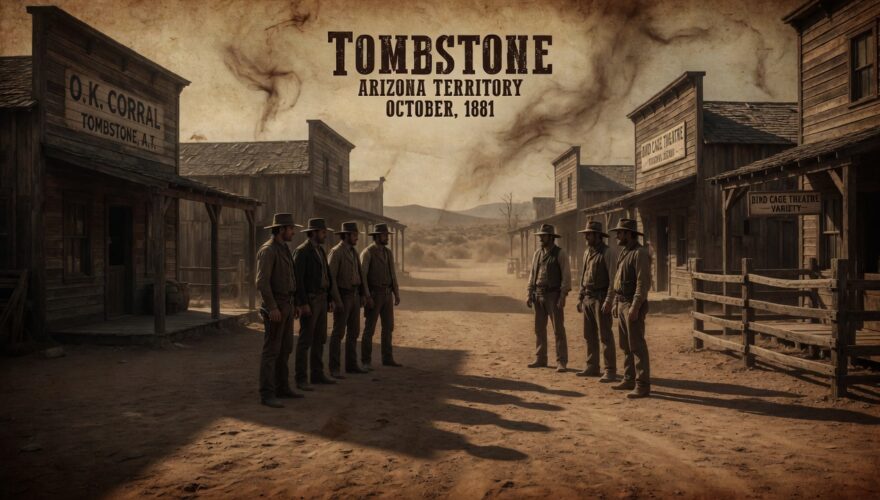
The O.K. Corral gunfight lasted 30 seconds and wasn’t fought inside the corral at all. Discover the real story of politics, threats, and a divided town behind the West’s most famous shootout.
- 1 The O.K. Corral: What Really Happened
- 2 A Silver Town Built on Borrowed Time
- 3 Virgil Earp Was the Man in Charge
- 4 Doc Holliday Had Nothing Left to Lose
- 5 The Cowboys Were a Power Structure, Not a Gang of Cartoon Villains
- 6 A Law About Guns Lit the Fuse
- 7 Eighteen Feet and Thirty Seconds
- 8 The Hearing That Split a Town in Two
- 9 The Vendetta Ride: When the Real Bloodshed Began
- 10 Why This Story Still Matters
The O.K. Corral: What Really Happened
It lasted about as long as it takes to read this paragraph aloud. Thirty seconds. Maybe less. Roughly thirty shots cracked through a narrow dirt lot in Tombstone, Arizona, and when the smoke cleared, three men lay dying and a town’s idea of itself lay shattered right alongside them. There was no slow walk down a dusty street at high noon. No long, silent stare-down while tumbleweed rolled past. Just eight men crammed into a space barely wider than a modern living room, a handful of shouted words nobody can fully agree on, and then chaos.
The most famous gunfight in American history wasn’t a duel. It wasn’t even fought inside the O.K. Corral. It was a botched attempt to disarm a few angry men on a cold October afternoon, and it ended with the law and the lawless so tangled together that, more than a century later, historians still argue about who the real outlaws were.
A Silver Town Built on Borrowed Time
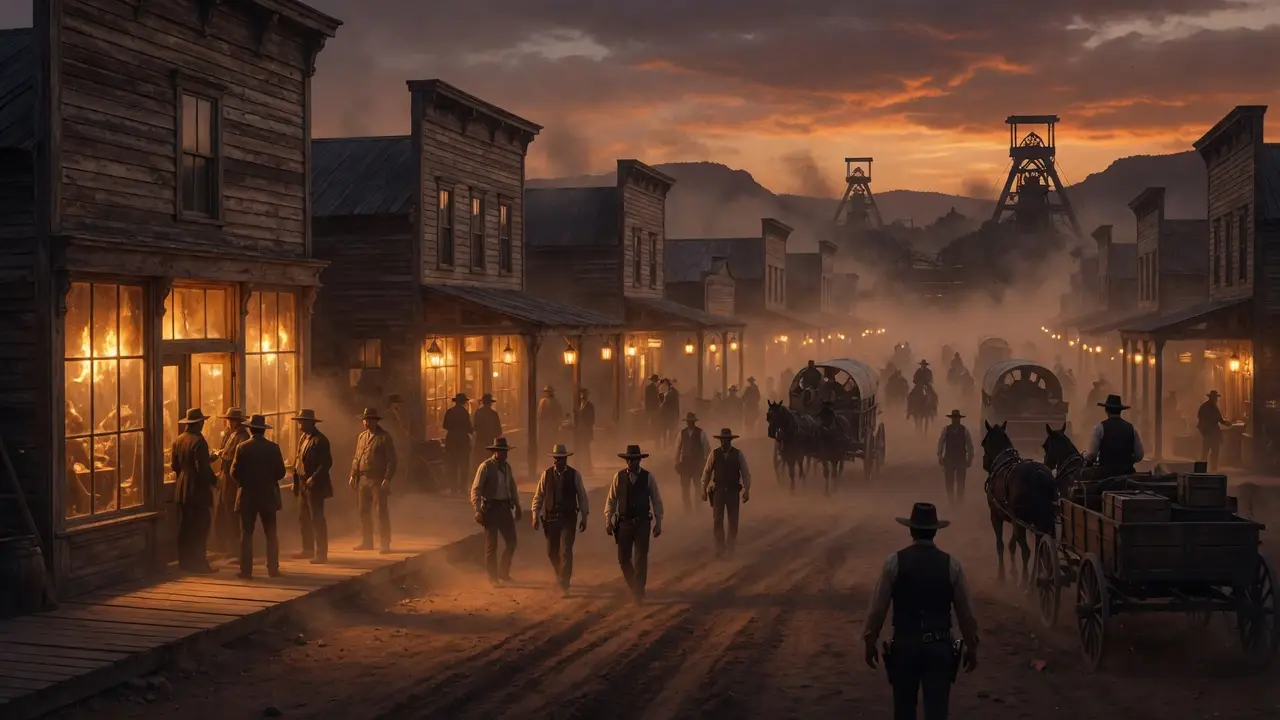
Tombstone in 1881 was not a sleepy frontier outpost. It was a boomtown drunk on silver, and boomtowns do strange things to people. Two years earlier, a prospector named Ed Schieffelin had been warned that all he’d find in that stretch of Apache territory was his own tombstone. He found a silver vein instead, and named his claim as a joke on the men who doubted him. By 1881, the joke had grown into a town of roughly seven thousand people, fourteen saloons working around the clock, gambling halls stacked with cash, and a level of nightly gunfire so routine that newspapers barely mentioned it.
Money like that doesn’t just attract miners. It attracts lawyers, bankers, con men, prostitutes, preachers, and gunmen, all competing for a slice of something that might dry up tomorrow. Tombstone had two newspapers that hated each other on principle, two competing law enforcement structures that overlapped and contradicted one another, and a county sheriff whose loyalties depended on which way the political wind was blowing that week.
“Don’t shoot, I don’t want to fight!”
Billy Clanton, as the Earps approached
This is the detail people skip past too quickly: Tombstone wasn’t really lawmen against outlaws. It was business against business, faction against faction, with guns as the final argument. The Earps were aligned with Tombstone’s Republican business class, men who wanted order, taxes, and a town safe enough for investment capital. The rural ranchers and cattlemen outside town leaned Democratic, resented town authority, and had their own economy running on rustled cattle and Mexican silver smuggled across the border. Add a county sheriff who needed Cowboy votes to keep his job, and you have a recipe that has nothing to do with white hats and black hats.
By October of 1881, Tombstone wasn’t a powder keg waiting for a spark. It was a powder keg that had already been smoldering for months.
Virgil Earp Was the Man in Charge
Here’s where most retellings get the story backward. Wyatt Earp became the legend, but on October 26, 1881, Wyatt wasn’t running the show. His older brother Virgil was.
Join The Archive Briefing
Weekly dispatches. The history they didn't teach you — sourced, subverted, delivered to your inbox.
Virgil held two jobs that mattered enormously that day: he was Tombstone’s town marshal, and he carried a commission as a deputy U.S. marshal. That made him the man legally responsible for enforcing Tombstone’s city ordinance against carrying firearms within town limits, a law that existed precisely because Tombstone’s mix of liquor, money, and pride made armed men a constant danger to everyone around them.
Wyatt, by contrast, held a far murkier position. He’d been a Wells Fargo shotgun guard, a part-time lawman, a faro dealer, and a man with deep financial interests in Tombstone’s gambling halls. He wanted respectability. He wanted a shot at being elected sheriff of the newly formed Cochise County, a job that came with a lucrative tax-collecting commission attached to it.
He was tough, sharp, and fiercely loyal to his brothers, but he was also ambitious in ways that tangled his motives with money and reputation. He was not a man in a white hat riding in to save a helpless town. He was a man with skin in the game, and that’s a more interesting truth than the legend ever allowed.
Doc Holliday Had Nothing Left to Lose
If Virgil brought the authority and Wyatt brought the ambition, Doc Holliday brought something far darker: a man who already knew he was dying.
John Henry Holliday trained as a dentist in Pennsylvania before tuberculosis chased him west, hoping the dry desert air might buy him a few more years. It didn’t buy him peace. He became a gambler instead, moving from boomtown to boomtown with a deck of cards in one hand and, increasingly, a reputation for violence in the other. He coughed blood into handkerchiefs between hands of poker. He drank to numb a body that was slowly suffocating itself from the inside. And somewhere along that bleeding, restless road, he became one of Wyatt Earp’s closest friends, a loyalty so fierce that Doc would draw on Wyatt’s enemies before Wyatt even asked him to.
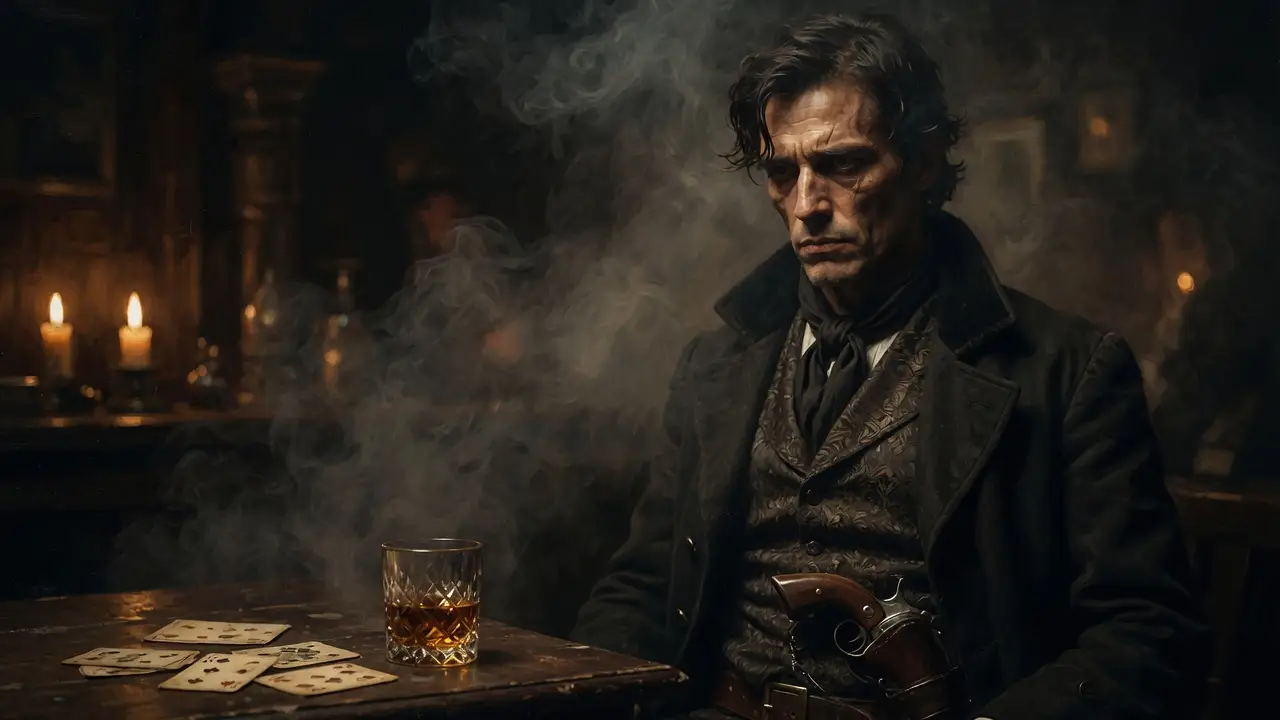
A dying man calculates risk differently than everyone else at the table. Holliday had already lost the only fight that mattered to him, the one against his own lungs, and that made him terrifyingly unpredictable to anyone standing across from him with a gun. By the time he walked toward Fremont Street that October afternoon, carrying a short shotgun under his long coat, he had less left to protect than almost any man in Arizona Territory.
The Cowboys Were a Power Structure, Not a Gang of Cartoon Villains
The men the Earps faced that day belonged to a loose, sprawling network historians now call the Cochise County Cowboys, though no one called themselves that at the time. They weren’t a gang with a name and a hideout. They were ranchers, rustlers, smugglers, and gunhands scattered across the borderlands, tied together by family, cattle, and a shared resentment of being told what to do by men in town suits.
Ike Clanton ran his mouth more than his ranch, a loud, anxious man given to drinking too much and threatening too freely, then panicking when those threats came due. His younger brother Billy Clanton was only nineteen years old, a kid trying to prove himself among older, harder men. Frank McLaury was sharp and capable, the kind of man other Cowboys actually listened to, while his brother Tom McLaury worked cattle and ran supplies, with a far thinner violent record than legend later gave him. Billy Claiborne, barely out of his teens himself, tagged along that day mostly because he happened to be standing nearby.
Sheriff Johnny Behan’s claim to Virgil Earp moments before the shooting: “I have disarmed them.”
These men were connected, in varying degrees, to cattle theft across the Mexican border and to a stagecoach robbery that had left a popular driver dead months earlier, a crime that still haunted the town’s nerves. But reducing them to mustache-twirling villains misses the actual stakes. The Cowboys represented an older frontier order, one where a man settled his own disputes, where county lines and city ordinances meant little once you were back on open range. Tombstone’s business class wanted a Cowboy-free reputation to attract eastern investment. The Cowboys wanted to be left alone. Those two desires were on a collision course long before anyone reached Fremont Street.
A Law About Guns Lit the Fuse
Strip away every grudge, threat, and rumor, and the spark that actually set off the gunfight was almost mundane: a city ordinance.
Tombstone law required visitors to check their firearms at a hotel or livery stable upon entering town, the same kind of ordinance plenty of frontier towns adopted once they got tired of drunken men settling card-game disputes with bullets. On the morning of October 26, Ike Clanton was wandering the streets armed and loudly threatening the Earps, fallout from a tangled, half-true rumor about a stagecoach robbery payoff that had Ike convinced Wyatt had betrayed him. Virgil pistol-whipped Ike and hauled him before a judge for violating the ordinance. Tom McLaury got the same treatment from Wyatt not long after.
By early afternoon, witnesses reported that Frank McLaury, Tom McLaury, Billy Clanton, and Ike Clanton had gathered near the O.K. Corral, several of them visibly armed in direct defiance of the law Virgil was sworn to enforce. A railroad engineer named H.F. Sills, a man with no stake in Tombstone’s politics whatsoever, later swore he’d overheard the group say they intended to kill the marshal and “kill all the Earps.” Whether that threat was real bravado or just drunken talk, it reached Virgil’s ears, and a lawman cannot simply ignore a credible threat against his own life and his brothers’ lives.
Virgil deputized Wyatt and Morgan on the spot and asked Doc Holliday, already armed and already furious at Ike Clanton, to come along. Four men began walking toward Fremont Street with one stated purpose: disarm the Cowboys and prevent a killing. What they walked into instead became the killing they were trying to stop.
Eighteen Feet and Thirty Seconds
The fight didn’t happen inside the O.K. Corral at all. It happened in a narrow vacant lot beside C.S. Fly’s photography studio on Fremont Street, just a few doors down from the corral’s back entrance, close enough to share the name but nowhere near the actual stalls and stables tourists picture today.
As the four lawmen turned the corner, they found Billy Clanton, Frank McLaury, and Tom McLaury standing against the side of a building, with Ike Clanton and Billy Claiborne nearby in the open lot. Sheriff Johnny Behan, who’d spent the morning trying to talk the Cowboys into giving up their weapons, ran up to intercept Virgil. “I have disarmed them,” Behan said, or something close to it. Believing him, Wyatt slid his pistol from his hand into his coat pocket. It was a fatal miscalculation. Several of the Cowboys were still armed, and Behan’s claim, whether a lie or simply wrong, did nothing to stop what came next.
Virgil moved to within a few feet of the group, the cane Doc had loaned him now in his free hand. “Throw up your hands,” he reportedly called out. “I have come to disarm you.” For one suspended heartbeat, it looked like it might actually work. Billy Clanton, only nineteen and clearly frightened, threw his hands halfway up and said he didn’t want to fight. Tom McLaury insisted he was unarmed, though witnesses later disagreed sharply on whether that was true.
Then someone’s hand moved toward a holster. Maybe Billy Clanton’s. Maybe Frank McLaury’s. To this day, no two witnesses fully agree on who drew first or who fired the opening shot, and that uncertainty isn’t a gap in the historical record so much as the entire point of it. Eight armed, frightened, furious men stood within arm’s reach of each other in a space barely eighteen feet wide. Once one gun went off, there was no version of events where the rest stayed holstered.
Reported last words of Morgan Earp to Wyatt, after being shot: he told his brother he could no longer see, undercutting any romantic notion of a noble death… it was abrupt, confused, and human.
What followed was not a gunfight in the cinematic sense. It was a brutal, close-range scramble. Doc Holliday’s shotgun blast tore into Tom McLaury, who had ducked behind a horse for cover and still didn’t survive it. Morgan Earp and Billy Clanton traded shots at near point-blank range, Billy taking a hit to the chest and another to the wrist, somehow still raising his pistol with his off hand even as he slid down the wall behind him.
Frank McLaury, gut-shot early in the fighting, kept fighting anyway, dragging his pistol around to fire at Doc before finally collapsing. Virgil took a bullet through the calf. Morgan was hit across the back, the round skipping along his shoulder blades. Doc Holliday caught a graze along his hip. Wyatt Earp, standing in the middle of all of it, was the only man on either side who walked away without a mark.
Ike Clanton, unarmed by every account including his own, never fired a shot. He grabbed at Wyatt, begged not to be shot, and then ran, weaving through the chaos and out of the lot entirely. Billy Claiborne bolted at the first gunshot and kept running. When the gunsmoke finally cleared, less than thirty seconds after it began, Billy Clanton and both McLaury brothers were dead or dying in the dirt, and Tombstone would never quite be the same town again.
The Hearing That Split a Town in Two
Three dead bodies in a mining town demanded an answer, and Tombstone got one in the form of a month-long preliminary hearing that revealed just how divided the town truly was.
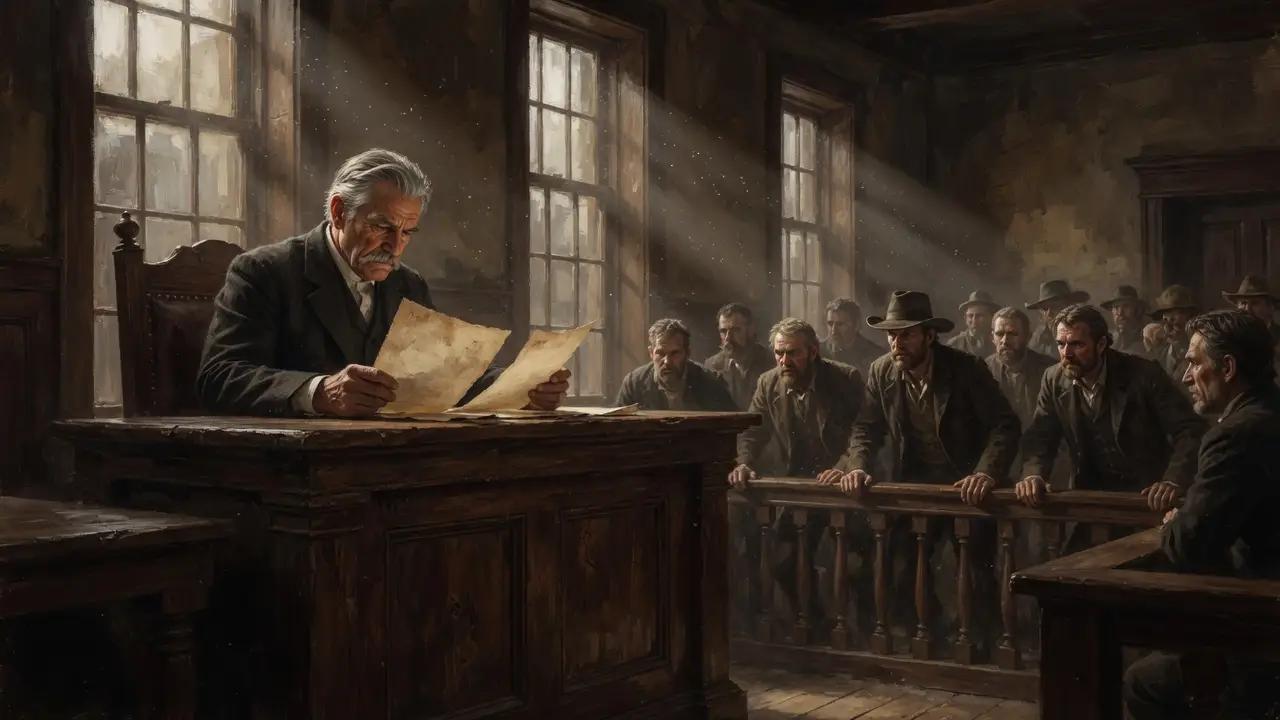
Ike Clanton, still alive and furious, filed murder charges against all four men. Justice of the Peace Wells Spicer was tasked with a narrower question than guilt or innocence: was there enough evidence to send Virgil, Wyatt, Morgan, and Doc to a full jury trial? For thirty days, more than thirty witnesses paraded through Spicer’s courtroom, and their accounts contradicted each other so completely that reading the transcripts today feels like two separate gunfights happened in the same lot at the same time.
Some witnesses swore the Cowboys had their hands up, surrendering, when the Earps opened fire without warning. Others insisted Frank McLaury and Billy Clanton were already drawing, already firing, and that Virgil had genuinely tried to talk his way out of bloodshed right up until the moment it became impossible. Sheriff Behan testified against the Earps. The town’s newspapers split along the same lines as the town itself, with the Tombstone Epitaph defending the Earps and the rival Nugget siding with the Cowboys’ families.
“I cannot resist the conclusion that the defendants were fully justified in committing these homicides.”
From Wells Spicer’s official ruling, November 30, 1881
After weeks of conflicting testimony, Spicer ruled there wasn’t sufficient evidence for a trial. In language that has been quoted ever since, he wrote that he could not resist the conclusion that the defendants were fully justified in committing these homicides. The men walked free.
But freedom in a courtroom isn’t the same as peace in a town, and Tombstone never fully accepted Spicer’s verdict. Half the town saw four men who’d done their dangerous, necessary job. The other half saw four armed men who’d walked up to a group with their hands rising and shot them down anyway, then used badges and a friendly judge to escape the consequences. Both versions of that story are still told today, sometimes by the same historians in the same breath, because the evidence genuinely supports both readings. That ambiguity is not a flaw in the record. It is the record.
The Vendetta Ride: When the Real Bloodshed Began
If the legend ended at the gunfight, it would already be a dark story. The truth is darker still, because October 26 didn’t end the feud. It detonated it.
Two months after Spicer’s ruling, in December of 1881, Virgil Earp was walking home at night when shotgun blasts erupted from a darkened building under construction. He survived, but his left arm was shattered so badly it never fully worked again. Then in March of 1882, Morgan Earp was playing billiards in a Tombstone saloon, his back turned toward a glass-paned door, when a bullet shattered the glass and tore through his spine. He died within the hour, reportedly with his last words being an apology, telling Wyatt he couldn’t see anymore.
Something in Wyatt broke after that. Whatever restraint had kept him operating inside the law up to that point disappeared entirely. Armed with a federal posse commission and a list of men he believed responsible, Wyatt Earp rode out of Tombstone with Doc Holliday and a small group of loyal gunmen on what history now calls the Earp Vendetta Ride.
Over the following weeks, several men connected to the Cowboys turned up dead, shot by Wyatt’s posse in confrontations that left little room for arrest or trial. Wyatt wasn’t enforcing the law by that point so much as becoming the very thing the law was supposed to prevent: a man delivering his own verdict at the end of a gun barrel.
He eventually rode out of Arizona Territory entirely, never to return, leaving behind a legend that would take decades, several biased memoirs, and an entire Hollywood industry to fully construct.
Why This Story Still Matters
Strip away the myth, and the O.K. Corral stops being a story about good guys and bad guys. It becomes something far more uncomfortable and far more familiar: a story about what happens when a community fractures into factions, when law enforcement and political ambition become impossible to separate, and when armed men on both sides of a divide convince themselves that violence is simply self-defense waiting to happen.
The most haunting detail might be this one, buried in old newspaper accounts: in Tombstone’s early days, before the bodies and the hearings and the vendetta, the local paper had actually praised the town’s relative peace, noting that despite the saloons and the gambling, serious gunplay was rare. That peace was fragile, propped up by exactly the kind of fragile authority Virgil Earp represented. It took one afternoon, one law about firearms, and a handful of frightened, furious men standing too close together to tear it apart for good.
We still tell this story because we still recognize it. Divided loyalties. Competing versions of the truth. A justice system asked to deliver clarity in a situation that never had any. Tombstone didn’t get a clean answer in 1881, and more than a century later, neither do we. Maybe that’s exactly why the gunfight near the O.K. Corral has never stopped firing.