Who pulled the trigger, who gave the order, and who slept better afterward. Every major political assassination in history shares a structural feature: the person most visibly harmed is rarely the person most deeply damaged by the death. The killers, whether idealists, fanatics, or tools, operate on emotion and ideology. The beneficiaries operate on patience.
- 1 The Knife Goes In. The Story Begins.
- 2 Caesar: The Murder That Saved Nothing and Started Everything
- 3 Thomas Becket: When a King Speaks Out Loud
- 4 Archduke Franz Ferdinand: The Assassination That Was Supposed to Prevent War
- 5 Abraham Lincoln: The Question That Never Goes Away
- 6 What They All Had in Common
The Knife Goes In. The Story Begins.
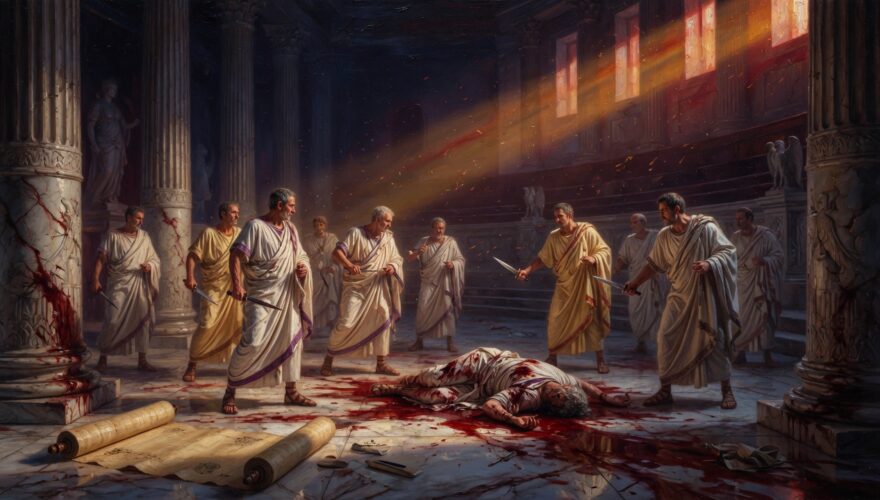
On the Ides of March, 44 BC, Julius Caesar walked into the Theatre of Pompey with a warning folded in his hand, unread. A soothsayer had already told him to watch the date. His wife Calpurnia had dreamed of his murder the night before. He went anyway. Within minutes, twenty-three senators drove their blades into him, taking turns like men fulfilling an obligation rather than committing a crime. The act was theatrical, almost ceremonial. Which should tell you something.
Because here is the question history rarely asks loudly enough: when an assassination happens in public, with dozens of willing participants, and the men responsible suffer almost no serious consequences, was it really a crime at all? Or was it a transfer of power wearing the costume of violence?
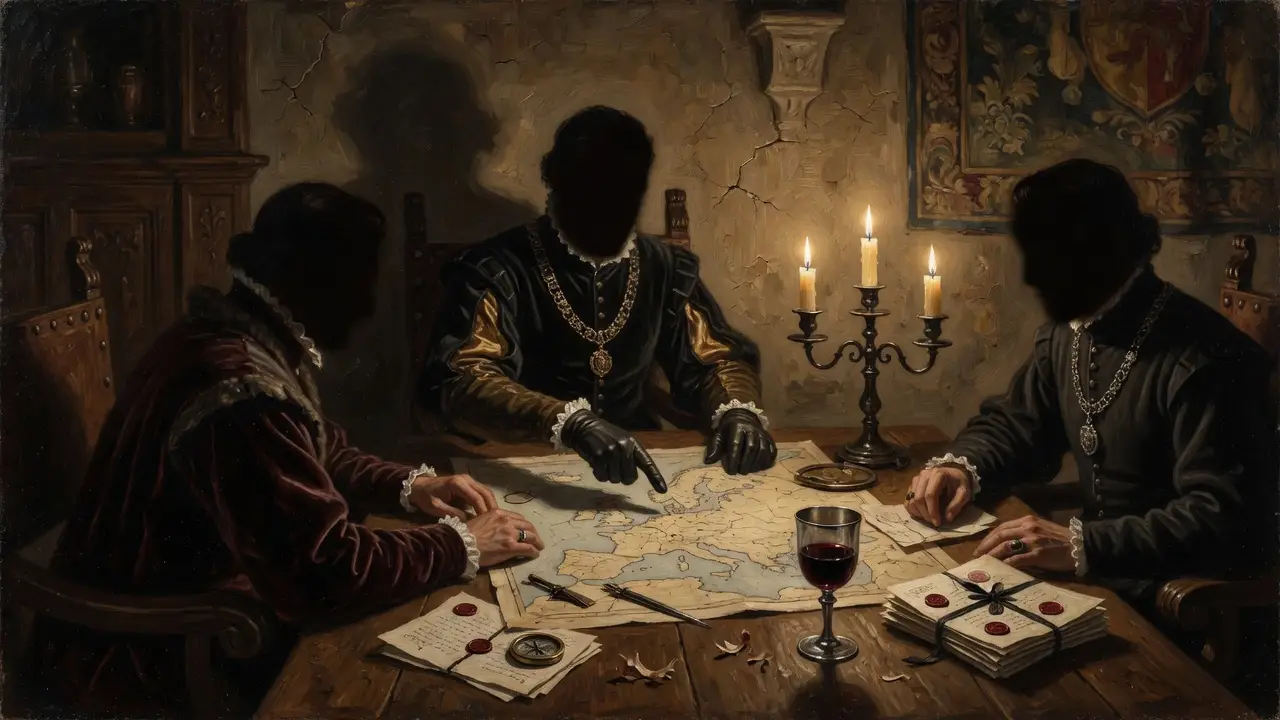
The assassinations that defined history were rarely what they appeared to be. Behind the official story, always another story. Behind the lone gunman, a room full of interested parties. Behind the tragedy, someone who absolutely, quietly benefited.
Caesar: The Murder That Saved Nothing and Started Everything
By 44 BC, the Roman Senate was a body of men who understood they were becoming decorative. Caesar had restructured Roman power so thoroughly that the republic, the thing they claimed to love, was already gone in everything but name. The senators who killed him, men like Brutus and Cassius, told the crowd they had saved Rome from a tyrant.
The crowd did not agree.
What followed the assassination was not stability. It was seventeen years of civil war, the rise of Octavian, and the birth of the Roman Empire. In killing the man they called a would-be king, the senators produced an actual dynasty that would last five centuries. The irony is almost too neat to be accidental.
“The tyrant is dead. But I fear we have merely changed masters.”
Marcus Tullius Cicero
The lesser-known detail most people miss: Caesar had named his grandnephew Octavian as his heir only weeks earlier. The senators knew this. They killed the father and left the son. Within a generation, Octavian, renamed Augustus, held more power than Caesar ever had, and did it with far more patience.
The “liberators” did not save the republic. They simply changed who buried it.
Join The Archive Briefing
Weekly dispatches. The history they didn't teach you — sourced, subverted, delivered to your inbox.
Thomas Becket: When a King Speaks Out Loud
In December 1170, King Henry II of England reportedly shouted, “Will no one rid me of this turbulent priest?” Four of his knights, apparently very literal men, rode to Canterbury Cathedral and hacked Archbishop Thomas Becket to death at the altar.
Henry spent the rest of his life insisting he hadn’t meant it. He performed public penance. He was flogged by monks. He wept.
He also got almost everything he wanted in the political dispute with Becket that had caused the tension in the first place.
The argument between them was essentially about whether the Church or the Crown had authority over English clergy who committed crimes. Henry wanted them tried in royal courts. Becket refused. After Becket died, the Pope and the English throne negotiated, quietly, and Henry retained significant influence over clerical appointments and taxation. The man whose death he denied ordering conveniently removed the obstacle that had stood in his way for nearly a decade.
“I am ready to die for my Lord, that in my blood the Church may obtain liberty and peace.”
Recorded by eyewitness Edward Grim
Becket was canonized as a saint. His shrine became one of the most visited pilgrimage sites in medieval Europe. And Henry II rebuilt his reputation as a pious king who had suffered greatly for his terrible words.
It was, in the end, a remarkable outcome for a man who claimed to be the victim.
Archduke Franz Ferdinand: The Assassination That Was Supposed to Prevent War
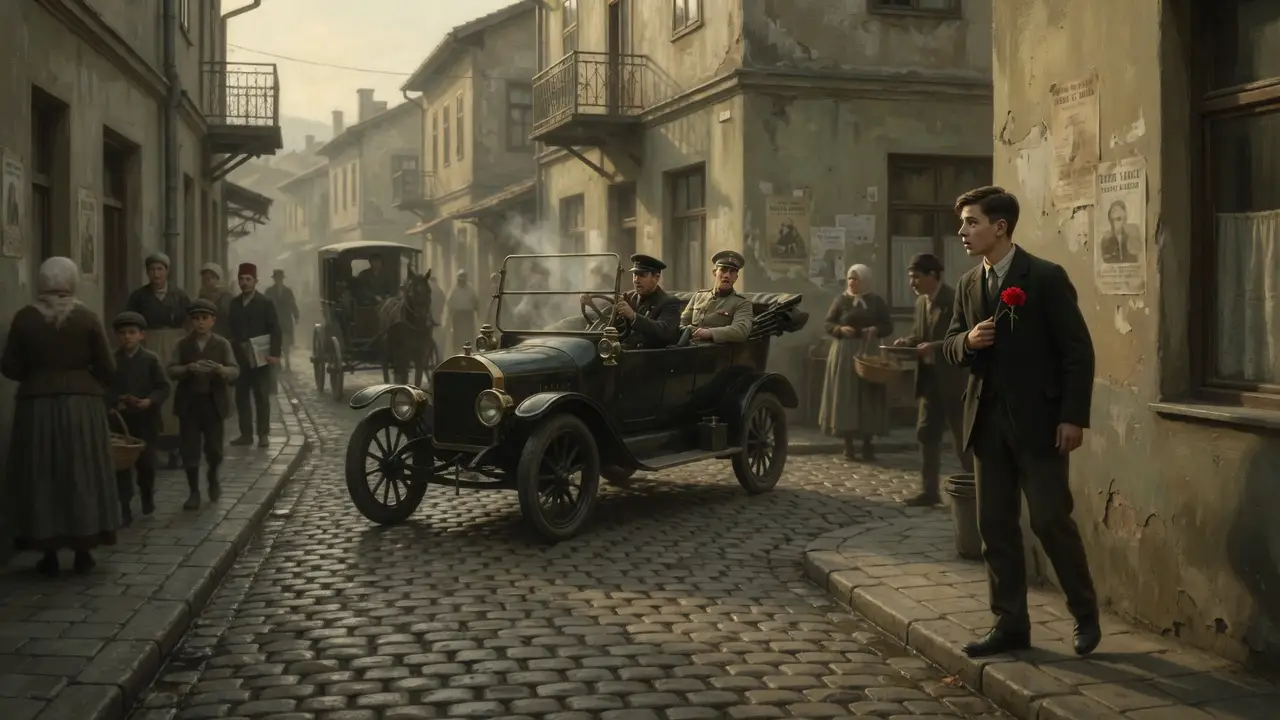
Sarajevo, June 28, 1914. The Archduke’s motorcade took a wrong turn, stalled directly in front of Gavrilo Princip, and the nineteen-year-old student did what five other conspirators that morning had failed to do. He pulled the trigger twice.
The world has since been told this moment started the First World War. Which is technically accurate and almost entirely misleading.
Franz Ferdinand was not popular with the Austro-Hungarian establishment. He was known for wanting to reform the empire’s relationship with its Slavic populations, which made him dangerous to the hardliners inside Vienna who preferred ethnic Serbs to remain subordinate. The Archduke’s death was convenient for the war faction in the Austro-Hungarian government, the men who had been looking for a justification to crush Serbia militarily. They got their justification wrapped in a tragedy they could publicly mourn.
The treaty ultimatum Austria-Hungary sent to Serbia afterward was deliberately designed to be rejected. Historians have known this for decades. It was not a demand for justice. It was a trigger mechanism for a war they had already decided to start.
Princip and his co-conspirators were trained by Serbian nationalist organization the Black Hand, with probable knowledge from Serbian military intelligence. The evidence suggests that at minimum, certain factions within Serbia knew the plot was in motion. And within Austria-Hungary, the deaths of a man nobody truly mourned were processed into the justification for a conflict that millions of people paid for with their lives.
“I am not a criminal,” Princip said at trial, “for I destroyed a bad man.” He died in prison in 1918, four years into the war his bullet had nominally ignited, never fully understanding what he had been used for.
Abraham Lincoln: The Question That Never Goes Away
John Wilkes Booth walked into Ford’s Theatre on April 14, 1865, with a single-shot derringer and a plan that included simultaneous attacks on Vice President Andrew Johnson and Secretary of State William Seward. The attacks on Johnson and Seward both failed. Booth’s did not.
The official story is relatively clean: a Confederate sympathizer, enraged by the South’s defeat, acted with a small circle of conspirators. Booth was killed twelve days later. Eight others were tried by a military tribunal rather than a civilian court, a decision that remains contested to this day, and four were hanged.
What rarely gets discussed in polite historical circles is the precise timing. Lincoln was five days from the end of the Civil War in practical terms. He had signaled a Reconstruction plan that was notably moderate, even generous toward the former Confederate states. His death transferred power to Andrew Johnson, a man who shared almost none of Lincoln’s sympathies for the freed enslaved population but had considerable sympathy for the Southern planter class.
“I have too great a soul to die like a criminal.”
John Wilkes Booth (from his diary)
The Radical Republicans in Congress, who wanted a punitive Reconstruction, found Johnson far more useful as a political opponent they could override than they ever would have found Lincoln as a president they would have had to negotiate with. Reconstruction became something else entirely. The rights of four million freed people were systematically dismantled over the following decades.
Was there a broader conspiracy? The evidence remains genuinely contested. What is not contested is who benefited, and who did not.
What They All Had in Common
Caesar’s senators freed Rome into tyranny. Henry II’s knights silenced a rival and handed their king a political solution wrapped in a scandal he could survive. The men who wanted war in 1914 got their war delivered by a teenager who believed he was fighting for his people. And the question of who truly ordered Lincoln dead, beyond the six men in a boarding house, has never been answered to anyone’s complete satisfaction.
The assassin steps into history. The strategist steps back into the room.
“The first method for estimating the intelligence of a ruler is to look at the men he has around him.”
Niccolo Machiavelli, The Prince, 1513
This is not conspiracy thinking. It is pattern recognition. Power does not mourn its own advancement. It adapts. It absorbs. It continues.
The next time a figure inconvenient to powerful interests dies violently, the first question worth asking is not who pulled the trigger. It is who folded up the warning and walked past it without reading, and who in the room already knew.