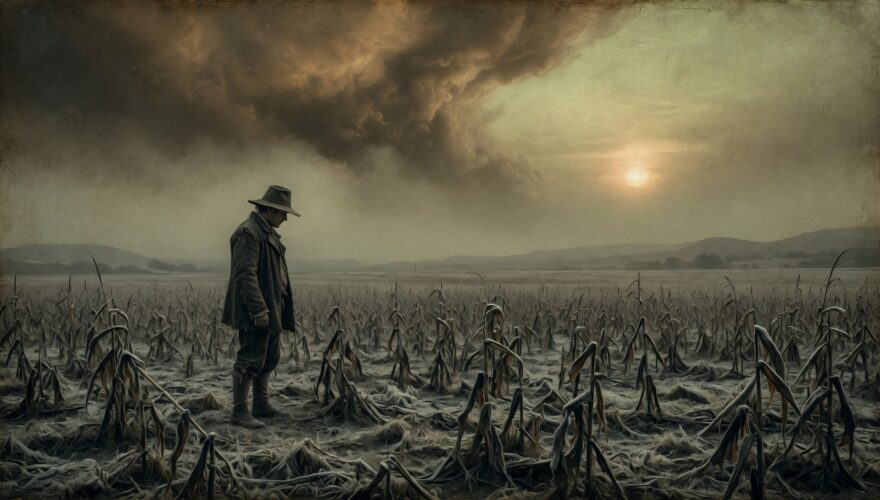
In July of 1816, a farmer in Vermont walked out to his fields and found them sheeted in frost. Not in October. Not in a cold snap that would break by noon. In July, with the haying season supposedly underway, ice crusted the grass and the sky overhead had taken on a strange, bruised color, as if the sun itself were sick.
Crops that had survived a June snowstorm were now dying a second death. Somewhere across the Atlantic, families in the German countryside were grinding sawdust into flour because there was nothing else left to grind. Nobody connected the dots. Nobody knew that fourteen months earlier and ten thousand miles away, a mountain in Indonesia had torn itself apart so violently that it changed the weather on every continent on Earth.
This is the story of the year the sun forgot how to warm the world, and the desperate, inventive, sometimes monstrous ways that people clawed their way through it.
A Mountain Erupts, and the World Doesn’t Notice
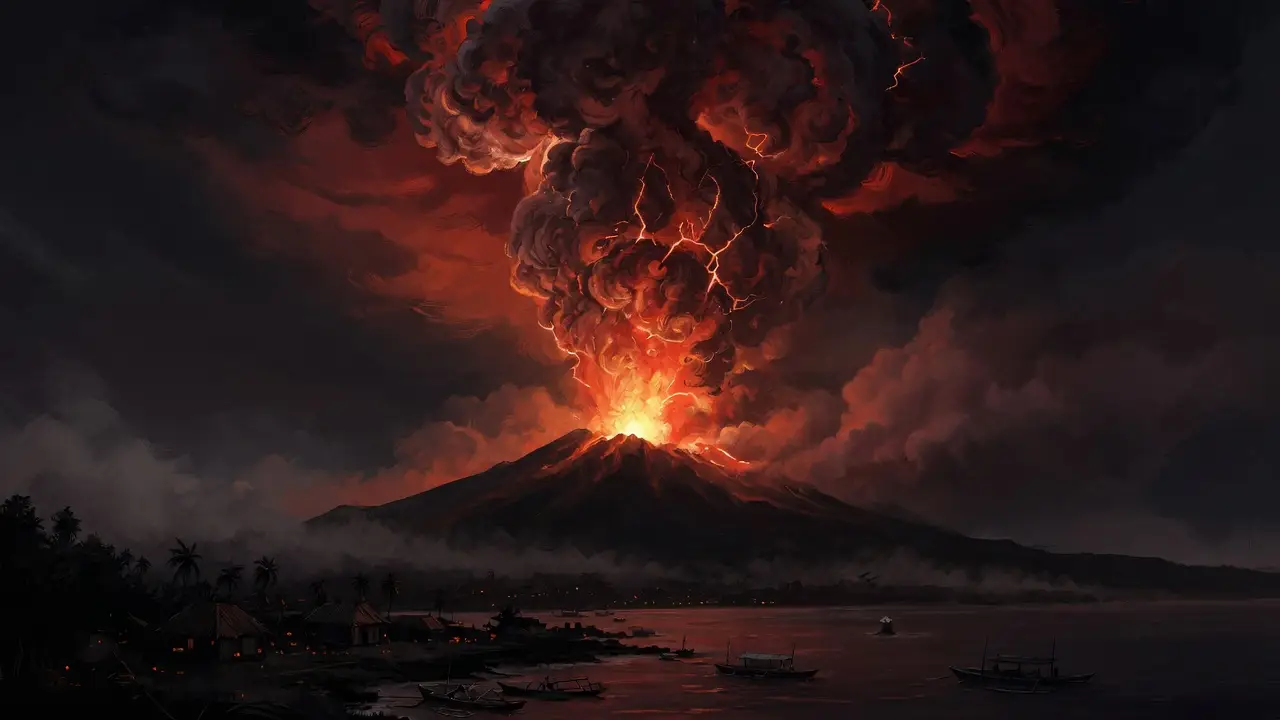
The mountain was called Tambora, a volcano on the island of Sumbawa in what was then the Dutch East Indies. For three years before 1815, it had been grumbling, venting smoke, rattling the nerves of villagers who lived in its shadow. Then, on the evening of April 10, 1815, it stopped grumbling and started screaming.
The explosion that followed remains, to this day, the most powerful eruption ever recorded by human beings. Tambora hurled roughly 160 cubic kilometers of rock, ash, and pulverized mountain into the sky, enough material that if you spread it evenly across the entire United Kingdom, it would bury the country nearly a foot and a half deep.
The blast was heard 1,600 miles away on Sumatra, where soldiers mistook it for cannon fire and prepared for an attack that wasn’t coming. The eruption column punched 25 miles into the sky, straight through the troposphere and into the stratosphere, which is exactly where a volcano does not want to send its gases if the rest of the planet would like to keep its climate intact.
Tambora itself lost nearly 5,000 feet of its own height in the blast, its summit collapsing inward to form a caldera over three miles wide. Roughly 10,000 people died on Sumbawa in the eruption itself, vaporized, buried, or drowned in the tsunamis that followed. Tens of thousands more would die in the months after, as ash smothered farmland and the survivors starved in a famine that history barely remembers, because the world had not yet learned the eruption had happened at all.
What made Tambora different from an ordinary catastrophe wasn’t just its size. It was the chemistry. The eruption released somewhere in the neighborhood of 60 million tons of sulfur dioxide gas, and unlike ash, which falls out of the sky within weeks, sulfur dioxide in the stratosphere does something far more patient and far more dangerous.
It combines with water vapor to form a fine mist of sulfuric acid droplets, an aerosol veil that can drift on stratospheric winds for years, circling the globe again and again, reflecting sunlight back into space before it ever reaches the ground. Tambora’s veil eventually wrapped itself around the entire planet. A volcano in the tropics had loaded a gun that wouldn’t go off until the following summer, in places its inhabitants had never heard of and would never visit.
Join The Archive Briefing
Weekly dispatches. The history they didn't teach you — sourced, subverted, delivered to your inbox.
The Summer That Forgot to Arrive
By the time the aerosol veil had spread and settled into the upper atmosphere, it was 1816, and the Northern Hemisphere was about to learn what it feels like to live under a dimmer switch.
The first sign was the color. People across Europe and North America described a strange, persistent haze, sometimes called the “dry fog,” that dimmed the sun to a dull red disc you could stare directly at without squinting. Sunspots were visible to the naked eye through it. Some witnesses described a sickly greenish or bronze cast to the daylight, the kind of light that makes a landscape look like it’s being viewed through old, yellowed glass. The fog resisted wind. It resisted rain. Nobody could explain where it had come from or why it wouldn’t leave.
Then came the cold, and the cold did not behave like cold is supposed to behave. This wasn’t a hard winter. It was winter showing up uninvited, again and again, throughout a season that was supposed to belong to summer. Frost was reported in New England in every single month of 1816, including July and August.
On June 6th, six inches of snow fell across New England; in Quebec, the snow piled up a foot deep. In Switzerland, Mary Shelley would later describe rivers swollen and flooded under skies that simply refused to clear, lightning splitting the dark for hours at a stretch. An Albany newspaper, looking back that October, called it the most uncommon weather “not only in this country, but, as it would seem, throughout the world.”
For farmers, this was not an inconvenience. It was an extinction-level threat to everything they understood about how the world worked. Corn that sprouted in May froze in June, was replanted, and froze again in August before it could mature. Wheat rotted in waterlogged fields or shriveled under frost. The agricultural calendar, the single most trusted rhythm in pre-industrial life, simply broke. Farmers had spent generations learning to read the sky for warning signs of bad weather. Nothing in that inherited knowledge had prepared them for a sky that stayed wrong for months on end.
Thomas Jefferson, retired to Monticello and still an obsessive farmer at heart, watched his own harvest collapse and wrote with the particular despair of a man who had seen plenty of hard seasons but never one like this: “We have had the most extraordinary year of drought and cold ever known in the history of America.” Jefferson, like everyone else trying to make sense of 1816, had no idea a volcano on the other side of the planet was responsible. The science of stratospheric aerosols wouldn’t exist for another century. All anyone had to go on was dread, and the conviction that something had gone fundamentally wrong with the sky.
Eating the Unthinkable
When the harvest fails once, a community tightens its belt. When it fails twice in a row, in a world without refrigeration, without global shipping networks, without any of the buffers a modern food system takes for granted, the result isn’t hardship. It’s starvation, arriving on a continental scale.
Grain prices in parts of Europe tripled within months. Oats, the fuel that powered every horse-drawn cart, plow, and carriage, climbed to eight times their normal price, which meant that even people who could scrape together money for human food often couldn’t afford to keep their animals fed. What followed was a famine diet so desperate it reads now like the inventory of a society eating its own foundations.
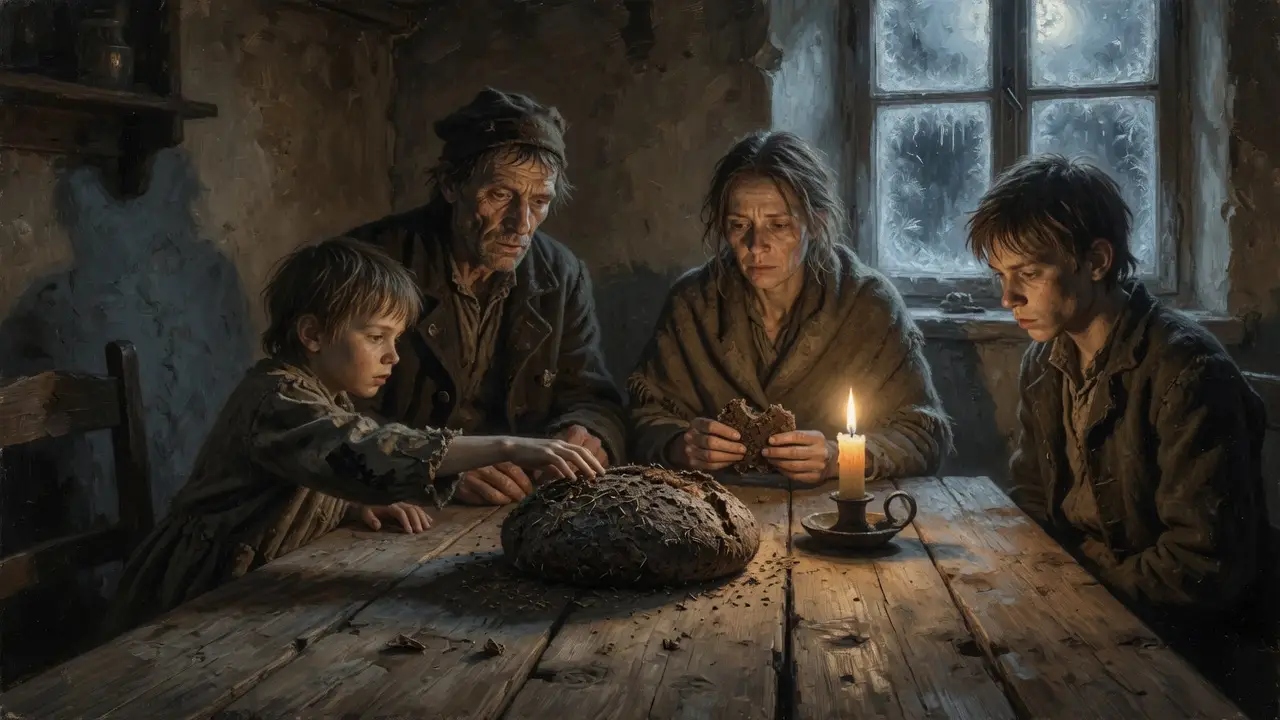
Families in Germany and Switzerland baked what came to be called “hunger bread,” loaves bulked out with ground sawdust, straw, and tree bark, anything with enough fiber to fool a starving stomach into feeling full for an hour. People boiled nettles. They ate hedgehogs and pigeons and, by some accounts, the carcasses of animals that had already died of starvation themselves. In the most extreme tellings, desperate mothers mixed clay into water and gave it to crying children, a substance with no nutritional value whatsoever, offered because there was simply nothing else to offer.
Livestock died in droves, not from disease but from the simple absence of fodder. Farmers who couldn’t feed their horses, oxen, and cattle through the failed hay harvest faced an impossible choice: slaughter the animals now for whatever meat they could get, or watch them starve to death producing nothing. Either way, the long-term math was brutal. An animal eaten in autumn 1816 was an animal that couldn’t plow a field, pull a cart, or produce milk in 1817, which meant farmers weren’t just losing a harvest. They were eating their own future.
Desperation curdled fast into anger, and anger went looking for someone to blame. Europe in 1816 was barely a year removed from Waterloo, full of fragile governments trying to stabilize themselves after decades of war, and they now faced populations who were hungry, frightened, and increasingly convinced their rulers were either incompetent or indifferent. Bread riots broke out in London, Paris, and Zurich.
In the East Anglian countryside of England, armed laborers marched on the cathedral town of Ely under flags reading “Bread or Blood,” took local magistrates hostage, and fought pitched battles against the militia sent to put them down. Grain shipments were seized. Markets were looted. In China, the famine that followed the same volcanic winter weakened imperial control in the southwest so severely that it fed ethnic rebellion and allowed the opium trade to take root in Yunnan province, a single eruption’s fingerprints showing up in conflicts the people living through them could never have connected back to a mountain they’d never heard of.
Historians studying the period later called 1816 to 1817 the last great subsistence crisis of the Western world, the final time famine on this scale would sweep across Europe before industrialization and global trade made anything similar essentially unthinkable. Mortality across the continent in 1817 ran more than fifty percent above its already elevated wartime rate. Hundreds of thousands of people, driven from homes that could no longer feed them, fled east toward Russia or west across the Atlantic toward America, refugees of a disaster whose actual cause wouldn’t be understood for another hundred years.
What People Built in the Dark
It’s tempting to imagine a famine year as nothing but suffering, a long gray stretch of misery with no other story attached to it. But human beings under extreme pressure don’t just endure. They improvise, and some of what they improvised in 1816 reshaped the centuries that followed.
In Germany, a civil servant and amateur inventor named Karl Drais watched the price of oats climb out of reach for ordinary people and realized that horses, the backbone of personal transportation for all of human history, were becoming a luxury few could afford to keep. So he built something that didn’t need to eat: a two-wheeled wooden contraption you straddled and propelled by pushing off the ground with your feet, steering with a handlebar up front.
He called it the Laufmaschine, the “running machine.” It had no pedals and no chain, nothing that would be recognizable as a bicycle to a modern eye, but the basic architecture, two wheels in a line, balanced and steered rather than pulled, was unmistakably the ancestor of every bicycle built since. Drais patented his invention in 1817, born directly out of a famine that made horses too expensive to feed.
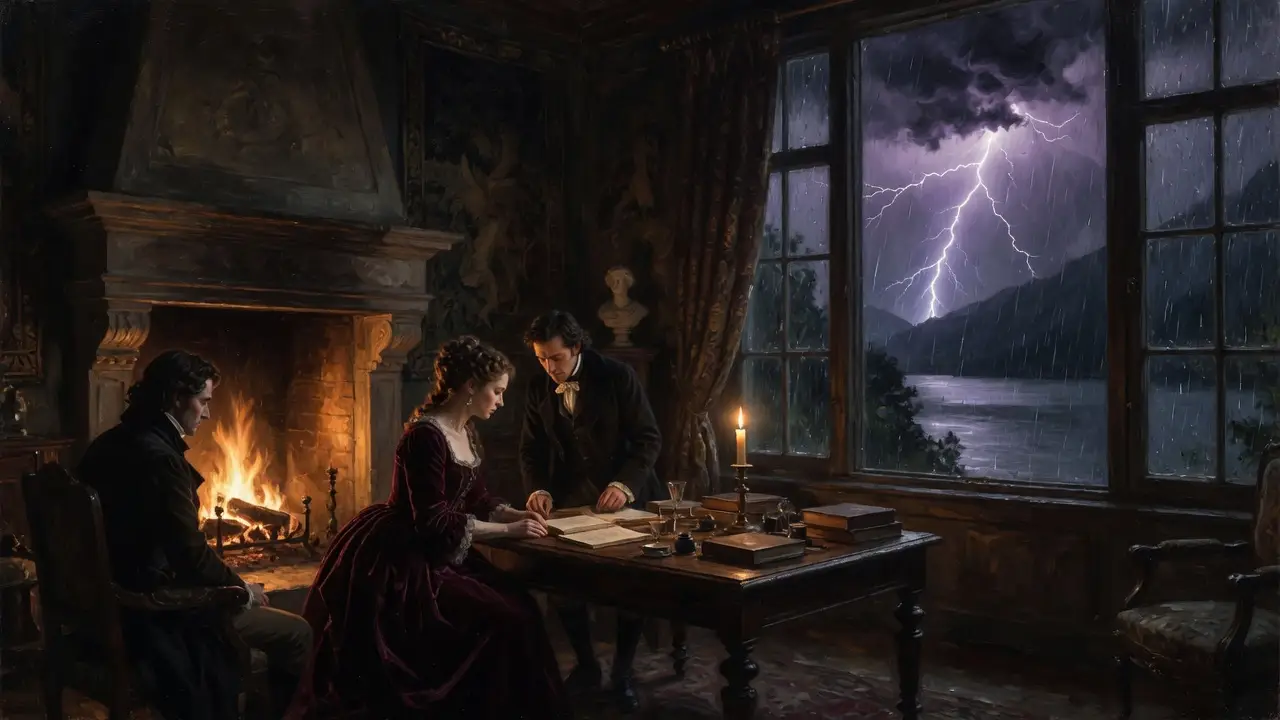
Across the mountains in Switzerland, a different kind of creation was taking shape, one driven less by economic necessity than by sheer claustrophobic boredom. At a rented house on the shores of Lake Geneva, the poet Lord Byron and his physician John Polidori had taken up residence at the Villa Diodati, joined by eighteen-year-old Mary Wollstonecraft Godwin, her lover Percy Bysshe Shelley, and Mary’s stepsister Claire Clairmont.
They’d come to Switzerland expecting a summer of lake-side leisure. What they got instead was incessant rain and skies that wouldn’t clear. Mary would later write that “it proved a wet, ungenial summer, and incessant rain often confined us for days to the house.” Storms lit up the Alps for hours at a stretch; the lake flooded; there was simply nothing to do but stay indoors and talk.
So they read ghost stories aloud, a volume of German tales translated into French, and one evening Byron proposed a contest: each of them would write a horror story of their own. Most of the group’s attempts went nowhere. Byron himself, in that same gloomy stretch of weather, wrote instead a poem called “Darkness,” imagining a future in which the sun itself had died and humanity descended into chaos beneath a permanently black sky, a vision that felt less like fantasy and more like reportage to anyone reading it that particular summer.
But it was Mary, after days of failing to land on an idea, who produced something that would outlast everyone in that room. Lying awake one night, she imagined a scientist who breathes life into something he’s built and immediately recoils in horror from what he’s made. The story she wrote out of that vision became Frankenstein, a novel that gave the world its defining myth of science gone wrong, conceived almost entirely because a volcanic winter had trapped its author indoors with nothing to do but think about darkness, isolation, and the terrible things that can happen when nature stops behaving the way it’s supposed to.
The art of the era absorbed the same mood. Painters working in the years after 1816 captured skies of a strange, lurid intensity, sunsets bruised with color that owed less to artistic imagination than to literal volcanic particulate scattering light across the upper atmosphere. The whole cultural temperature of the period tilted toward the apocalyptic, toward stories of endings and judgment and a natural world turned hostile, because for the people living through it, that wasn’t metaphor. That was the weather report.
What the Ash Left Behind
By 1817, the aerosol veil had finally thinned enough for the sun to do its job again. Harvests recovered. Grain prices fell back to earth. The migrants who’d fled west into Ohio and Indiana, or east into the Russian interior, mostly stayed in their new homes, having already rebuilt lives there. The world, in the way the world tends to do, moved on, and the eruption that had caused all of it faded into a half-remembered curiosity, a strange year nobody could quite explain, eventually filed away under sunspots or divine punishment or simple bad luck.
It would take until the late twentieth century, with ice cores and tree rings and a far better understanding of atmospheric chemistry, for scientists to draw a confident, unbroken line from a single mountain in Indonesia to a famine that reshaped Europe, a bicycle, and a monster.
That gap, the fourteen months between the bang and the consequence, between a volcano nobody outside Indonesia had heard of and a Vermont farmer staring at frost in July, is the part of this story worth sitting with. We live now in a food system that is, in its own way, just as globally interconnected and just as exposed as any farmer in 1816, except today a bad harvest in one hemisphere ripples through grain futures and supermarket shelves on the other side of the planet within days, not months. We’ve gotten extraordinarily good at moving food long distances quickly. We have gotten no better at growing food without sunlight.
Geologists who study the deep history of volcanism are blunt about the odds: a VEI-7 eruption, the same scale as Tambora, is not a once-in-history fluke. It’s a recurring event on a timescale of centuries, and the planet is, by most reckonings, overdue for another one. A modern Tambora wouldn’t arrive as a curiosity explained away by sunspots. We would know almost immediately what had happened and roughly what to expect. Whether we are actually prepared for a multi-year global harvest failure, with a human population many times larger than 1816’s and supply chains optimized for efficiency rather than resilience, is a far less comfortable question, and not one anyone has satisfactorily answered.
Humanity survived the Year Without a Summer. It survived the hunger bread and the bread riots and the refugee roads heading east and west, and out of the wreckage it even produced a bicycle and a monster that have both outlived everyone involved. But survival, in 1816, came at a cost measured in hundreds of thousands of lives and a kind of inherited unease that outlasted the famine itself, a quiet cultural memory of just how fast the sky can turn against the people living beneath it.
The mountain spoke once, on an island most of the people it would eventually starve had never heard of, and the world spent two years answering back in frost, in ash-colored bread, and in stories about monsters born from nature gone wrong.