
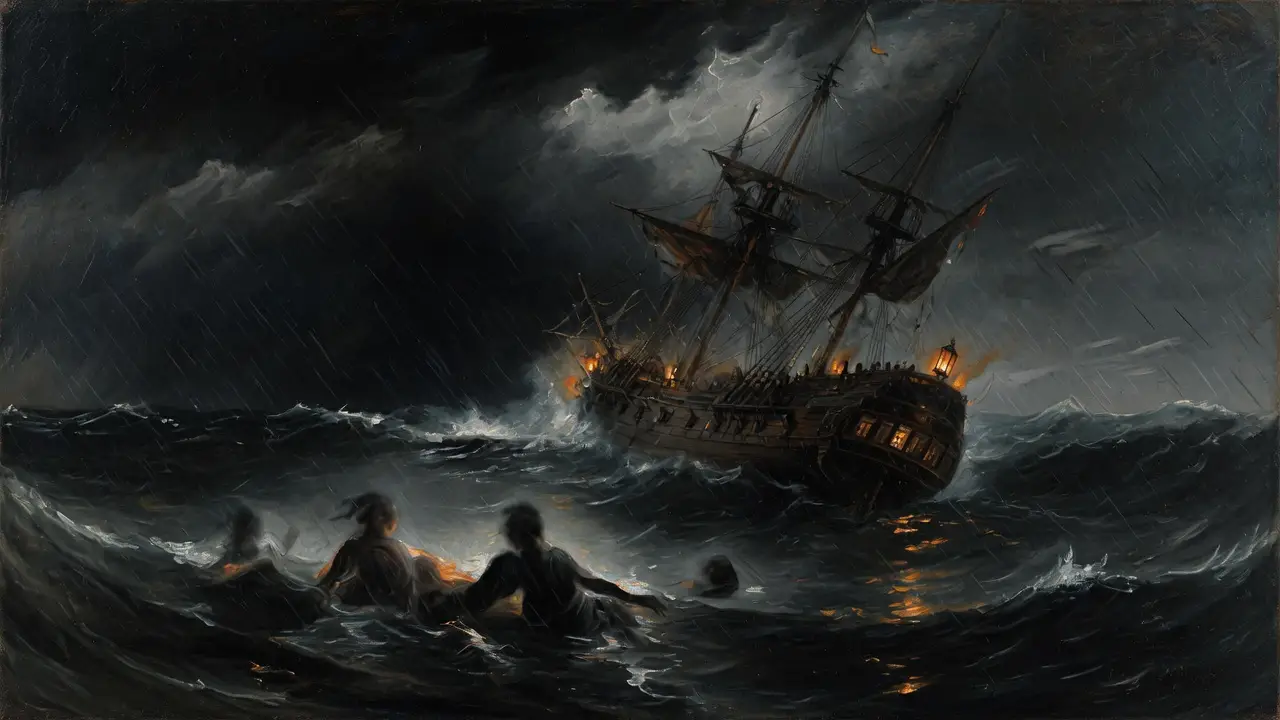
In 1781, the captain of a British slave ship called the Zong ordered 133 enslaved Africans thrown overboard into the Atlantic Ocean. Not because of a storm. Not because the ship was sinking. Because the ship’s water supply was running low, and under the terms of the insurance policy covering the voyage, dead cargo could be claimed. Live cargo could not.
The owners filed for £30 per person.
The case went to court, not as a murder trial, but as an insurance dispute. The insurers fought back, not on moral grounds, but because they suspected fraud. A British court debated whether the massacre was legally covered under maritime loss. The men, women, and children thrown into the sea were never once referred to as people in the proceedings.
That detail tells you everything about how the slave trade actually worked. It wasn’t a crime operating in the shadows. It was a business. Ledger-balanced, shareholder-approved, insured, and listed on the London market.
Built on Paper as Much as on Ships
Most people learn the slave trade as a story of ships, chains, and plantations. That’s accurate, but it’s only the surface layer. Beneath it ran an entire financial architecture, one so sophisticated, so deeply embedded in European capitalism, that it didn’t just fund the trade. It became the trade.
“The property of the owners of this ship is not to be compared with the property of black men.”
Granville Sharp, abolitionist, responding to the Zong massacre trial, 1783
By the mid-1700s, the transatlantic slave trade was one of the largest commercial enterprises on earth. Somewhere between 12 and 12.5 million Africans were forcibly transported across the Atlantic between the 16th and 19th centuries. The sheer scale demanded infrastructure. Not just ships and ports, but banks, insurance houses, investors, and paper instruments that could spread risk and multiply profit across an entire continent.
European banking didn’t merely support slavery. It engineered it.
Shares in Human Lives
In 1672, King Charles II of England granted a royal charter to the Royal African Company, giving it a monopoly on the English slave trade. The company sold shares. Investors bought them. Among the early shareholders was John Locke, the philosopher who would later write extensively about the natural rights of man and the foundations of human liberty.
Join The Archive Briefing
Weekly dispatches. The history they didn't teach you — sourced, subverted, delivered to your inbox.
He held stock in the Royal African Company for years.
When the RAC’s monopoly ended in 1698 and the trade opened to independent merchants, the market exploded. Investors could now buy shares in individual voyages. A Bristol merchant who couldn’t afford to outfit an entire slaving expedition could purchase a fractional stake, spread his risk across three or four ships, and collect dividends based on the number of enslaved people sold on arrival.
This was, functionally, a commodity market. The commodity was human beings.
By the mid-1700s, Lloyd’s of London (the insurance institution that still operates today) was routinely underwriting slave ships. Policies covered the usual maritime risks: storms, piracy, navigation errors. But they also covered what the industry called “mortality of slaves,” with one critical carve-out. Death by “natural causes” was not covered. Jettison deliberately throwing enslaved people overboard to save the ship, or to manufacture an insurance claim, sometimes was.
The Zong massacre wasn’t an anomaly. It was a system working exactly as designed.
The Banking Families Behind the Curtain
No institution understood the financial machinery of slavery better than the merchant banks of Britain, France, and the Netherlands.
Barclays Bank traces part of its origins to the Quaker merchant David Barclay, whose family had direct ties to the slave trade. The Baring Brothers, once called “the sixth great power of Europe” by the Duc de Richelieu, financed American cotton plantations worked by enslaved people, extending credit lines that kept the entire plantation economy liquid. When the United States purchased Louisiana from France in 1803 for $15 million, it was the Barings and Hope & Co. of Amsterdam who arranged the transaction, a deal that massively expanded the geographic reach of American slavery.
“Slavery is not an idea. It is a contract, enforced by law, secured by credit, and underwritten by the respectable houses of Europe.”
Eric Williams, Capitalism and Slavery, 1944
In France, the Bordeaux merchant houses grew fat on the “exclusif”, the colonial system that locked Caribbean islands into trading exclusively with the French mainland. The port of Nantes became the epicenter of the French slave trade, with local banking families financing voyage after voyage. By some estimates, nearly 40% of all French slave expeditions departed from Nantes alone.
In Hamburg, Frankfurt, and Amsterdam, banking networks extended credit to plantation owners using enslaved people themselves as collateral. A plantation owner could mortgage his “human property”, the people he claimed to own, to secure loans for more land, more ships, more expansion.
People were simultaneously the labor, the product, and the loan security.
The Insurance Architecture of Atrocity
Lloyd’s wasn’t the only insurer in this market. Specialist underwriters in Bristol and Liverpool competed aggressively for the slave trade business, which was considered enormously profitable despite its risks. The Middle Passage, the crossing from West Africa to the Americas, killed somewhere between 10 and 20 percent of enslaved people on average voyages, sometimes more. Shipboard disease, violence, and despair extracted a brutal toll.
For insurers, this created a precise actuarial problem: how do you price mortality risk on human cargo?
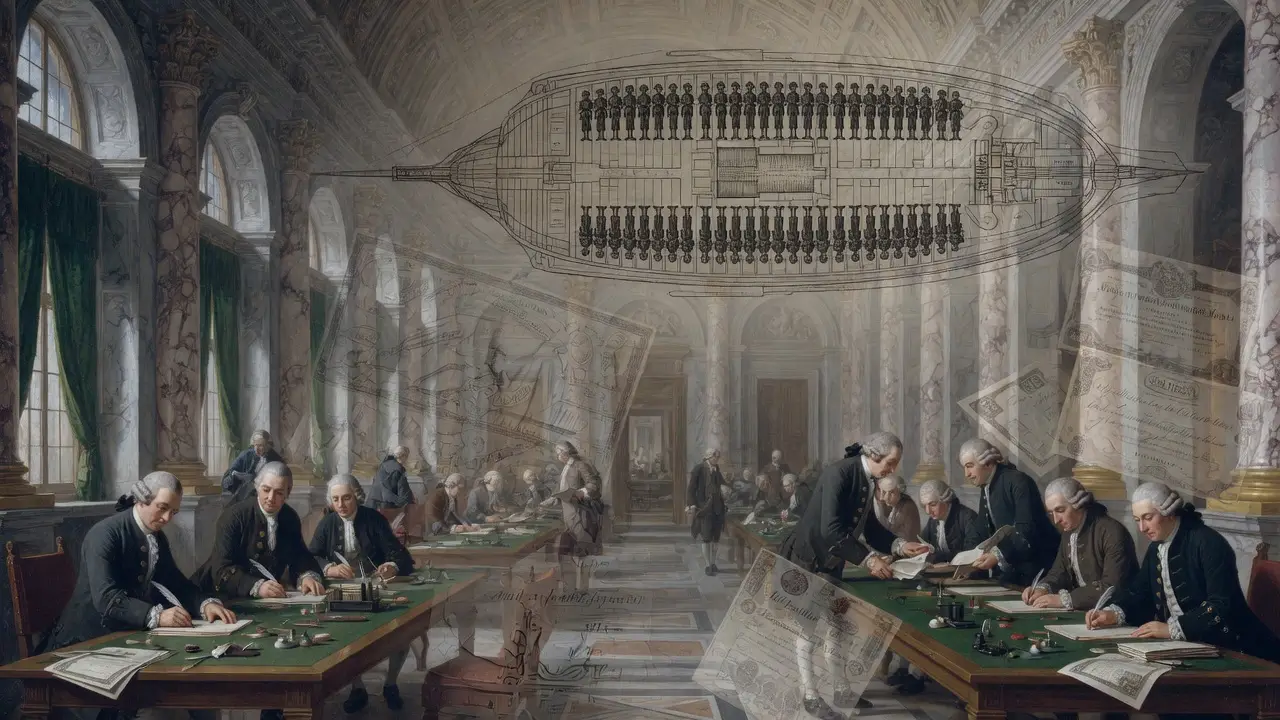
They solved it the way all insurance markets do… with data. Slave traders kept meticulous records. Death rates by region of origin, by age, by season, by route. The volume of paperwork generated by the Atlantic slave trade was staggering. Manifests listing every person by name (or by number), physical description, and perceived value. Cargo logs noting deaths mid-voyage. Insurance claims filed on arrival.
“Men are not cattle. But they may be insured as such, if the law permits.”
Abolitionist pamphlet, Bristol, circa 1788 (author unknown)
One particularly grim entry from a Liverpool slave ship log, dated 1788, notes the deaths of “14 slaves” alongside a note on cargo spoilage affecting barrels of rice. Same handwriting. Same column.
The documentation preserved in British archives is extraordinary. The slave trade was one of the most thoroughly recorded commercial operations of its era, because every death was a potential insurance claim, and every claim had to be proven.
When the Numbers Started Working Against It
By the late 18th century, the economics of slavery began to crack, not primarily because of moral pressure, though the abolitionist movement was growing, but because the numbers were shifting.
The Haitian Revolution of 1791 was the earthquake that shook the financial architecture. Saint-Domingue, the French colony that would become Haiti, had been the most profitable slave colony on earth, producing roughly 40% of all European sugar and more than half its coffee. When enslaved people rose up and eventually won their freedom in 1804, the plantation economy of the Caribbean took a blow it never fully recovered from.
Insurance rates on voyages to the Caribbean spiked. Investors grew nervous. Some banking houses quietly began diversifying away from slave trade debt.
Then came the British abolition of the slave trade in 1807. What followed revealed the financial system’s true nature with unusual clarity. Rather than simply ending, the trade went underground. Slave ships began flying American or Portuguese flags. Insurance fraud exploded as captains sought to collect on “lost” cargo. The financial infrastructure adapted, because financial infrastructure always does.
And when Britain finally abolished slavery in 1833, the government paid £20 million in compensation, roughly 40% of the national budget at the time. Not to the enslaved people. To the slaveholders. For their property loss.
The British taxpayer was still paying off that debt in 2015, when the National Archives quietly noted that the loan financing the compensation had only just been fully retired.
The Long Money
The wealth generated by the slave trade didn’t evaporate when the trade ended. It compounded.
Historians like Eric Williams argued as early as 1944, in his landmark work Capitalism and Slavery, that profits from the slave trade directly financed the British Industrial Revolution. Cotton mills in Manchester. Railway investment. The very infrastructure of modern Britain. His thesis remains debated in its specifics, but its core insight, that slavery wasn’t peripheral to Western capitalism but foundational to it, has only grown more supported as researchers dig deeper into colonial financial records.
“The profits of the [slave] trade contributed directly to the laying of the foundations of capitalism.”
C.L.R. James, The Black Jacobins, 1938
The Legacies of British Slave-ownership project at University College London spent years mapping the compensation payments of 1833. What they found was striking: the families who received that government money went on to invest in railways, banking, insurance, and industry. Some of those family names still appear on corporate boards, hospital wings, and university buildings.
The money moved. It didn’t disappear.
The Reckoning
In 2020, Lloyd’s of London issued a formal apology for its role in insuring the slave trade. In 2023, the Caribbean Community formally renewed calls for reparations from former colonial powers, citing precisely this financial history. Several European cities, Bristol, Nantes, Amsterdam, have begun confronting their slave trade wealth in public memorials, museum exhibitions, and civic debates.
These aren’t exercises in collective guilt. They’re attempts to map the actual financial circuitry of the modern world, to trace where the money came from and where it went. Because when you follow the paper, the insurance policies, the stock certificates, the loan ledgers, you stop seeing the slave trade as a historical horror and start seeing it for what it also was: an economic system whose outputs are still inside the walls of institutions that exist today.
The Zong insurers eventually refused to pay the claim. The murdered men, women, and children received no justice. But the court case helped spark the British abolitionist movement, proving that sometimes the cruelest exposure of a system’s logic is what finally breaks it.
It took another half century after Zong for Britain to abolish the trade. The ledger is still being balanced.