The sanitized version involves idealistic children marching for faith. The real version involves slave traders, mass drowning, and adults who orchestrated the whole thing.
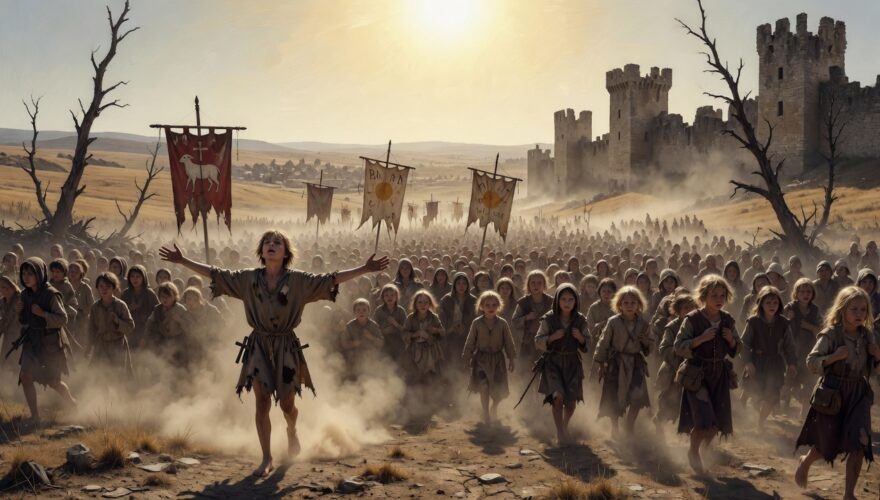
In the summer of 1212, a shepherd boy in France named Stephen stood before King Philip II with a letter he claimed had been handed to him by Jesus Christ. He was twelve years old. The king, unimpressed, told him to go home. Stephen ignored this entirely. Within weeks, he had assembled a crowd of roughly thirty thousand followers, many of them children, all of them convinced that God would part the Mediterranean Sea before their feet and allow them to march into Jerusalem without spilling a single drop of blood. It was the kind of story that ends in triumph only in fairytales. This was not a fairytale.
What followed was one of the most tragic episodes in the long, blood-soaked history of the Crusades: a mass movement of the poor, the young, and the desperate, exploited at every turn by adults who saw profit in their faith and their naivety.
The World That Made Them Believe
To understand why tens of thousands of people followed a child into the wilderness, you have to understand the world they were living in. By 1212, the Crusades had already ground through four grueling, largely catastrophic campaigns. Jerusalem had been retaken by Saladin in 1187. The Fourth Crusade, which ended in 1204, had not even made it to the Holy Land. Instead, Crusader forces sacked Constantinople, a Christian city, burning churches and slaughtering fellow believers for plunder. The whole movement had become synonymous with failure, corruption, and blood.
Into this disillusionment stepped a peculiar theology: the idea that perhaps God was punishing the faithful because the Crusades were being led by the wrong people. Proud knights, greedy lords, corrupt clergy. Maybe what God actually wanted was the humble. The pure. The children.
“God wills it,” the preachers said. He always did. The question was which God, and whose children.
Stephen, Nicholas, and the Two Crusades
Most accounts conflate two separate events, but they ran nearly parallel and ended in almost identical catastrophe. While Stephen preached in France, a German boy named Nicholas was doing the same thing in Cologne, claiming that the sea would part for him just as it had for Moses. He led a column of around seven thousand people south through the Alps toward the Italian coast. The mountains killed many of them. Cold, starvation, and exhaustion thinned the column as it snaked through the passes. By the time the survivors staggered into Genoa, they were skeletal and desperate. The sea, predictably, did not part.
Some broke away and made it to Brindisi in the south. The bishop there took one look at them and sent them home. Others pushed on to Pisa, where two ships gave passage to an unknown number. Their fate is unrecorded. Many of the German children who survived the march simply never returned. Some wandered into slavery. Some died of disease. A chronicler writing a generation later noted that people called the roads home the “road of the wandering children,” because so many of the survivors still hadn’t made it back years after the march ended.
LESSER-KNOWN DETAIL
Nicholas of Cologne’s father, who had encouraged and helped organize the march, was reportedly hanged by furious survivors when they returned. It was one of the few moments of accountability in the entire tragedy.
The Ships That Were Waiting
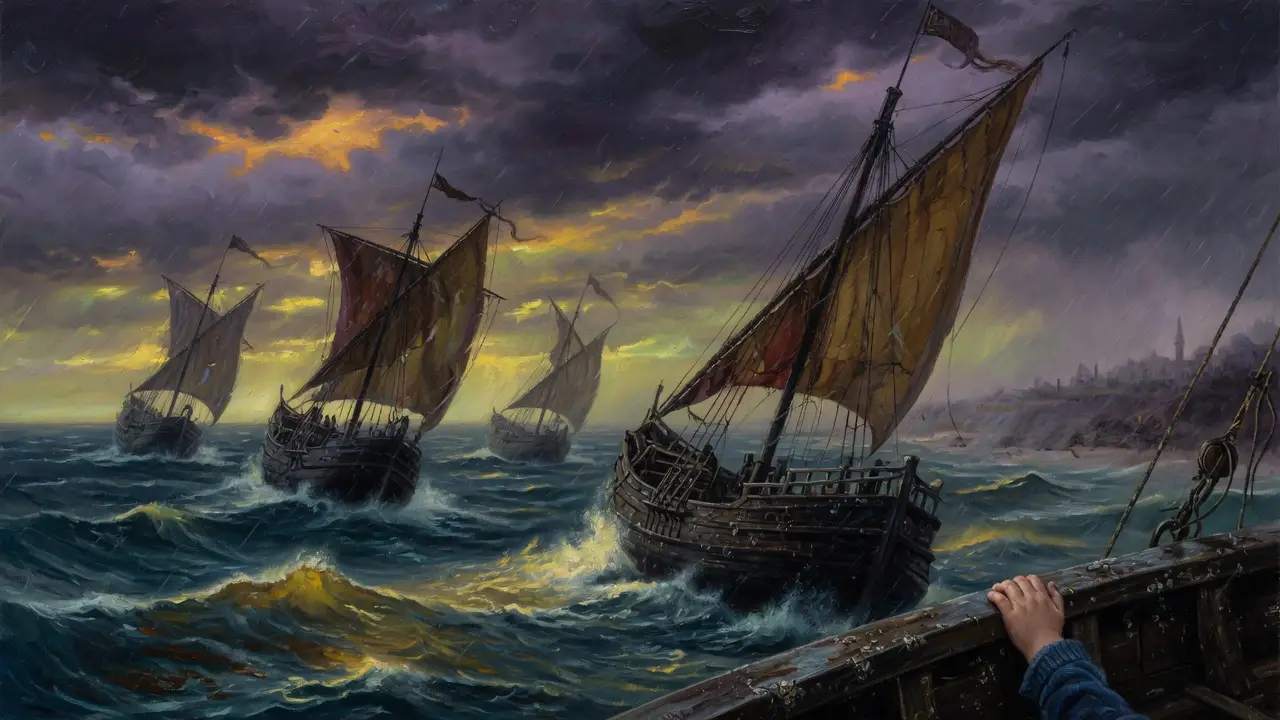
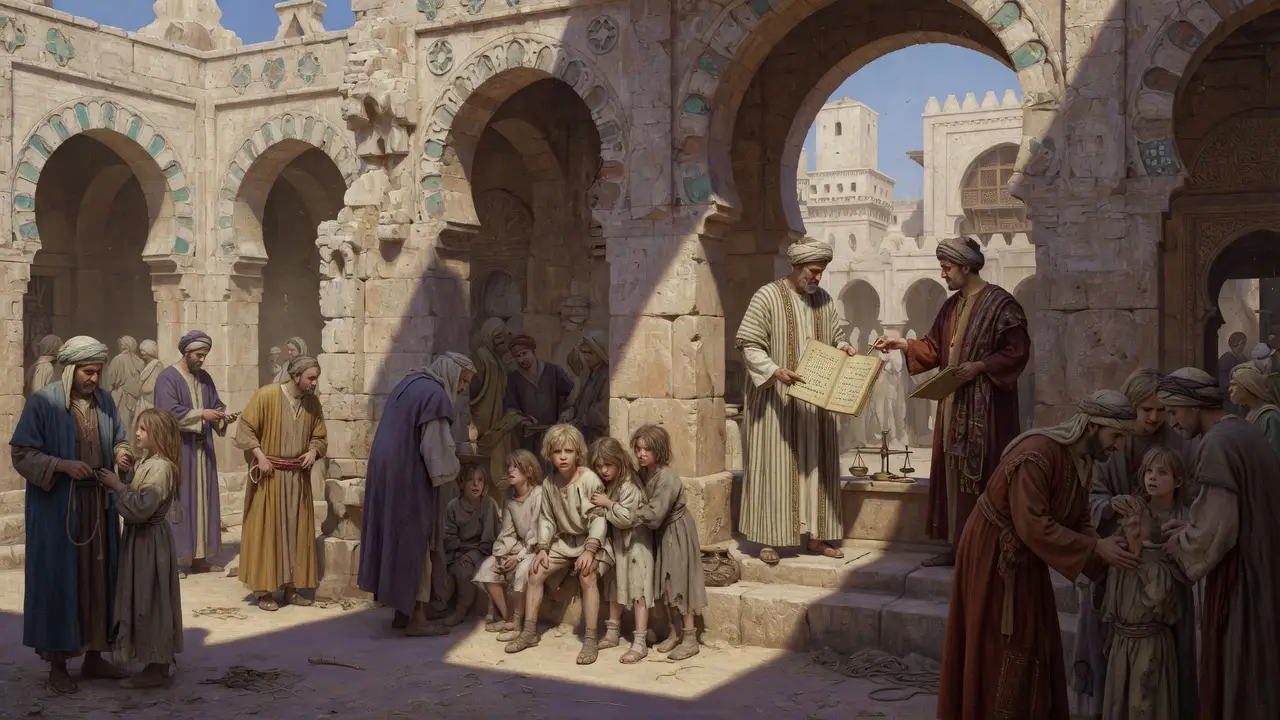
Stephen’s French contingent reached Marseille. Seven ships had been arranged for them. This is the moment where the story stops being merely sad and becomes genuinely sinister.
Join The Archive Briefing
Weekly dispatches. The history they didn't teach you — sourced, subverted, delivered to your inbox.
The ships were provided by two merchants named Hugh Ferreus and William Porcus. History has not been kind to their reputations, and with good reason. They offered free passage to the Holy Land. No cost. Nothing owed. Just board the ships. The children boarded.
Two of the seven ships wrecked in a storm off Sardinia. Every child aboard drowned. The remaining five ships did not sail to the Holy Land. They sailed to North Africa. To the slave markets of Bougie and Alexandria.
The children who survived the crossing were sold. Eighteen of them reportedly refused conversion to Islam and were executed in Alexandria. The rest disappear into the silence of the historical record, absorbed into a world that had no mechanism for tracking them and no interest in bringing them back.
Hugh Ferreus and William Porcus had planned it from the beginning. They were, in the blunt language of their own era, slavers. They had looked at a crowd of trusting, fervent children and seen cargo.
Then Who Actually Sent Them?
Here is the question the sanitized version never asks: how did a twelve-year-old shepherd boy in rural France organize thirty thousand followers? How did a child in Cologne coordinate a march across the Alps? Where did the food come from? Who spread the message fast enough to gather crowds that large?
The answer, which modern historians have worked to piece together, is that adults were involved from the start. Local clergy preached the message from pulpits. Minor lords saw an opportunity to appear pious without risking their own knights. And there were wandering preachers, the kind of unaffiliated holy men who filled the medieval landscape, who found in Stephen and Nicholas a story worth selling to crowds hungry for miracles.
The children were the face of the movement. They were not its architects. They were, in the most painful sense, its material.
“The poor children did not know what shore they were being taken to.”
Alberic of Troisfontaines, chronicle written c. 1241
The Aftermath
The immediate aftermath was near silence. The Church did not formally condemn what had happened. No inquiry was launched into Hugh Ferreus or William Porcus. Pope Innocent III, hearing of it, was said to have remarked that the children put the faithful adults to shame with their zeal. He did not say anything about the drownings. Nothing was recorded about the slave markets.
Stephen’s fate is unknown. Nicholas survived and reportedly returned home to Germany, though what became of him after that no chronicle records. The survivors who straggled back from Italy told their stories, and those stories circulated, but without an institution willing to amplify them, they filtered into folklore rather than official memory. What the Church preferred to remember was the faith. What actually happened was inconvenient.
The story only fully re-entered public consciousness in the nineteenth century, when Romantic writers found it irresistible: innocent children, holy faith, tragic end. They dressed it up. They stripped out the slave traders. They turned a structured exploitation into a spontaneous tragedy of innocence, which was a much easier story to tell and an infinitely more dishonest one.
The Children’s Crusade is often treated as a medieval aberration, a footnote in the history of religious mass movements. But what it actually demonstrates is something with no expiration date: how institutional momentum, ideological fervor, and the credulous faith of ordinary people can be directed by those with access, power, and a willingness to use both without accountability.
The children who followed Stephen and Nicholas were not stupid. They were living inside a framework that told them God rewarded radical sacrifice, that purity of faith could accomplish what armies could not, and that adults with authority were guiding them toward something real. Every element of that framework was either wrong or weaponized against them.
The slave traders did not create the movement. They simply waited for it to arrive at the port.