Ancient prophecies weren’t mere superstition, they were political weapons. From Delphi’s riddled verses to China’s Mandate of Heaven and the Book of Daniel, discover how oracles shaped wars, justified conquests, and determined the fate of entire civilizations.
Before the first sword was drawn at a dozen of history’s most decisive battles, someone had already read the outcome in smoke, in entrails, in the flight of birds, or in the riddled verses of a god. Prophecy was never simply superstition. It was power. The power to make a king march, a general hesitate, a people surrender without a fight, or a conquered nation believe their humiliation had been written by heaven long before it happened.
The rulers of the ancient world understood something modern strategists are reluctant to admit: what people believe shapes what they do. A prophecy, believed with enough conviction, becomes a self-fulfilling engine of history. And the men who controlled those words controlled everything downstream from them.
The Oracle at the Center of the World
In the mountains above Corinth, carved into the cliffs of Parnassus, sat the most consulted address in the ancient world. Delphi. The Greeks called it the omphalos, the navel of the earth, and for centuries, no serious decision, military or political, was made without first sending a delegation there.
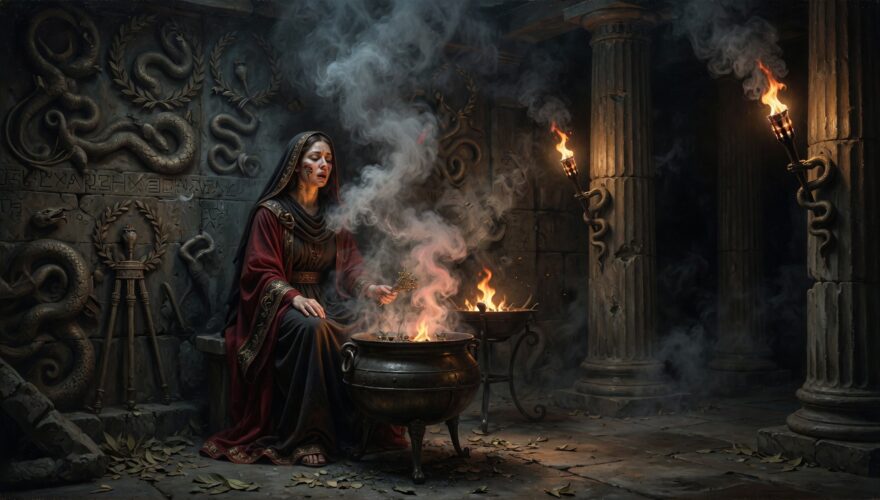
The Pythia, a woman seated above a chasm in the inner sanctum, breathed fumes that rose from below the rock and spoke her answers in a state that terrified observers. Priests transcribed what she said and rendered it into verse, usually ambiguous enough to survive any outcome.
“Know thyself.”
Inscription at the Temple of Apollo at Delphi, attributed to the Seven Sages.
When Croesus, king of Lydia and the wealthiest man alive, asked whether he should attack Persia, the Oracle told him that if he crossed the Halys River, a great empire would fall. He crossed. An empire fell. His own.
The genius of Delphi was not deception, exactly. It was structured ambiguity deployed with political precision. Delphi accumulated intelligence from every delegation that arrived, building a geographic and political picture of the Mediterranean world that no single court could match. What they gave back in prophecy often reflected that knowledge disguised as divine revelation.
LESSER-KNOWN DETAIL
The Pythia at Delphi was always a local woman from the area, not a trained priestess from elsewhere. The gas she inhaled has been identified by modern geologists as ethylene, which causes euphoria and disorientation at low concentrations.
The Oracle counseled Athens to trust in her “wooden walls” when Persia invaded in 480 BC. The general Themistocles interpreted this as the Athenian fleet. He was right. The Persian armada was crushed at Salamis. Whether the Oracle knew this outcome or merely offered a phrase flexible enough to mean anything useful, it guided one of history’s most consequential naval decisions.
Join The Archive Briefing
Weekly dispatches. The history they didn't teach you — sourced, subverted, delivered to your inbox.
Rome’s Emergency Instructions
The Romans were practical people. They built roads, aqueducts, and legal codes. They also kept a set of prophetic texts locked in the Temple of Jupiter on the Capitoline Hill, guarded by a special college of priests, consulted only when the state faced catastrophe.
The Sibylline Books, said to have been purchased by the early Roman king Tarquin from a mysterious old woman, contained Greek hexameter verses of apocalyptic counsel. When plague hit. When the Gauls sacked Rome. When Hannibal stood at the gates. The Senate voted to open the books.
What the priests found inside always seemed to prescribe exactly what the political situation required, which tells you something about who was really reading them.
“A great empire will fall.”
The Oracle at Delphi to Croesus of Lydia, circa 547 BC
In 205 BC, during the long nightmare of the Second Punic War, the Books reportedly directed Rome to bring the goddess Cybele, the Great Mother, from Phrygia to Rome. This was not a small instruction. It required diplomacy, a sea voyage, and the introduction of a foreign cult that initially shocked Roman conservatives. But the Senate complied. The war against Carthage turned. Rome won.
The historian Livy was skeptical of much of this. But he recorded it faithfully because he understood what it meant politically. The Sibylline Books gave the Senate sacred cover to do what necessity demanded. They were a mechanism for crisis governance dressed in divine language.
The Son of Zeus, Confirmed
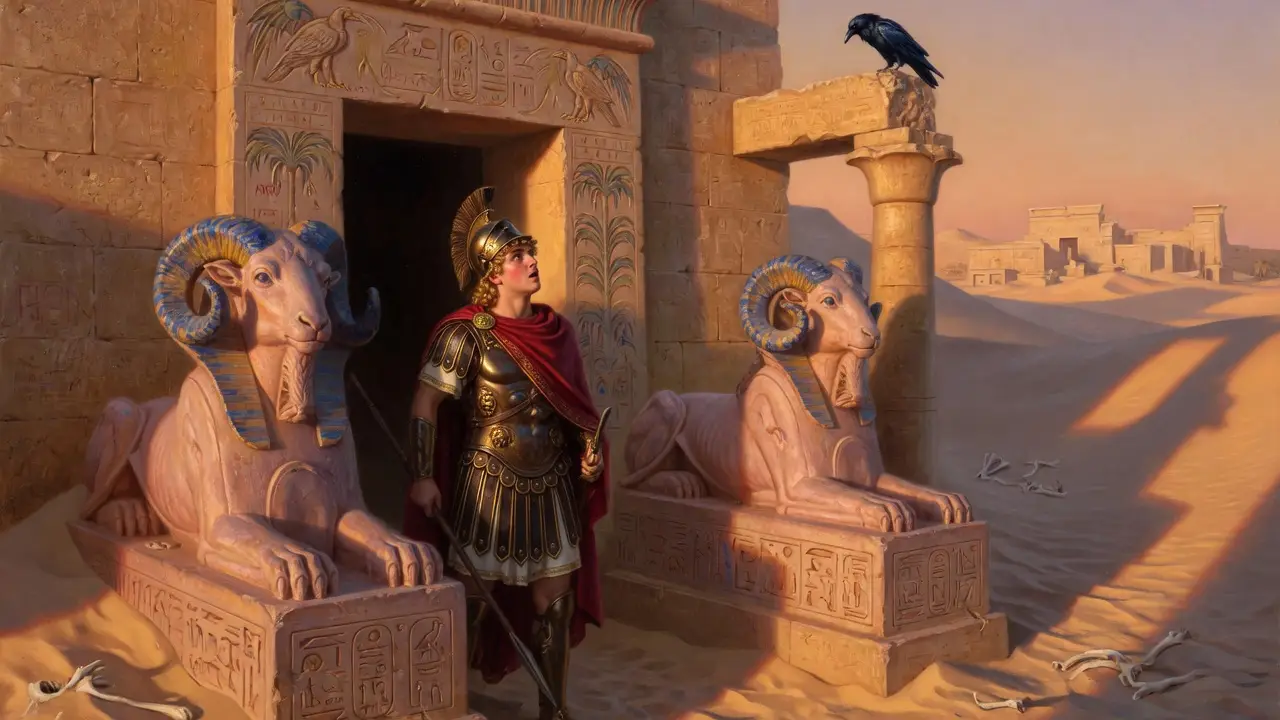
By the time Alexander of Macedon marched into Egypt in 332 BC, he had already conquered most of the known world west of Persia. He was twenty-four years old and he needed the gods to say something specific.
He crossed the Libyan desert to reach the oracle of Amun at Siwa, a journey that nearly killed his men. The high priest met him at the entrance of the temple and addressed him not as king, but as son. Son of Amun, the Egyptian equivalent of Zeus. Whether this was genuine religious protocol, flattery, or a linguistic accident in translation, Alexander chose to receive it as confirmation of divine parentage.
He emerged from his private consultation with the oracle saying only that he had heard what he wished to hear.
That phrase carried the entire conquest forward. His Macedonian officers were skeptical. His Greek soldiers were uneasy. But the Persians, the Egyptians, the Babylonians, all of them had cultural frameworks in which a ruler could be the earthly vessel of a god. Alexander’s visit to Siwa was the political signal to the East that he was not a foreign invader. He was a legitimate divine king in the tradition they already understood.
When Babylon opened its gates to him shortly after, the Babylonian priests of Marduk confirmed his kingship using their own prophetic texts. They had a word for what he was. They fit him into a preexisting story. That is how prophecy functions at its most powerful: not by predicting the future, but by absorbing the present into a narrative that makes conquest feel inevitable rather than violent.
Heaven’s Verdict, Indefinitely Renewable
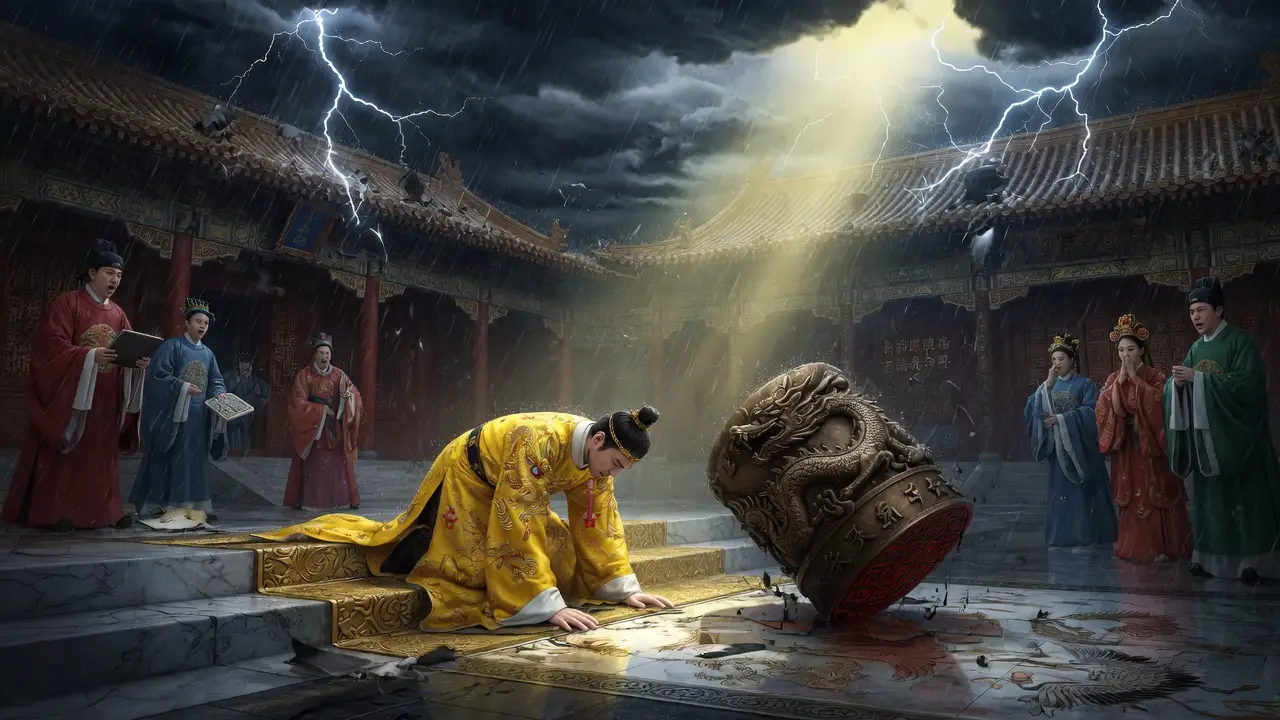
No political theology in human history has proven more durable than China’s Mandate of Heaven. The concept was formalized during the Zhou dynasty around 1046 BC, when the Zhou overthrew the Shang and needed to explain why this was not usurpation but righteousness.
The logic was elegant and ruthless. Heaven, a supreme moral force, granted the right to rule to virtuous kings. When a dynasty fell, it was proof, after the fact, that Heaven had already withdrawn its mandate. The fall itself was the verdict.
This meant that every rebellion that succeeded was, by definition, justified. Every dynasty that collapsed had deserved to. And every new dynasty began with a clean slate of divine legitimacy, which it would then spend the next several centuries slowly spending down through corruption, incompetence, or natural disaster.
“Heaven’s mandate is not fixed; Heaven is hard to depend on.”
From the Book of Songs (Shijing)
The Mandate of Heaven was not really a prophecy in the Delphic sense. It was a retrospective interpretation machine. But it functioned as prophecy does in politics: it made outcomes feel ordained. When flooding and famine struck, scholars and peasants alike read those as signs that Heaven was withdrawing its favor. Rebellion, when it came, did not feel like treason. It felt like cooperation with a divine verdict already in progress.
The Ming, the Qing, and every dynasty in between used the Mandate to justify themselves and to interpret the disasters of their predecessors as moral failures rather than structural ones. It was the most successful piece of political theology ever invented.
Omens Over Tenochtitlan
The Mexica people of the Aztec Empire had no shortage of prophecy. Their cosmology was structured around cyclical time, divine conflict, and the constant threat of destruction. The world had already ended four times. They were living in the fifth sun, and they knew it would end too.
When the Spanish arrived in 1519, the Aztec court was already unsettled. There had been signs. A comet. A fire in the temple of Huitzilopochtli that refused to be extinguished. A woman’s voice crying in the night. A bird with a mirror in its head, in which warriors could be seen approaching.
These omens were recorded, but they were recorded after the conquest, by indigenous scholars writing in the 1540s and 1550s, which complicates the picture. What we cannot know with certainty is how much of the omen tradition was genuine pre-contact belief and how much was retrospective meaning-making imposed on events after they had already happened.
What we do know is this: Moctezuma II hesitated. He sent gifts rather than troops. He negotiated rather than expelled. Whether he truly believed Hernan Cortes was the returning god Quetzalcoatl, as later accounts claim, is now disputed by most scholars. But the paralysis was real, and it was fatal.
The prophetic framework the Mexica used to interpret reality gave Cortes’s arrival a significance it might not otherwise have had. Not because Cortes was a god, but because the Aztec elite read his arrival through a lens that made decisive resistance feel cosmologically complicated. Prophecy, even an uncertain one, can buy an invader the weeks he needs.
Daniel’s Map of Empires
The Book of Daniel, written in the second century BC but set in the Babylonian court of the sixth century, contains some of the most politically explosive prophecies in human history. Its visions of four successive kingdoms, culminating in a divine intervention that would establish an eternal realm, became the template for apocalyptic politics across three major world religions.
Daniel’s four kingdoms were interpreted by Jewish scholars as Babylon, Persia, Greece, and Rome. The fourth kingdom, iron-footed and terrible, would be shattered not by human hands but by a stone cut from a mountain. The message was clear to anyone living under Roman occupation: empires end. This one will too.
“The stone was cut out of the mountain without hands, and it struck the statue on its feet of iron and clay, and broke them in pieces.”
Daniel 2:45
The Maccabean revolt of 167 BC drew heavily on this prophetic tradition. So did the Jewish rebellions against Rome in 66 and 132 AD. The Book of Revelation, written in the same apocalyptic register, was essentially a coded political tract about Nero and Rome dressed in the language of cosmic war.
LESSER-KNOWN DETAIL
The Book of Daniel was written in two languages: Hebrew and Aramaic. This was not an accident. The Aramaic sections were addressed to a wider, cosmopolitan audience. The Hebrew sections to a specifically Jewish one. It was a bilingual political document disguised as scripture.
The downstream effects are almost impossible to overstate. Medieval Christian rulers organized crusades partly around apocalyptic prophecy. The expectation of a final earthly kingdom before divine judgment shaped the politics of the Reformation. It shaped colonial projects in the Americas, framed as preparation for the end times. It shaped British support for Zionism in the nineteenth century among Protestant millenarians. The threads run forward continuously.

The Norse Scaffold of the End
The Vikings operated under their own prophetic horizon: Ragnarok, the twilight of the gods. This was not a vague spiritual concept. It had specific signs. Winters that lasted three years. Brothers killing brothers. The sun going dark. And then the final battle, in which gods and giants would destroy each other and the world would submerge and resurface, renewed.
What Ragnarok gave Norse culture was a particular relationship to fate. The Norse word for it was wyrd, a web of destiny in which even the gods were caught. Odin knew his own death at Ragnarok and prepared for it anyway, spending his long immortality gathering warriors in Valhalla for a battle he knew he would lose. The courage valued in Norse culture was not optimism. It was action in the face of certain doom.
This shaped how Norse warriors understood their own deaths. To die in battle was not tragedy. It was participation in the grand pattern. Prophecy here was not a tool of political manipulation but a cosmological frame that made stoic courage feel rational.
The Prophecy That Outlasted Its Empire
Perhaps no prophecy has had a stranger political career than the oracles attributed to Merlin in Geoffrey of Monmouth’s twelfth-century account of British history. Written around 1136, they described a sequence of symbolic kingdoms, animals, and disasters that could be retroactively applied to almost any political crisis Britain would face.
“He who overcomes himself is strong.”
Attributed to Laozi, Tao Te Ching
Medieval kings took them seriously. Richard I consulted them before the Crusades. Henry II reportedly went pale when a specific passage was read aloud at a feast, fearing it predicted his sons’ rebellion. Which it arguably did, though only after the sons had already rebelled.
Prophecy deployed in political crisis has a psychological mechanism that is consistent across all these examples. It does not require literal belief. It requires only that the listener cannot rule out its truth at the moment the decision must be made. That uncertainty is enough to change behavior.