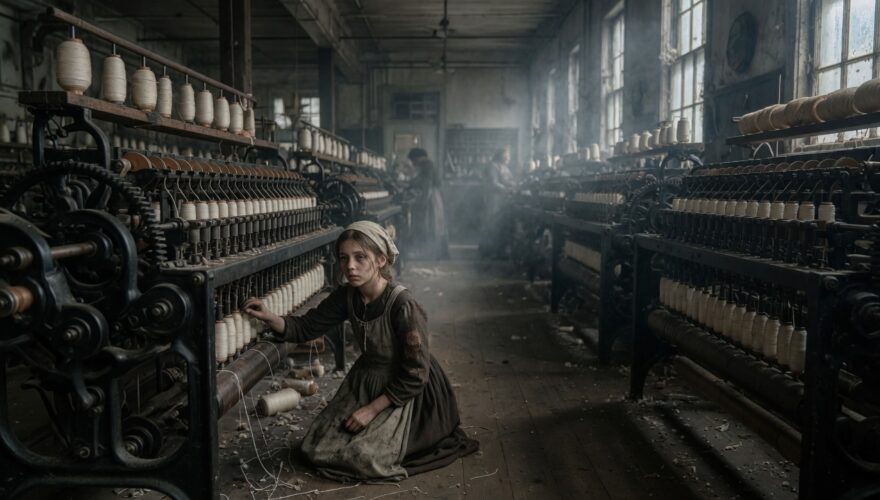
In the early 1830s, a parliamentary investigator named Michael Sadler sat across from a man named Matthew Crabtree, who had entered a textile mill at the age of eight. Sadler asked him what happened when the children fell asleep at their machines. Crabtree answered without hesitation. The overlooker would beat them with a strap. If the strap didn’t work, he would take the child’s head and beat it against the wall. Not out of cruelty, exactly. Out of schedule. The machines did not stop.
That story became part of the Sadler Report of 1832, one of the most damning documents in British political history. But what the report couldn’t fully capture, and what history has largely smoothed over, is something far colder than cruelty: the fact that the children dying in those mills weren’t a scandal to the people running them. They were a projection. A line item. A depreciating asset with a calculable end date.
A System That Ran on Small Hands
The mythology around the Industrial Revolution tends to focus on the genius of it. The steam engine. The spinning jenny. The sudden, miraculous expansion of output that pulled England out of agrarian poverty and into global dominance. What gets skipped is the labor architecture that made it possible.
Children had always worked. On farms, in homes, in trades passed from father to son. But the factory system transformed child labor from a family arrangement into an industrial supply chain. Mill owners didn’t hire children because no adults were available. They hired children because children were cheaper, more pliable, and could fit their small bodies into spaces no adult could reach. The gap beneath a spinning frame. The narrow shaft of a coal mine. The inside of a chimney.
By 1800, roughly a third of all textile mill workers in England were under the age of fourteen. In some mills, that figure climbed higher. In the coal mines of Yorkshire and Durham, children as young as five worked as “trappers,” sitting alone in the dark for twelve-hour shifts, holding a rope that opened a ventilation door whenever a cart passed through. They were not paid enough to survive. They were not expected to survive long.
The Tables That Priced a Child’s Life
This is where the story turns from tragedy into something more deliberate.
By the mid-nineteenth century, the British insurance market was sophisticated enough to price almost any risk. Lloyd’s of London had been underwriting maritime ventures since the 1680s. Actuarial mathematics had advanced considerably since Edmund Halley (yes, the comet man) published his mortality tables in 1693. Life expectancy, occupational hazard, the statistical weight of dangerous work, all of it could be quantified. And it was.
Join The Archive Briefing
Weekly dispatches. The history they didn't teach you — sourced, subverted, delivered to your inbox.
“I was seven years old, and knew nothing but that I was to work. What work was, I had no means of knowing until it was done to me.”
Robert Blincoe (mill survivor, 1822 memoir)
Insurance companies writing policies on industrial operations began developing occupational mortality tables that distinguished between types of workers. Child workers in textile mills, in coal mines, and in match factories appeared in these tables with their own projected lifespans, shorter and more predictable than adult workers because their working conditions were more extreme and their bodies more fragile. These weren’t moral judgments. They were actuarial observations.
Mill owners used this information in ways that modern readers might find almost incomprehensible. If a child worker was expected to remain productive for, say, six to eight years before their health gave out, that figure entered the investment calculus of the operation. The cost of replacing a child every few years was factored against the cost of paying higher wages for adult labor. Children were cheaper even accounting for turnover, because turnover, in this context, meant the child either left or died, and either outcome was operationally equivalent.
The historian E.P. Thompson described the result plainly in The Making of the English Working Class: “What was being created was not simply a new form of work, but a new form of human being, one whose lifespan was understood in terms of productive utility.”
The Pauper Apprentice Trade
If the actuarial tables represent the cold logic of the system, the pauper apprentice trade represents its darkest operational expression.
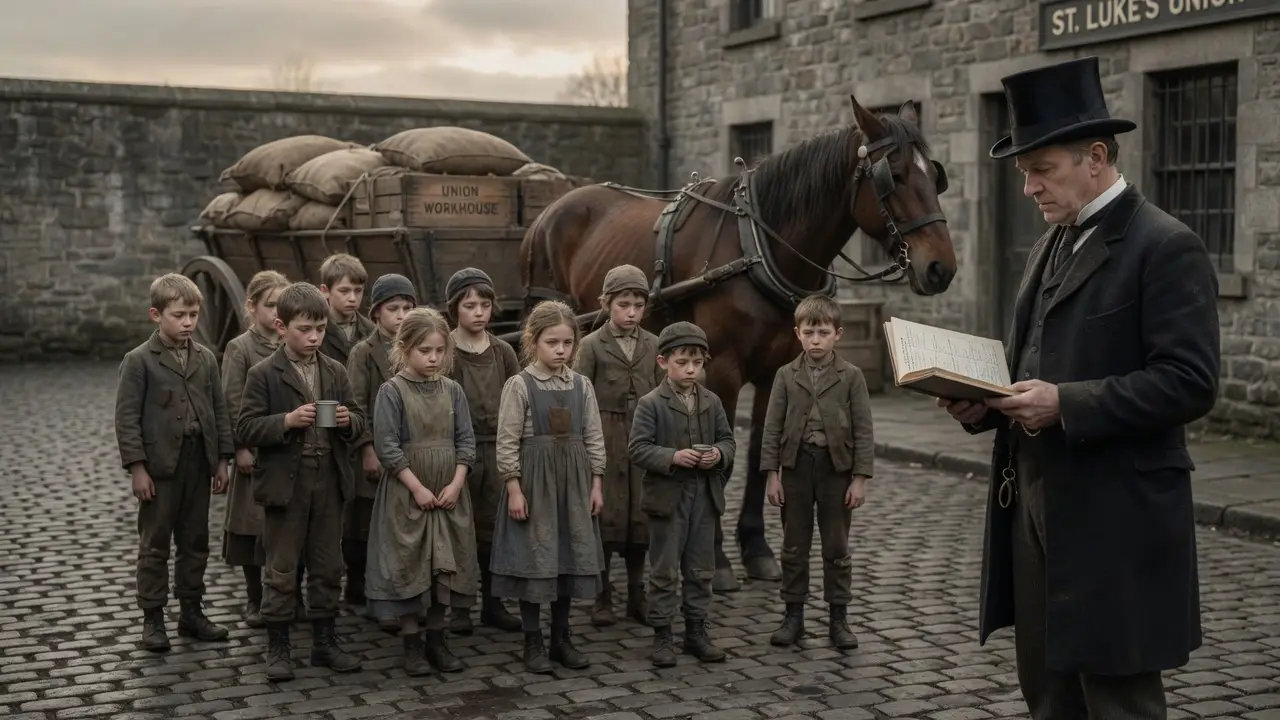
Beginning in the late eighteenth century, mill owners struck deals with urban parish poorhouses to take their orphaned and abandoned children as “apprentices.” The word was a legal fiction. These children, some as young as six, were transported in cartloads from London and Birmingham to mills in Lancashire and Derbyshire. They were housed in “apprentice houses” adjacent to the mills, fed minimally, worked for twelve to sixteen hours a day, and were legally bound to their employer until the age of twenty-one.
They had no recourse. They could not quit. If they ran away and were caught, they were returned. The parish that handed them over had discharged its legal obligation to house them. The mill owner had acquired a workforce that cost almost nothing in wages. The arrangement was entirely legal, widely practiced, and openly discussed in the business correspondence of the era.
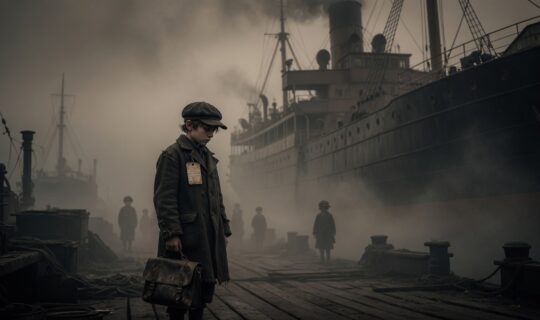
Robert Blincoe, who entered a Nottinghamshire mill as a pauper apprentice around 1799 at age seven, later dictated a memoir that described ears being boxed until they bled, teeth being filed down as punishment, and children being forced to eat food off the floor. His account, published in 1832, was initially dismissed as exaggeration. Subsequent investigation confirmed most of it.
“Thousands of our fellow-creatures are at this very moment existing in a state of slavery more horrid than are the victims of that hellish system, Colonial Slavery.”
Richard Oastler, “Yorkshire Slavery” letter, Leeds Mercury, 1830
What makes Blincoe’s account significant is not its horror, though it is horrible. It’s the normalcy he describes in the adults around him. The overlookers weren’t monsters from outside the community. They were local men doing a job, operating within a system that had been rationalized from top to bottom.
LESSER-KNOWN DETAIL
Pauper apprentice houses were often locked from the outside at night. Children who tried to escape were not just returned, they were sometimes publicly displayed as a warning to others.
The Numbers Behind the Smoke
Several specific figures from this era deserve attention because they clarify just how industrialized child exploitation had become.
In 1833, the Factory Commission found that the average age of entry into textile mill work was ten. In some mills, children were beginning work at seven or eight. Working hours averaged between twelve and fourteen per day, six days a week. The commission’s medical witnesses testified that children in mills showed consistent patterns of skeletal deformity, particularly curvature of the spine and bowing of the legs from prolonged standing on hard floors.
The coal industry was, if anything, worse. The Children’s Employment Commission of 1842 produced a report with illustrations that shocked Parliament into action. Children were documented pulling coal carts through low tunnels while harnessed at the waist like animals. Girls as young as six were doing this work. The report noted that in some collieries, children were underground for so long that they had never seen sunlight during working months.
LESSER-KNOWN DETAIL
Children working in match factories were exposed to white phosphorus, which caused a condition called “phossy jaw,” a necrosis of the jawbone that glowed greenish in the dark. It was agonizing and fatal. Match manufacturers lobbied against the ban on white phosphorus for over twenty years on cost grounds.
The insurance and investment community was aware of all of this. The health consequences of child factory work were not secret. They were, in a precise sense, known, modeled, and priced into the ongoing operations of British industry.
The Reformers Who Were Called Radicals
The men and women who tried to stop it were not initially celebrated. They were treated as threats to the economy.
Richard Oastler, a Yorkshire land agent, published a letter in 1830 calling Yorkshire textile mills “Yorkshire Slavery” and comparing the treatment of English children to the treatment of enslaved Africans in the Caribbean. The comparison was meant to be inflammatory, and it was. He lost his job. He spent years in debtors’ prison, partly because his employer, angered by his activism, called in a debt.
“Children employed in factories are almost universally of stunted growth, very frequently deformed, and their constitutions generally broken down before they reach the age of twenty.”
Dr. Loudon, testimony before the Factory Commission, 1833
Lord Shaftesbury, who steered the Ten Hours Act of 1847 through Parliament after years of effort, was repeatedly told by mill owners that limiting working hours would destroy the British economy. One manufacturer wrote to Parliament claiming that the entire profit margin of a textile operation resided in the last hour of a child’s working day, and that any reduction would render the business nonviable. It was, in retrospect, a remarkable argument to make in public, but it was made, earnestly, repeatedly, by men who believed it.
The Factory Acts came incrementally: 1833, 1844, 1847, 1850, each one extending protections and shrinking the legal space for child exploitation. But enforcement was thin. Inspectors were few. Mill owners who wanted to circumvent the rules found it easy to do so. Children who looked underage were told to claim they were older. Witnesses were pressured to stay quiet.
The Architecture of Forgetting
There’s a reason this particular dimension of the Industrial Revolution, the actuarial one, the cold financial logic of pricing child lifespans, tends to be absent from the standard narrative.
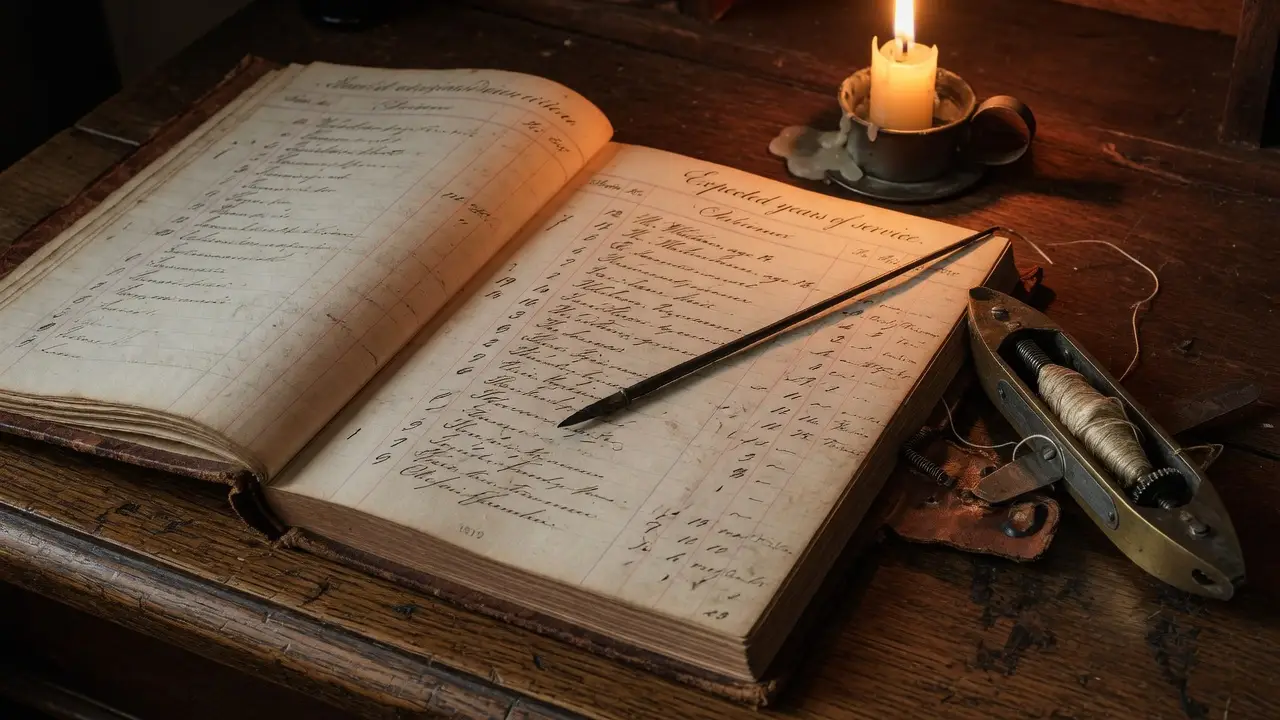
Partly it’s because the records that would make it fully explicit are scattered across insurance archives, private correspondence, and ledger books that haven’t been comprehensively analyzed in this context. Partly it’s because the story of industrial progress is a story most Western economies still want to tell about themselves with a certain pride. The steam engine is a triumph. The children harnessed to the steam engine complicate the triumph.
“I assert that the children of the poor are entitled to the care and protection of the State. Not as a charity. As a duty.”
Lord Shaftesbury (Anthony Ashley Cooper), House of Commons, 1844
But the evidence is there. Parliamentary reports. Insurance histories. Medical testimony. The personal accounts of survivors like Robert Blincoe and the workers who testified before the Sadler Commission. Taken together, they describe not an industry that tolerated child suffering as a regrettable side effect of progress, but one that incorporated child suffering into its operational planning with the same systematic attention it applied to machinery maintenance and raw material costs.
The philosopher and social critic John Stuart Mill, who was himself subjected to an extreme educational regimen in childhood, wrote in 1848: “The laws and conditions of the production of wealth partake of the character of physical truths. There is nothing optional or arbitrary in them.” He meant it as a defense of economic law. But read against the backdrop of what those laws had produced, the line carries a different weight.
What the Machines Left Behind
The Ten Hours Act of 1847 was a genuine victory. So were the Factory Acts that followed, and the Education Act of 1870, which began making school attendance compulsory and pulled children out of the labor market incrementally.
But the framework that made child labor possible, the legal, financial, and moral infrastructure that allowed a human being’s lifespan to be modeled and priced as a production input, didn’t disappear. It migrated. To the colonies. To the successor economies of the twentieth century. To the supply chains that today sit behind the consumer goods of the wealthiest nations on earth.
The children in those early English mills are distant enough to feel like history. The actuarial logic that governed their lives is not.
In the Sadler Commission testimony of 1832, a mill worker named William Cooper was asked whether children at his mill were ever beaten. He said yes. He was asked whether this was common. He said it was universal. He was asked whether the parents of these children knew. He paused. Then he said that many of the parents had no choice, and that knowing and having no choice amounted, in the end, to the same thing.
“If the hours of labor were reduced by one hour per day, the whole net profit would be destroyed.”
Nassau Senior, economist, opposing the Ten Hours Bill, 1837
That sentence, from a man who could barely read, contains more economic philosophy than most textbooks acknowledge. Systemic coercion doesn’t require malice at every level to function. It only requires that the logic be sound and the alternatives be absent. The Industrial Revolution mastered that formula. And it taught the world how to scale it.
Global supply chains manufacturing goods for Western markets today run, in documented cases, on child labor in South Asia, sub-Saharan Africa, and parts of Latin America. The International Labour Organization estimated, as recently as 2022, that 160 million children were engaged in child labor worldwide, 79 million in hazardous conditions.
The financial logic is identical to the one running beneath the English mills of 1800. Child labor is cheaper. The costs, health, developmental, generational, are externalized onto the children themselves and onto the societies that absorb them. The actuarial calculus hasn’t been abandoned. It’s been offshored.
“We saw girls of six years of age, many of them girls, crawling upon their hands and feet, harnessed like dogs in a go-cart.”
Report of the Children’s Employment Commission, 1842