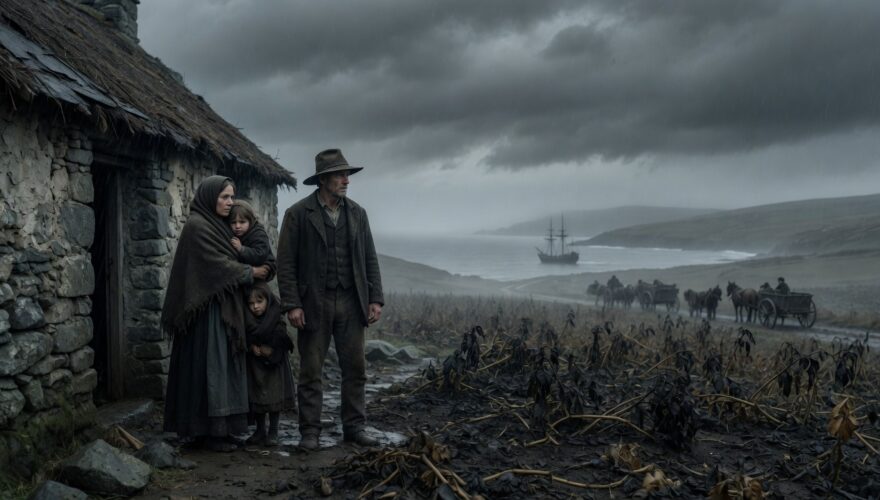
The Irish Famine wasn’t just a natural disaster, it was a political choice. Discover how British colonial policy, laissez-faire ideology, and deliberate land clearances turned a crop failure into one of history’s most devastating acts of state-sponsored erasure, killing over a million people while food left Irish ports under armed guard.
- 1 The Black Fields: How the Irish Potato Famine Began
- 2 A Crisis That Did Not Have to Become a Catastrophe
- 3 Food Leaving a Starving Land
- 4 The Ideology That Became a Death Sentence
- 5 “Providence” and the Language of Erasure
- 6 The Ships That Carried the Remnants of a Nation
- 7 The Arithmetic of Loss
- 8 Wounds That Refuse to Close
The Black Fields: How the Irish Potato Famine Began
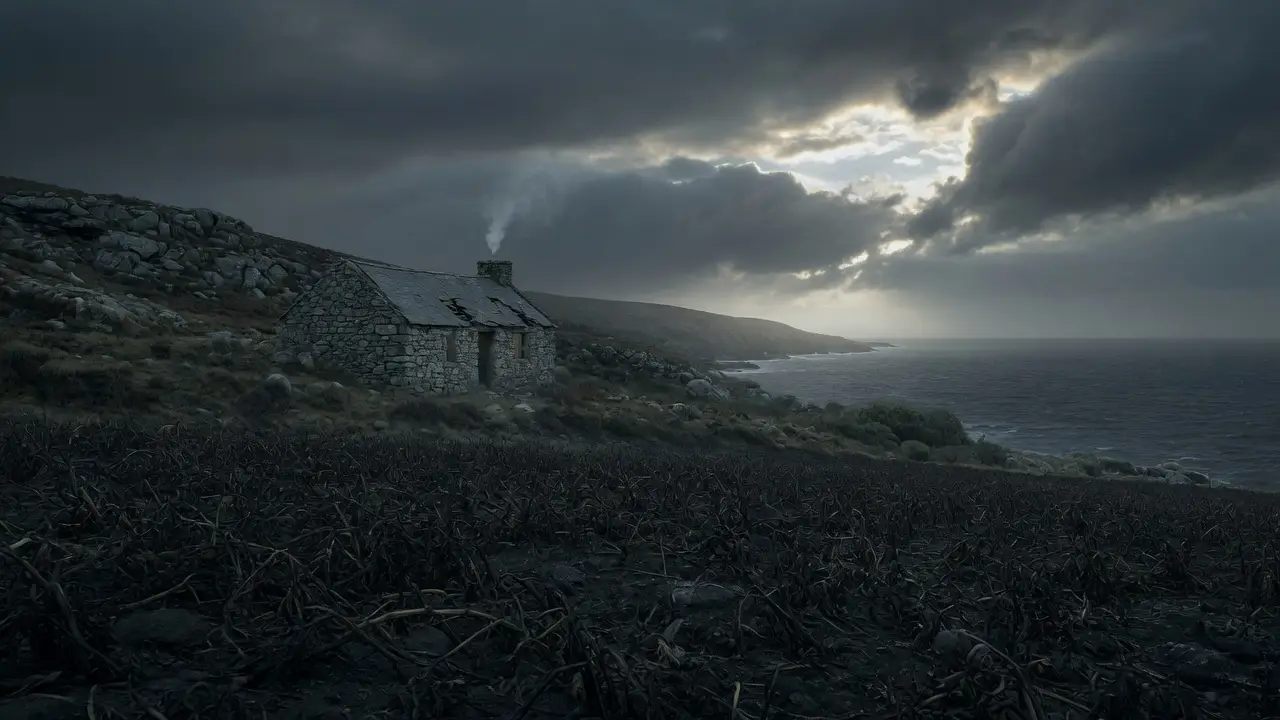
In the autumn of 1846, a County Clare priest named Father Mathew traveled the road from Cork to Dublin and wrote of what he witnessed with the shaking hand of a man struggling to believe his own eyes. The potato fields, which only weeks before had stood green and full, had turned overnight into a landscape of black, collapsing rot. The smell, travelers reported, was overwhelming… the sweet, suffocating stench of a million acres decomposing at once. Families knelt in their ruined gardens and wept. Others simply stared.
What happened next is where history fractures into two separate stories. The first is the one most people know, a tragic natural disaster, a fungus that arrived from the Americas, a people too dependent on a single crop. A catastrophe, certainly, but one born of misfortune. The second story is the one that actually happened. It is the story of warehouses full of food. Of armed soldiers escorting grain convoys out of starving counties. Of government officials who read reports of mass death and concluded that market forces must be allowed to correct themselves. Of a colonial administration that, at every critical turn, chose ideology over lives.
The fungus Phytophthora infestans killed the potato. British policy killed the Irish.
A Crisis That Did Not Have to Become a Catastrophe
The blight first appeared in Ireland in the autumn of 1845. It was not, at that stage, unprecedented in scope. Crop failures had struck before. What made this one different was not its agricultural severity but the political architecture already in place when it arrived.
“The judgment of God sent the calamity to teach the Irish a lesson; that calamity must not be too much mitigated.”
Charles Trevelyan
Ireland in 1845 was not a poor country in the way we misremember it. It was a colonized country, which is an entirely different condition. The land was overwhelmingly owned by Anglo-Irish landlords, many of whom were absentees collecting rents from London or Bath while their Irish tenants worked the soil for subsistence wages. The potato had become the diet of the rural poor not because Irish people lacked agricultural sophistication, but because it was the only crop dense enough in calories to sustain a family on the tiny plot of land a tenant could afford. Everything else they grew, the oats, the wheat, the barley, the cattle was paid out in rent or exported to feed England.
This was the tinder. The blight was merely the match.
When the first partial failure of 1845 prompted a government response, Prime Minister Robert Peel quietly imported £100,000 worth of Indian corn from America and established a network of food depots. It was imperfect and inadequate, but it was something. Then Peel’s government fell. Lord John Russell took office on a platform of strict laissez-faire economics. And the machinery of deliberate neglect began to turn.
Join The Archive Briefing
Weekly dispatches. The history they didn't teach you — sourced, subverted, delivered to your inbox.
Food Leaving a Starving Land
The fact that catches most people off guard the first time they hear it is that throughout the worst years of the Great Hunger, Ireland remained a net exporter of food.
In 1845, the year of the first partial failure, Ireland exported 3.2 million quarters of grain to Britain. In 1846, as the second and total failure set in and people began dying in the fields, Ireland exported 3 million quarters. Cattle, pigs, butter, eggs… the flow of food out of Irish ports never stopped. It barely slowed.
A Quaker relief worker, William Bennett, traveled through Connaught in 1847 and recorded what he found in language that reads more like a dispatch from a war zone than a Victorian travel journal. Men reduced to skeletons working in relief gangs on roads that led nowhere. Women too weak to stand nursing infants who had already died. Whole families locked inside their cottages, having retreated there to die together rather than be seen collapsing in public.
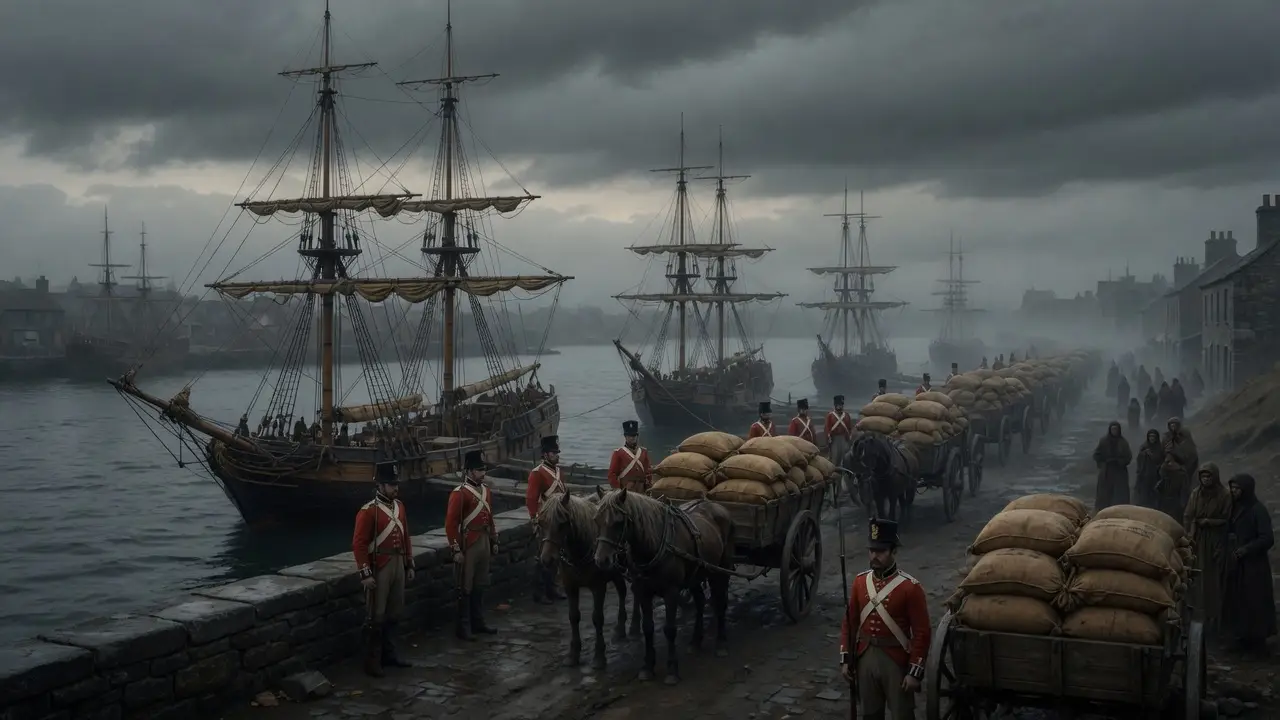
Meanwhile, on those same roads, British Army regiments escorted shipments of oats, wheat, and livestock from the interior to the port towns of Cork, Waterford, and Limerick. Local inhabitants watched through sunken eyes as food they had grown, on land their families had worked for generations, was loaded onto ships bound for English markets. There were confrontations. There were raids. Crowds of starving people occasionally overwhelmed smaller escorts and seized food. The response was to increase the military presence, not to redirect the supply.
“The Almighty indeed sent the potato blight, but the English created the Famine.”
John Mitchel (Irish nationalist writer, 1860)
In the town of Dungarvan in 1846, a confrontation between a starving crowd and soldiers guarding a grain convoy ended with shots fired into the mob. The grain continued to the port.
The defense offered by British officials at the time, and parroted by apologists ever since was that Ireland was producing food that the free market had already allocated. Interference would damage trade, undermine confidence, and set a dangerous precedent.
Charles Trevelyan, the senior Treasury official who effectively controlled famine relief policy, put it more bluntly. The famine was, in his view, “the judgment of God on an indolent and unself-reliant people,” and it was not the government’s place to stand between the Irish and divine correction.
He meant it.
The Ideology That Became a Death Sentence
Charles Edward Trevelyan is, in many ways, the human face of this catastrophe, not because he was uniquely evil, but because he was a true believer. He genuinely held that the operation of free markets was a moral as well as an economic principle. He thought that government relief would corrupt the Irish character, breed dependency, and distort the natural mechanisms of supply and demand. He wrote these things. He argued them vigorously. He implemented them with the quiet efficiency of a bureaucrat who has never heard anyone screaming.
In the summer of 1847, with something approaching a million people already dead and millions more weakened to the point of susceptibility to typhus, dysentery, and relapsing fever, the British government closed its soup kitchen program. The Temporary Relief Act had been, by any measure, the most effective intervention of the entire famine period, at its peak, the soup kitchens were feeding over three million people per day. Trevelyan called it “demoralizing” and pushed for its termination. The burden of relief was transferred back to the local Poor Law unions, many of which were already functionally bankrupt because their rate-paying landlords had fled or were themselves near ruin.
The effect was predictable to anyone who cared to look at the numbers, and some did. The Poor Law Commissioner Edward Twistleton resigned in protest, telling a parliamentary committee that what was being done to Ireland amounted to “a great and notorious public calamity” and that the government was carrying out “the deepest disgrace to the annals of history.” He was ignored.
“We have made it a matter of pride not to feed the Irish, but to compel the Irish to feed themselves.”
Lord John Russell
In his place, the machinery kept grinding. The Gregory Clause, named after its author, William Henry Gregory, MP for Dublin became one of the famine’s most devastating administrative weapons. Passed in 1847, it stipulated that no tenant holding more than a quarter-acre of land was eligible for Poor Law relief. In practice, this meant that a starving family could receive government assistance only if they surrendered their land first. Quarter-acre plots were the smallest unit of subsistence farming available to the poorest Irish families.
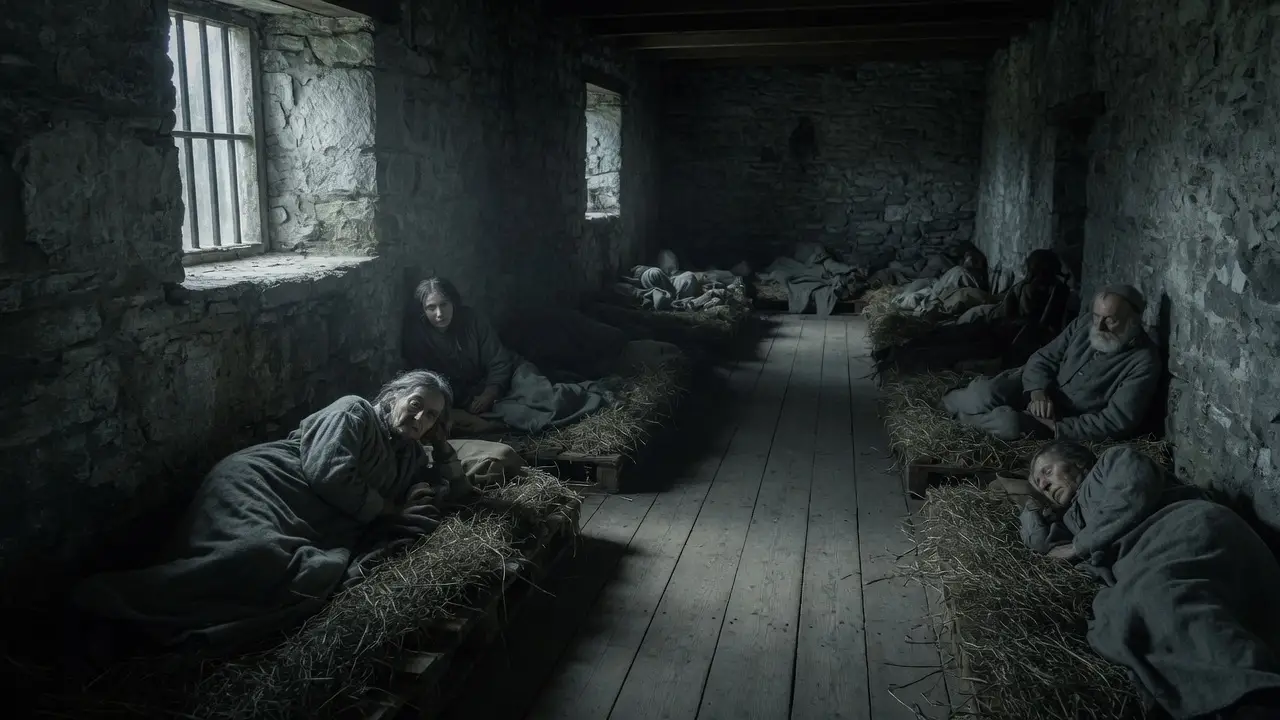
The clause effectively forced a choice between starvation with your land or survival without it. Hundreds of thousands chose survival. They signed over their plots, walked into the workhouses, and often died there anyway from the typhus and dysentery that ravaged the overcrowded facilities.
For the landlords, the clause was a windfall. Land that had been economically awkward to clear, occupied by destitute tenants who had legal, if precarious, tenure, was suddenly vacated by administrative fiat. The blight gave them the excuse. The Gregory Clause gave them the mechanism.
“Providence” and the Language of Erasure
The Victorian governing class had a particular gift for dressing atrocity in the language of theology and progress. Trevelyan was not alone in describing the famine as providential. Nassau Senior, an influential Oxford economist who helped shape British poor relief policy, reportedly remarked that he feared the famine would not kill more than a million people, which would “scarcely be enough to do much good.” Whether or not the quote is precisely accurate, and historians have debated its exact provenance, it reflects an attitude that was genuinely present in the correspondence, private letters, and official memoranda of the period.
“In many places the wretched people were seated on the fences of their decaying gardens, wringing their hands and wailing bitterly at the destruction that had left them foodless.”
Father Theobald Mathew
The Times of London, the paper of the British establishment, ran editorials in 1847 arguing that the famine was nature’s remedy for Irish overpopulation and that British charity was a perversion of the natural order. The Irish, the paper contended, were a race constitutionally unsuited to self-governance, and their suffering was inseparable from their character. This was not fringe opinion. It was mainstream.
What this framing accomplished was the rhetorical transformation of a political emergency into a natural inevitability. If God or nature had ordained the suffering of the Irish, then no human agency was responsible. If the Irish were constitutionally idle and dependent, then their starvation was the predictable consequence of their own deficiency. The British government was not causing a catastrophe; it was, at most, declining to interrupt one. This is the grammar of colonial impunity, and it has echoed across every empire’s self-justification ever since.
On the ground, the practical expression of this ideology was mass eviction. Between 1847 and 1854, an estimated half a million people were evicted from their smallholdings. Landlords found that clearing land of impoverished tenants and consolidating it into larger, more profitable grazing farms was now both legal and, in the famine’s chaos, socially invisible. Sheriff’s officers arrived with crowbar brigades, teams of laborers paid to demolish the roofs and walls of cottages so they could not be reoccupied. Families were turned out in winter. Some died on the roadside within sight of the ruins of their homes. Others joined the columns of skeletal figures moving toward the workhouses or the ports.
LESSER-KNOWN DETAIL
The Quakers (Society of Friends) were among the most effective relief operators during the famine, establishing soup kitchens and food distribution networks that the British government later scaled, but they eventually stopped their operations not because funds ran dry, but because they concluded that private charity was being used by the government as an excuse to avoid its own responsibilities. Their withdrawal was a deliberate political statement.
The question of whether this constitutes genocide is not merely rhetorical. The 1948 UN Convention on the Prevention and Punishment of the Crime of Genocide defines the crime as acts committed “with intent to destroy, in whole or in part, a national, ethnical, racial or religious group.” It includes not only direct killing but “deliberately inflicting on the group conditions of life calculated to bring about its physical destruction in whole or in part.” The continued export of food from a starving population. The targeted removal of land rights through legislation.
The deliberate termination of life-saving relief programs on ideological grounds. The conscious transfer of relief costs to institutions known to be incapable of bearing them. Each individual policy, viewed in isolation, carries plausible deniability. Viewed together, as a sustained pattern of decisions made by an imperial administration about a colonized people they openly regarded as racially and culturally inferior, the picture becomes harder to dismiss.
John Mitchel, the Irish nationalist journalist and one of the period’s most incandescent writers, put it without equivocation in 1860: “The Almighty indeed sent the potato blight, but the English created the Famine.”
The Ships That Carried the Remnants of a Nation
Those who did not die often fled, and the conditions under which they fled were themselves a form of prolonged killing.
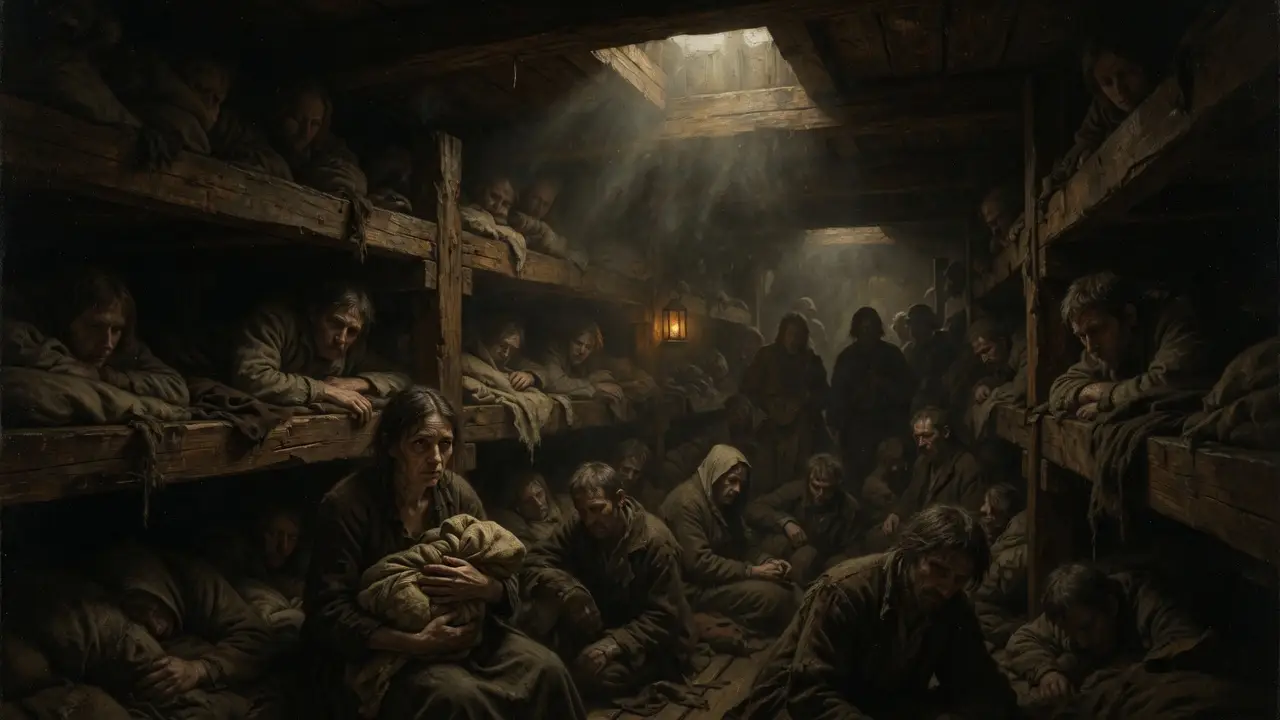
The emigrant ships of the famine years earned their name honestly. Coffin ships were overcrowded, undermaintained timber vessels hired cheaply by landlords anxious to clear their estates of human liabilities. Passage to North America was sometimes paid by landlords not out of generosity but because it was cheaper than the ongoing Poor Law rates they would have to pay for their tenants to remain. Some landlords chartered entire ships.
Lord Palmerston, later British Prime Minister, arranged the passage of over 2,000 of his tenants from Sligo to New Brunswick in 1847. They arrived, hundreds of them sick and dying, in late October. Canadian authorities were horrified. The ships had been provisioned inadequately, the passengers were in advanced states of starvation and disease, and several had died en route.
LESSER-KNOWN DETAIL
At the height of the famine, some Irish landlords under the Poor Law system could reduce their rate liability by clearing tenants from their land, meaning they had a direct financial incentive to evict, not merely a desire to consolidate. The law itself created a perverse incentive structure that accelerated clearances.
The mortality rate on some crossings exceeded thirty percent. Survivors who reached Quebec were often quarantined on Grosse Île in the St. Lawrence River, where the burial ground still holds the remains of thousands of famine Irish. A monument erected there in 1909 by the Ancient Order of Hibernians carries an inscription in Irish, English, and French that closes with: “Thousands of the children of the Gael were lost on this island while fleeing from foreign tyrannical laws and an artificial famine.”
Those who survived and reached New York, Boston, Montreal, or Liverpool brought with them something more durable than grief. They brought a specific, bone-deep political memory, the knowledge that their people had been allowed to die while food left their land under armed guard. This memory did not dissipate. It calcified. It shaped the Irish-American identity for generations. It funded the Fenian movement, the Irish Republican Brotherhood, and eventually contributed to the political conditions that produced the Irish War of Independence in 1919. The British government’s decision to manage the famine as it did did not simply kill people; it created an international diaspora permanently organized around resentment of British colonial power.
The Arithmetic of Loss
Before the famine, Ireland’s population stood at approximately 8.2 million. By 1851, it had fallen to around 6.5 million. By 1900, it had dropped to 4.4 million, the only country in the developed world whose population was lower at the century’s end than at its beginning.
Approximately one million people died of starvation and famine-related disease between 1845 and 1852. Another million and a half emigrated in the same period. The demographic collapse continued for decades afterward, driven by a cultural normalization of emigration that became structurally embedded in Irish life. Emigration was not exceptional. It became the expected life path for the rural poor, and then for the educated, and then for nearly everyone. Ireland’s population today remains roughly half what it was in 1845.
The cultural cost is harder to quantify but no less real. The Irish language, already weakened by colonial education policy, collapsed catastrophically during and after the famine. The counties of the west and southwest, the most Irish-speaking regions of the country, were exactly the regions that suffered the highest mortality and emigration. By 1891, the number of Irish speakers had fallen from an estimated four million to under 700,000. Entire ways of life, oral traditions, local histories, musical forms, all of it went into the ground with the dead or onto the ships with the living.
LESSER-KNOWN DETAIL
The British government’s corn depots were frequently positioned in areas not easily accessible to the poorest populations, and relief works (road-building, drainage projects) required workers to walk miles to reach them, in a state of advancing starvation. People died on the road to and from relief works.
The Irish who settled in America, Australia, Britain, Argentina, and elsewhere did not simply assimilate. They organized. They remembered. And they told their children. The Irish diaspora today numbers somewhere between 70 and 80 million people worldwide, a demographic explosion born directly from a 19th-century catastrophe. The Irish-American political influence that shaped U.S. foreign policy toward Britain throughout the 20th century, the transatlantic pressure during the Troubles, the sustained involvement in the Northern Ireland peace process, the annual St. Patrick’s Day rituals of American political deference to Irish heritage, all of it traces a direct line back to those black fields and those coffin ships.
Wounds That Refuse to Close
In 1997, British Prime Minister Tony Blair issued a statement acknowledging that those who governed in London at the time “failed the people” of Ireland during the famine. It was not, pointedly, a formal government apology. It was carefully worded to stop short of institutional responsibility. But it was something, a public acknowledgment that what happened was not simply a natural disaster passively witnessed.
Ireland, for its part, has spent much of the last two centuries in a complex relationship with the memory of the famine. The trauma was for a long time not spoken of directly, a silence that psychologists and historians have connected to the mechanism of intergenerational trauma, the way that catastrophic collective suffering gets absorbed into cultural behavior and transmitted forward without being consciously named. The Irish tendency toward emigration, the particular relationship with land ownership, the deep suspicion of governmental authority, the black-edged humor deployed against suffering, none of these are coincidental.
LESSER-KNOWN DETAIL
In the United States, the Choctaw Nation, a people who had themselves been forcibly removed from their land in the Trail of Tears just 16 years earlier, collected $170 (approximately $5,000 in today’s values) and sent it to Ireland. The gesture is now commemorated with a sculpture in Midleton, County Cork, and the two peoples have maintained a symbolic relationship of solidarity ever since.
What the Great Hunger demands of us today is not pity. It demands precision. The habit of calling man-made catastrophes natural disasters is not innocent. It is a political act, the act of removing human agency from human decisions. When we say the Irish Famine was caused by a blight, we are participating, however unconsciously, in the same rhetorical move that Trevelyan and The Times made in 1847. We are removing the decision-makers from the scene of the crime.
The same move is made today. When we describe contemporary food crises as the product of drought or conflict without accounting for the trade policies, debt structures, and geopolitical decisions that made those populations vulnerable in the first place, we are writing the same evasion in a new century’s language. When we allow market ideology to override food security for populations already at the margins, we are applying the same logic that Trevelyan applied with such devastating consistency.
The Great Hunger is not a closed chapter. It is a case study in how power describes its own cruelties. And the first step toward not repeating it is refusing to accept the description.