Imagine waking up before dawn knowing your job might kill you. Not in some abstract, long-term way. Today. This morning. The work itself.
Historians love their generals. Their kings. Their explorers who planted flags in foreign soil and called it glory. But civilization was not built by men on horseback. It was built by the ones who never made it into the paintings. The ones who went underground with a candle, or climbed into a chimney still hot from the night’s fire, or walked into a house where everyone inside was already dying.
This is their story…
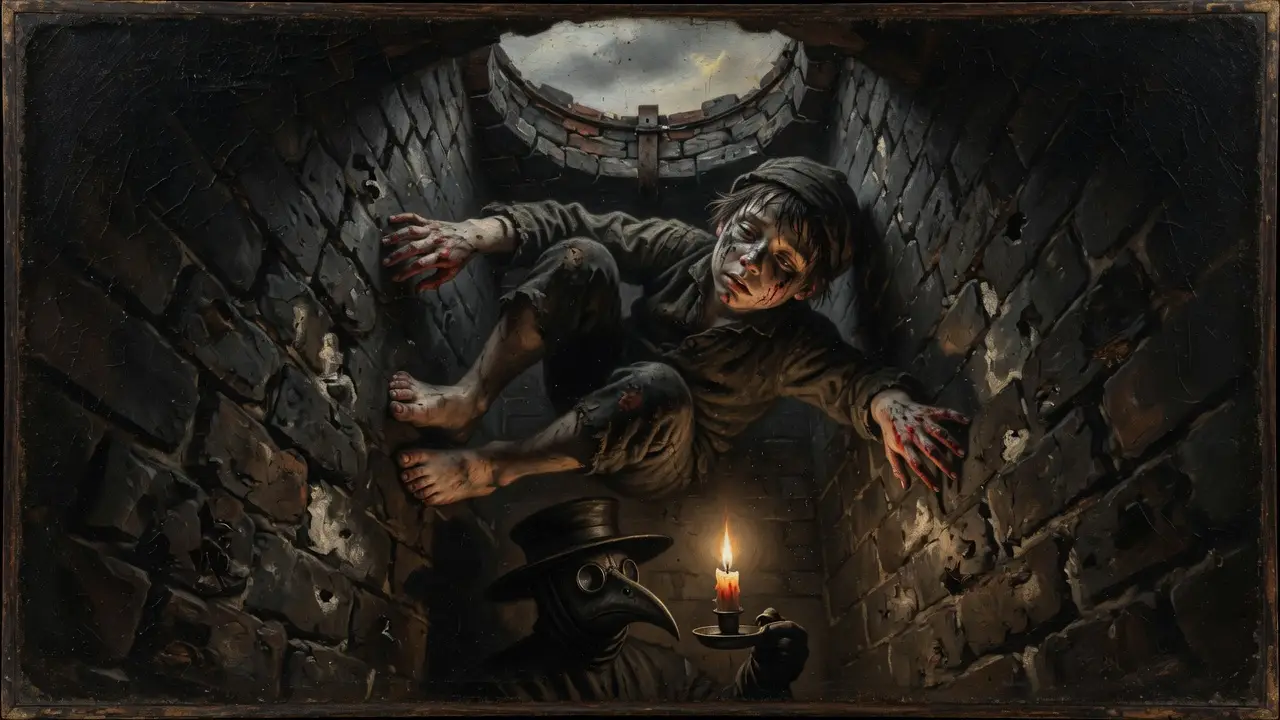
The Boy in the Chimney
London, 1800. A child no older than seven is stripped of his shirt, pressed against the inside of a brick flue, and told to climb. The space is roughly forty centimeters wide. Soot falls into his eyes. The walls scrape his elbows, his knees. If he stops moving, his master shouts from below. If he hesitates too long, he might be poked with a pin, or worse, a small fire is lit beneath him to encourage speed.
Chimney sweeps are one of history’s cruelest overlooked industries. Britain’s master sweeps purchased apprentices as young as four from orphanages and workhouses. These children became human brushes, forced into chimneys to scrub and loosen soot while climbing blind in pitch darkness. Many died from suffocation. Others developed “chimney sweep’s cancer,” a scrotal cancer caused by constant soot exposure, which physician Percivall Pott first documented in 1775. He was looking at young men in their twenties, already dying from a childhood they never chose.
The Chimney Sweepers Act of 1788 attempted to raise the minimum age to eight and limit working hours. Almost nobody enforced it. The children kept climbing until well into the Victorian era, often surviving their apprenticeships only to carry the damage with them for the rest of their abbreviated lives.
Charles Lamb once wrote that these boys were “sooty artificers,” a phrase that managed to sound almost poetic while describing something that should have horrified every person who read it. It did not horrify enough of them.
The Man Beneath the Mountain
Go back further. Medieval Europe. The mines.
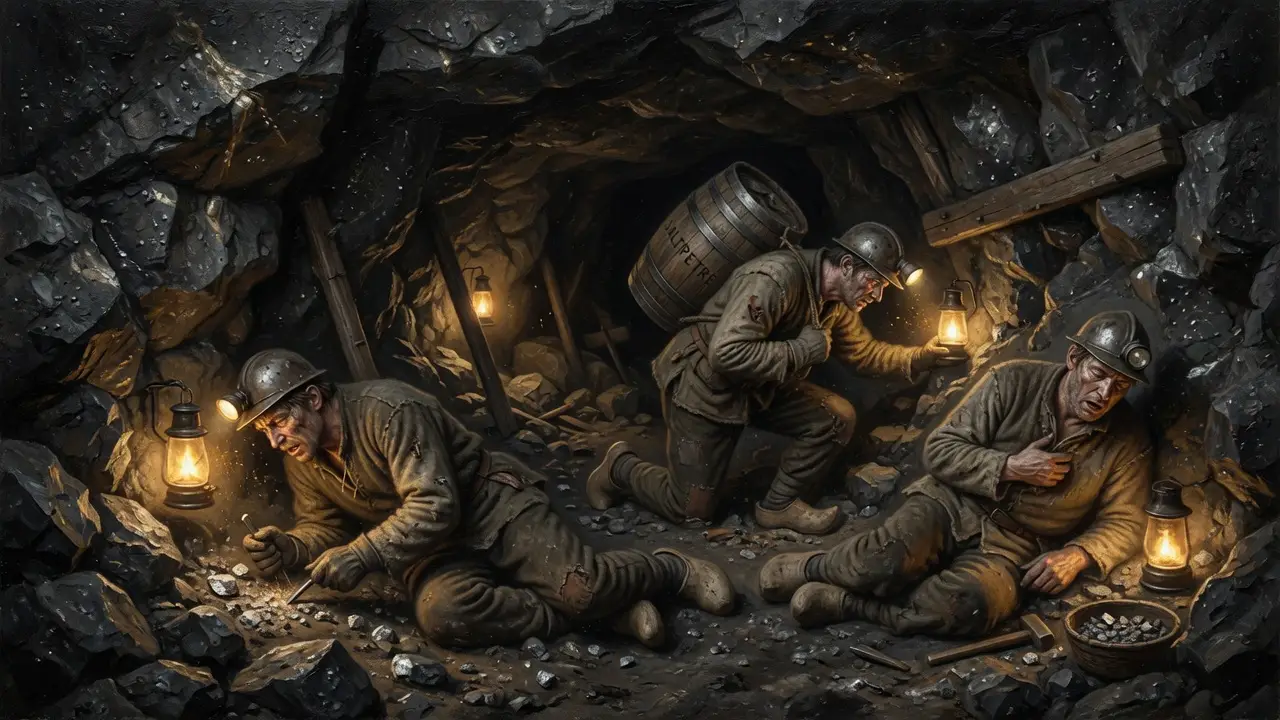
There are no photographs from inside a 14th-century German silver mine, but there are enough records to paint the picture clearly. Men worked on their knees or lying flat, chipping at rock faces in tunnels barely tall enough to crouch in, lit by oil lamps that burned through the oxygen faster than anyone cared to admit. They came up at the end of a shift covered in dust that had already started its quiet work on their lungs.
Join The Archive Briefing
Weekly dispatches. The history they didn't teach you — sourced, subverted, delivered to your inbox.
Silicosis. Pneumoconiosis. Lead poisoning. The medieval miners did not have names for these things, but they felt them. A productive miner was an old man at thirty. By forty, if he had survived roof collapses, flooding, and explosive pockets of gas, his breathing had taken on the quality of wet cloth.
The mines of the Ore Mountains along the German-Czech border, the silver operations that financed much of the Holy Roman Empire, employed tens of thousands across the medieval and early modern periods. The wealth they produced was staggering. A single mine could make a prince rich for a generation. The men who worked it were paid just enough to come back tomorrow.
Agricola, the 16th-century scholar, documented their conditions with a clinical detachment that barely conceals the horror: miners developed “difficulty in breathing and the destruction of the lungs.” He noted that some wives had buried seven husbands. The mine had outlasted all of them.
The Doctor Who Wore a Beak
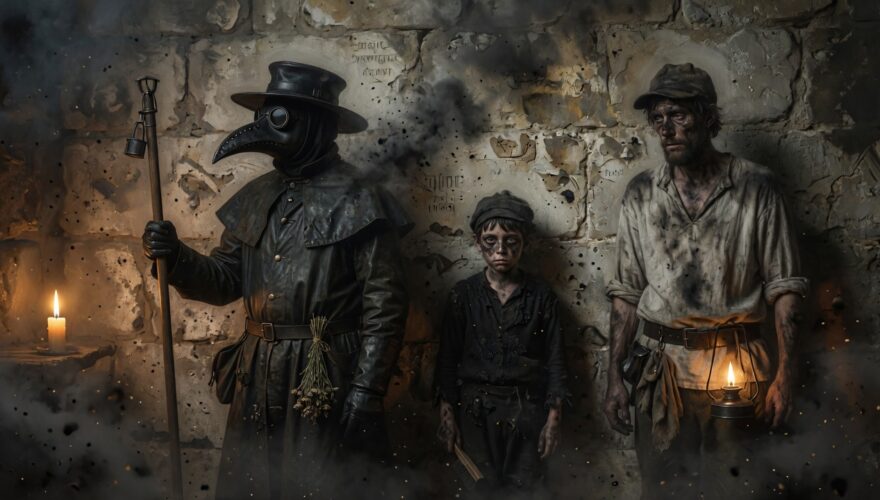
By the time the Black Death arrived in Europe in 1347, roughly a third of the continent would be dead within four years. Someone had to go into the houses. Someone had to examine the bodies, the swellings, the blackened skin. That someone wore a long waxed coat, leather gloves, a wide-brimmed hat, and a mask shaped like a bird’s beak, stuffed with aromatic herbs meant to filter the “bad air” that physicians believed carried disease.
The plague doctor is perhaps the most visually striking figure in medieval history, an almost absurd silhouette that looks more like theater than medicine. But the costume was the sincerest attempt at protection that the era could conceive. And these men, many of them not even formally trained physicians but contract workers hired by desperate municipalities, walked into homes that nobody else would enter.
They were not heroes in the romantic sense. Many were coerced. Some cities contractually bound plague doctors and forbade them from leaving during an outbreak. Venice paid its plague doctors a salary of six florins a month in 1348, a reasonable wage that reflected, at minimum, a civic acknowledgment that what was being asked of them was extraordinary.
Some survived multiple outbreaks. Many did not. The herbs in the beak did nothing against Yersinia pestis. They smelled pleasant as you died.
What strikes most about these figures is not their courage but their consistency. Plague returned to Europe repeatedly over three centuries. The doctors kept showing up.
The Nightsoil Man
There is a job so unglamorous that history has nearly scrubbed it from the record. Before municipal sewage systems, before indoor plumbing, someone had to empty the cesspits beneath city homes. These were the nightsoil men, named because they worked after dark to spare the public the sight of what they were doing.
In 18th-century London, a team of two or three men would descend into a cesspit, fill wooden tubs with human waste by hand, carry those tubs up and out, load them onto a cart, and transport the whole thing to farms outside the city, where it was sold as fertilizer. A full cesspit might take an entire night to clear. The men were paid better than common laborers precisely because the work was so repellent that no one else would do it.
They also died of it. Hydrogen sulfide accumulates in enclosed pits. Workers sometimes lost consciousness and asphyxiated before their partners could pull them out. Others died from waterborne infections picked up through constant exposure to raw sewage. A contemporary account from 1850 describes a night worker found dead in a pit in Bermondsey, presumably overcome by fumes before he could call out.
The nightsoil trade quietly sustained urban agriculture across Europe and Asia for centuries. It is one of the most consequential industries you have never been taught to think about.
The Mill Girl’s Silence
History tends to romanticize the Industrial Revolution as the moment everything got faster and better. For the women and children working in the cotton mills of Lancashire and Massachusetts in the early 1800s, faster meant something different.
Mill girls worked fourteen-hour shifts in rooms deliberately kept humid, because dry air snapped the threads. The cotton fiber was everywhere. They breathed it. Over years, it accumulated in their lungs in a condition known as byssinosis, or “brown lung,” marked by tightening chest, chronic cough, and a slow erosion of breathing capacity. The machinery was deliberately left unguarded to save money. Losing fingers was common enough that some workers had their own informal language for describing which hand and how many.
These women were not uneducated. Many of the Lowell mill girls in Massachusetts published a literary magazine. They organized early labor actions. They wrote letters home that described both the pride of earning their own wages and the relentless physical cost of the work. One girl wrote to her family in 1845 that her hearing had begun to fail from the constant roar of the looms, and that she had learned to read lips to compensate.
She was nineteen.
The ships that crossed oceans. The cathedrals that still stand. The gas lighting that made Victorian cities feel modern. The coal that powered every engine of the industrial age. None of it came from thin air. It came from bodies bent over labor that was slowly, or sometimes quickly, killing them.
History gives us the finished product and forgets the cost. The great buildings of Rome were raised by slaves and free workers in conditions that would horrify any modern safety inspector. The silk that made Europe’s aristocracy gleam was unwound by the hands of children in Chinese workshops, their fingers scalded repeatedly in boiling water to soften the cocoons.
Every era has found its invisible workforce and decided, collectively, that their suffering was an acceptable overhead. The plague doctor’s beaked mask hangs in museums now as a curiosity, a conversation piece. The chimney boy’s small handprints on old brick are rarely pointed out on heritage tours.
But they were there. They did the work that nobody else would. And the civilization that survived, that grew wealthy, that eventually invented the very safety regulations designed to protect later generations, was built on the fact that someone showed up anyway.
Some things about the present become clearer when you know who paid for the past.
Next time you walk into a heated building, consider that for centuries, someone small had to climb inside the thing that made it warm.