Popular history gave us the romanticized pirate: the skull and crossbones, the drunken rebel, the man who rejected civilization to live free on the open sea. That version is not entirely wrong, but it leaves out the part that made piracy sustainable as a business.
A Ship Comes In
The merchant vessel Nossa Senhora do Cabo limped into the harbor at Tortuga in 1698 with a broken mast and a hold full of silver. Her captain, a Portuguese trader named Ferreira, had just survived a pirate attack in the Florida Strait. Or so he claimed.
What actually happened is more interesting.
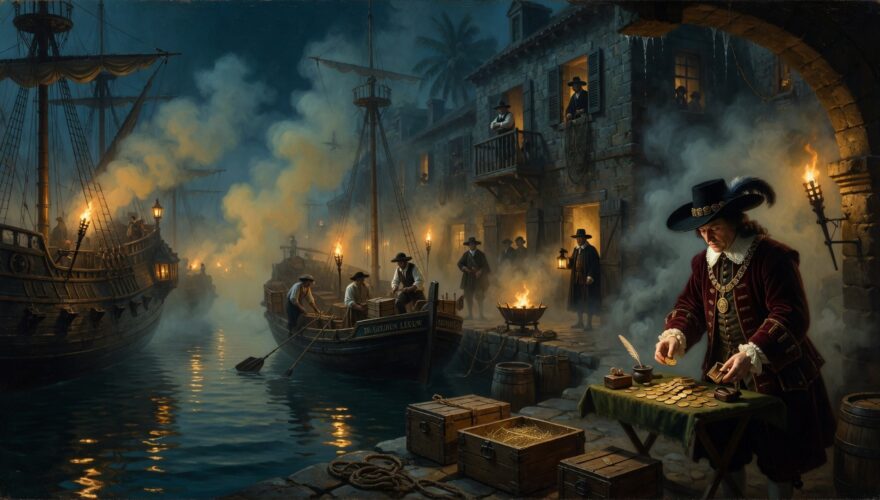
Ferreira had arranged the whole thing. The “pirates” were hired men. The silver was real but insured. And waiting for him at the dock was a port official who would certify the loss, pocket his cut, and file nothing that could be traced. Within six weeks, Ferreira had collected his insurance payout from a London underwriter, recovered his silver through a silent intermediary, and sailed back into open water richer than he’d left.
Pirates didn’t just steal. They were, in many cases, the sharp end of an economic system built on fraud, bribery, and institutional corruption that stretched from the Caribbean all the way to the counting houses of Amsterdam and London.
The golden age of piracy, roughly 1650 to 1730, did not thrive because rogues were brave. It thrived because legitimate commerce was saturated with people willing to profit from theft as long as their hands stayed technically clean. Merchants, insurers, port governors, and naval officers all participated in an informal economy built around maritime crime, and most of them did so without ever setting foot on a pirate ship.
Understanding piracy as a purely criminal phenomenon misses the point. It was an industry, and like any industry, it had investors, middlemen, and regulatory capture.
“They vilify us, the scoundrels do, when there is only this difference: they rob the poor under the cover of law, and we plunder the rich under the protection of our own courage.”
Samuel Bellamy (reported by Captain Johnson, 1724)
The Extortion Circuits
Long before modern organized crime formalized the practice, pirates ran protection rackets that would be recognizable to any Sicilian don.
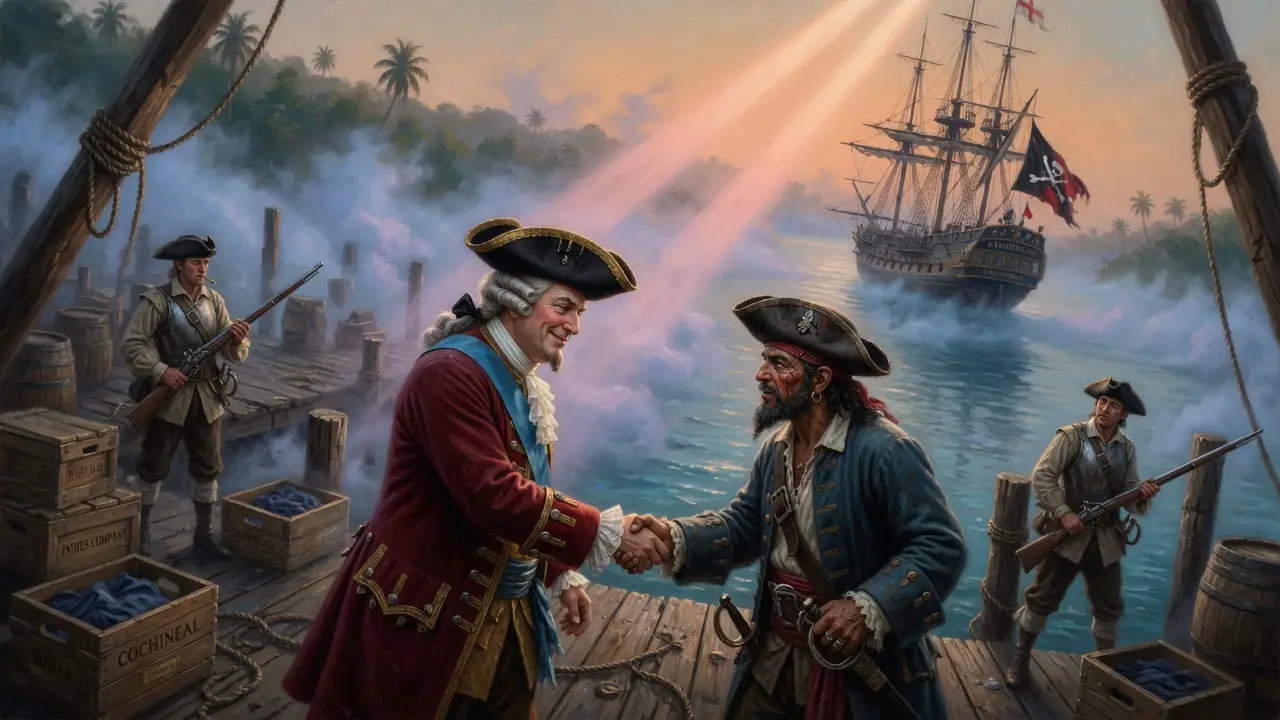
In the Indian Ocean during the 1690s, the Red Sea pirates operating out of Madagascar established something close to a regional toll system. Ships passing through certain corridors could either be boarded and stripped or pay a negotiated fee to pass unmolested. The fee varied. Big cargo, bigger price. Repeat customers got a discount.
Join The Archive Briefing
Weekly dispatches. The history they didn't teach you — sourced, subverted, delivered to your inbox.
This wasn’t chaos. It was commerce.
The merchant firms of Surat and Bombay, serving the powerful Mughal trade networks, eventually arrived at an uncomfortable accommodation. Some captains carried letters of passage purchased from known pirate captains. Others built the “piracy tax” into their shipping costs and passed it on to buyers. The violence was real when negotiations broke down, but the system functioned with a surprising degree of consistency.
Henry Every, one of the most notorious pirates of the era, was not simply a thief. After his attack on the Ganj-i-Sawai in 1695, a ship belonging to the Mughal emperor Aurangzeb, the fallout threatened to destroy the East India Company’s entire commercial relationship with India. Aurangzeb imprisoned the Company’s factors in Surat. The English were suddenly facing the loss of their most lucrative trade network because one pirate had hit the wrong target.
The lesson learned was predictable: it was cheaper to pay pirates than to fight them, and cheaper still to quietly route certain ships around known pirate corridors while pretending, in official correspondence, that the sea lanes were secure.

The Insurance Fraud Machine
London’s Lloyd’s Coffee House, which became the center of maritime insurance in the late seventeenth century, was built on a fundamental vulnerability: underwriters had no reliable way to verify what happened to a ship once it left port.
This created an opening so large that a generation of merchants drove wagons through it.
The mechanics were straightforward. A merchant would over-insure a cargo, typically valuing it at two or three times its actual worth. He would then arrange a “pirate attack” with trusted confederates, lose the cargo into their hands, collect the inflated payout, and quietly retrieve the goods through a fence operating out of a port like Port Royal or Nassau.
The fence was often a legitimate merchant. The insurance adjustor was often bribed. The port official who certified the attack as genuine was almost always on the take.
Peter Heywood, a Jamaican merchant who operated in the first decade of the eighteenth century, was investigated no fewer than four times for suspected insurance fraud. He was never convicted. The governor of Jamaica at the time was receiving a percentage of Port Royal’s import duties and had little enthusiasm for prosecuting men who kept the harbor busy.
This was not an anomaly. It was the standard arrangement.
The Officials Who Made It Possible
No part of the piracy economy worked without someone in official capacity willing to be bought.
Nicholas Trott, the governor of the Bahamas in the 1690s, is the most documented example, but he was representative of an entire class of colonial administrators who discovered that neutrality paid poorly and complicity paid extremely well. Trott allowed pirate ships to resupply at Nassau, certified false manifests, and collected personal fees from captains he should have arrested. When the pirate Henry Every arrived seeking safe harbor after the Ganj-i-Sawai attack, Trott let him in. Every eventually escaped. Trott kept the bribes and faced minimal consequences.
“I have been sworn against by perjured and wicked people.”
From the trial of pirate captain William Kidd, Admiralty Court, London, 1701
The colonial administration in the Caribbean was not designed to prevent this. Governors were underpaid, far from oversight, and surrounded by merchants whose prosperity depended on a loose interpretation of maritime law. The incentive structure pointed in one direction.
In the Mediterranean, the picture was similar. The Barbary states of North Africa, nominally under Ottoman suzerainty, operated an institutionalized version of what Caribbean pirates did informally. European powers paid tribute directly to the Deys of Algiers and Tunis for the protection of their shipping. Britain paid. France paid. The United States eventually went to war over the practice in 1801, but even then, the first instinct of the Jefferson administration was to keep paying and negotiate.
Corruption wasn’t a bug in the system. It was the architecture.
When the House of Cards Fell
The beginning of the end for the golden age piracy economy came not from naval enforcement but from market forces and insurance reform.
Lloyd’s began developing more rigorous loss verification requirements in the early eighteenth century, partly in response to the staggering fraud losses accumulating on their books. Syndicates started requiring sworn testimony from multiple independent witnesses. Payouts were delayed pending investigation. The informal network of corrupt port certifiers became a liability rather than an asset, since their testimony was now viewed with open suspicion.
At the same time, the major naval powers began posting permanent squadrons in the Caribbean and Indian Ocean, not primarily out of moral commitment to lawfulness but because the insurance fraud was destabilizing the cost of commerce. When piracy raises the cost of every cargo, the people who pay are ultimately the merchants who need credit, and the banks that extend it start complaining to governments.
“No man here is safe in his person or property while the pirates continue their depredations on this coast, and the corrupt officials who should suppress them take their share of the plunder like silent partners in a criminal firm.”
Woodes Rogers, in official correspondence to the Board of Trade, 1718
Woodes Rogers arrived in Nassau in 1718 with a royal pardon in one hand and a hanging rope in the other. Several dozen pirates accepted the pardon. Those who refused, Rogers executed publicly. The port was cleaned up, the corrupt networks disrupted. It was brutal, efficient, and commercially motivated. The Bahamas needed to become a functioning trade hub, not a pirate sanctuary, and the investors backing Rogers’ governorship said so explicitly.
The pirates who died on Nassau’s gallows in 1718 were not martyrs to freedom. They were employees of a corrupt system that had become inconvenient to the people who’d previously found it useful.
The Somali piracy crisis of the 2000s reproduced the golden age model almost exactly, including the ransom negotiators who worked both sides, the shipping insurers who quietly built hostage premiums into their coverage, and the coastal officials who received cuts in exchange for port access and silence.
The International Maritime Bureau documented dozens of cases in which ransom payments were facilitated through networks that included legitimate financial intermediaries, and in which the same fishing communities providing cover for pirate skiffs were also receiving protection money from regional militias connected to the nominal government.
The romantic pirate of popular imagination, the free spirit who rejected the corrupt world of commerce, was in nearly every meaningful case a contractor for that corrupt world, operating under different letterhead. The real pirates were the ones who never left the harbor, sitting behind polished desks, signing documents they knew were fraudulent, and collecting fees for looking the other direction when a ship arrived with a story that didn’t quite add up.