Imagine climbing nearly four thousand steps into the Alps, each one cut from stone by men who never lived to see the finished work. Imagine a fortress so vast, so vertical, so obsessively constructed over decades that it hugs an entire mountainside like a second skin, and then was never once tested in battle. That is Forte di Fenestrelle. And the more you learn about it, the stranger and more haunting it becomes.
A Wall in the Sky
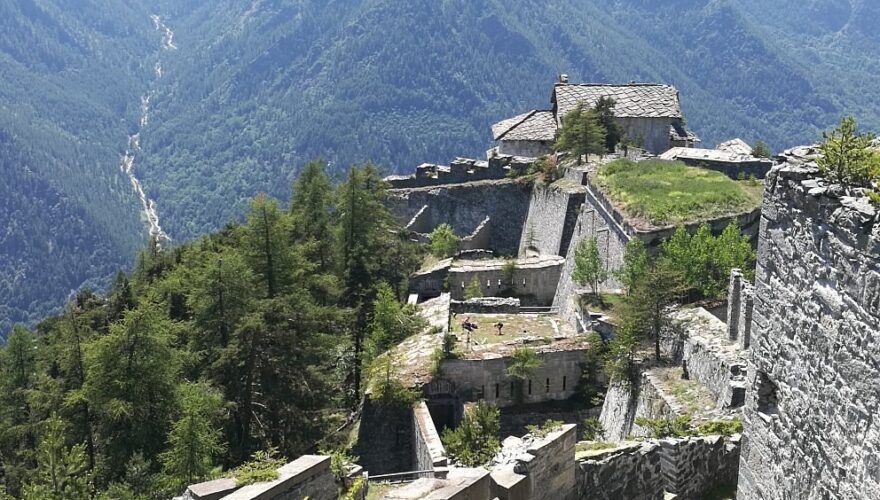
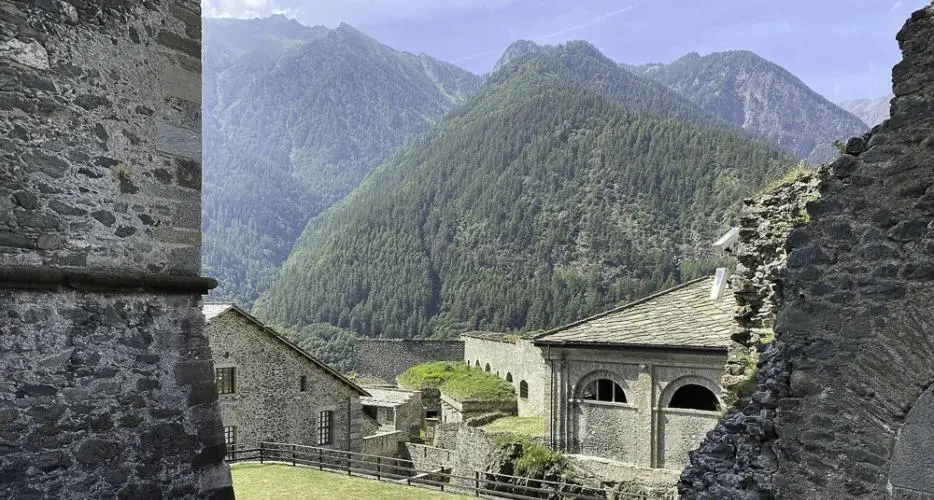
Tucked into the Chisone Valley in Piedmont, in the shadow of the Italian Alps, Fenestrelle doesn’t look like a fortress from a distance. It looks like the mountain itself has grown architecture: towers, bastions, curtain walls, and battlements cascading down nearly 700 vertical meters of rock, connected by a single covered staircase of 3,996 steps. Locals call it la Grande Muraglia delle Alpi. The Great Wall of the Alps.
It is the largest mountain fortress in Europe. Possibly the second largest fortification on Earth, after the Great Wall of China.
And most people have never heard of it.
The Savoy Obsession
The story begins in fear. In the early 18th century, the Duchy of Savoy sat squeezed between two empires with territorial appetites, France to the west and Austria to the east. The Alps were not merely scenic. They were a gauntlet. Every valley was a potential invasion route, and the Chisone Valley was one of the most exposed of all.
In 1728, the House of Savoy began building. What they envisioned was not a single fort but a system, an interlocking chain of structures at different elevations that would make the valley functionally impassable. Forte delle Tre Denti at the top. Forte di San Carlo in the middle. Forte Santa Maria at the base. All bound together by that extraordinary staircase, roofed in stone so that soldiers could pass between positions even in heavy Alpine snowfall without exposure to enemy fire or the weather.
Construction would continue, in fits and starts, for over a century.
The ambition was almost delusional in its scale. Workers hauled stone up slopes that barely allowed footpaths. Engineers surveyed positions so high that the air thinned and the maps ran out of contour lines. Thousands of laborers spent their lives on this mountain, shaping it into something that had no precedent in military architecture.
When it was finally complete, Fenestrelle could garrison three thousand men. It had its own bakeries, cisterns, powder magazines, barracks, chapels, and vegetable gardens suspended on terraces above the clouds. It was, in every practical sense, a self-contained vertical city built for a war that never came to its gates.
The Silence of the Unconquered
Here is the darkly comic truth at the heart of Fenestrelle’s history: it was never stormed. Not once.
Napoleon marched his armies through the Alps in 1796 and simply went around it. The French took Turin, reshaped northern Italy, and rendered the entire fortification strategically irrelevant in a matter of weeks. The cannons were never fired in anger. The staircase, built for rushing troops to crisis points, saw no crisis. Fenestrelle stood perfect and untested, like a sword never drawn from its scabbard.
Join The Archive Briefing
Weekly dispatches. The history they didn't teach you — sourced, subverted, delivered to your inbox.
After Italian unification in the 1860s, the fortress found a grimmer purpose. It became a prison. Among those held there were soldiers and civilians from the former Kingdom of the Two Sicilies, men from Naples, Sicily, and Calabria who had resisted, or were simply suspected of resisting, the Piedmontese-led unification. The conditions were brutal. The Alpine cold was not designed for men from the sun-scorched south. Mortality rates inside those walls were devastating.
The exact numbers remain disputed among historians, but the human reality is not. Men who had never seen snow died inside a mountain fortress built to repel a French invasion that never materialized. History has a particular cruelty for its minor characters.
The Fortress Remembers
By the 20th century, Fenestrelle had been abandoned. The Italian military no longer needed it. Nature began its quiet reclamation: moss on the bastions, trees pushing through parade grounds, rain wearing the mortar from joints that had held for two hundred years.
Then, in the 1990s, a group of volunteers decided they weren’t ready to let it disappear. The Associazione Progetto San Carlo began the slow, staggering work of restoration: clearing debris, stabilizing walls, reopening passages. Today, guided tours take visitors up through the fortress complex, through barracks rooms and powder stores, up portions of that famous covered staircase, where you can still feel the engineering logic of it: the angle of the treads, the height of the ceiling, the narrowing of the passage at certain defensive points.
Standing at the top on a clear day, you can see why someone once thought this place was impregnable. The valley spreads below you like a map. The ridgelines crowd in on every side. The whole landscape looks designed for defense.
But the fortress above you, for all its centuries of stone and labor and fear and ambition, was never what kept anyone out.
The mountain did that on its own.
Fenestrelle endures today as a monument not to military victory, but to military imagination, to the particular human compulsion to build something permanent against an uncertain world. It is a place where you can touch the stones and feel the weight of everything they were supposed to prevent. They never had to. And somehow, that makes them heavier.