History is written by the victors. But what happens when the victors don’t just write their own version, they burn yours first?
This is the story of one of the most calculated acts in human history: the systematic destruction of indigenous records, languages, and memory by colonial powers across four continents. Not as collateral damage. Not as ignorance. As strategy.
From the ashes of Mayan codices in a Yucatán plaza to the locked vaults of European museums, the erasure was methodical, the justifications were polished, and the consequences are still unfolding. What was lost wasn’t just culture. It was science, law, astronomy, medicine, and the lived memory of entire civilizations.
The Day the Books Burned
July 1562. The plaza of Maní, Yucatán.
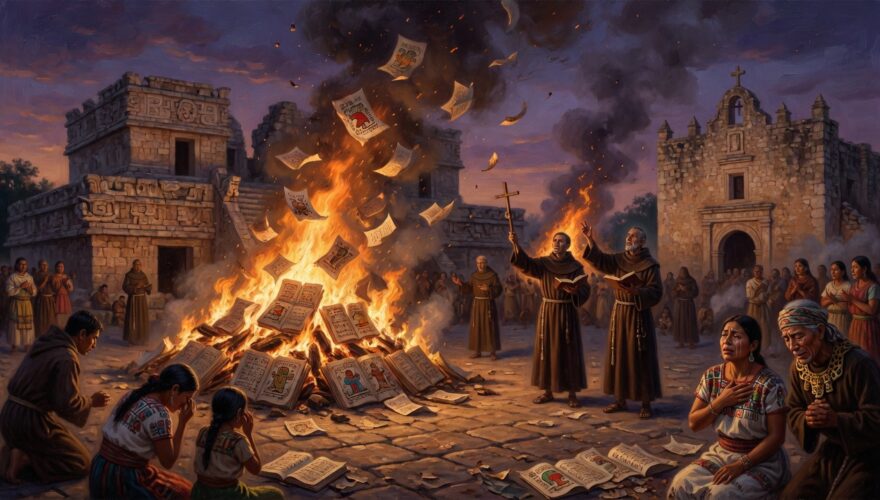
A Franciscan friar named Diego de Landa stands before a pile of screaming color… thousands of Mayan manuscripts, folded like accordions, painted in red and black and the deep green of jade. He calls them the work of the devil. He orders them burned. The Maya watching from the edges of the square weep openly. Some faint. According to witnesses, the sound they made was unlike ordinary grief. It was something older. Something that had no name in Spanish.
In a single afternoon, centuries of astronomical data, medical knowledge, genealogical records, and religious ritual vanished into smoke over the Yucatán sky.
De Landa later wrote, without apparent remorse: “We found a large number of books in these characters and, as they contained nothing in which were not to be seen as superstition and lies of the devil, we burned them all, which they regretted to an amazing degree, and which caused them much affliction.”
He noticed their grief. He burned the books anyway.
A Pattern, Not an Accident
What happened in Maní was not an isolated act of religious zeal. It was a blueprint.
Join The Archive Briefing
Weekly dispatches. The history they didn't teach you — sourced, subverted, delivered to your inbox.
Across the Americas, Africa, Asia, and the Pacific, colonial powers executed a remarkably consistent strategy: destroy the records, control the memory, and the people lose their footing in time. Once a civilization cannot prove its past, it becomes easier to convince them they never had one worth keeping.
This was not accidental. It was policy dressed in the language of salvation.
The Spanish Crown had an official doctrine called reducción, the forced relocation of indigenous people into compact, controllable towns, which deliberately severed communities from the sacred landscapes embedded in their oral traditions. The British Empire institutionalized the boarding school system across Canada, Australia, and parts of Africa with a stated mission that left nothing to interpretation. Richard Pratt, founder of the Carlisle Indian Industrial School in Pennsylvania, articulated it plainly in 1892: “Kill the Indian in him, and save the man.”
Language first. Then the stories. Then the identity. The sequence was almost always the same.
The Machinery of Erasure
The burning of codices was the dramatic version. The quieter methods were often more effective.
In the Congo Free State under King Leopold II of Belgium, local record-keeping traditions, intricate systems of knotted cord, oral genealogies maintained by dedicated memory-keepers called griots in West Africa, were systematically dismantled by replacing communal authority with Belgian administrative structures that recognized none of them as legitimate. If your history wasn’t written in French, it didn’t exist.
In Australia, the British declared the continent terra nullius (empty land), belonging to no one. The legal fiction required that Aboriginal Australians have no complex society, no territorial claims, no history of governance. To maintain that fiction, evidence had to be managed. Ceremonial objects were confiscated. Sacred sites were renamed or built over. The Stolen Generations, Aboriginal children forcibly removed from their families between roughly 1910 and 1970, were forbidden from speaking their languages. The goal was not just assimilation. It was the engineering of amnesia.
“The most merciful thing that can be done for a people whose country has been taken is to teach them the language and the habits of those who have superseded them.”
Canadian Department of Indian Affairs Annual Report, 1889
In Mexico, after the initial wave of burning, Spanish priests commissioned indigenous scribes to redraw certain codices from memory, but filtered through Catholic interpretation. The result was a corrupted archive, indigenous in form but colonial in content. The originals were gone. What replaced them was a mirror image designed to reflect the conqueror’s worldview back at the conquered.
The Theft Rebranded as Rescue
Then came the museums.
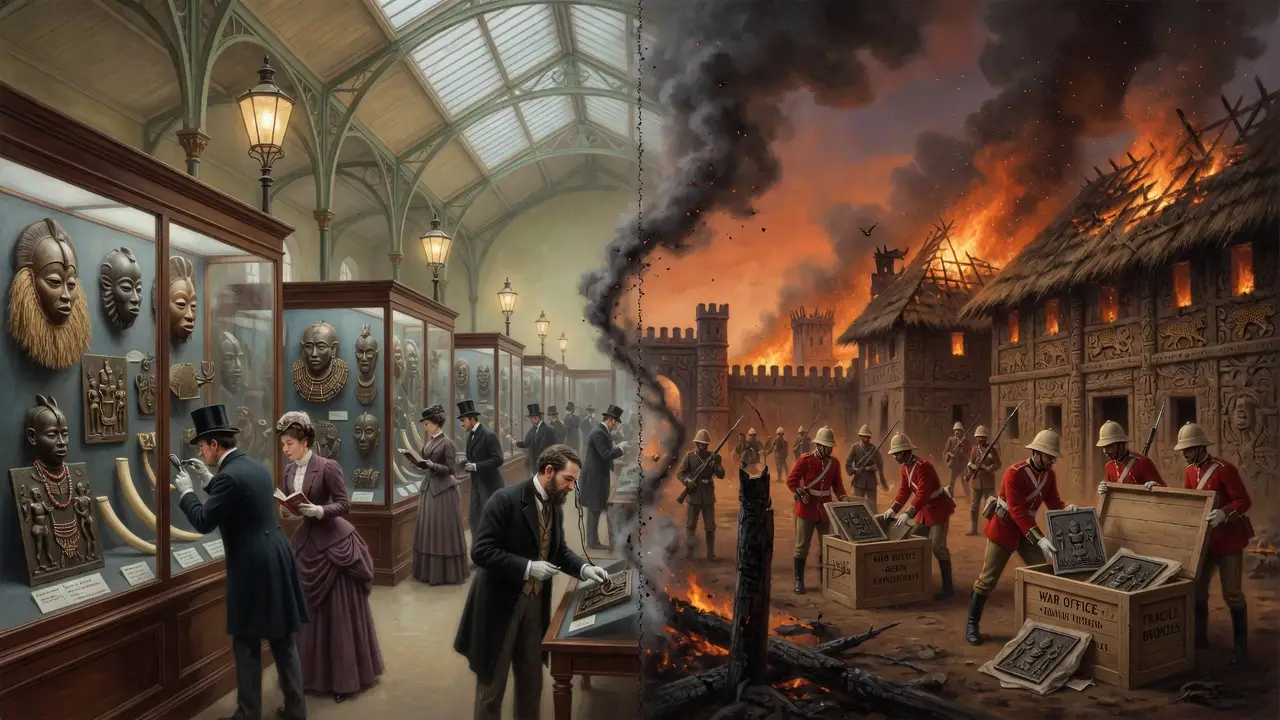
By the 19th century, the naked brutality of burning and confiscation had become somewhat unfashionable in European intellectual circles. A new justification emerged, one far more insidious: preservation. European institutions began acquiring, through purchase, coercion, excavation without consent, and outright theft, the material culture of colonized peoples. Masks, burial objects, sacred texts, ancestral remains. They arrived in London, Paris, Berlin, and Brussels, catalogued and displayed behind glass.
The Elgin Marbles were pried from the Parthenon between 1801 and 1812 by British diplomat Lord Elgin, who claimed he was saving them from Ottoman neglect. The Benin Bronzes, some of the most technically sophisticated metalwork produced anywhere on earth before the industrial age, were looted by British forces in 1897 during the Punitive Expedition, which razed the Kingdom of Benin to the ground. The bronzes ended up in the British Museum. The city that created them was reduced to ash.
“A great number of them were burned; I do not know whether out of great piety or on some other pretext.”
Bartolomé de las Casas, Dominican friar and critic of Spanish colonial violence
A lesser-known detail: many of those Benin Bronzes had themselves been created to preserve history. They were royal commemorative plaques, hung in the king’s palace to record the deeds of past rulers. When the British took them, they didn’t just steal art. They stole the archive.
The framing was always generous. We are keeping these safe. We have the climate-controlled rooms, the conservation specialists, the scholarly infrastructure. The implicit message underneath: you cannot be trusted with your own past.
The Voices They Could Not Fully Silence
Here is what the colonial project underestimated.
Memory is not only material. It lives in the body, in rhythm, in the particular way a grandmother adjusts her voice when a story turns serious. The Quipu, a system of knotted strings used by the Inca to record census data, tribute tallies, and possibly narrative history was banned by Spanish authorities in 1583 because they could not fully decode it and therefore could not control what it said. But knowledge of how to read it persisted in certain Andean communities for generations, passed quietly through families who understood that survival sometimes requires discretion.
In West Africa, the griot tradition, oral historians who memorized centuries of lineage, law, and legend survived colonialism not by confronting it directly but by adapting around it. Griots became musicians, storytellers at public events, figures whose cultural function was tolerated because it appeared decorative to outsiders who didn’t understand what they were actually maintaining.
The Māori of New Zealand preserved genealogical knowledge in the form of whakapapa, a recitation practice that traced ancestry back to creation itself. British colonial authorities found it baffling and therefore largely ignored it as a threat. It survived. Today it is legally recognized in New Zealand courts as a valid form of historical testimony.
The Long Reckoning
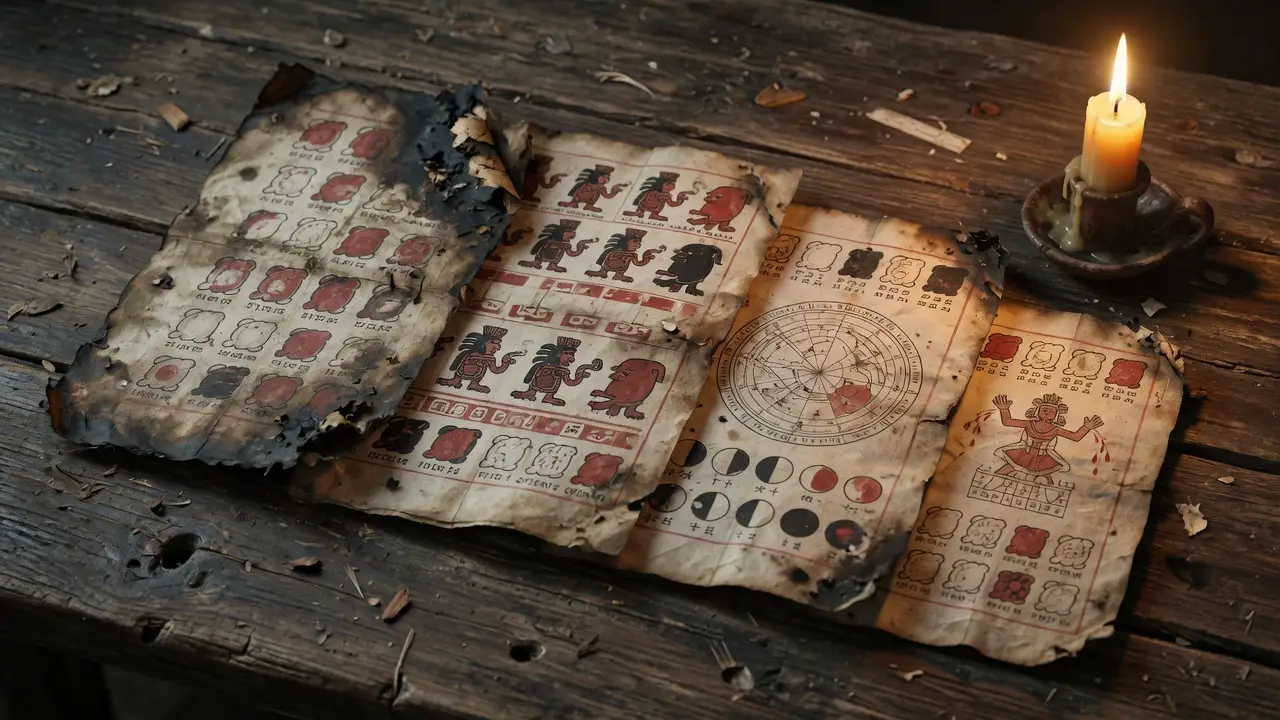
Of the thousands of Mayan codices that existed before the Spanish arrived, four are confirmed to have survived. Four. The Dresden Codex, the Madrid Codex, the Paris Codex, and the fragmentary Grolier Codex. What those four contain, tables predicting Venus cycles accurate to within minutes, complex calendrical systems, records of ritual and kingship gives researchers enough to understand that what was lost was staggering. We are reading four pages of a library.
Diego de Landa, in a twist almost too strange for fiction, later wrote one of the most detailed accounts of Mayan culture ever produced, the Relación de las Cosas de Yucatán apparently without recognizing the irony of destroying the primary sources and then writing a secondhand summary. He even invented a phonetic “Mayan alphabet” that had no basis in actual Mayan script but confused researchers for centuries. The man who burned the books also wrote the book about the books.
“The object of our school is to turn out men who will be useful members of society.”
Reverend E.F. Wilson, Shingwauk Indian Residential School, Ontario, 1886
In 2020, Germany began negotiations to return the Benin Bronzes. France passed legislation in 2021 allowing the restitution of 26 objects to Benin and Senegal. The British Museum, as of this writing, continues to hold the Elgin Marbles and resists formal repatriation, citing a 1963 law that prohibits the permanent removal of objects from its collection, a law, critics point out, that the museum itself lobbied to create.
The archive is still incomplete. The negotiations are still ongoing. The smoke from Maní has never entirely cleared.
What the Silence Cost Everyone
There is a tendency to frame the destruction of indigenous records as a tragedy for indigenous peoples specifically. That framing is too small.
When the Mayan astronomical codices burned, humanity lost data accumulated over centuries of rigorous sky-watching. When Aboriginal songlines were severed from the communities that maintained them, ecological knowledge about water sources, seasonal animal behavior, and land management that had kept people alive for 60,000 years began to disappear. When the Inca Quipu system was suppressed, we lost what may have been one of the most elegant non-alphabetic information storage systems ever devised.
This was not just cultural loss. It was intellectual loss. Scientific loss. The destruction was comprehensive enough to damage the human record itself.
And the mechanism behind it, the idea that some people’s knowledge counts as civilization and other people’s knowledge counts as superstition, that idea did not retire when the empires did. It persists in which histories get taught, which archives get funded, which voices get described as sources and which get described as folklore.
The bonfire in Maní in 1562 is over. The question of who gets to own the past is not.