Before hospitals, before ethics, ancient healers wielded pain as proof of divine favor. Discover the stomach-turning reality of ritualistic healing practices, where trepanation, bloodletting, and sacred torture were humanity’s first medicines, and who really held the power.
The Surgeon Believes Your Blood Is a Gift to the Gods
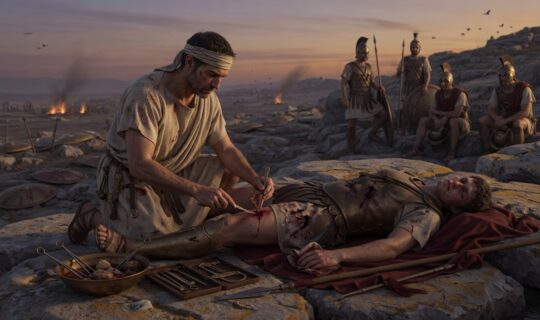
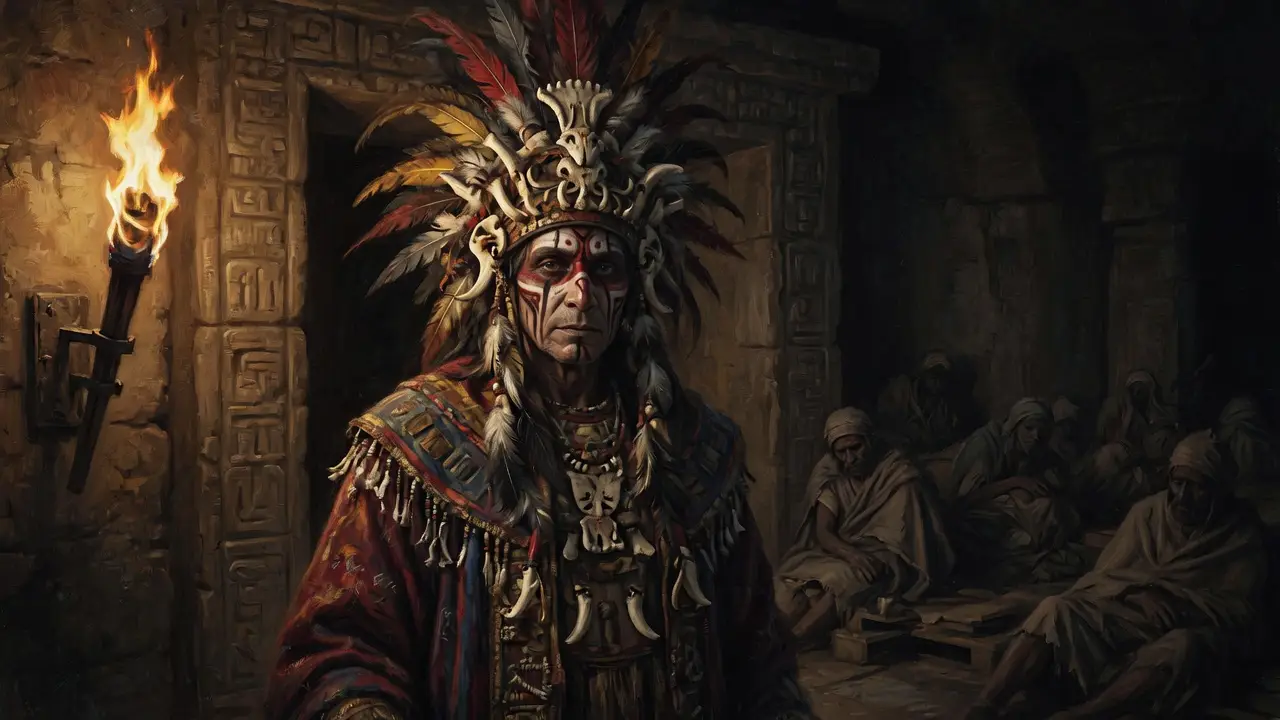
You are feverish. Your skull throbs with a pressure that feels like something alive pushing from inside. You cannot see straight. Your family carries you to the only person in your village with the power to save you, a man dressed in animal skins and painted bones, holding a stone blade that has been passed down through three generations of healers.
He does not examine you. He does not ask what you ate or where you slept. He already knows the cause. A spirit has breached your skull. The only way to drive it out is to open a hole in your head and let it escape.
And here is the detail that should stop you cold: you will survive.
“If a man has been taken with a headache and his face is set to the right, his hands and feet are always on the move, his eyes are full of blood: this is the grip of the god Sín.”
Babylonian Diagnostic Handbook (Sakikku), c. 1067 BCE
Thousands of skulls recovered from Neolithic sites across Europe, South America, and the ancient Near East bear the marks of trepanation, holes drilled or scraped through living bone, and the smooth, healed edges around those holes tell us that a disturbing number of patients lived through the procedure. Not once. Not twice. Some skulls show three or four separate openings, suggesting repeat surgeries, or a healer who kept refining his craft on the same unfortunate subject.
This is the world before medicine was divorced from religion. A world where pain was not a symptom to be treated but a language spoken between the body and the divine. Where the line between physician and priest did not exist. And where the people who held the cutting tools held something far more valuable than surgical skill: they held authority over life itself.
The Theater of Pain
Long before operating theaters were designed for hygiene or observation, ancient healing rituals were performances built for an audience. The sick body was not private. It was a stage.
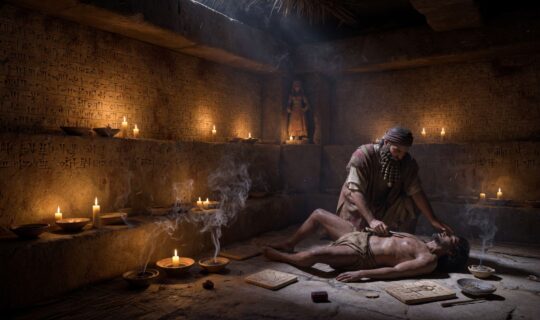
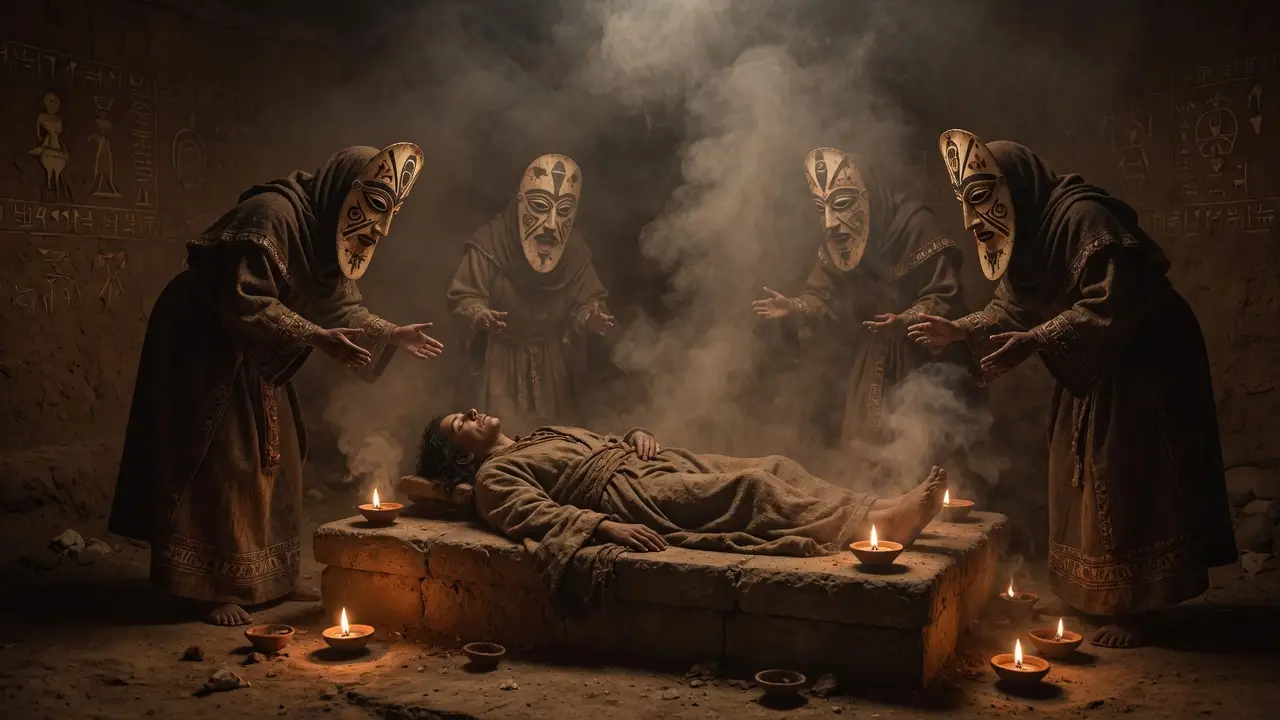
In Mesopotamian healing ceremonies dating to roughly 2000 BCE, the afflicted were laid at the center of a space heavy with burning cedar and juniper incense, surrounded by the low, rhythmic chanting of ashipu, exorcist-physicians who served both Marduk and the patient simultaneously.
The incense was practical as well as theatrical: it masked the smell of infection and blood. The chanting overwhelmed the screams. The fire cast shadows that turned a simple ritual into something monstrous and magnificent for everyone watching from the edges.
The community gathered deliberately. Healing was not a private medical transaction. It was a public event, and the presence of witnesses was considered essential to its success. The gods, after all, needed to see that the community took illness seriously.
“The physician’s art is the gift of the gods; he who possesses it should not be doubted.”
Egyptian maxim recorded in the Edwin Smith Papyrus commentary tradition, c. 1600 BCE
This created an architecture of theater around suffering. Egyptian sekhmet priests, healers associated with the goddess of plague and war, wore masks during procedures, transforming themselves into divine intermediaries. The patient, by extension, stopped being a person and became a contested territory between cosmic forces.
Join The Archive Briefing
Weekly dispatches. The history they didn't teach you — sourced, subverted, delivered to your inbox.
Whatever agony the ritual produced was understood not as harm inflicted by the healer but as the visible struggle of gods fighting over a soul.
The physical suffering itself was marketed with sophisticated psychological framing: if it hurt this much, the demon inside must be powerful. If the demon was powerful, the healer fighting it was more powerful still. Pain became proof of the ritual’s seriousness. To ask for relief would have been to admit the ceremony was failing.
Tools of the Sacred Violator
The instruments recovered from ancient healing contexts are not primitive in the way we typically imagine. They are not crude. They are carefully made, often beautiful, and they reveal something about the people who used them: these were craftsmen who took their work seriously.
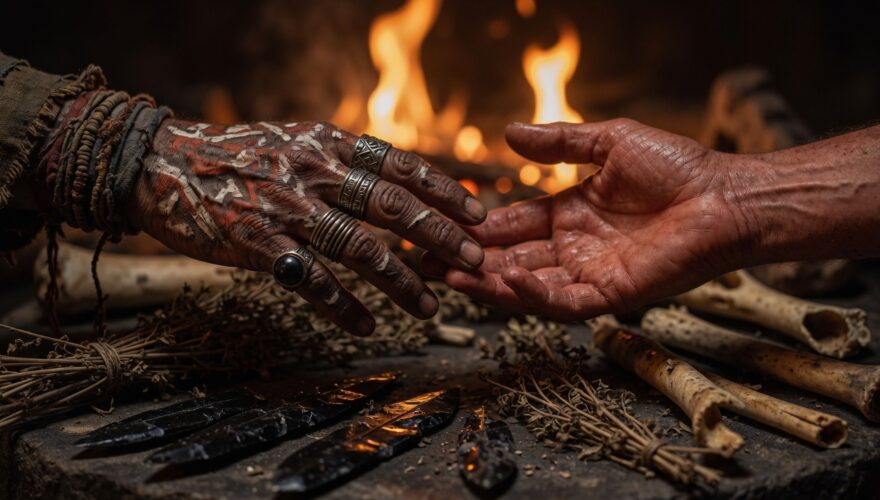
Obsidian blades from pre-Columbian Mesoamerican surgical contexts have been analyzed and found to hold an edge sharper than modern surgical steel. The problem was never the blade. The problem was everything surrounding it with no concept of infection, no anesthesia beyond intoxicants that were partially effective at best, and a cosmological framework that required the patient to remain conscious throughout.
Consciousness was not incidental. It was required.
In Andean trepanation traditions, the belief held that the patient’s awareness was necessary for the expulsion of the invading spirit. If the patient lost consciousness, slipped from the world then the demon might slip out with them. The healer needed the patient awake, responsive, present. This was not cruelty for its own sake. It was theology with a bone scraper.
“The surgeon who opens the skull releases not only blood but the very breath of the spirit within.”
Paraphrased from Galen, On the Usefulness of the Parts of the Body, c. 170 CE
The tools themselves tell a story of iteration and craft. Early Neolithic trepanation instruments were flint scrapers used in a circular grooving motion. By the time of the ancient Greeks and Romans, bronze trephines (cylindrical saws with serrated edges) had been developed that could remove a disc of skull with something approaching efficiency. The Inca, working entirely without metal tools in their early period, achieved survival rates from trepanation that some historians estimate at over fifty percent. Galen, the second-century Roman physician who understood more about the brain than most of his contemporaries, still operated without anesthesia on conscious patients, noting in his writings that the sounds patients made during cranial surgery were “of diagnostic value.”
He was listening to the screams for information.
Bloodletting instruments form their own category of sacred violence. The Egyptian sekhmet priests used lancets to open veins at prescribed points on the body corresponding to celestial alignments. Medieval European barber-surgeons inherited this tradition almost unchanged, cutting into patients with fleams, spring-loaded blades designed for speed, while the patient was held still by assistants. The Aztec drew blood with maguey spines in rituals that blended healing, sacrifice, and devotion into a single act that cannot be separated into its component parts without losing its meaning entirely.
Sanctified Trauma as Therapy
What made these practices sustainable across centuries was not ignorance. It was belief… and belief is a more durable architecture than most people credit.
The psychological conditioning that convinced patients their suffering was evidence of divine attention began long before the healer ever lifted a blade. It began in childhood, watching the adults of the community undergo the same rituals and survive. It was reinforced through communal storytelling that framed past patients not as victims but as warriors who had fought demons and won. By the time a person was laid down before the healer, they had spent their entire life being prepared to understand pain as meaning.
LESSER-KNOWN DETAIL
A skull found in Ensisheim, France (5100–4900 BCE) shows two separate trepanations, both fully healed, meaning the patient survived both procedures and likely lived for years afterward. This is one of the oldest known surgical patients in human history.
The priest-physician understood this completely. Figures like the Sumerian azu and ashipu, whose titles translate roughly to “water-knower” and “incantation-priest” occupied a social position that made resistance to their treatments almost unthinkable. They were the only people in the community with the authority to speak directly to the gods about your particular case. Questioning their methods was not skepticism. It was heresy.
This authority was self-reinforcing in ways that modern medicine would recognize, if uncomfortably. When patients died, the ritual had been performed correctly but the demon had been too powerful. When patients survived, the ritual had worked. The healer absorbed the credit and distributed the blame. The failures were the patient’s fault, or the gods’ will, or a spiritual contamination the healer hadn’t been warned about. The successes were proof of the system.
“Pain is the voice of the body asking permission from the gods.”
Mesopotamian ashipu healing tradition; recorded in cuneiform tablets from Nineveh, c. 650 BCE
There was also a dimension of communal theater that transformed trauma into social cement. In many tribal healing contexts, the entire community fasted, chanted, and participated in the ritual alongside the patient. The shared experience of witnessing extreme suffering created bonds between people that functioned like collective trauma bonding, the same psychological mechanism that ties soldiers together in combat. You watched your neighbor screaming with a hole in his skull, and the two of you would carry that shared experience for the rest of your lives.
The ritual didn’t just treat the patient. It treated the community.
The Sociology of Survival
The obvious question is why populations continued submitting to practices that killed a significant percentage of those who underwent them. The answer sits at the intersection of desperation, social control, and the complete absence of alternatives.
A fever in 3000 BCE was not merely unpleasant. It was existential. Without any framework to understand infection, inflammation, or neurological disease, the people experiencing these conditions faced something that looked, from the inside, exactly like what their healers described: an invisible force entering the body and trying to take it over. The metaphor of demonic possession wasn’t superstition layered over ignorance. It was the most rational available explanation for something that genuinely felt like an invasion.
Into this void stepped the healer class, and what they offered was not just treatment but narrative. They gave people a story in which suffering had purpose and death had meaning. For a community with no other story to tell, this was not a small gift.
LESSER-KNOWN DETAIL
Studies comparing pre-Columbian Andean trepanation survival rates found that Inca surgeons achieved roughly 80–90% patient survival by the Inca Imperial period (1400–1532 CE), higher than the survival rate for the same procedure in 19th-century Europe, where germ theory was still unknown.
But the healer class also understood, consciously or not, that their authority depended on maintaining a monopoly over both knowledge and practice. Medical knowledge in ancient cultures was typically hereditary or initiatory, passed through family lines or secret societies, deliberately obscured from outsiders. The Egyptian medical papyri, while remarkable documents, were priestly texts, not public health resources. The knowledge belonged to the priesthood. The priesthood controlled access to healing. This control was political as much as it was spiritual.
The weak, the sick, and the dependent were the primary subjects of ritualistic healing. Children, the elderly, women in childbirth, the poor, these were the populations who most often could not refuse the healer’s authority. The social hierarchy of ancient medicine was a hierarchy of vulnerability, and the healer sat at the top of it.
LESSER-KNOWN DETAIL
Aztec ritual bloodletting was not limited to sacrifice victims. Nobles and priests regularly bled themselves through the tongue, earlobes, and genitals as acts of devotion and healing simultaneously, the pain was offering and medicine collapsed into a single gesture.
What kept the system functional was a survival rate that, while terrible by modern standards, was not zero. Some patients recovered from trepanation. Some bloodletting reduced the dangerous fever of an infected wound by coincidence. Some herbal preparations administered alongside rituals contained genuine pharmacological compounds that worked. The healing tradition was not purely invention. It was a tangle of effective and ineffective practice, wrapped in cosmology so dense that disentangling one from the other was impossible without a framework of controlled observation that wouldn’t exist for thousands of years.
The patients who survived became the system’s best advertisement.
What We Carry Forward
Across much of the world today, the formal boundary between ritualistic healing and clinical medicine is legally and ethically enforced. A surgeon must have your consent. An anesthesiologist ensures you feel nothing. The individual patient’s right to refuse treatment exists as a principle, however imperfectly practiced, in every modern medical system.
But look sideways at the cultural fringe of alternative medicine and the architecture of ancient healing becomes recognizable. The practitioners who promise that their painful procedure is proof it’s working. The authority figures who frame doubt as a failure of the patient’s faith. The communities gathered around testimonials that function like the chanting circles of Mesopotamian exorcism, witnesses who validate the narrative by showing up. The careful separation of knowledge from the patient, who is told only what the practitioner decides they need to know.
LESSER-KNOWN DETAIL
The first named physician in history was a woman: Merit Ptah, described as “chief physician” in ancient Egypt around 2700 BCE. She practiced within a tradition that made no meaningful distinction between medical and ritual healing.
This is not an accident. The psychological mechanisms that made ancient ritualistic healing persuasive — the need for narrative in the face of chaos, the comfort of authority, the social bonding of shared suffering, are still fully operational in modern human cognition. They were not superstitions. They were features of a brain that had to find meaning in suffering or go insane from the randomness of it.
The ethical revolution of clinical medicine was not primarily technological. Ether and antiseptics and the randomized controlled trial were tools. The revolution was philosophical: the decision that the patient’s experience, including their pain, their fear, their consent, mattered independently of what the healer needed them to feel.
We are not as far from the stone blade as we prefer to believe. The same desperation that drove a Neolithic farmer to let someone drill a hole in their skull still drives people toward treatments that promise certainty in uncertain times. The healer who holds the answer to your worst fear has always held enormous power.
The only thing that changes is whether we notice it.