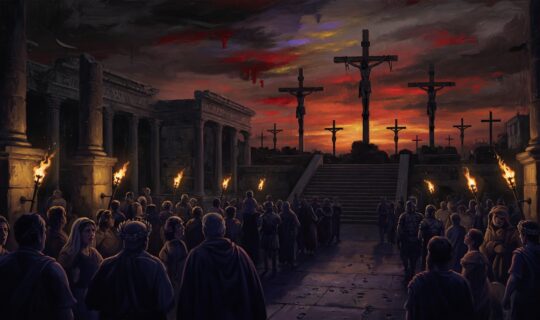
In the summer of 650 BCE, somewhere in the ancient city of Nineveh, a man was carried into a temple by his terrified family. He hadn’t slept in days. He spoke to figures no one else could see. He tore at his own skin and screamed at the ceiling. His name has been lost to history, but his symptoms were recorded on a clay tablet that still exists. The diagnosis carved beside them read, roughly translated: “the hand of Ishtar.”
He wasn’t sick. He was claimed.
That distinction between illness and possession, between a broken brain and a broken covenant with the gods would define how humanity treated its most vulnerable minds for thousands of years. And depending on which empire you happened to be born into, that distinction could mean the difference between being anointed as a prophet or being locked in a hole in the ground.
The Gods Made You This Way
Before there were psychiatrists, there were priests. And before there were diagnoses, there were omens.
In Mesopotamia, the world’s first bureaucratic civilization, mental disturbance was catalogued with the same cold precision the Babylonians applied to astronomy and trade law. The Diagnostic Handbook, a medical text compiled around 1067 BCE by a physician named Esagil-kin-apli, listed behavioral symptoms with startling clinical detail like depression, mania, paranoia, self-harm, and attributed every single one to supernatural interference. Depending on the constellation at your birth, the deity who owned your ailment, and the specific shape of your suffering, a different god had put their hand on you.
This wasn’t superstition in the dismissive sense. It was a complete system of logic. If the universe was governed by divine will, then a mind that had shattered must have shattered for a divine reason. The question wasn’t what is wrong with this person. The question was who sent this, and why.
Treatment followed the same logic. Exorcists (called ashipu) were medical professionals with years of training. They didn’t replace physicians; they worked alongside them. You might receive herbal compounds for your body while a trained ritual specialist performed incantations over you for three nights running. The Mesopotamians weren’t choosing superstition over medicine. They were doing both at once, because to them, both addressed real dimensions of the same problem.
Egypt: Where Madness Could Be Holy
Travel west to the Nile Valley and the calculus shifts slightly. Egyptian medicine was sophisticated by any ancient standard, their physicians correctly identified the brain as the seat of sensation as early as 1700 BCE, documented in the Edwin Smith Papyrus. They understood trauma. They understood epilepsy. And yet even here, the line between the mentally ill and the spiritually chosen was rarely fixed.
Certain forms of madness weren’t feared in Egypt. They were revered.
Join The Archive Briefing
Weekly dispatches. The history they didn't teach you — sourced, subverted, delivered to your inbox.
People who experienced visions, who spoke in tongues during rituals, who seemed to channel something beyond themselves, these individuals were often drawn into temple service rather than cast out. The god Sekhmet, lion-headed goddess of destruction and healing both, was believed to cause and cure mental affliction. Her priests served as healers of the mind. Temples functioned, in part, as early psychiatric facilities: places where the disturbed could be housed, kept from harming themselves, exposed to music, water, dream interpretation, and the supposed proximity of divine healing.
“Men ought to know that from the brain, and from the brain only, arise our pleasures, joys, laughter and jests, as well as our sorrows, pains, griefs, and tears.”
Hippocrates, “On the Sacred Disease,” c. 400 BCE
This wasn’t entirely naive. Rest, ritual, community, and structured time have genuine therapeutic value, a fact modern psychiatry continues to rediscover. The Egyptians didn’t know why these things helped. But they’d noticed that they did.
Greece: The Birth of a Dangerous Idea
Then came the Greeks. And everything got more complicated.
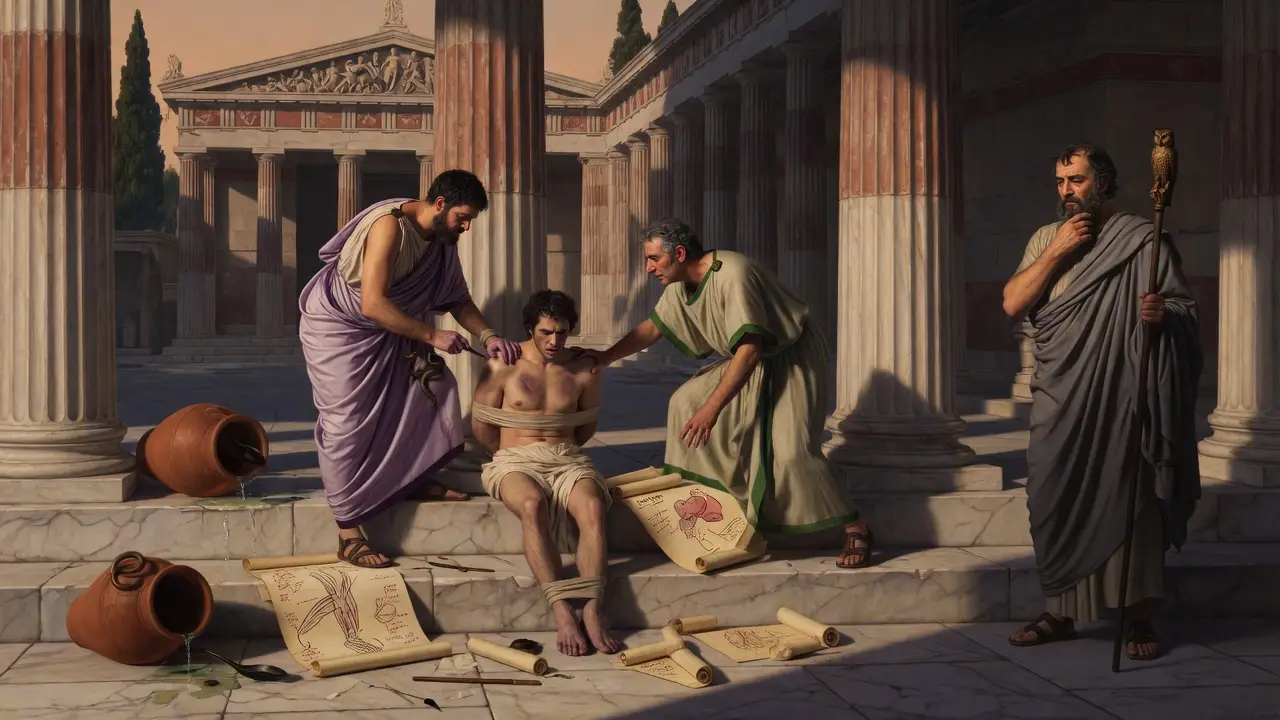
Hippocrates, born around 460 BCE on the island of Cos, looked at the convulsing, screaming, weeping people around him and made an argument that was, for its time, almost violently radical. Mental illness had nothing to do with the gods. It was the brain. A physical organ. Subject to physical causes. The sacred disease, as epilepsy was then called, was not sacred at all. It was a malfunction. And malfunctions could, theoretically, be fixed.
This was the birth of the secular diagnosis. And it was liberating and catastrophic in equal measure.
Liberating because it moved the conversation toward the body, toward observation, toward treatments that didn’t require divine intercession. Catastrophic because stripping madness of its sacred dimension also stripped the mad of their protected status. If you weren’t possessed by a god, you were just broken. And broken things, in the wrong hands, could be controlled.
The Greeks also gave us the concept of melancholia, black bile they called it, pooling in the body and darkening the mind. Depression wasn’t weakness. It wasn’t divine punishment. It was hydraulics. This was almost poetic in its wrongness and yet produced real insights. Aristotle noted that many great thinkers seemed to suffer from it. “Why is it,” he asked, “that all men who are outstanding in philosophy, poetry, or the arts are melancholic?” It was the first clinical observation of what we now call the relationship between creativity and mood disorders.
But Greece was also the civilization that shackled its mentally ill. That subjected them to cold-water immersion, bloodletting, and confinement. The rationalist tradition produced both the most humane ideas and some of the most brutal practices. The mind, once demystified, became something to correct.
Rome: The Asylum as Architecture
Rome inherited Greek medicine and industrialized it. The empire was vast and efficient, and it eventually needed systems for handling people who could not function within its machinery.
The word asylum comes from the Greek asylon, meaning sanctuary. But the Roman version of that sanctuary could be grim. Wealthy Romans with disturbed relatives had options: private physicians, seaside retreats, diet, exercise, baths. The Roman writer Celsus recommended humane engagement with the mentally ill, conversation, gradual trust-building. His contemporary Asclepiades argued against physical restraint, calling it cruel and counterproductive.
These voices lost.
For the poor, for slaves, for anyone without family resources, Roman urban life offered almost nothing. They wandered. They begged. They were occasionally chained in public temples as cautionary spectacles or, when the disruption became intolerable, removed from the city entirely. Roman law did recognize furiosi (the violently mad) as a legal category requiring a guardian. This was protection of a sort. It was also the formal beginning of a tradition that would shadow Western civilization for centuries: the removal of agency from those whose minds did not conform to the expected standard.
The Roman military, notably, had some of the earliest records of what we would now recognize as PTSD. Veterans who returned from campaigns exhibiting erratic behavior, emotional numbness, or violent episodes were noted in historical accounts. Some were dismissed as cowards. Some were treated by military physicians with rest and herbal remedies. None were understood.
Persia and the House of Wisdom
Here is where the standard history diverges from the more honest one.
While medieval Europe would go on to associate mental illness almost exclusively with demonic possession and subject the afflicted to exorcism, imprisonment, and execution, the Islamic world took a different path. And it did so centuries earlier than most people know.
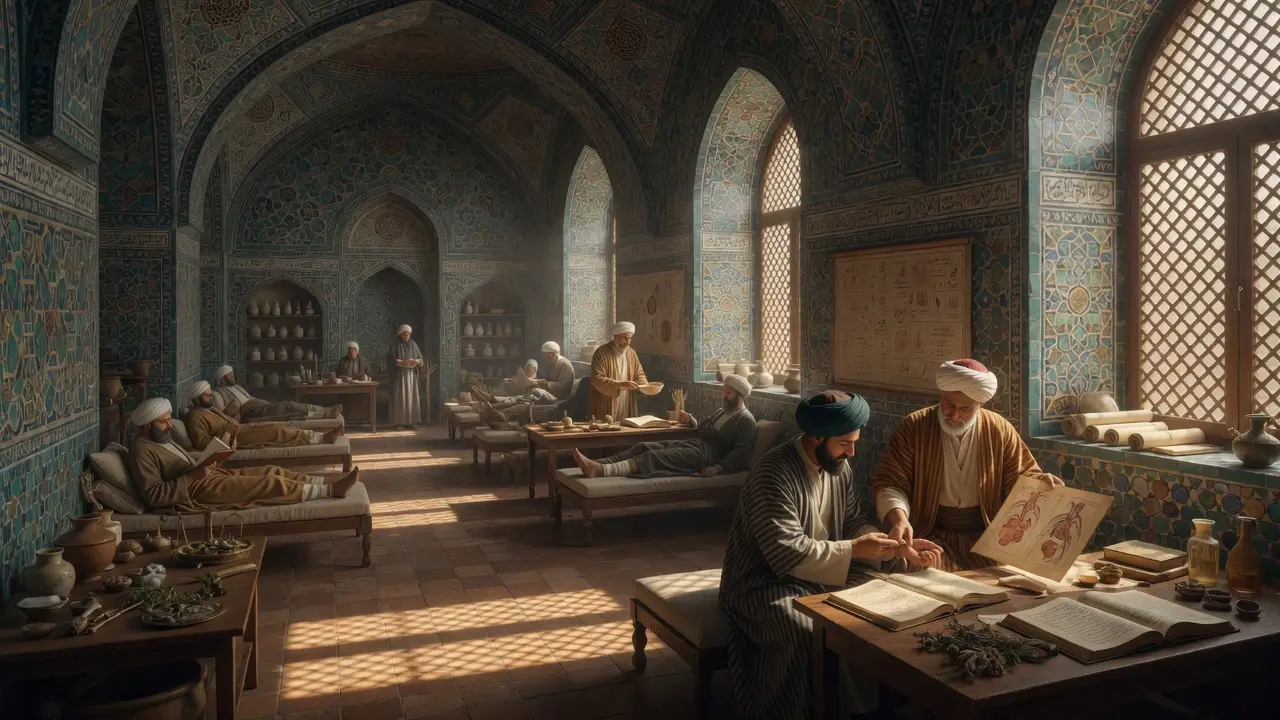
In 705 CE, the first dedicated psychiatric hospital in recorded history opened in Baghdad. Not a prison. Not a temple. A hospital. The Bimaristan, funded by the Umayyad Caliph al-Walid I, housed the mentally ill alongside the physically sick. Physicians examined patients, prescribed treatments, tracked outcomes. A century later, the great physician Al-Razi was classifying mental illnesses, recommending psychological approaches alongside physical ones, and insisting that the mind was as legitimate a subject of medicine as the body.
By the 9th century CE, Islamic physicians understood depression, psychosis, and anxiety as medical conditions requiring care, not punishment. While the rest of the world was still debating divine origin, Baghdad had moved on.
“The diseases of the mind are more and greater than those of the body.”
Cicero, “Tusculan Disputations,” 45 BCE
This wasn’t a minor development. It was a civilizational rupture. And its influence eventually traveled into medieval Europe through translation, quietly seeding the rational approach to mental health into a culture still burning witches for hearing voices.
What the Ancient World Got Right (And Terribly Wrong)
The ancient answer to mental illness was never just one thing. It was a shifting, contested terrain across thousands of years and dozens of cultures.
The Mesopotamians got something right: treating mental and physical illness as intertwined, not separate. Modern psychiatry is slowly returning to that integration, recognizing that the body and the mind are not distinct systems.
The Egyptians got something right: community, rest, music, ritual, and structured environment all have measurable therapeutic effects. Their temple-hospitals, however primitive, produced genuine healing alongside genuine mysticism.
The Greeks got something right: rational inquiry, observation, and categorization were tools that could, over centuries, lead somewhere useful. They also got something dangerously wrong: once the divine protection was stripped from the mad, the machinery of control could grind them up with a clean conscience.
The Romans built institutions. They passed laws. They medicalized what they didn’t understand. Sound familiar?
And the Islamic world, in the moment that mattered most, chose compassion over condemnation.
We tend to tell this story as a march toward enlightenment. Primitive people blamed demons, smarter people found the brain, and now we have therapy apps and antidepressants. Progress.
But the actual history is less comfortable. The same cultures that produced the most sophisticated ideas about the mind also produced the cruelest treatments. Rationalism didn’t always produce kindness. Mysticism didn’t always produce cruelty. And the forced institutionalization that seemed like modern progress in the 19th century turned out to produce horrors that rival anything the ancient world imagined.
The man in the Nineveh temple, the one carried in by his family with the hand of Ishtar pressed to his skull, was probably kept warm, fed, spoken to by trained priests, and surrounded by people who believed his suffering had meaning. That’s not nothing.
We’re still arguing about whether suffering has meaning. We’re still debating who gets to define what a mind is supposed to look like. We’re still building institutions, and we’re still, sometimes, getting it exactly as wrong as Rome did.
The gods may have changed. The problem hasn’t.