The Bones That Built Cathedrals: How Medieval Europe’s Fake Relic Trade Became the Biggest Con in History.
The medieval relic trade was the biggest economic scam in European history, and the Church built cathedrals with the profits. Discover how forged bones, stolen saints, and manufactured miracles powered an underground economy that lasted a thousand years, who ran it, who profited, and why the pilgrims kept coming long after the questions started.
In 1125, a monk named Guibert of Nogent sat down to write something that took considerable courage: an accusation that the Church was lying to its own faithful. The monastery at Saint-Médard, he noted, claimed to possess one of Jesus Christ’s baby teeth. Guibert’s response was sharp and unsparing. Christ had risen bodily into heaven, he argued. Every part of him went with him. So whose tooth, exactly, was rotting in that reliquary?
Nobody listened. The pilgrims kept coming.
A Economy Built on the Sacred
To understand how an entire continent got conned by dead men’s knuckles, you have to understand what relics meant in the medieval world. These weren’t decorations or curiosities. They were technology.
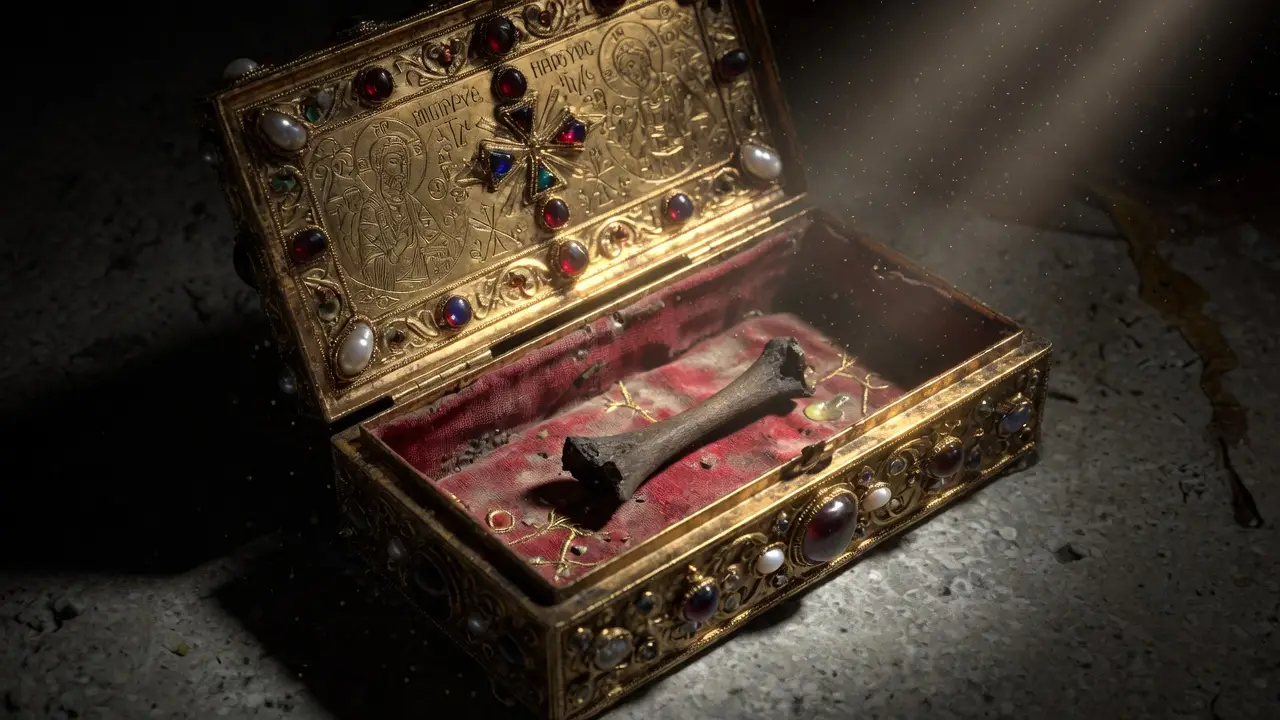
The theological logic ran like this: saints were with God. God was everywhere, but particularly concentrated in the physical remains of his most beloved servants. Touch a saint’s bone, pray at his tomb, press your face against the glass case holding his dried finger, and you were reaching through the material world into something beyond it. Healing, mercy, intercession, these things moved through sacred objects like electricity through a wire.
And in a world without hospitals, without courts that reliably protected the poor, without any safety net of any kind, that belief wasn’t superstition. It was survival.
“What is more absurd than to exhibit publicly to be adored by the people the teeth of some unknown person?”
Guibert of Nogent, De pignoribus sanctorum, c. 1120
Churches and monasteries understood this completely. A major relic didn’t just attract worshippers. It attracted money, land grants, royal patronage, and the kind of political prestige that kept your institution alive through wars, famines, and papal politics. Canterbury had Thomas Becket. Rome had Peter and Paul. Santiago de Compostela had James the Apostle, however he got there.
Every institution that didn’t have a major saint was watching its neighbors grow rich and was asking the same question: how do we get one?
Join The Archive Briefing
Weekly dispatches. The history they didn't teach you — sourced, subverted, delivered to your inbox.
The Supply Problem
Here was the inconvenient truth nobody said aloud: there weren’t enough genuine relics to go around.
Christianity had produced, by the most generous count, a few hundred recognized saints in its first millennium. The physical remains of most of them were either lost, destroyed, or already claimed by powerful institutions that weren’t sharing. Yet by the 12th century, thousands of churches across Europe were displaying authenticated holy bones, teeth, hair, clothing, and fragments of the True Cross. The mathematician Erasmus would later calculate, with barely concealed contempt, that the pieces of the True Cross scattered across European churches would together “make up a good shipload.” Elsewhere he noted that there were enough arms of Saint Andrew in circulation to assemble several complete saints.
Someone was lying. Most likely, several thousand someones.
LESSER-KNOWN DETAILS
Multiple churches claimed to possess Mary’s breast milk, preserved in vials. John Calvin noted this phenomenon with particular dryness: “Had the Virgin been a cow, she could not have produced so much.”
The supply chain for relics had, from very early on, run through channels that ranged from ethically ambiguous to straightforwardly criminal. The most polite term the Church used was furta sacra , sacred theft. The idea held that a saint’s remains couldn’t truly be stolen, because the saint himself, if he approved of the new home, would permit the translation. If he didn’t approve, miracles wouldn’t follow. Miracles did follow. Therefore the saint approved. The logic was airtight, as long as you didn’t ask who was producing the miracles.
The Professionals
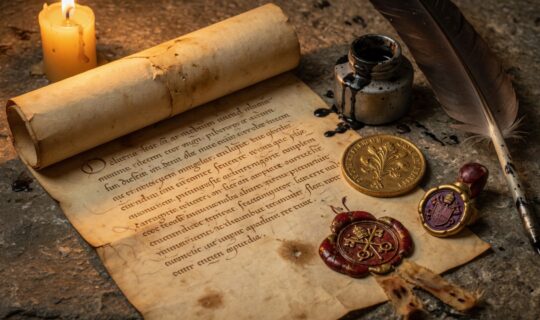
By the 10th and 11th centuries, the relic trade had professionalized. There were merchants who specialized in sourcing sacred remains, networks that ran from Rome through the trading cities of northern Italy up into France and Germany, and a brisk secondary market in authentication documents that could make any old bone sacred with the right piece of parchment.
“The veneration of the saints is attended with more of superstition than of true religion.”
Erasmus, Praise of Folly, 1511
The most audacious operator in this market was a man named Deacon Deusdona, who in the 820s approached a Frankish court official named Einhard, the same Einhard who had written the biography of Charlemagne, with an extraordinary offer. Deusdona, claiming connections to the Roman catacombs, could provide first-class martyrs. Einhard was interested. What followed was a covert extraction operation in which Einhard’s agent, a man named Ratleig, smuggled the supposed remains of Saints Marcellinus and Peter out of Rome in what amounted to a grave-robbing expedition conducted under cover of darkness, complete with misdirection, bribery, and a harrowing journey north.
Einhard documented the whole affair in a work called Translatio Sanctorum Marcellini et Petri, apparently with no sense of irony. The relics performed miracles on the road. The saint approved. Case closed.
The Factory of Miracles
Once the bones arrived, the real work began.
A relic without miracles was a relic without income. The pilgrims came to be healed, and healing required a track record. Monasteries kept meticulous records of cures: the blind who saw, the lame who walked, the possessed who found peace, and these records served a dual purpose. They were spiritual testimony, yes. They were also marketing.
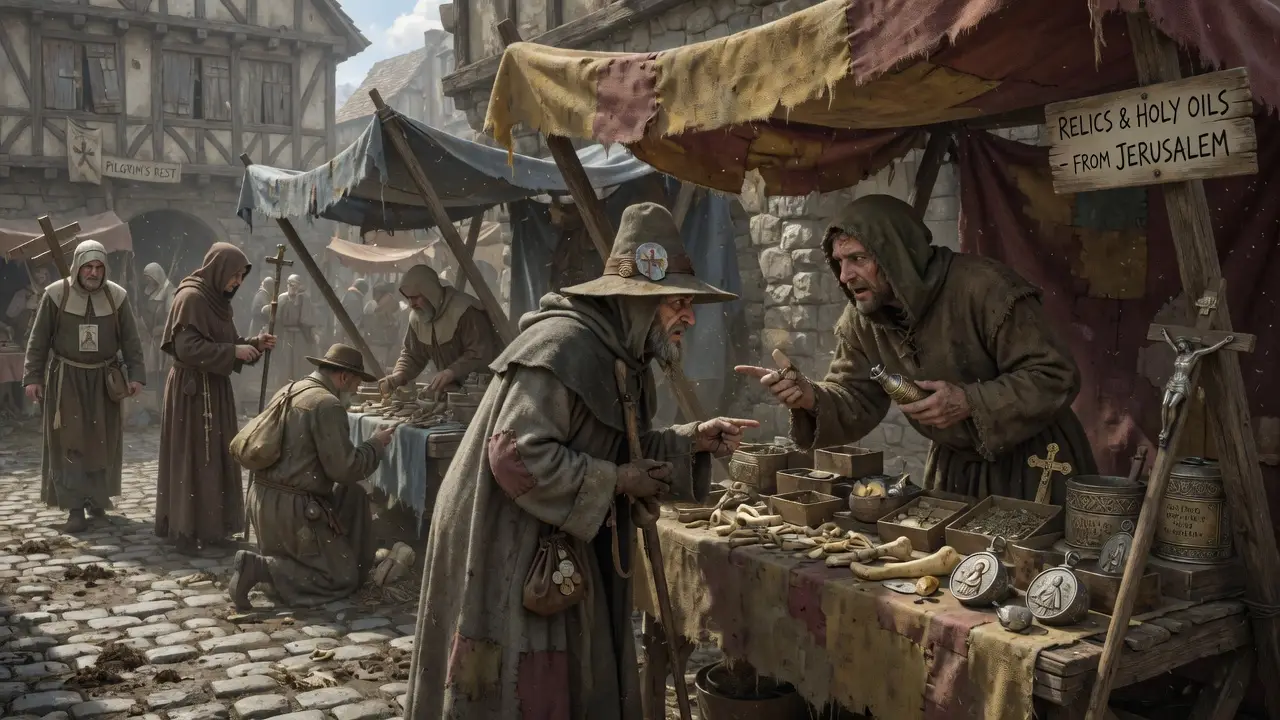
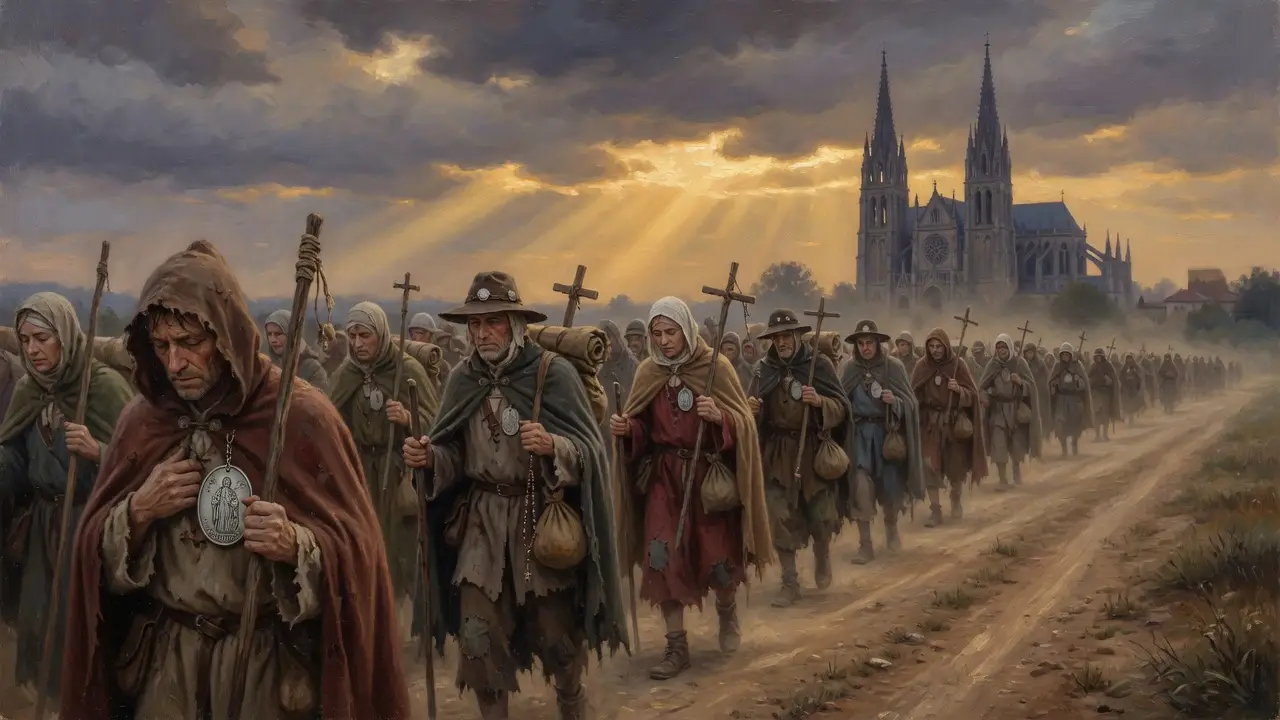
The more sophisticated establishments developed what might be called a full pilgrim experience. Approaches to major shrines were lined with vendors selling ampullae, small lead flasks filled with water that had supposedly touched the relic, and these could be taken home as secondary relics in their own right. The church at Canterbury sold these by the tens of thousands after Becket’s murder in 1170. Souvenir badges cast in lead, depicting the saint’s image, proliferated at every major site.
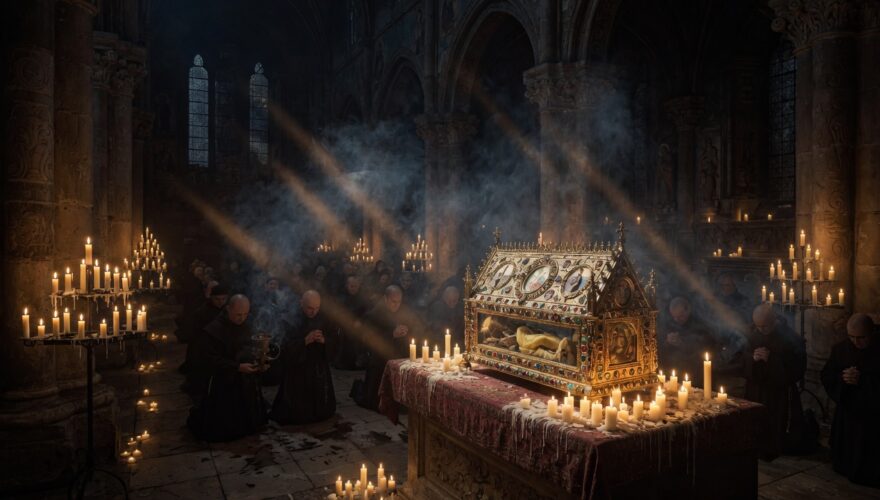
Inside the church, the staging was deliberate. Darkness, incense, candlelight, the accumulated weight of devotion from thousands of previous pilgrims, all of it primed the visitor for an experience. Psychologists today would recognize the conditions for exactly the kind of altered state that produces felt healings and intense emotional responses. The medieval church didn’t know the vocabulary. But they knew how to create the environment.
LESSER-KNOWN DETAILS
Venice’s claim to possess the body of Saint Mark, supposedly smuggled out of Alexandria in 828 under a layer of pork to confuse Muslim customs officials, is one of the most brazenly elaborate relic heists in history, and the story was considered a point of civic pride, not shame.
Some of the miracles were simply invented. Monastic chronicles contain entries that, read carefully, describe the same healing in suspiciously perfect narrative form, with named witnesses who cannot be traced and symptoms that resolved at dramatically convenient moments. Others may have been real in the sense that deeply believed experiences genuinely affect the body, what medicine now calls the placebo effect operating at the scale of an entire civilization.
The Crusades: A Relic Gold Rush
The fall of Jerusalem to the First Crusade in 1099 detonated a relic market that was already overheated. Suddenly, Europeans with access to the actual Holy Land were walking the streets where Christ had walked, and everything they touched or claimed to find was potentially worth a fortune.
The True Cross alone spawned an industry. The original, supposedly discovered by Helena, the mother of Constantine, in the 4th century, had been venerated in Jerusalem for centuries. The Crusaders encountered it, carried it into battle, and then watched in horror as Saladin captured it at the Battle of Hattin in 1187. After that, without the original to constrain the market, every fragment in Europe became unverifiable, which is to say, every fragment became a business opportunity.
“If we were to collect all the pieces of the True Cross exhibited in various parts, they would form a whole ship’s cargo.”
John Calvin, Treatise on Relics, 1543
But the crown jewel of Crusader relic acquisition was the Crown of Thorns. King Louis IX of France, later Saint Louis, purchased it from the bankrupt Latin Empire of Constantinople in 1239 for an almost incomprehensible sum. The price was 135,000 livres, roughly three times the annual French royal revenue. To house it, he built the Sainte-Chapelle in Paris, a building of such breathtaking beauty that it stands today as one of the architectural masterpieces of the medieval world.
He paid more for the relic than for the building. The economics of sanctity had reached their logical apex.
When the Church Argued With Itself
The fraud was never invisible. Scholars, monks, and occasional bishops knew perfectly well that the market had run far beyond any honest accounting of what Christianity’s saints had actually left behind.
Guibert of Nogent, the monk who questioned the baby tooth, went further in his treatise De pignoribus sanctorum, “On the Relics of Saints.” He catalogued the implausibilities with something close to fury: multiple claimed heads of John the Baptist, conflicting locations for the same saint’s body, relics that had supposedly moved between institutions in ways that required the object to be in two places at once. He wasn’t arguing that relics were theologically wrong. He was arguing that this particular relic was almost certainly the wrong tooth, attached to the wrong saint, profiting the wrong monastery.
“The Church is resplendent in her walls, beggarly in her poor. She clothes her stones in gold, and leaves her sons naked.”
Bernard of Clairvaux, 12th century
The institutional Church’s response to this line of argument was, broadly, to ignore it. The Fourth Lateran Council of 1215 did take a swing at reform, requiring that relics be authenticated before display and prohibiting the sale of newly discovered relics without papal approval. The effect was modest. Authentication meant asking the local bishop, who had every incentive to say yes.
The more persistent critique came from a different direction. Reformers within the Church, and eventually, decisively, outside it, began asking not whether this specific relic was genuine, but whether the entire system reflected Christian values at all. Was God really more present in a box of bones than in a sincere heart? Was a poor farmer’s coin, dropped into the collection box of a wealthy monastery, purchasing grace, or purchasing the monastery’s next expansion?
That question, asked loudly enough and repeatedly enough, became the Reformation.
What the Pilgrims Built
It would be a mistake, though, to reduce the relic trade to simple fraud and leave it there.
The pilgrimage economy genuinely functioned. The roads to Santiago de Compostela, Rome, and Canterbury were among the most well-maintained, most traveled routes in medieval Europe. They carried not just pilgrims but merchants, scholars, and ideas. The infrastructure of inns, hospitals, and bridges built to serve pilgrims served everyone who traveled. The cathedrals and churches funded by relic income are, many of them, among the most extraordinary buildings human beings have ever made.
LESSER-KNOWN DETAILS
The Abbey of Charroux claimed to possess Christ’s foreskin (the “Holy Prepuce”), and they weren’t alone. At least a dozen European churches made the same claim simultaneously, prompting such theological embarrassment that the Vatican eventually placed the topic under a formal prohibition in 1900.
In the 12th century, a theologian named Hugh of Saint-Victor wrote: “The relics of the saints are to be venerated, not because of what they are in themselves, but because of the souls to which they once belonged, and because of Him to whom those souls belong.” It was a careful way of saying that the thing in the box mattered less than what the box pointed toward.
Most pilgrims probably understood this, in the way that people hold beliefs without examining every implication. The woman who walked three weeks to touch a saint’s tomb and came home feeling lighter, was she deceived? The community that built a cathedral and felt, for the first time, that they had made something permanent and beautiful in a world that was mostly mud and uncertainty, was that a con?
The promoters and the merchants and the monks filing false miracles in monastery ledgers, yes, those people were running a con. But the thing they were running it on was real human need, and some of what they built to service that need outlasted the belief system entirely.
The Reckoning That Took Five Centuries
When Protestant reformers finally dismantled the relic system in the 16th century, they did so with a ferocity that matched the enterprise they were attacking. Calvin’s Treatise on Relics in 1543 was the most systematic demolition: he worked through the major relics of Europe with an accountant’s cold eye, noting duplicates, anatomical impossibilities, and attributions that collapsed under any scrutiny.
In England, Henry VIII’s dissolution of the monasteries stripped the shrines. Thomas Becket’s spectacular tomb at Canterbury was destroyed in 1538 on the king’s orders; the saint’s bones, if they were ever truly there, scattered or burned. Twenty years later, pilgrims who had once come from across Europe to kneel at that spot found nothing.
The economy built on sacred bones had lasted roughly a thousand years. What it left behind were the roads that connected Europe, the hospitals built along them, the art created to serve them, and the extraordinary buildings that still anchor the skylines of cities whose populations have long since stopped believing in the miracles that funded them.
The Con That Became Civilization
Here is the uncomfortable thing about the fake relic trade: it worked. Not in the way its promoters promised, no saint’s finger actually cured leprosy. But the belief that it could brought people to specific places at specific times, in numbers large enough to require infrastructure, trade, and the kind of sustained collective project that builds civilizations.
We still do this. We still travel to places because of what we believe happened there, pay money to touch objects connected to figures we venerate, build institutions around sacred narrative. We still create economies out of meaning. The relics changed; the mechanism is ancient.
The medieval pilgrim who dropped his last coin into the box at Santiago wasn’t more gullible than anyone who has ever invested everything in a story too beautiful to verify. He was just more honest about needing the miracle.