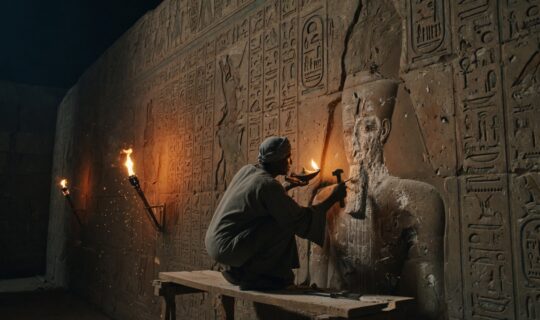
There is a particular kind of cruelty in being erased. Not killed, not exiled… erased. Your face chiseled from stone. Your name gouged from inscriptions. Your victories quietly reassigned to someone worthier. The Egyptians had a word for the soul, the ka, that required your name to survive in the afterlife. Destroy the name, destroy the person not just in life, but forever.
This was not vandalism. It was policy.
Across centuries and civilizations, the most powerful people in history weaponized memory itself. They understood something modern politicians still understand: control the record, control the truth. The Romans even gave it a name, damnatio memoriae, the condemnation of memory. But the Romans didn’t invent it. They just perfected the paperwork.
The Woman Who Built an Empire, Then Disappeared
For twenty-two years, Hatshepsut ruled Egypt. Not as queen… as pharaoh. She wore the double crown, carried the crook and flail, and ordered her artists to portray her with a ceremonial beard because the iconography of power was male, and she intended to wear it completely. Under her reign, Egypt grew rich. Trade routes opened to Punt. Temples rose at Deir el-Bahri that still stand today, their columns catching the same desert light they did three thousand years ago.
Then she died, around 1458 BC, and the erasure began.
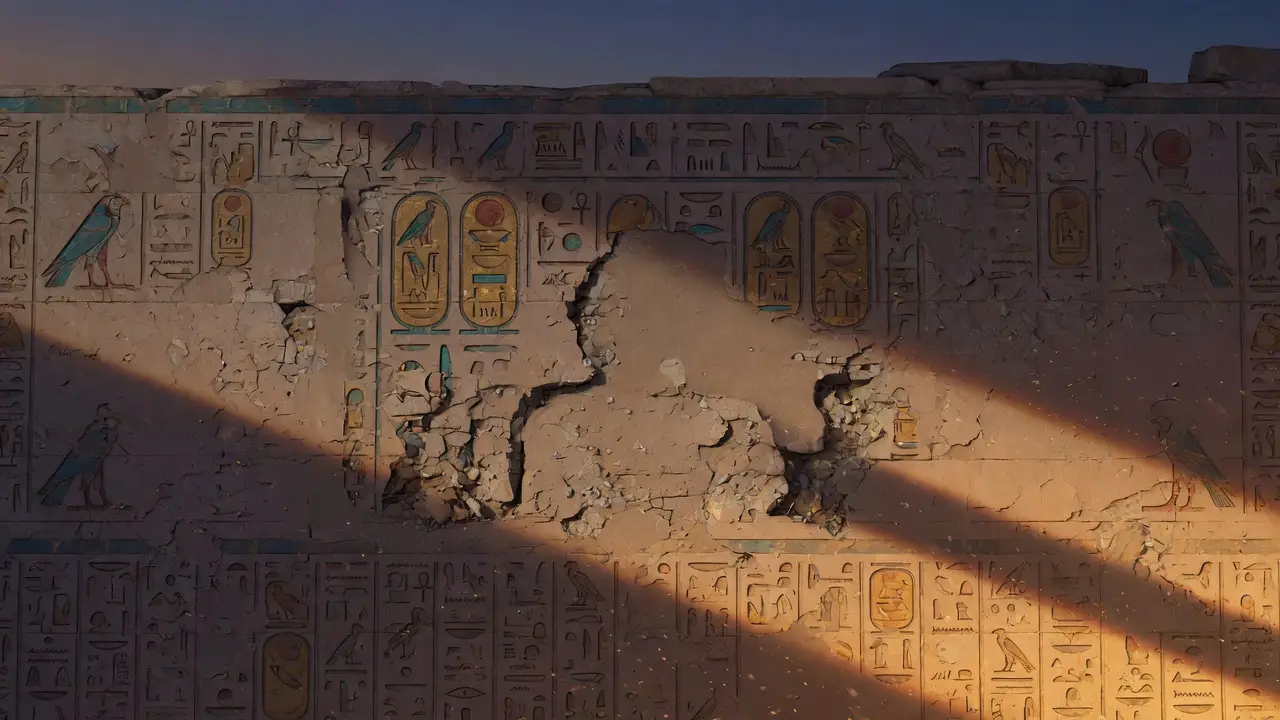
Her stepson Thutmose III, who had ruled alongside her for decades in awkward co-regency, ordered her monuments defaced. Statues were smashed and buried. Reliefs were chiseled smooth. In the great mortuary temple she built for herself, workers carved out her figure with such precision that the surrounding text still makes grammatical sense, she simply ceased to exist within it. Her name was replaced with that of her father, her husband, or Thutmose himself.
LESSER-KNOWN FACTS
Few history books mention that Thutmose III’s workmen, when removing Hatshepsut’s statues, didn’t smash and scatter them randomly. They buried them carefully in a pit, organized and intact. Why? Possibly reverence. Possibly fear. Possibly both.
For three thousand years, it worked. When early Egyptologists first surveyed her temple in the nineteenth century, they found a confusing tangle of male pronouns and female verb endings, a grammatical ghost haunting the walls. It wasn’t until 1903, when Howard Carter’s excavations uncovered a pit filled with smashed Hatshepsut statues near Deir el-Bahri, that the scale of the obliteration became clear.
What remains unresolved is the motive. Thutmose III waited until roughly twenty years into his solo reign to begin the erasure, not immediately after her death, which suggests this wasn’t grief or rage. It was calculation. Some historians believe he needed to secure his own dynasty’s legitimacy, eliminating any competing line of succession. Others suggest her erasure was meant to restore the traditional male pharaonic order she had so visibly disrupted. Either way, the decision was cold and deliberate.
She was, in every measurable sense, one of Egypt’s most successful rulers. The erasure didn’t survive. She did.
Join The Archive Briefing
Weekly dispatches. The history they didn't teach you — sourced, subverted, delivered to your inbox.
The Heretic King
If Hatshepsut’s erasure was methodical, the treatment of Akhenaten was something closer to religious warfare.
Akhenaten, born Amenhotep IV, did something no Egyptian pharaoh had dared: he dismantled the entire priestly establishment, closed the temples, redirected the wealth of Amun’s cult, and declared that there was only one god, the sun disc Aten, and that he, Akhenaten, was its sole earthly intermediary. Egypt had been polytheistic for two thousand years. He rewired it in a decade.
He built a new capital from scratch in the desert, a city he called Akhetaten (modern Amarna) and filled it with art unlike anything Egypt had produced before. Where royal portraits had always idealized the human form, Amarna art was strange and elongated, almost surrealist: elongated skulls, soft bellies, drooping jaws. Whether this reflected a genuine artistic philosophy, a medical condition, or deliberate religious symbolism remains debated.
He also, almost certainly, fathered Tutankhamun.
“The most effective way to destroy people is to deny and obliterate their own understanding of their history.”
George Orwell
When Akhenaten died around 1336 BC, the backlash was total. His successor, possibly a short-lived ruler named Smenkhkare, possibly Nefertiti herself under a new name, began dismantling Atenism. But it was under Tutankhamun, the boy king, that the restoration of the old gods became official. The priests of Amun reclaimed their temples, their wealth, their power.
Then came Horemheb, a general who had served under Akhenaten and clearly spent those years deciding he despised everything about him. Horemheb systematically dismantled Akhetaten, the city, using its carved blocks as fill material inside his own monuments. He removed Akhenaten’s name from records and reassigned his regnal years to earlier pharaohs, meaning that officially, Akhenaten’s reign simply had not happened. He also erased Tutankhamun and Ay from the record. Three pharaohs wiped clean, the decade of Atenism written out of history as though it were a clerical error.
The irony is that Horemheb’s thoroughness is precisely why so much survives. To demolish a temple efficiently, workers numbered each block before dismantling it. Archaeologists found those numbered blocks centuries later and reassembled them, literally reconstructing what Horemheb tried to bury. The talatat blocks, as they’re called, have given us some of the most detailed records of Akhenaten’s reign.
Destruction as preservation. History does this sometimes.
Brother Against Brother
On February 26, 212 AD, the Roman Emperor Caracalla invited his brother Geta to a meeting, supposedly to discuss reconciling their increasingly violent rivalry over the empire. Their mother, Julia Domna, was present. The meeting lasted minutes.
Caracalla had arranged for soldiers to be waiting. Geta was stabbed to death in his mother’s arms.
What followed was damnatio memoriae executed at scale. Caracalla ordered twenty thousand of Geta’s supporters killed. Every inscription bearing Geta’s name was chiseled out across the Roman Empire — an empire spanning from Scotland to Mesopotamia. Coins with Geta’s portrait were melted down or defaced. Statues were destroyed or re-carved into Caracalla’s likeness. The official portraits that had shown the brothers side by side were altered, Geta’s face smoothed away and replaced with another figure or simply with blank stone.
LESSER-KNOWN FACTS
Geta’s name was scratched from papyrus documents in Egypt with such frantic thoroughness that in some texts the scribes accidentally removed adjacent words, leaving grammatical nonsense. The rush to comply left its own kind of signature.
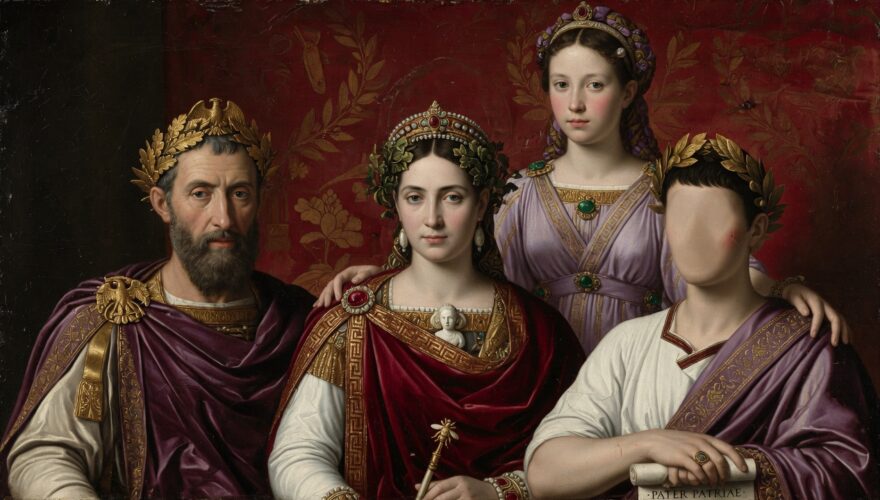
One of the most haunting artifacts of this purge is the Severan Tondo, a painted panel portrait of the imperial family. Septimius Severus, Julia Domna, Caracalla as a teenager, and where Geta should be: nothing. His face has been scraped away, leaving a pale oval of bare wood surrounded by his family’s faces. It was found in Egypt, where someone had clearly chosen to keep it despite the danger. They removed Geta’s face rather than destroy the portrait entirely.
What the painting reveals is both the efficiency of the erasure and its limits. You could eliminate the name. You could melt the coins. You could not make people forget they had seen the man’s face at the top of the world.
Stalin’s Darkroom
The Romans needed hammers and chisels. The Soviets had photography.
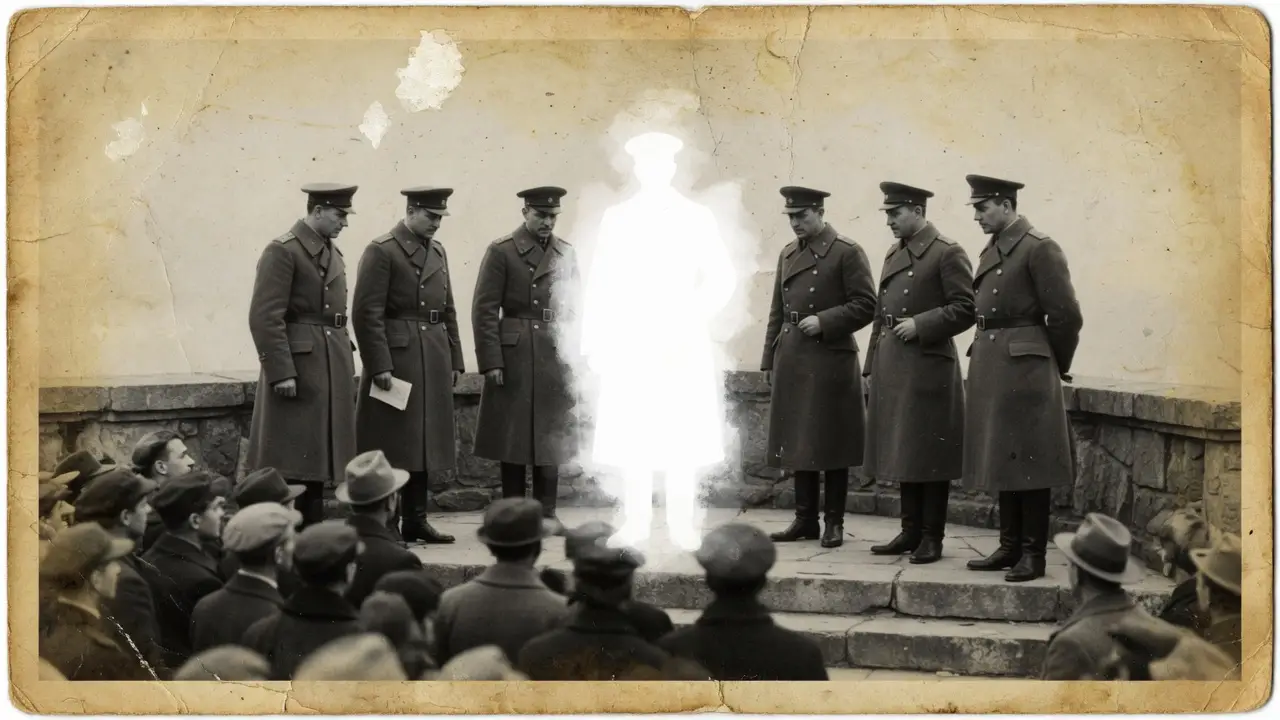
After the Russian Revolution, Josef Stalin’s government produced an extraordinary series of doctored images, group photographs from which former allies, now fallen rivals, had been quietly removed. Leon Trotsky, one of the architects of the revolution and commander of the Red Army, was systematically airbrushed from photographs, cut from films, and excised from official histories after his fall from power in the late 1920s. A famous photograph shows Lenin addressing a crowd in Moscow in 1920, Trotsky standing prominently on the steps to his right. In the Soviet edition, the steps are empty.
LESSER-KNOWN FACTS
Stalin, in his later years, reportedly had portraits retouched to make himself appear younger, thinner, and taller. The same apparatus used to erase others was used to construct his own myth. The darkroom worked in both directions.
The technique required skilled darkroom workers, meticulous retouching, and the complete suppression of original prints. For a time, it worked almost perfectly. Citizens who kept unaltered photographs risked denunciation. Encyclopedias were recalled and reissued with altered entries. The Great Soviet Encyclopedia famously sent subscribers replacement pages for the entry on Lavrentiy Beria after his arrest in 1953, instructing them to cut out the existing pages with a razor and substitute the new ones, which expanded nearby entries on the Bering Sea to fill the space.
The problem was that people remembered. Memory proved harder to retouch than film.
The Mechanisms of Forgetting
What’s striking across these cases is how consistent the method is, separated by millennia and continents. The process always begins with the name. Names carry legal weight, religious weight, the weight of being counted among the living. Remove the name and you sever every official connection. To property, to legacy, to the historical record.
Then come the images. Faces are intimate. A face on a coin passes through ten thousand hands; a face on a wall is seen by generations. Obliterating a face is more viscerally satisfying to a conqueror than any legal decree, which is why it happens even when it serves no practical purpose.
Then comes the reassignment of achievements. Hatshepsut’s trading expeditions became Thutmose’s. Geta’s coins became Caracalla’s. Trotsky’s military victories became footnotes or disappeared entirely. This is perhaps the most sophisticated form of erasure. Not claiming the person never existed, but ensuring that everything they accomplished is attached to someone else’s name.
A name is like a second soul. Destroy it and you destroy the man twice.”
Paraphrase of Egyptian religious belief from Book of the Dead
The Romans were notably procedural about it. Damnatio memoriae had to be formally voted on by the Senate, which gave it a veneer of legal legitimacy. It applied to Caligula, to Domitian, to Commodus. In Domitian’s case, the Senate voted the condemnation so quickly after his assassination that they reportedly ran out into the streets to drag down his statues personally. The historian Suetonius described the scene with barely concealed relish.
What Survives the Knife
None of it worked. Not once, not fully.
Hatshepsut’s temple stands at Luxor and receives millions of visitors a year. Her statues, smashed and buried, were reassembled and are displayed at the Metropolitan Museum of Art in New York. Akhenaten’s dismantled city gave archaeologists some of the richest textual and artistic evidence from the entire ancient Egyptian period. Geta’s scraped face makes the Severan Tondo one of the most frequently reproduced images in discussions of Roman imperial politics. Trotsky’s photographs exist in their unaltered forms in archives, libraries, and on every internet search engine on earth.
There is something almost comic about it, except that the attempts were never actually comic. People died to protect the names of the erased. People were executed for keeping the wrong coin, the wrong portrait, the wrong book.
The lesson that keeps emerging from history is not that erasure fails because the truth eventually wins. That’s too clean, too satisfying. The real lesson is that the act of erasure itself becomes evidence. Chiseling a name from a wall leaves the chisel marks. Cutting a face from a photograph leaves a hole shaped exactly like a face. The violence of forgetting is always visible if you know where to look.
We are living in the longest, most documented period of human history. More is recorded now than ever before, and more is deliberately shaped, selectively archived, and quietly altered than ever before. The digital equivalent of a chiseled wall is a server that gets wiped, a URL that returns a 404 error, a Wikipedia edit that happens at 2 AM with no explanation.
The figures in this article survived their erasures because stone is stubborn, papyrus is fragile but numerous, and enough people remembered anyway. The question worth carrying forward is not whether power will try to erase inconvenient truths, it always will, but whether enough people will keep the original photographs.