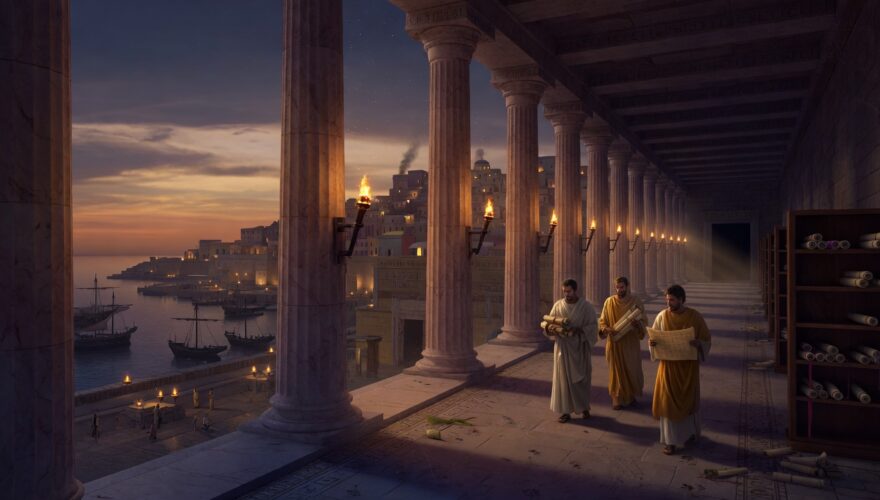
The real story of how Alexandria’s library died is far more unsettling, because it has no single villain, no single night of destruction. It has something worse: neglect, politics, money, and the slow, creeping indifference of people who should have known better. The Library of Alexandria didn’t burn. It was starved, stripped, and quietly abandoned by a civilization that stopped caring about what it had.
The Fire That Never Happened
The story we tell ourselves goes like this: one night, in a city lit by torches and ambition, Julius Caesar’s soldiers set fire to enemy ships in the harbor. The flames spread. The greatest library in the ancient world burned. Centuries of human knowledge, gone in a single catastrophic night.
It’s a perfect story. Clean, dramatic, morally legible. The kind of story that makes sense around a fire, or in a movie trailer.
The true end of the great library is more disturbing than the legend, because it cannot be blamed on one fire or one enemy. What happened was slower, and in some ways, worse.
The Library of Alexandria was not simply burned down. It was neglected, drained, and slowly forgotten by a world that no longer understood the value of what it was losing.
A Machine Built to Consume the World’s Knowledge
To understand what was lost, you first have to understand what the Library actually was. It wasn’t a quiet room full of scrolls. It was an institution of almost aggressive intellectual ambition.
Around 300 BCE, Ptolemy I, one of Alexander the Great‘s generals-turned-pharaohs, commissioned a project unlike anything the ancient world had attempted. He wanted to collect every book ever written. Not a selection. Not a highlights reel. Every book. The Library sat inside a larger complex called the Mouseion, essentially the world’s first research university, where scholars received state salaries, free meals, and tax exemptions to do nothing but think.
At its peak, the Library held somewhere between 400,000 and 700,000 scrolls. The range is wide because ancient sources disagreed even then, which tells you something about how staggering the collection was. Works of mathematics, medicine, astronomy, poetry, philosophy, theater. Texts from Egypt, Persia, Babylon, India, Rome. Plays by Sophocles. Early drafts of what would become the Hebrew Bible. Manuals for surgery. Star charts. Anatomical studies that wouldn’t be replicated for a thousand years.
The Mouseion is a part of the royal palaces; it has a covered walk, an exedra with seats, and a large hall in which the men of learning who belong to the Mouseion take their common meal.”
Strabo (geographer, visiting Alexandria circa 20 BCE)
There was a standing royal order that any ship docking in Alexandria’s harbor had its books confiscated, copied, and sometimes returned. Sometimes not. The copy went back to the owner; the original stayed in Alexandria. The Ptolemies weren’t shy about this. They considered it a tax on knowledge, and they collected it ruthlessly.
Join The Archive Briefing
Weekly dispatches. The history they didn't teach you — sourced, subverted, delivered to your inbox.
This was a place that functioned less like a library in the modern sense and more like a living engine of intellectual production.
Caesar’s Fire: The Moment That Became a Myth
Here is what Julius Caesar actually did in 48 BCE: he burned ships.
He was trapped in Alexandria’s harbor during a military crisis, outnumbered and desperate. To prevent the enemy fleet from being used against him, he ordered the ships set ablaze. The fire spread from the harbor to the docks. Some ancient sources, most notably Plutarch and Seneca, suggest warehouses near the waterfront caught fire, and those warehouses may have contained scrolls, possibly tens of thousands of them waiting to be loaded onto ships.
This was real. This was damaging. But it almost certainly destroyed a storage facility, not the Library itself, which sat further inland in the royal quarter of the city. Strabo, who visited Alexandria just years after Caesar’s campaign, wrote about the Library as a functioning institution. It was still there. Still operating. Still full of scholars.
Caesar’s fire killed books, without question. But it did not kill the Library. What it did, historians now argue, was something subtler: it gave future generations a convenient story. A moment to point to. A single catastrophe that explained a complicated, painful, drawn-out failure.
We chose the fire because the truth was harder to stomach.
The First Cuts
The Library’s real decline began not with flames but with a change of management.
When Rome absorbed Egypt in 30 BCE after the death of Cleopatra, the patronage that had kept the Library alive for nearly three centuries began to dry up. The Ptolemaic rulers had poured money into the institution because it was their project, their monument, their argument that Alexandria was the intellectual capital of the world. Roman emperors had different priorities. Some were generous, Augustus and Claudius in particular maintained interest in the Mouseion. But the ferocious, almost obsessive funding of the early Ptolemaic period never returned.
Scholars who had once been royal guests became less certain of their position. Budgets fluctuated with each new emperor. The collection, which had once grown by policy and design, began to stagnate. No institution this large survives stagnation. Without continuous acquisition, curation, and copying, scrolls deteriorate. Papyrus is fragile. It needs dry conditions, careful handling, and regular recopying before the old versions crumble. Without money and staff, the edges of the collection started to fray.
“Forty thousand books were burned at Alexandria. Let someone else praise this library as the most noble monument to the wealth of kings… it was not a beautiful thing, it was not refined, it showed no love of the muses, but only scholarly ambition.”
Seneca (Roman philosopher, first century CE)
Eratosthenes, the man who calculated the circumference of the Earth with startling accuracy using nothing but shadows and geometry, had worked in Alexandria as the Library’s chief librarian in the third century BCE. He was the kind of mind the institution had been designed to attract and sustain. By the first and second centuries CE, that caliber of institutional support was becoming a memory.
The Slow Cannibalization
What happened next unfolded across generations and barely left a footprint in the historical record, which is itself part of the tragedy.
Alexandria remained an important city. It remained a center of learning. But the Library as a formal, funded, royal institution began dissolving into something more informal and fragmented. Private collections absorbed some of its scholars. Temples became repositories for texts that had once been centralized. The Serapeum, a grand temple complex in a different part of the city, held its own secondary library, and as the royal Library weakened, the Serapeum’s collection became increasingly important.
The Roman emperor Aurelian dealt a serious blow in 270 CE when his military campaign to retake Alexandria from the rebel queen Zenobia resulted in the destruction of much of the royal quarter, the very neighborhood where the Library had been built. Aurelian wasn’t targeting the Library specifically. He was fighting a war. The Library simply had the bad luck of being located in a neighborhood that was strategically inconvenient.
By this point, many historians believe the original Library as a functioning institution had already effectively ceased to exist. The fire everyone blames hadn’t happened yet.
Theophilus, the Serapeum, and the Violence of Certainty
In 391 CE, the Christian bishop Theophilus of Alexandria received permission from the emperor Theodosius I to demolish pagan temples throughout the city. Theophilus was a man of intense conviction and, by most accounts, considerable ruthlessness. He led a Christian mob against the Serapeum, the temple complex that had housed Alexandria’s secondary library.
The mob tore it apart. Statues were destroyed. The building was gutted. What remained of the scrolls stored there, whether thousands or tens of thousands, was lost.
“Caesar was forced to repel the danger by using fire, which spread from the dockyards and destroyed the great library.”
Plutarch on Caesar’s fire
This is the moment that gets conflated with the great burning in popular imagination, and in a literal sense, it was probably the most destructive single event in the Library’s long decline. But by 391 CE, the golden age of Alexandrian scholarship was already roughly 400 years in the past. The Serapeum’s library was a remnant, an echo of what had existed.
Theophilus didn’t destroy the Library of Alexandria. He destroyed what was left of it, after centuries of neglect had already done most of the work.
The Last Librarian
One of the most haunting figures in this story is Hypatia of Alexandria, a mathematician, astronomer, and philosopher who taught in Alexandria in the early fifth century. She was the daughter of Theon, himself a renowned scholar, and by all accounts one of the most brilliant minds of her era.
In 415 CE, a mob led by a group of Christian paramilitaries called the parabalani dragged her from her carriage, stripped her, and murdered her in the street. The reasons were political as much as religious: she was associated with the pagan intellectual tradition and with Orestes, the city’s prefect, who was at odds with the bishop Cyril.
Hypatia wasn’t the Library’s librarian in any formal sense, the Library had long ceased to exist as an institution by then. But she represented something of what it had stood for: the idea that the world could be understood through observation, reason, and rigor rather than inherited authority. Her murder marked, for many historians, the final extinguishing of the Alexandrian intellectual tradition.
Socrates Scholasticus, a Christian historian writing shortly after her death, described the event with clear discomfort, noting that it brought considerable shame upon Cyril and the Alexandrian church. Even within the faith that had displaced the old order, people recognized that something irreplaceable had been destroyed.
She was killed not because of what she knew, but because of what she represented. That is how ideas die, rarely in a single bonfire, more often when the people who carry them are no longer safe.
What the Ashes Actually Contained
Lesser-known detail worth sitting with: among what was likely lost were the works of Aristarchus of Samos, who proposed a heliocentric model of the solar system roughly 1,800 years before Copernicus. We know of his theory only through a single surviving reference in Archimedes. The full argument, the calculations, the detailed astronomy, gone.
Hero of Alexandria, working in the first century CE, designed a steam-powered device called the aeolipile, essentially a rudimentary steam engine. His engineering texts survived only in fragments. What other mechanical innovations those texts contained, what paths they might have opened, is a question with no answer.
“She was torn from her chariot, stripped of her garments, and murdered by their hands… this brought no small opprobrium, not only upon Cyril, but also upon the whole Alexandrian church.”
Socrates Scholasticus on Hypatia’s murder
The Library held a complete collection of Greek plays. Around 33 works by Aeschylus survive today. He wrote approximately 90. What we have is less than a third. Sophocles wrote around 120 plays. Seven survived. Euripides fared slightly better: 19 out of roughly 90. We think of Greek tragedy as one of the great achievements of human culture, and we are reading it through a keyhole.
The City That Forgot What It Had
By the time the Arab general Amr ibn al-As conquered Alexandria in 641 CE, there was no great library to destroy. The story that he wrote to Caliph Umar asking what to do with the Library’s books, and that Umar replied “If those books are in agreement with the Quran, they are useless and need not be preserved; if they are opposed to the Quran, they are harmful and must be destroyed,” is almost certainly a later fabrication. Most historians date this story to the twelfth century, invented or embellished long after the fact by writers with their own political agendas.
The Arabs did not destroy the Library of Alexandria. By 641 CE, there was nothing left to destroy.
That absence is the real verdict.
A Wound That Keeps Giving
Here is the part that should stay with you.
The Library of Alexandria didn’t fall to a single act of barbarism. It fell to the compounding weight of underfunding, political instability, changing priorities, and the quiet decision, made repeatedly across centuries by people who had other things to worry about, that maintaining the greatest repository of human knowledge was somebody else’s problem.
Every era has its version of that decision. The scroll that doesn’t get recopied. The scholar who doesn’t get funded. The archive that floods and nobody fixes the roof. The digital database that loses its grant.
Alexandria’s destruction is not a story about fire. It’s a story about what a civilization values when the immediate pressures are high and the long-term costs are invisible. It’s about what happens when the people who hold knowledge are no longer protected, when funding for preservation is seen as a luxury, when the slow work of maintaining what we already know is less exciting than whatever comes next.
The Library of Alexandria burned in a thousand small decisions, made by a thousand ordinary people who thought the loss was someone else’s problem.