Rome did not build the Colosseum just to watch men die.
That is the assumption we carry into every conversation about gladiators, shaped by centuries of moral outrage, Hollywood dramatization, and a persistent tendency to view the ancient world through a lens of comfortable superiority. We tell ourselves that Romans were barbaric, that the arena was a symptom of civilizational sickness, and that nothing about it resembles us.
The truth is that the gladiatorial world was not a monument to savagery. It was a monument to organization. Behind every fight was a network of contracts, financial negotiations, training institutions, medical professionals, and marketing machinery that would feel entirely recognizable to anyone who has ever watched a pay-per-view event or argued about an athlete’s market value. The men who fought in the sand were not simply victims of Roman cruelty. Many of them were skilled professionals operating inside a system designed, above all else, to generate money and produce stars.
This is the story of that system: how it worked, who ran it, what it cost, and what it built. Strip away the mythology, and what you find underneath is not a horror story. It is a business model. And some of its logic has never left us.
“I come home more greedy, more cruel and inhuman, because I have been among human beings.”
Seneca, Letters to Lucilius, Letter 7 (1st century AD)
- 1 The Rock Star of the Roman World
- 2 How You Got Into the Game
- 3 The Lanista: Agent, Owner, Brand Manager
- 4 The Contracts Were Specific. The Stakes Were Absolute.
- 5 Sponsorship, Status, and the Ancient Brand Deal
- 6 The Body Was the Investment, So They Protected It
- 7 Walking Out of the Arena Alive, and What Came Next
The Rock Star of the Roman World
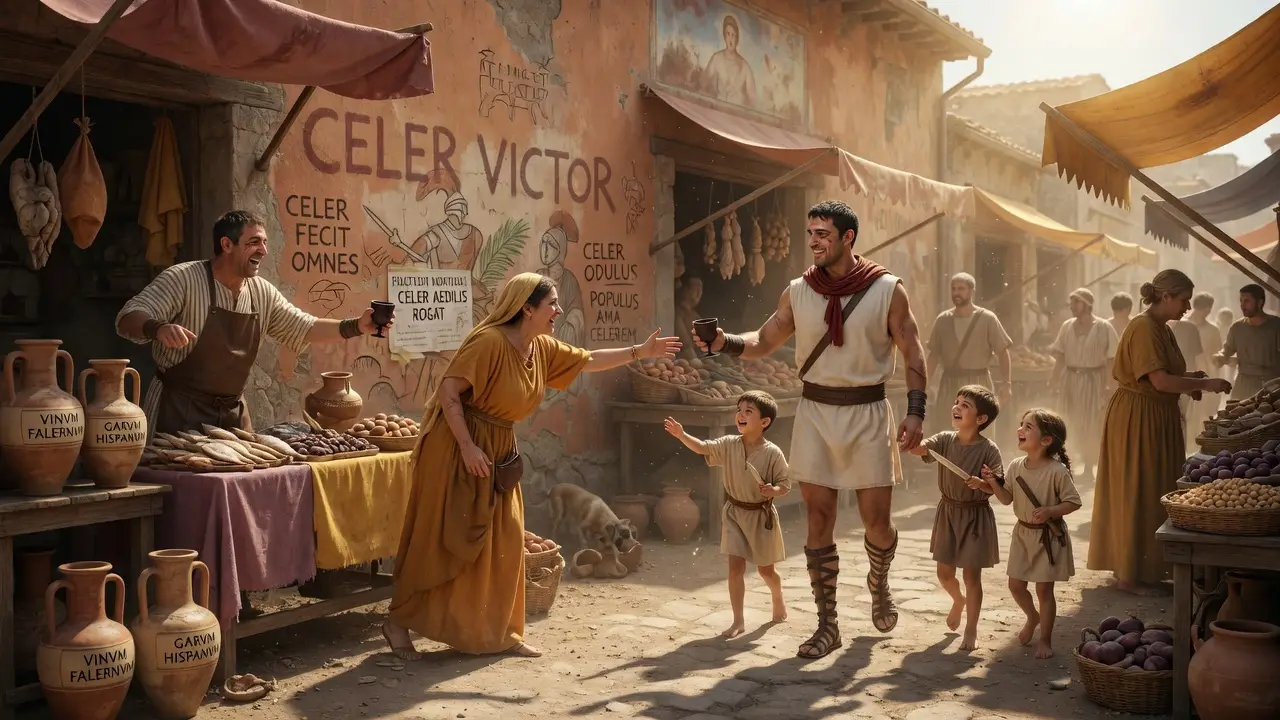
A man walks through the street market of Pompeii, and the crowd parts. Women press notes into his hand. A wine merchant offers him a free amphora. Children sprint ahead of him, shouting his name. He is not a senator. He is not a general. He is Celadus, a Thracian-style gladiator, and someone has carved the words “Celadus the Thracian, who makes the girls sigh” into the wall of a building near the city’s amphitheater. That inscription survives to this day.
We have been taught to imagine gladiators as tragic slaves dragged screaming into the sand, doomed men fighting for the entertainment of a civilization drunk on cruelty. That version is not entirely wrong. But it is catastrophically incomplete. The full picture is stranger, more human, and in many ways far more familiar. The Roman gladiatorial industry was not a chamber of horrors. It was, in almost every meaningful sense, a professional sports league, complete with contracts, agents, brand sponsorships, physical trainers, and post-career pension arrangements. The men at the center of it were not just fighters. They were stars.
How You Got Into the Game
The path into the arena was rarely a single road. Yes, slaves were forced into gladiatorial schools, and condemned criminals were sent to fight as punishment. But a surprising and often overlooked portion of the gladiatorial workforce was made up of volunteers. Free men. Some were veterans who missed the structure of military life. Others were younger men from the lower classes who looked at a gladiatorial contract and saw the only viable route to money, housing, regular meals, and something resembling fame.
The contract a free man signed was called the auctoratio. By agreeing to it, he accepted a set of conditions that echo uncomfortably through the centuries: he submitted to being beaten, burned, or killed at the will of his lanista, the man who owned and managed the gladiatorial school. In exchange, he received a signing fee, a salary, guaranteed meals, lodging, and medical care that most Roman citizens could not afford. The lanista was simultaneously his employer, his trainer, his promoter, and his owner. If that sounds like a blurry line between athlete and property, it was. But the money was real, and the fame was realer.
Join The Archive Briefing
Weekly dispatches. The history they didn't teach you — sourced, subverted, delivered to your inbox.
The Lanista: Agent, Owner, Brand Manager
The lanista occupies one of the more uncomfortable positions in Roman social history. He was, formally speaking, an infamis, a person of low legal standing, lumped in by Roman law alongside prostitutes and certain types of performers. Society looked down on him. And yet he was rich, connected, and indispensable to the political class that publicly scorned him.
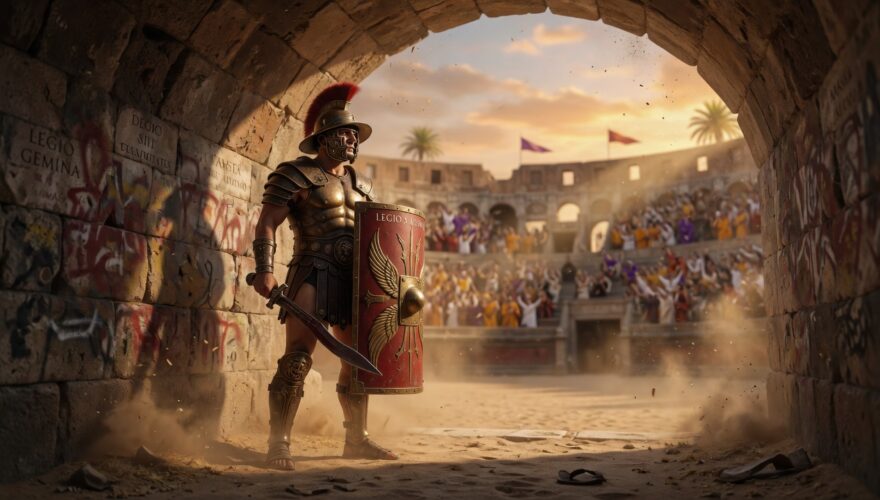
Running a gladiatorial school, called a ludus, was an enormously capital-intensive operation. The lanista had to purchase fighters, house them, feed them, pay specialized doctors, hire weapons masters, and cover burial costs for those who died in training or in the arena. In return, he hired out his fighters to event organizers, called editors, at rates that could run to several thousand sesterces per gladiator per appearance. The best fighters commanded premium prices. Some lanistae built rosters the way a modern sports franchise builds its lineup: strategically, with attention to fighting styles, audience preferences, and regional reputations.
There is evidence that certain lanistae maintained ongoing relationships with particular fighters long past their fighting days, employing retired gladiators as trainers, security personnel, and even as talent scouts. The business did not end when a man walked out of the sand for the last time. It just shifted roles.
The Contracts Were Specific. The Stakes Were Absolute.
What makes the gladiatorial system remarkable is how codified it became. This was not chaos. This was regulation.
By the Imperial period, Roman law had developed a detailed framework governing gladiatorial contracts. The price paid for a gladiator’s appearance was tiered based on his reputation and experience. A first-year fighter might fetch a modest fee. A veteran with a celebrated record was expensive enough that smaller municipalities had to pool civic funds just to book him. Emperors, recognizing the political value of these spectacles, eventually imposed price caps to prevent event costs from spiraling beyond the reach of local elites who were expected to fund public games as a display of civic generosity.
“What gladiator of ordinary merit has ever uttered a groan or changed his expression? Which of them has disgraced himself, I will not say on his feet, but even in his fall? Which of them, when he had fallen and was ordered to receive the fatal blow, has drawn in his neck?”
Cicero, Tusculan Disputations, Book II (45 BC) on gladiatorial discipline and professionalism.
When a gladiator lost a fight but survived, the decision of whether he lived or died was technically in the hands of the editor, the man financing the event, sometimes informed by the crowd. But economics played a deeply underappreciated role in this decision. Killing a defeated gladiator meant compensating the lanista at full market rate for a destroyed asset. Sparing him cost nothing. The famous “thumbs up or thumbs down” drama of Hollywood actually had a powerful financial undertow. Mercy was often just good accounting.
Sponsorship, Status, and the Ancient Brand Deal
Here is where it gets genuinely strange. Gladiators were commercially valuable outside the arena, not just inside it.
Their images appeared on oil lamps, pottery, mosaics, and glass vessels sold across the empire. A lamp bearing the likeness of a celebrated fighter was a consumer product, purchased by people who had never attended a games and never would. In this sense, a first-century Roman buying a gladiator lamp was doing something structurally identical to a twenty-first century fan buying a jersey. The logic is exactly the same: you purchase an object that affiliates you with someone whose skill and courage you admire.
Gladiators also appear in Roman graffiti as endorsers of a sort, their names attached to specific taverns, bathhouses, and even political candidates. “Celadus, supported by gladiators” appears on a Pompeian electoral notice. Their social pull was genuinely useful to people who wanted votes or customers. This was influence, monetized. It predates the concept by two thousand years and works by the same mechanics.
High-ranking fans sometimes sent gifts directly to fighters they admired. Wealthy women, including some from aristocratic families, are documented to have had relationships with gladiators, scandalizing moralists and feeding the rumor mills of Roman satirists. Juvenal, writing in the second century, was appalled that a senator’s wife had run off with a gladiator named Sergius. He described Sergius as scarred, with a damaged nose and a weeping eye, and then answered his own outrage by noting: “It was his sword that made him beautiful.” The fame did the work.
The Body Was the Investment, So They Protected It
This part is almost never discussed, but it changes everything about how we understand the institution.
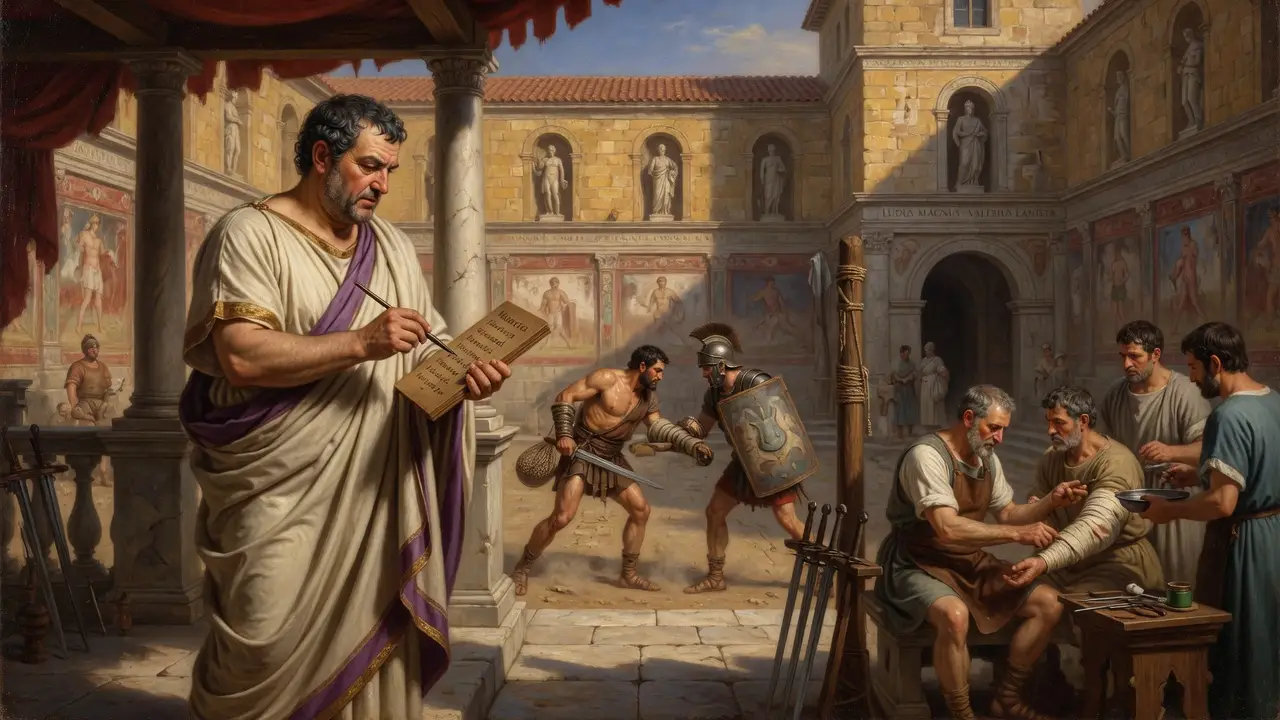
Gladiatorial schools maintained physicians on staff at a time when most Roman citizens received no formal medical care at all. The physician Galen, one of the most significant medical figures of the ancient world, worked at a gladiatorial school in Pergamon early in his career. He later credited that experience with giving him unparalleled practical knowledge of anatomy, wounds, and recovery. The gladiators were, in a brutal irony, the most medically supervised athletes in the ancient world precisely because their bodies were valuable property.
Archaeological analysis of gladiatorial burial sites, particularly one excavated in Ephesus in the early 2000s, found skeletal evidence consistent with high-protein, high-carbohydrate diets: barley, beans, and ash, which appears to have been consumed intentionally for calcium content. They were, by Roman standards, extremely well-nourished. They were also described by contemporaries as heavy, and some scholars believe this was deliberate: a layer of subcutaneous fat could absorb superficial sword cuts without damaging underlying muscle or vital organs. They were engineering their bodies the same way modern athletes do. The goal was performance and survival, not just appearance.
Walking Out of the Arena Alive, and What Came Next
When a gladiator had fought enough bouts and earned enough reputation, he could receive the rudis, a wooden sword presented ceremonially to mark his honorable retirement. It was the Roman equivalent of a championship ring: symbolic, emotionally loaded, and economically meaningful. A man holding the rudis was free from mandatory combat. Many stayed connected to the industry anyway, because the industry was where the money and the identity lived.
Some retired gladiators became trainers at ludi, passing on technique to the next generation of fighters. Others became bodyguards for wealthy Romans, their presence lending a physical authority that money alone could not buy. A few, particularly those who had been slaves and were subsequently freed, used their fighting earnings to start small businesses. There is evidence of gladiators purchasing their freedom outright with accumulated prize money and tips from wealthy patrons.
The retirement package was not a myth. It was not generous by modern standards. But in the context of the Roman world, a gladiator who survived long enough to claim it had done something extraordinary: he had converted mortal risk into something resembling a livelihood.
“The same men who praise the gladiator are those who condemn and punish him. How perverse the judgment, how inconsistent the feelings.”
Tertullian, De Spectaculis (On the Spectacles), Chapter 22 (c. 197 AD)
The gladiatorial industry lasted roughly seven centuries in various forms. That is longer than the United States has existed as a nation. Something that persistent does not survive on spectacle alone. It survives because it works, because it generates revenue, manages talent, satisfies a public appetite, and produces recognizable stars that people genuinely care about.
The machinery underneath the sand was as rational and commercially motivated as anything running through a modern sports franchise. The contracts, the agents, the medical staff, the branded merchandise, the celebrity culture, the retired athletes who become coaches: none of this is new. None of it is even particularly modern.
What the arena sold was not just violence. It was story. It was a man, known by name and fighting style and personal history, who walked out into a space where everything was at stake. The crowd already knew him. They had argued about him in taverns. Their children had drawn his face on walls.
That is not so different from what happens every Sunday.