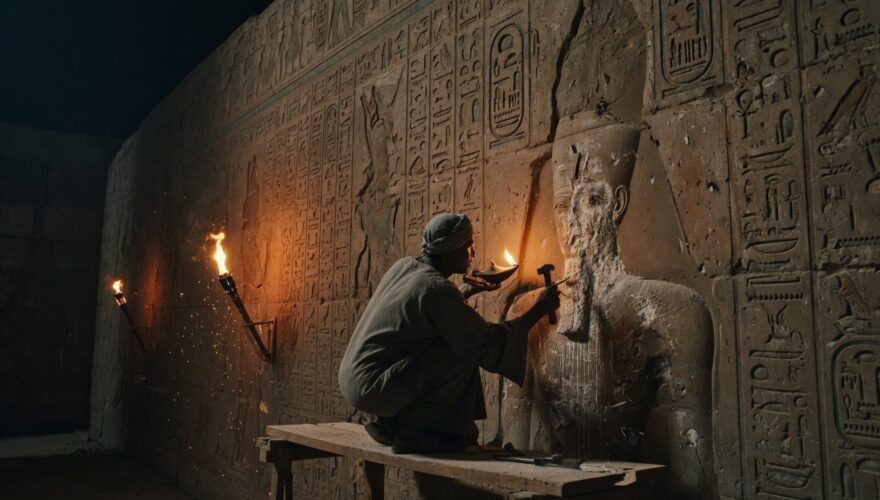
A man kneels before a wall of hieroglyphs, chisel in hand, and carefully carves away a face. Not a criminal’s face. Not an enemy’s. A pharaoh’s. He does it slowly, precisely, because the orders came from the throne itself. When he finishes, that pharaoh will have never existed. No tomb. No legacy. No name. Just smooth stone where a life used to be.
This is not a scene from a thriller. This happened. Repeatedly. And it was considered perfectly legal.
We tend to think of ancient Egypt as a civilization of gold and grandeur, a world of soaring monuments and divine rulers who governed through wisdom and cosmic order. That version of Egypt is true, in the way that a palace facade is true. It tells you what the people inside want you to believe. Turn around the monument and look at what holds it up, and the picture changes fast.
Egypt lasted over three thousand years. That is not luck. It is engineering, both architectural and political. And some of the methods used to sustain it were brutal in ways that rarely make it into the museum exhibit captions.
The Machine Beneath the Monument
Start with the labor.
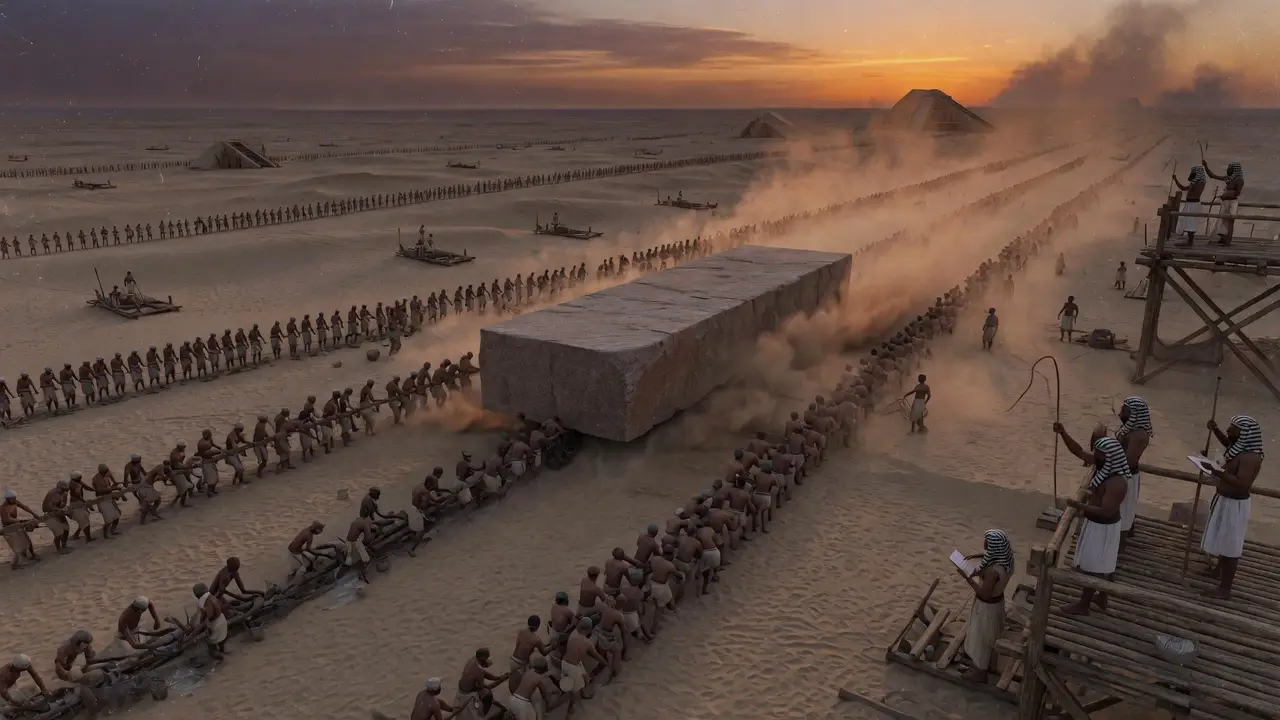
The pyramids at Giza are among the most studied structures on earth, and for decades the dominant myth was that they were built by slaves, hundreds of thousands of them, whipped into productivity under a merciless sun. Modern archaeology complicated that story. Excavations in the 1990s near the pyramid complex uncovered a workers’ village, complete with bakeries, breweries, and a surprisingly sophisticated medical facility. Workers had their broken bones set. They received wages, food rations, and beer. Some were buried with care.
So the slave narrative was wrong? Not exactly. It was incomplete.
What those discoveries revealed was a tiered labor system of staggering complexity. Skilled craftsmen who worked permanently on royal projects occupied something close to a professional class. Below them sat rotating gangs of conscripted laborers, Egyptian peasants pulled from their villages for months at a time under a system called the “corvee.” This was not slavery in the Roman sense. But it was not voluntary either. You did not say no to the pharaoh’s administrators when they showed up in your village with their lists.
“Today the work squad crossed the walls of the necropolis shouting, ‘We are hungry!’ Eighteen days have passed in this month since the men sat behind the funerary temple of Thutmose III.”
Amennakht – Turin Strike Papyrus, c. 1157 BCE
And beneath that tier, far less documented and far more uncomfortable to discuss, was the use of genuine enslaved labor on a massive scale. Egypt’s wars were not fought only for glory. They were fought for people. Campaigns into Nubia, Libya, and Canaan returned not just with gold and cattle but with human beings counted among the spoils. Thutmose III alone recorded capturing tens of thousands of prisoners during his campaigns in Syria and Canaan. Many ended up in temple workshops, royal estates, and private households.
Join The Archive Briefing
Weekly dispatches. The history they didn't teach you — sourced, subverted, delivered to your inbox.
One administrative papyrus from the New Kingdom period casually lists enslaved workers alongside grain and tools as assets of a wealthy estate. They had names, occasionally. More often, they had numbers.
The monuments that draw millions of tourists every year were not built by a happy, unified workforce laboring in devotion to their god-king. They were built by a system that treated human beings as a renewable resource. Egypt did not advertise this.
When the Ceremony Was the Murder
The pharaoh was not simply a king. He was, in official ideology, the living embodiment of Horus, the falcon god, and upon death he became Osiris, lord of the dead. The throne carried divine authority so absolute that challenging it was not just treason. It was cosmic disorder.
Which made assassination awkward.
Egypt solved this problem with ritual. When a ruler needed to be removed, or when one died under circumstances the state preferred not to examine too closely, the ceremony swallowed the truth whole.
Consider the case of Ramesses III, who ruled during the slow unraveling of the New Kingdom in the twelfth century BCE. On the surface, his reign looked like a triumph. He repelled the Sea Peoples, those mysterious confederacies of raiders who had collapsed nearly every other Bronze Age civilization around him. He built magnificently. His mortuary temple at Medinet Habu still stands, its walls covered in battle scenes that cast him as Egypt’s savior.
Behind those walls, his household was rotting.
“Do not cause fear among men; for this the God punishes likewise.”
Maxims of Ptahhotep, c. 2375 BCE
A papyrus discovered in the nineteenth century, now known as the Judicial Papyrus of Turin, documents a conspiracy so elaborate it reads like a political thriller. A secondary wife named Tiye, apparently furious that her son had been passed over for succession in favor of Ramesses IV, organized a plot involving palace officials, military officers, harem administrators, and even women recruited to seduce guards. The plan was to kill the pharaoh during the Opet festival, a sacred celebration, and install Tiye’s son on the throne.
The plot failed. Investigations followed. The papyrus records the trial of dozens of conspirators with judicial precision, listing their crimes and punishments. Some were executed outright. Others were allowed to kill themselves in the courtroom, a mercy of sorts. A few of the accused judges, it turned out, had spent too much time partying with the female conspirators during the investigation and were punished alongside them.
But here is the detail that stops you cold: CT scans of Ramesses III’s mummy, conducted in 2012, revealed a deep cut across his throat, nearly severing the windpipe. He had been murdered after all. The conspiracy had partially succeeded. Egypt’s records of his death were written to suggest otherwise, folded into the ceremony of transition, smoothed over by priests and scribes who understood their job.
The ceremony was the cover story. It always had been.
The Pharaoh Who Unmade His Predecessor
No tool in the Egyptian political arsenal was more powerful, or more chilling, than the erasure of a name.
Egyptian theology held that a person’s name was part of their soul. To speak a name was to keep someone alive in the afterlife. To destroy it was to kill them twice, once in the body, once in eternity. This was not metaphor to the Egyptians. It was physics.
After the death of Akhenaten, the pharaoh who dismantled Egypt’s traditional religion and replaced it with a single solar deity in a convulsion that still divides historians, his successors got to work. His name was carved out of inscriptions from one end of Egypt to the other. His city was abandoned and systematically stripped. His images were defaced. Within a generation, official records treated him as if he had never drawn breath.
Hatshepsut, the female pharaoh who ruled for over twenty years and launched one of Egypt’s most prosperous eras of trade and construction, suffered the same fate. After her death, her stepson Thutmose III ordered her image removed from nearly every monument she had commissioned. Her face was hammered from walls. Her statues were buried in pits. For three thousand years, history had no idea she had ruled at all. It was not until the late nineteenth century, when Egyptologists began piecing together fragments and noticing suspicious absences in the record, that she re-emerged.
She had built temples, led expeditions, expanded Egypt’s wealth, and dressed as a male pharaoh to legitimize her rule in a world that had no frame for what she was doing. Her reward was three thousand years of official non-existence.
Thutmose’s motivations remain debated. It may have been political strategy to consolidate his own dynastic line. It may have been personal. Whatever drove it, the machinery he used was already well-oiled. Egypt had been rewriting itself in stone for centuries.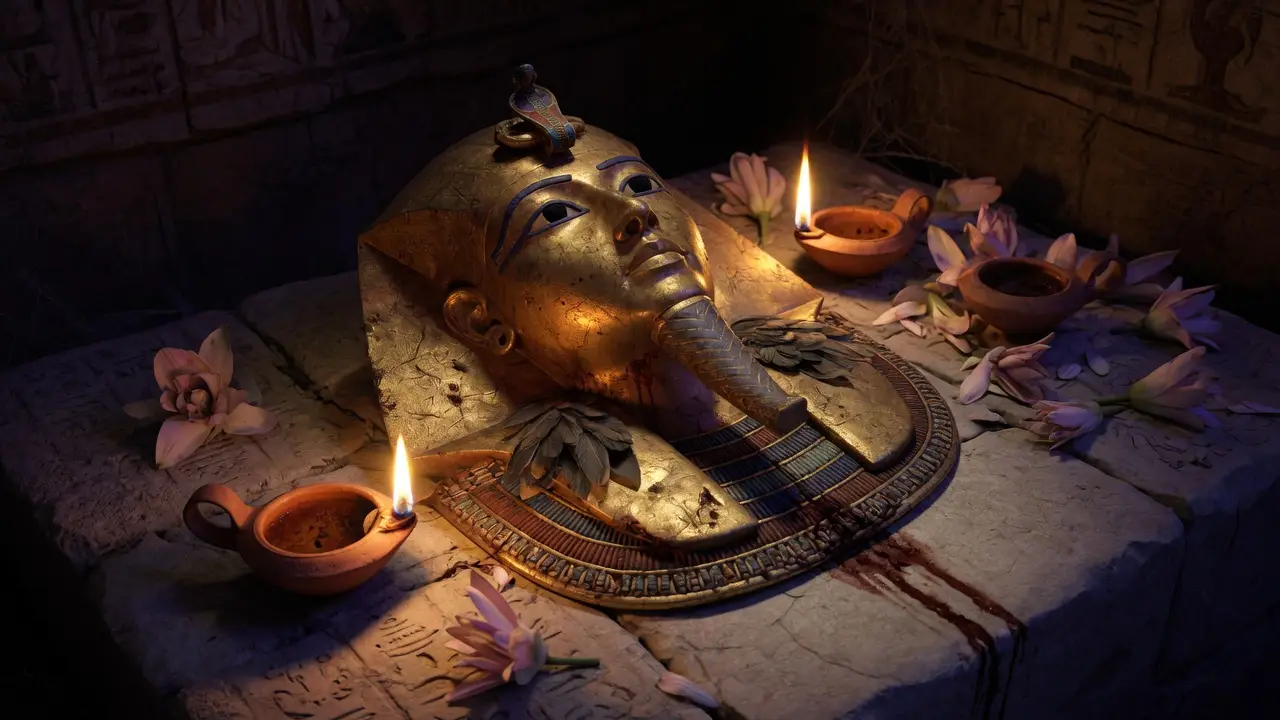
It Matters More Than You Think
There is a version of ancient Egypt that exists to comfort us. Wise pharaohs, timeless beauty, a civilization that reached toward the divine. That version is not false, but it is curated by the civilization itself, and we have been, for a long time, reading the press release rather than the record.
The erasure of Hatshepsut is not just an ancient injustice. It is a lesson in how completely power can reshape what we think we know. If Egyptologists had not been skeptical, had not noticed the suspicious gaps, she would still be no one.
The labor system that built the pyramids is not simply a historical footnote. It is the machinery beneath every monument, the thing that makes the grandeur possible and the thing that official narratives are designed to obscure.
And Ramesses III, lying in his golden wrappings with a severed throat while the priests read the sacred rites over him, is a portrait of what power does when it cannot afford to be honest about itself. It performs. It decorates. It writes its own version in a medium that was supposed to last forever.
The pyramids have not moved. But the story of who built them, and what it cost, keeps shifting every time someone is willing to look at the stone instead of the ceremony.