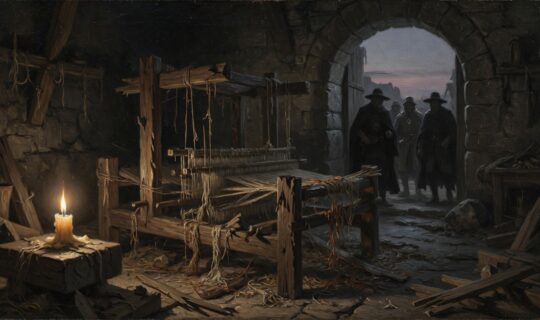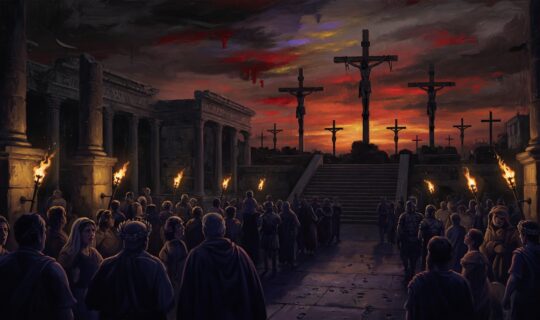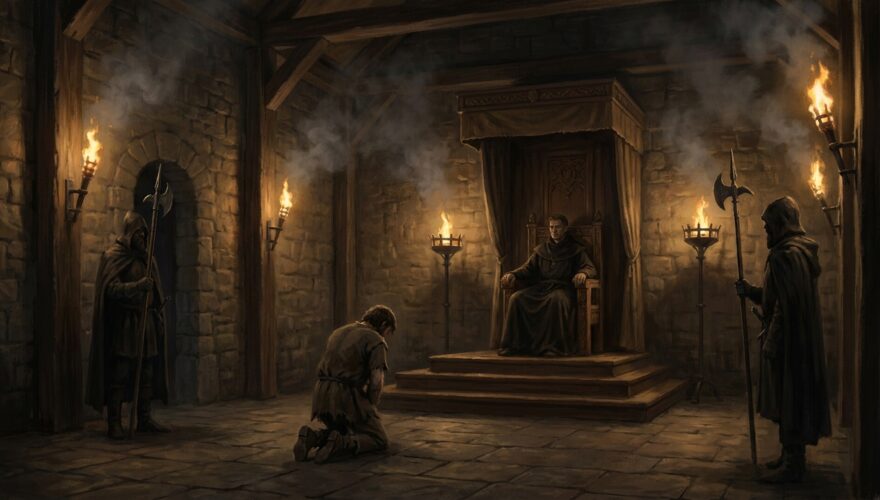
Medieval justice wasn’t primitive, it was engineered. From judicial torture to public execution and wergild pricing, explore the calculated brutality behind the laws that governed life, death, and power in the medieval world.
- 1 When Medieval Justice Burned the Wrong Man
- 2 A Justice System Built to Confess
- 3 How Courts Made Torture Look Legal
- 4 The Price of a Life, Precisely Calculated
- 5 When Criminals Ran to the Church
- 6 When Justice Was a Spectacle
- 7 When Medieval Justice Started to Collapse
- 8 Who Medieval Justice Really Protected
- 9 The Ledger Doesn’t Balance
When Medieval Justice Burned the Wrong Man
The fire was ready before the verdict.
In 1022, a group of canons in Orléans were dragged before King Robert II of France on charges of heresy. The outcome was never really in question. The townspeople wanted blood. The clergy wanted an example. And the king, a devout man desperate to protect the Church’s authority, wanted the problem gone. Within hours, the accused were led to a pyre outside the city walls and burned alive. They had confessed, though no one asked how those confessions were obtained.
This was not a failure of medieval justice. This was medieval justice working exactly as intended.
For centuries, historians softened the story. They called these proceedings primitive, products of a superstitious age that simply didn’t know better. But that framing lets the medieval world off the hook far too easily. The men who designed these systems were not ignorant. Many were brilliant legal minds, deeply educated in Roman law and scripture. They built frameworks that blended punishment, spectacle, and social control with a sophistication that still warrants serious examination. Understanding what they actually constructed and why, reveals something unsettling about the mechanics of power that didn’t disappear with the Middle Ages.
A Justice System Built to Confess
Before the thirteenth century, much of Europe relied on a peculiar institution called trial by ordeal to determine guilt. The accused might plunge their hand into boiling water, carry a red-hot iron bar, or be thrown bound into a pond. If the wound healed cleanly, God had pronounced them innocent. If they sank, they were saved but guilty. If they floated, also guilty, because only a witch could defy submersion.
The logic was theological, not evidentiary. The entire premise rested on the belief that the divine would intervene to reveal truth in ways human judges could not. Courts weren’t designed to discover facts; they were designed to ratify predetermined verdicts through ritual.
“He who confesses and is penitent shall receive lighter punishment; he who denies and is convicted shall be punished more severely.”
Fourth Lateran Council pronouncements, 1215
When Pope Innocent III banned clerical participation in trial by ordeal in 1215, it didn’t liberate the accused. It made things worse. Without God as the arbiter, courts needed a new mechanism to extract certainty. They found one: the confession. Roman-canon law, spreading through ecclesiastical courts and then secular ones, elevated the confession to what jurists called “the queen of proofs.” Nothing else mattered as much. A confession ended debate. It satisfied both theology and law. It gave the court exactly what it needed.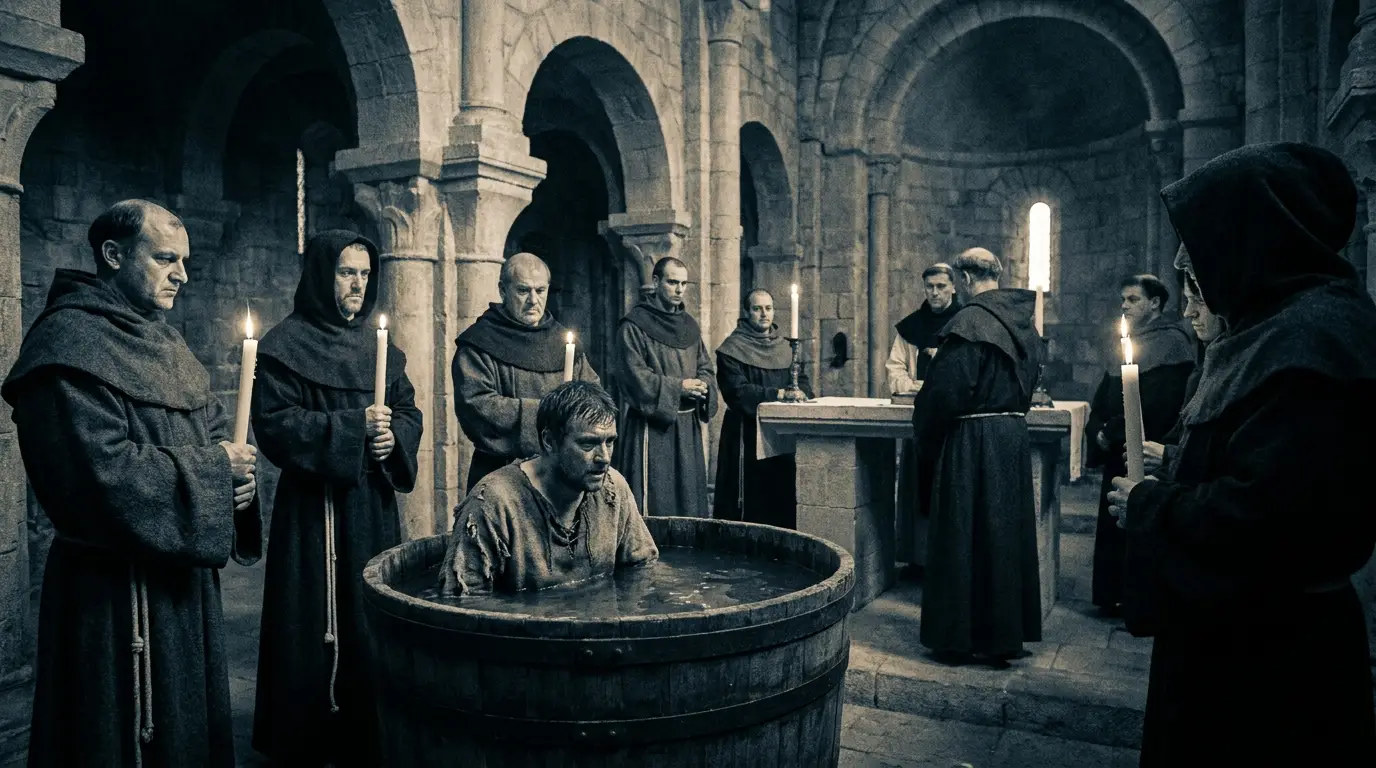
How Courts Made Torture Look Legal
Torture entered the formal legal record of Europe not through barbarism, but through bureaucracy.
Join The Archive Briefing
Weekly dispatches. The history they didn't teach you — sourced, subverted, delivered to your inbox.
By the mid-thirteenth century, courts in Italy, France, and the Holy Roman Empire had codified procedures for judicial torture. These weren’t acts of passion. They followed written protocols specifying who could be tortured, under what circumstances, with what implements, and how many times. A suspect could theoretically not be tortured based solely on their word against an accuser, here had to be “half proof,” meaning some credible evidence already existed. The torture was meant to confirm, not discover.
In practice, the distinction was irrelevant. The definition of “half proof” bent to prosecutorial need. Judges who wanted a conviction found their half proof. The torture chamber wasn’t an aberration at the edge of the system. It was the room the system was built around.
“The pain of torture is not to punish but to reveal truth.”
Inquisition procedure manuals, 13th–14th century
The instruments themselves tell a story. The strappado, where a suspect’s hands were tied behind their back and they were suspended by the wrists, sometimes with weights attached, was a favored method precisely because it left few visible marks. Courts were not entirely lawless. They understood the optics of broken bones. Suffocation, stress positions, and prolonged sleep deprivation also served the same function: pain that didn’t announce itself on the body.
And the rules stated, with straight-faced solemnity, that a confession obtained under torture had to be voluntarily repeated afterward, without duress, for it to count. If the accused recanted, they could be tortured again to re-confirm. The circular logic was airtight.
The Price of a Life, Precisely Calculated
Not every legal dispute ended in a dungeon. Medieval law also had an elaborate civil architecture, and parts of it were strangely rational.
Germanic legal traditions codified what was called wergild, literally “man payment”, a system assigning a monetary value to every person’s life based on their social rank. Kill a nobleman and his family was owed a specific sum. Kill a serf and the price dropped accordingly. This wasn’t sentiment. It was an attempt to replace blood feuds with a negotiated economy of injury.
A free Frankish man’s wergild under the Salic Law was set at 200 gold solidi. A count’s was 600. The life of a woman of childbearing age was valued higher than other women… not out of respect, but because she represented future labor and reproduction. Children, the elderly, and slaves occupied the lowest rungs. The entire human community had been quietly priced.
“A man’s worth in gold is not his worth before God — but it is his worth before the court.”
Germanic legal tradition, reflecting wergild practice
This system functioned alongside trial procedures but rarely intersected with them fairly. Wergild only applied when someone could pay and someone could collect. The poor had neither function. A peasant who killed another peasant in a land dispute might find himself facing royal courts and public punishment precisely because no wergild framework existed to absorb the conflict between people who had nothing.
When Criminals Ran to the Church
One of the least examined features of medieval justice is how deliberately the Church carved out zones of immunity from it.
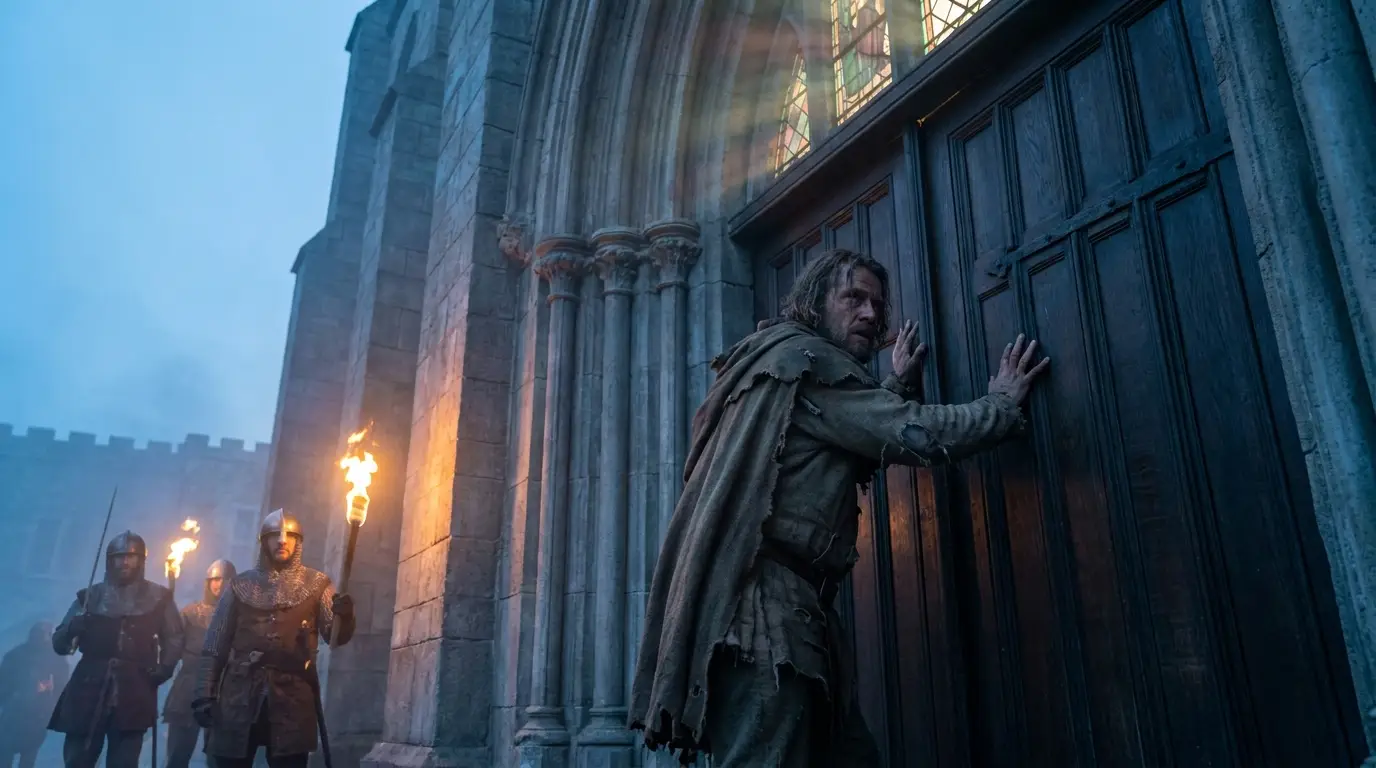
Sanctuary law allowed any accused person who reached the doors of a church to claim protection. Once inside, no secular authority could legally drag them out. In England, the practice was elaborate enough to have its own bureaucracy. A person claiming sanctuary had between thirty and forty days to either surrender to authorities or, in some jurisdictions, undergo a formal ritual called abjuration of the realm, confessing their crime to a coroner, surrendering their possessions, and walking to the nearest port while wearing a white robe and carrying a wooden cross, never to return.
LESSER-KNOWN DETAIL
In medieval England, a person who refused to enter a plea, was subjected to peine forte et dure: heavy stones were piled on their chest until they either spoke or died. Some defendants chose death rather than plead, because a conviction meant their property was forfeited to the Crown; dying under stones meant their heirs could inherit.
The Church positioned this as mercy. But sanctuary also functioned as leverage. It was one of the few consistent points in medieval life where ecclesiastical authority could demonstrate its power over secular rulers. The king’s men could surround the church. They could wait. But they could not enter. Every time they didn’t, the Church won.
Murderers, thieves, debtors, and political fugitives all used sanctuary at various points. So did, on at least one documented occasion, a man in York who had simply killed another man in a brawl and was hoping the whole thing would blow over. Sometimes it did.
When Justice Was a Spectacle
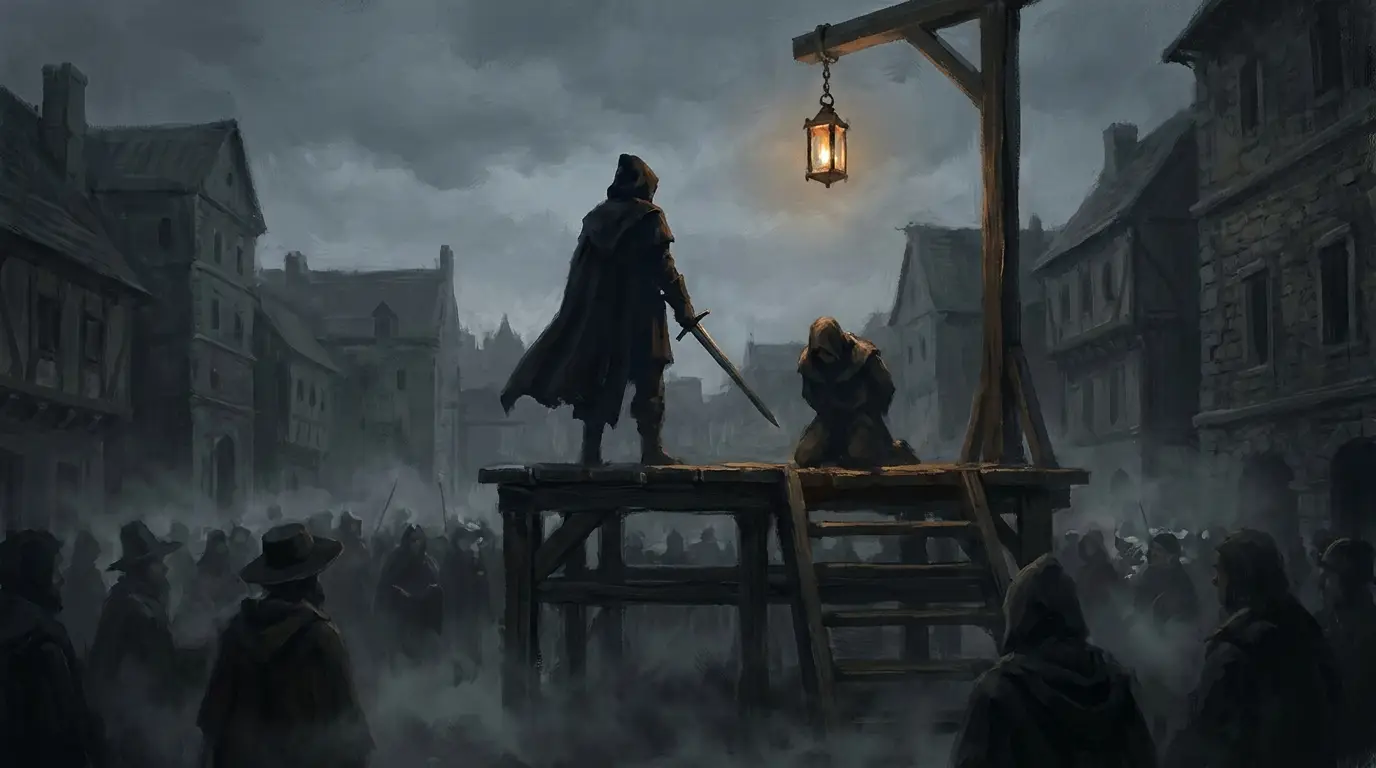
Medieval execution was not designed to kill efficiently. It was designed to communicate.
Public punishment served as what legal historians now call “theater of the scaffold.” The criminal’s body became a text, and the punishment… mutilation, branding, hanging, burning, was the message. Cut off a thief’s hand and you marked them permanently as someone outside the social compact. Break a murderer on the wheel and the suffering itself became a public performance of sovereign power. Crowds were expected to attend. Their presence was part of the function.
LESSER-KNOWN DETAIL
The Inquisition actually forbade torture that drew blood or caused permanent injury or death. Inquisitors found this limitation no great obstacle, the strappado and similar methods could cause excruciating pain and lasting internal damage while technically complying with the prohibition.
The gradations were specific. In England, high treason carried a sentence that reads like a manual for cruelty: to be hanged until nearly dead, disemboweled while still conscious, castrated, the entrails burned before the condemned’s eyes, and then beheaded and quartered. This was not improvised sadism. Parliament specified it. Lawyers argued over it. The Crown authorized it. Every step existed in written law.
What is less often noted is that these rituals frequently went wrong. Executioners were imprecise. Condemned prisoners sometimes survived hanging and had to be cut down and finished by hand. The spectacle, meant to project authority, occasionally devolved into chaos that undermined it. Crowds sometimes turned against executioners. Some convicted felons were treated as heroes by onlookers who disagreed with the verdict. The theater of punishment was never as controlled as the law pretended.
When Medieval Justice Started to Collapse
The crack appeared slowly, then all at once.
By the fifteenth and sixteenth centuries, cracks in the edifice of medieval justice had widened into something structural. The Inquisition, originally deployed to root out heresy in southern France, had become a mechanism so efficient at generating confessions that theologians began worrying about its own validity. If torture produced confession regardless of actual guilt, what exactly were they confirming?
LESSER-KNOWN DETAIL
In some German cities, a convicted criminal could be “adopted” by a family that had no children. If they walked the condemned man from the scaffold, the execution was legally suspended. The criminal then became a member of the family. This was not common, but it was legally valid.
Jurists in Italy and Spain began arguing that torture was epistemologically useless, not immoral in their framing, but logically broken. A man in enough pain will say anything. A false confession is indistinguishable from a true one. The queen of proofs was, on inspection, a forgery.
This critique didn’t immediately dismantle the systems in place. Inertia and political utility kept judicial torture alive in much of Europe until the eighteenth century. But the seeds had been planted. Reformers like Cesare Beccaria, writing in 1764, built their arguments on foundations that medieval skeptics had quietly laid. The Enlightenment didn’t invent the critique of cruel justice, it inherited it.
Who Medieval Justice Really Protected
The deepest truth about medieval justice systems is not that they were primitive. It is that they were highly functional, for specific people.
Wergild protected those with wealth to pay and claim it. Sanctuary protected those mobile enough to reach a church. Trial by compurgation, where an accused person could be cleared by gathering enough neighbors to swear to their good character, rewarded social standing. A man with powerful friends walked free. A man without them often didn’t reach a trial at all.
The poor, the itinerant, the accused witch in a village that had already decided her fate, the urban laborer with no patron, these people fell through every formal structure into informal retribution. Summary justice. Mob action. Extrajudicial killing dressed up as community response.
LESSER-KNOWN DETAIL
In some jurisdictions, the accused’s social rank determined how much torture was permissible. Nobles could not legally be tortured on the same evidence threshold required for commoners. The pain threshold was calibrated to class.
Medieval law was sophisticated. Its texts were learned. Its procedures were elaborate. And it consistently, deliberately, and structurally failed the people with the least power to resist it.
That is the unspoken truth. Not that medieval courts were barbaric. But that their barbarism was largely organized.
The Ledger Doesn’t Balance
The men burned at Orléans in 1022 died with the full endorsement of king, church, and crowd. The system performed exactly as designed. Their guilt was assumed; their deaths were educational; their names are barely remembered.
What medieval justice built was a working model for how law can be simultaneously sophisticated and brutal, how elaborate procedure can coexist with predetermined outcomes, how the language of fairness can insulate structures that serve power. That architecture did not end in the fifteenth century. It left blueprints.
Every modern reform of criminal justice is, in some measure, an argument against something the medieval world first codified. The right against self-incrimination, the exclusion of coerced testimony, the presumption of innocence, each of these exists because someone, eventually, identified exactly where the old system had been engineered to fail.
The fire in Orléans burned out a thousand years ago. The questions it raises haven’t cooled at all.