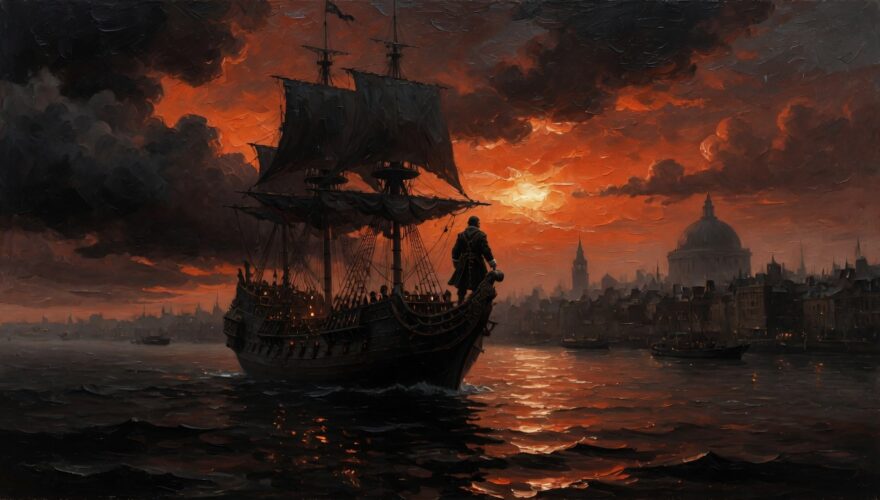
Captain Kidd was not a pirate by choice. He was a privateer with royal backing, powerful investors, and a legal commission, until politics turned against him and his patrons needed a scapegoat. Discover the true story behind the legend: the trial, the missing evidence, the powerful men who abandoned him, and the execution that made him infamous.
- 1 The Rope and the Crown
- 2 A Legal Business, More or Less
- 3 The Men Behind the Mission
- 4 When the Hunting Went Wrong
- 5 A Bucket and a Blow
- 6 The Prize That Destroyed Him
- 7 Patrons Who Vanished
- 8 The Old Bailey, May 1701
- 9 Execution Dock
- 10 The Treasure That Would Not Stay Buried
- 11 A Warning Written in Chains
The Rope and the Crown
The man hanged as one of history’s most infamous pirates had once sailed with the blessing of the English crown.
On the morning of 23 May 1701, Captain William Kidd stood at Execution Dock on the Thames, his name already being written into legend as a villain. He had been convicted of murder and five counts of piracy. The crowd that gathered to watch was enormous. What they did not know, and what history would spend centuries untangling, was that the man swinging from that rope had powerful friends who had quietly stepped back into the shadows and left him there.
The story of Captain Kidd is not really a pirate story. It is a story about power, convenience, and what happens to a man when he becomes more useful as a sacrifice than as an ally.
A Legal Business, More or Less
To understand Kidd, you first need to understand privateering, which was the polite fiction that separated respectable maritime violence from common piracy.
Privateers were privately funded sailors who held a document called a letter of marque, issued by a government, authorizing them to attack enemy ships and keep a portion of the prizes. They were, in plain terms, pirates with paperwork. The line between the two was never as clean as governments liked to claim, but the paperwork mattered enormously when it came time to decide who got a knighthood and who got the gallows.
“The sea has neither mercy nor memory.”
attributed to English merchant sailors in the late 17th century
Kidd was not some rough cutthroat scrambling up from poverty and rum. He was a respected sea captain based in New York, a married man with property, a man of standing. He had served the English crown before and done it well. When the proposal came to him in 1695, it must have seemed less like a gamble and more like an opportunity a man of his position could not refuse.
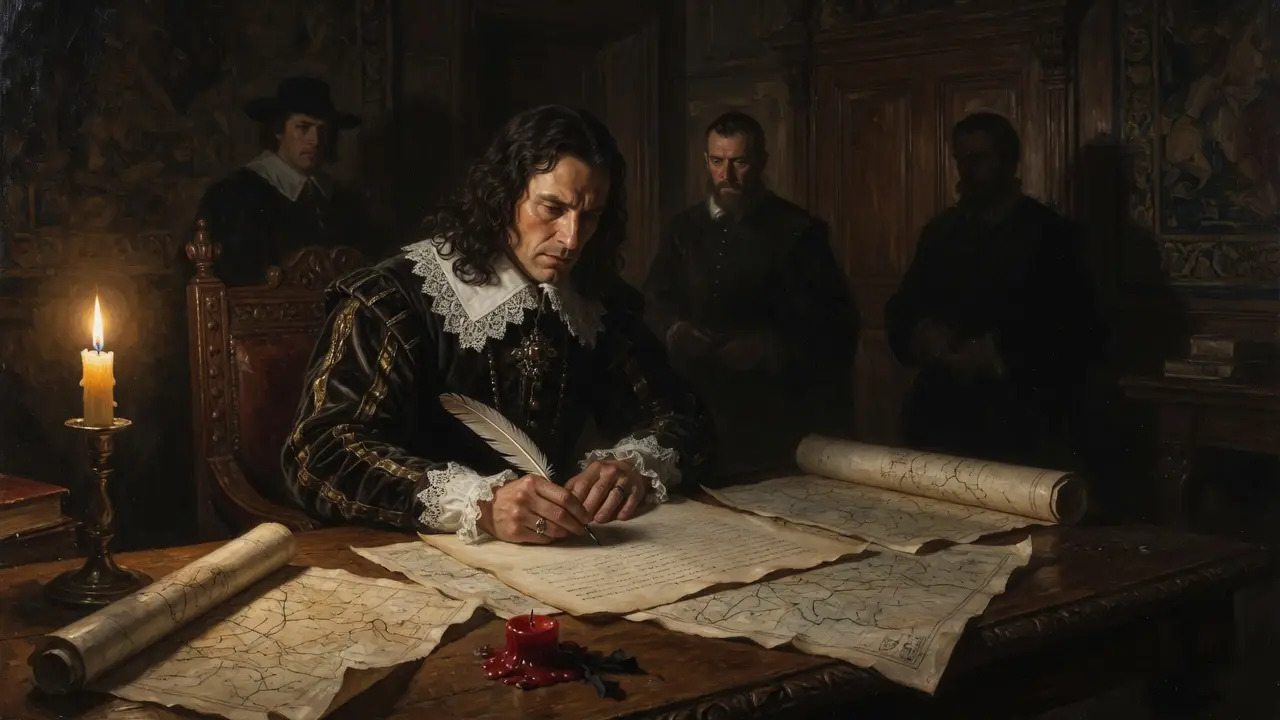
The proposal was this: fund a privateering voyage to hunt pirates in the Indian Ocean, particularly in the Red Sea and the waters around Madagascar where pirates were growing bolder and more dangerous. The venture would be backed by some of the most powerful men in England.
Join The Archive Briefing
Weekly dispatches. The history they didn't teach you — sourced, subverted, delivered to your inbox.
The Men Behind the Mission
This is where the story gets darker, and more interesting.
Kidd’s voyage was not backed by merchants who scraped together their savings. His investors were the kind of men whose names opened doors and closed trials. Richard Coote, the Earl of Bellomont and Governor of New England, was one of them. So were several prominent Whig politicians, including the Lord Chancellor himself. These men put up the money quietly, stood to profit if things went well, and expected discretion.
Kidd received two commissions from the crown: one authorizing him to take French vessels as prizes of war, and another, more unusual document, giving him authority to capture known pirates and seize their goods. The Adventure Galley, his ship, was purpose-built for the task. At 287 tons, she was fitted with both sails and oars, built for speed and pursuit in the complex coastal waters where pirates liked to hide.
LESSER-KNOWN DETAIL
Kidd’s wife, Sarah, was left in legal limbo. Under English law at the time, the wife of a convicted pirate could lose everything. Sarah Kidd faced the potential seizure of all her property following his conviction and had to fight to retain it.
On the surface, this was an orderly enterprise with legal backing, aristocratic capital, and a capable captain. Below the surface, it was a financial arrangement that would only stay respectable as long as it was profitable. The moment it turned inconvenient, Kidd would discover exactly how little that backing was worth.
When the Hunting Went Wrong
The voyage began in 1696 and quickly went sideways.
The Indian Ocean was not cooperating. The pirates Kidd was supposed to catch were elusive, or already gone, or protected by other interests. The Adventure Galley developed serious problems, leaking badly and slowing the ship. Then disease swept through the crew, killing dozens. Replacements had to be recruited from a pool of men who were less interested in legal privateering and more interested in results, specifically profitable results.
This is the brutal arithmetic of life at sea in the seventeenth century. Sailors on privateering voyages were not paid wages in any meaningful sense. They were paid in prizes. No prizes meant no money. No money meant hungry, angry men on a rotting ship in the middle of the ocean. The longer a voyage failed, the greater the pressure on the captain to find something, anything, worth seizing.
Kidd was caught between his legal obligation to his investors and the growing desperation of his crew. Some of his men eventually deserted outright to join known pirates. The rest stayed, but patience was thinning. The mission to hunt pirates was slowly rotting into something much harder to defend.
A Bucket and a Blow
In October 1697, off the coast of India, Kidd killed a man.
William Moore was a gunner aboard the Adventure Galley. The two men argued, the nature of the dispute probably connected to the wider tension about prizes and whether to attack ships that were not clearly legal targets. Moore called Kidd a lousy dog. Kidd picked up an iron-hooped wooden bucket and struck him on the head. Moore died the following day.
Kidd would later claim it was a moment of fury, not murder. He argued that Moore was stirring up the crew toward outright piracy and that discipline required force. That may have been true. Captains at sea had to maintain command with very few tools besides fear and respect, and losing either could mean losing everything.
But the distinction between a disciplinary killing and murder was exactly the kind of legal argument that required good lawyers, sympathetic judges, and political friends. By the time Kidd stood trial, he had none of those things.
The killing of William Moore gave prosecutors something simple and emotionally clear: not just a disputed privateer, but a man who killed one of his own crew with a bucket. Piracy could be complicated. Murder was not.
The Prize That Destroyed Him
In January 1698, Kidd took the ship that sealed his fate.
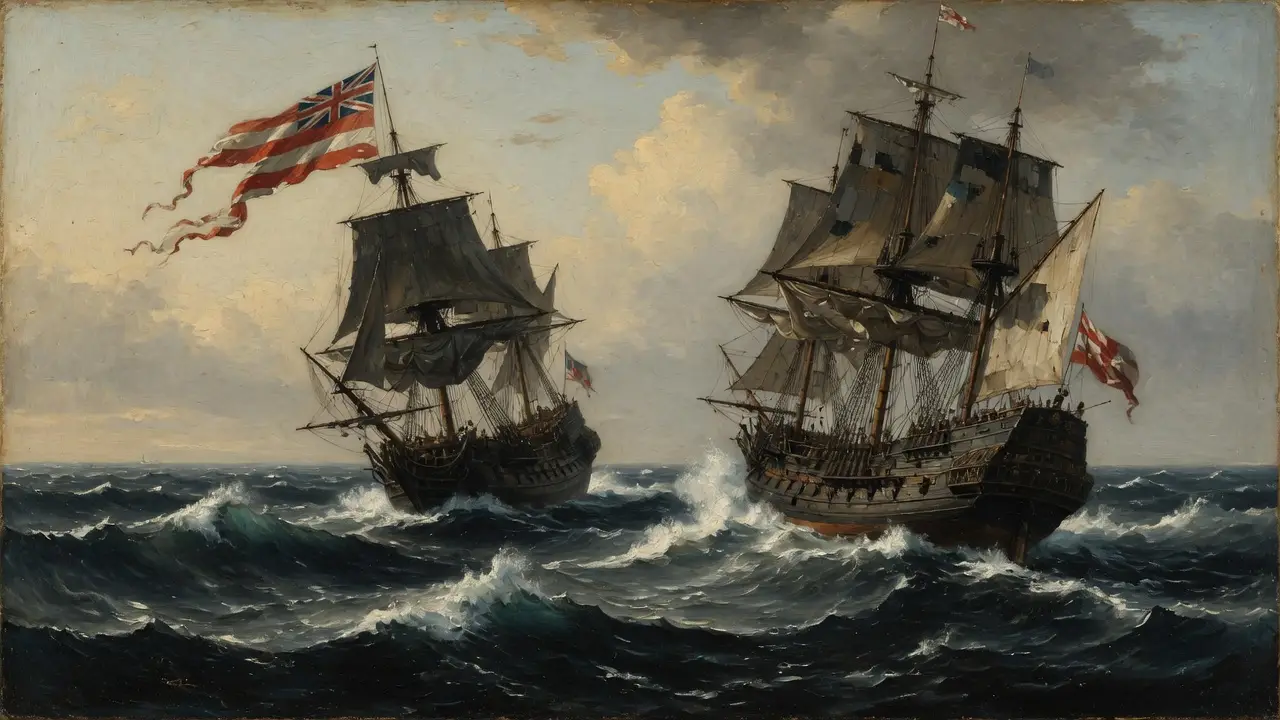
The Quedagh Merchant was a large Armenian-owned vessel sailing under Mughal imperial patronage, carrying an enormously valuable cargo of silk, gold, silver, and other goods. She was also, and this is the part that mattered to Kidd, carrying French passes. Under the terms of his commission, Kidd was authorized to take ships sailing under French documents as prizes of war. He took her.
What looked like a straightforward legal prize was, in reality, a catastrophe.
LESSER-KNOWN DETAIL
Some of Captain Kidd’s crew turned king’s evidence against him. Several sailors who had sailed with Kidd were offered leniency in exchange for testimony, which further undermined his ability to mount a coherent defense.
The ship was connected to powerful Mughal interests. The Mughal Emperor Aurangzeb was already furious at European pirates who had been raiding his subjects’ ships in the Red Sea, at one point imprisoning East India Company officials in retaliation. England’s trading position in India depended on keeping Mughal authorities calm. The last thing the English government needed was another pirate incident connected to their own flag.
Beyond the Mughal dimension, the Quedagh Merchant’s French passes became a legal tangle. Kidd believed they legitimized the capture. His prosecutors argued otherwise, and the French passes themselves, which might have supported Kidd’s defense, went missing before trial under circumstances that have never been fully explained. Some historians believe they were deliberately suppressed by parties who needed Kidd to be guilty.
The Quedagh Merchant was worth a fortune. It was also the clearest evidence that Kidd had crossed a line, or that he could be made to appear to have crossed one.
Patrons Who Vanished
Captain Kidd knew he was in trouble. He eventually left the Quedagh Merchant in the Caribbean and made his way back to Boston in 1699, apparently believing he could clear his name. He still thought his backers would support him. He still thought the French passes would protect him. He still thought the law meant what it said on paper.
Lord Bellomont arrested him.
The political situation in England had shifted dramatically. The Whigs, who had backed Kidd’s voyage, were under attack from the Tories, and the privateering commission had become a political liability. In Parliament, the Tories were using Kidd’s supposed piracy to damage Whig reputations. The investors who had quietly funded the venture now needed the story to be that they had been deceived by a rogue captain, not that they had knowingly backed a piracy venture. Kidd had to be a pirate for that story to work.
The men who had sat with Kidd over maps and money and grand plans simply went quiet. They had their own political survival to think about. Kidd, sitting in prison in Boston and then in Newgate in London, waited for help that did not come.
The Old Bailey, May 1701
The trial was, by the standards of the age, swift.
Captain Kidd faced one count of murder for William Moore’s death and five counts of piracy. He was poorly represented. He had almost no time to prepare, complained repeatedly about documents he could not access, and his request to enter the French passes as evidence was handled so badly that historians have argued about whether it was incompetence or deliberate obstruction.
The Quedagh Merchant sat at the center of everything. Kidd argued repeatedly that the French passes made his actions legal. Without those passes, the argument collapsed. The jury deliberated briefly. The verdict was guilty on all counts.
Whatever the law said in theory, in practice this was less a criminal trial than a political settlement. England needed to demonstrate to the Mughal Empire and to its own trading partners that it was serious about suppressing piracy. A high-profile conviction served that purpose. A powerful earl’s quiet admission that he had funded the voyage would not.
LESSER-KNOWN DETAIL
The French passes were found centuries later. Documents believed to be the missing French passes from the Quedagh Merchant were discovered in the Public Record Office in London in 1910, more than two centuries after the trial. They appeared to support Captain Kidd’s defense almost exactly as he had described them.
One legal scholar would later describe the proceedings as shaped less by the facts of piracy than by the interlocking pressures of domestic politics, colonial administration, and commercial empire. Kidd was useful dead. Alive and exonerated, he was a problem.
Execution Dock
They brought him to the Thames on 23 May 1701.
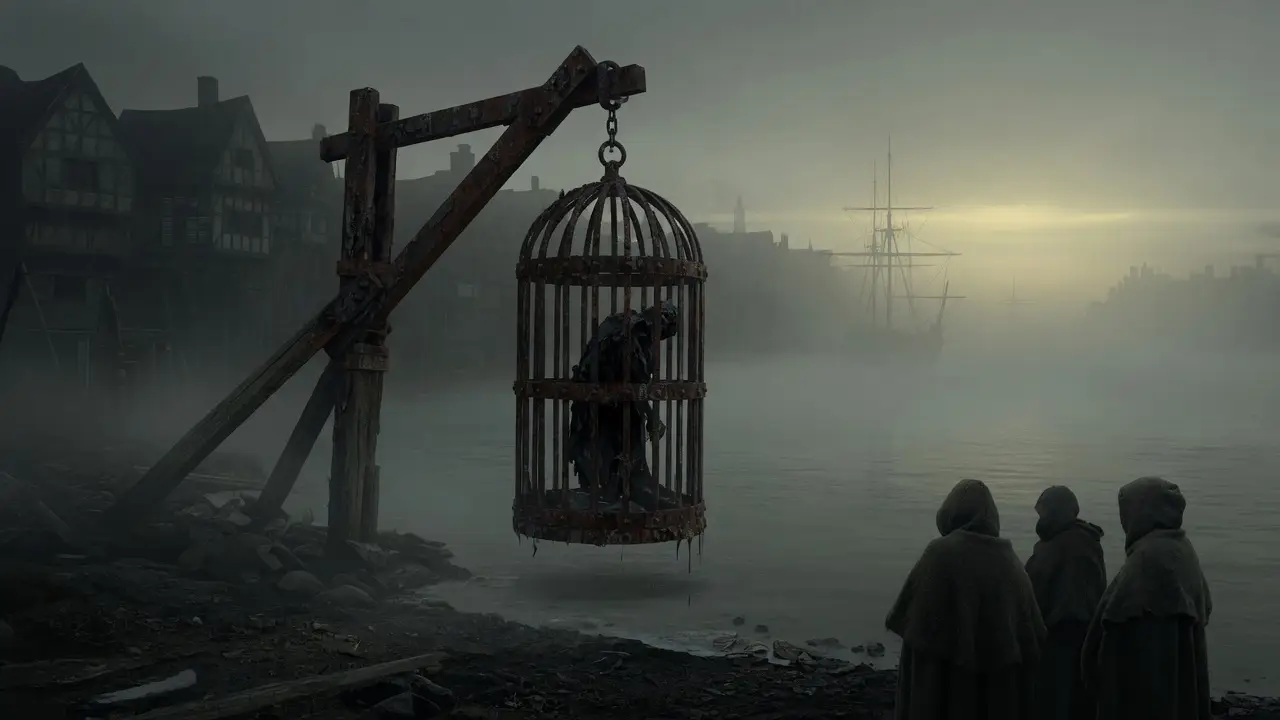
Execution Dock at Wapping was the traditional site for the execution of pirates and sailors convicted of crimes at sea. The location was deliberate and ceremonial: the gallows stood below the high-tide mark, so that the sea itself bore witness. Three tides were required to wash over the body before it could be taken down.
The first rope broke.
Whether this was chance or a condemned man’s grim luck, Captain Kidd survived the initial drop and had to be strung up a second time. He died on the second attempt.
His body was then coated in tar and hung in a gibbet over the Thames at Tilbury Point, where it swayed in the river wind for years. This was standard practice for convicted pirates: a visible warning to sailors coming in and out of London. The message was simple enough. The irony, for those who knew the full story, was considerably more complex.
“I have done nothing but what I have been ordered to do.”
Paraphrase of Kidd’s own defense before the court, recorded in the trial documents, 1701.
The man displayed as a warning against piracy had sailed with a royal commission, backed by lords and politicians, and gone to the gallows in part to protect the reputations of men who were never charged with anything.
The Treasure That Would Not Stay Buried
Some of Kidd’s loot was real. Before his arrest, he had offloaded goods on Gardiner’s Island off the coast of Long Island, burying a cache that included gold dust, silver, jewels, and other valuables. Lord Bellomont recovered much of it as evidence and sent it to London for the trial. What was recovered was impressive but not mythological.
The mythological version came later.
Rumors circulated that Kidd had buried a far larger treasure somewhere, a fortune waiting for whoever decoded the clues. The stories spread and grew across the eighteenth and nineteenth centuries, fed by the natural human appetite for hidden riches and unsolved mysteries. Edgar Allan Poe was drawn to the Kidd legend. Robert Louis Stevenson almost certainly absorbed it.
The treasure story is perfectly constructed for longevity: it involves a real person, a genuinely massive fortune in recovered goods, the suggestive incompleteness of the historical record, and the romantic location of a coastal island. Every generation finds fresh reasons to believe a bit more is still out there.
What is certainly buried is the truth of what happened to William Kidd, somewhere beneath the political maneuvering, the missing documents, and the convenient amnesia of powerful men.
A Warning Written in Chains
Captain Kidd’s body eventually came down from the gibbet. His name, however, never did.
He became the pirate of legend: buried treasure, the Jolly Roger, hidden codes. But the legend replaced the actual history with something simpler and more comfortable. The real story, of a privateer destroyed by the men who hired him, of a trial shaped by commercial empire and political survival rather than justice, is considerably less romantic and considerably more instructive.
Every era produces men like Kidd, competent and loyal until loyalty stops being useful. And every era finds ways to make the inconvenient ones disappear while the powerful men who sent them go home to dinner.
The rope at Execution Dock was strong enough the second time. The truth, it turned out, was harder to hang.