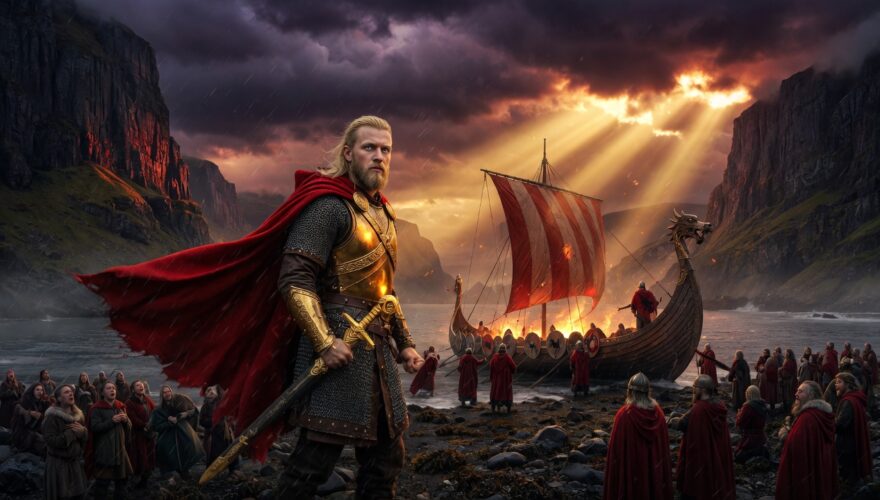
The ship that arrived at the Icelandic coast that morning looked unlike anything the farmers gathering on the shore had seen before. The men stepping off it were dressed in silk and scarlet, their weapons gilded, their cloaks the color of fresh blood. At their center stood one man, tall and composed, wearing the kind of clothes that belonged in an emperor’s court, not a windswept Icelandic harbor.
His name was Bolli Bollason. He had left Iceland as a young man with something to prove. He was coming back as a legend.
To understand Bolli, you have to understand the weight of the name he carried. His father, Bolli Thorleiksson, had killed the beloved Kjartan Olafsson in one of the most emotionally charged feuds in all of Norse saga literature. Then Bolli the father was himself killed in revenge by Kjartan’s brothers, cut down while his wife Gudrun watched. That woman, Gudrun Osvifursdottir, is considered one of the most complex female figures in medieval Icelandic literature. She buried four husbands, loved one man she could never fully have, and raised her son Bolli in the long shadow of all of it.
Growing up as Bolli Bollason meant inheriting a story soaked in blood and grief before you were old enough to shape your own. The saga world ran on honor and genealogy. Your father’s deeds defined your starting position. His death defined your obligation.
So Bolli left.
He went first to Norway, as many ambitious young Icelanders did, seeking patronage and polish at the courts of the Norse aristocracy. But Norway wasn’t enough. Something pulled him further, east and south, through the trading routes and warrior networks that connected the Norse world to the glittering civilization at the edge of Europe. He was headed for Constantinople, which the Norse called Miklagarðr, the Great City.
The Byzantine Empire in the early eleventh century was the most powerful and sophisticated state in the Christian world. Its capital was a city of half a million people, of marble palaces, layered bureaucracies, and theological arguments that could make a bishop’s head spin. At its heart was the Emperor, and protecting the Emperor was an elite unit of foreign fighters: the Varangian Guard.
The Varangians were Norsemen, mostly. Big, fierce, and deliberately kept foreign so that their loyalty ran to the Emperor rather than to any Byzantine faction. They were paid extraordinarily well, given access to the palace, and trusted with the Emperor’s life. They were also, by any measure, terrifying in battle.
Bolli Bollason joined them.
Join The Archive Briefing
Weekly dispatches. The history they didn't teach you — sourced, subverted, delivered to your inbox.
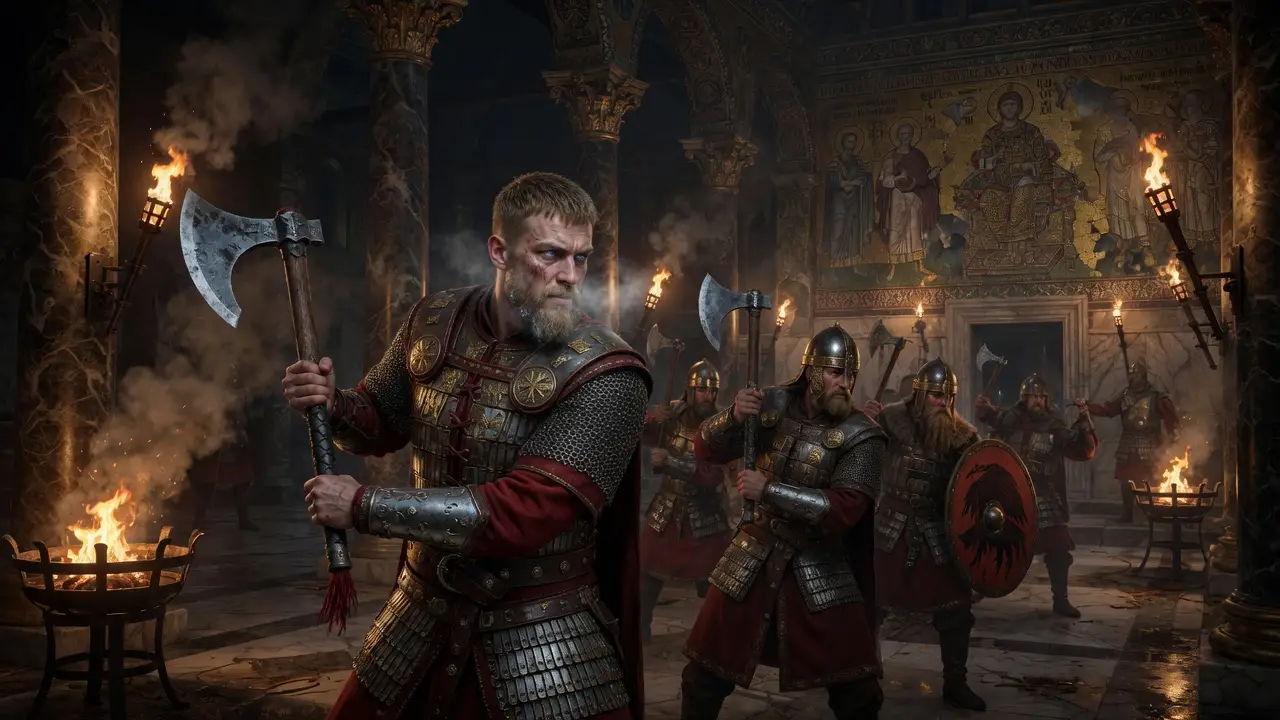
What he actually did during his years in Constantinople, the sagas don’t say with specificity. The Laxdæla saga and the shorter Bolla þáttr are more interested in what he came back as than in the granular details of his service. But the outline is clear enough: he fought, he distinguished himself, and he accumulated wealth on a scale that Iceland had rarely seen arrive in one man’s sea chest.
It’s worth pausing on what that service meant in practice. The Varangian Guard fought across the Mediterranean world. They put down rebellions in Asia Minor, campaigned in southern Italy, enforced the Emperor’s will across a geography that would have seemed almost incomprehensibly vast to a man raised on an Icelandic farm. Bolli Bollason had gone from a small island at the edge of the known world to the beating center of medieval civilization. He had served an emperor. He had seen cities that made Reykjavik look like a cattle shed.
When he finally sailed home, he brought all of it with him.
The saga describes his return with a kind of barely contained awe. He arrived with a company of twelve men, all of them dressed in the same brilliant scarlet. His weapons were inlaid with gold. His horse was magnificent. The people of the Dalir district in western Iceland, the region where the great families of the Laxdæla saga had their roots, came out simply to look at him. The saga says explicitly that people traveled from other districts just to see Bolli Bollason ride past.
Think about that for a moment. This was a society that prized reserve, practicality, and a certain cultivated understated quality. Icelandic saga heroes rarely peacocked. Bolli did. He understood, perhaps better than anyone of his generation, that spectacle was its own form of power.
One early account captures the scene with a detail so specific it feels witnessed: he wore a red cloak over his gilded armor, carried a gold-hilted sword, and had a gilded helmet on his head. He was not dressed for battle. He was dressed to be remembered.
He married Thorðis, the daughter of the powerful chieftain Snorri goði, a match that consolidated his position in the upper tier of Icelandic society. He became a goði himself, a local chieftain with both the legal authority and the social weight the title implied. The boy who had grown up carrying his father’s tragic name had transformed it into something else entirely.
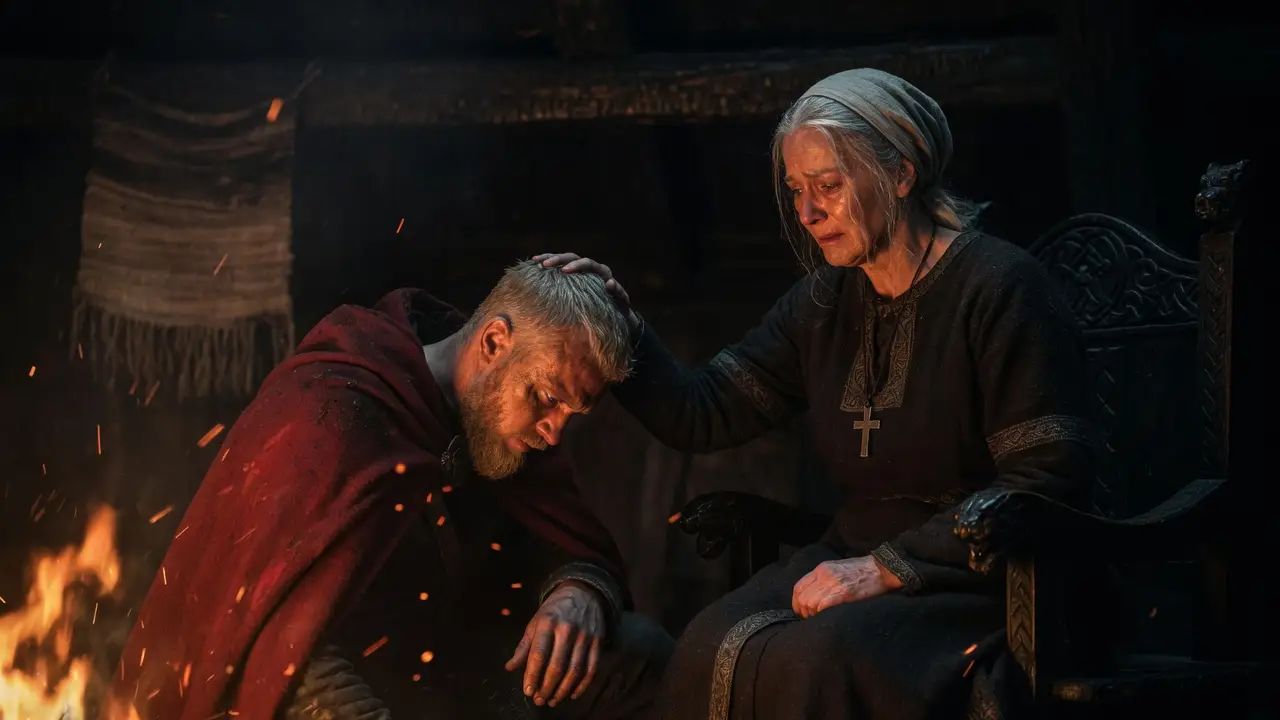
There is a lesser-known detail worth noting here. Gudrun Osvifursdottir, his mother, spent her final years as a committed Christian and, by some accounts, the first nun in Iceland. She is famous in the sagas for her dying words when asked who she had loved most: “I was worst to the one I loved best,” she said, meaning Kjartan. Her son Bolli inherited her gift for making a moment land.
What makes Bolli Bollason matter, beyond the vivid image of the man in scarlet, is what his story tells us about the reach of the Norse world at its peak. The eleventh century saw Norsemen at the courts of Byzantium, in the markets of Baghdad, on the shores of North America, and ruling kingdoms across the British Isles. Bolli was not an exception. He was a particular expression of something broader: the Viking Age as a story of restless, extraordinary movement.
He also matters because he refused to be only his father’s son. In a literary tradition built around the weight of family legacy, he managed to write his own chapter, and make it the most visually striking one in the book.
The farmers who gathered on the shore that morning to watch him step off the ship could not have known they were looking at a man who had helped guard an emperor. They only saw the scarlet cloak, the gilded sword, and the calm, deliberate way he stood among his men.
Some impressions, it turns out, need no explanation.