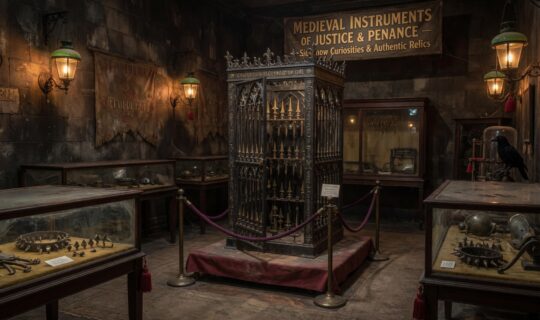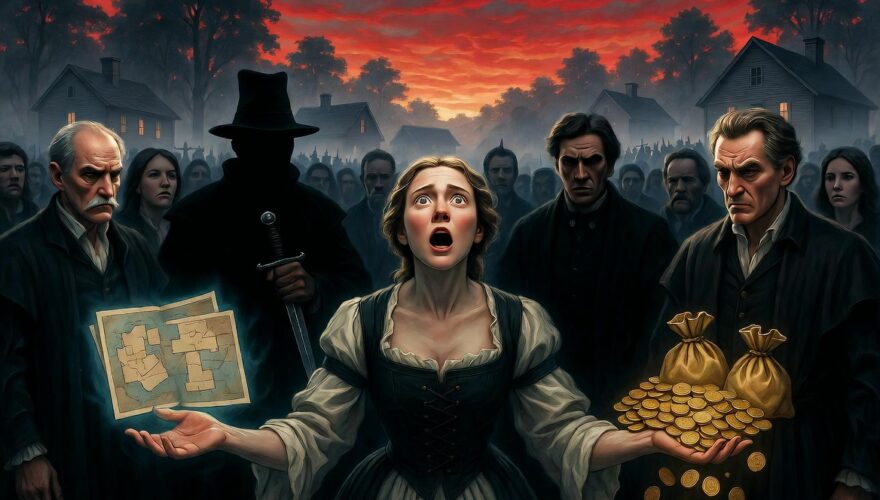
Salem witch trials were not a story about Puritans being strange, superstitious, and primitive. It was a story about human beings doing what human beings have always done with access to power and the cover of righteous language. The accused were real people. Their deaths were real. The property transfers were real. The debts were real.
The Devil, as it turns out, had very good lawyers.
The Devil’s Real Name Was “Deed”
In January 1692, a twelve-year-old girl named Ann Putnam Jr. began convulsing on the floor of her family’s farmhouse in Salem Village, Massachusetts. Her screams filled the room. Her parents watched in horror. And within weeks, her family would use that horror to destroy their neighbors.
History remembers the Salem witch trials as a story about Puritan fear, religious hysteria, and the dark edge of superstitious belief. That version is simpler. It’s also wrong.
Follow the property records. Follow the debts, the boundary disputes, the old insults, and the unpaid inheritances. What you’ll find isn’t a town consumed by spiritual panic. You’ll find something far more human, and far more disturbing. You’ll find people who used the language of the Devil to settle scores they could not settle in court.
A Village Already at War With Itself
Before a single person was accused of witchcraft, Salem Village was fracturing. It had been for decades.
The village sat in an awkward position, legally and geographically. It was subordinate to the wealthier town of Salem proper, which controlled its commerce and tax revenue. Families who farmed the western, poorer side of the village resented those with connections to the merchant economy of the east. The Putnams, one of the most prominent farming families, had been in a slow-burning legal war with the Porter family over land boundaries and political influence for years. These weren’t minor neighborly squabbles. These were generational feuds over who would control the village’s future.
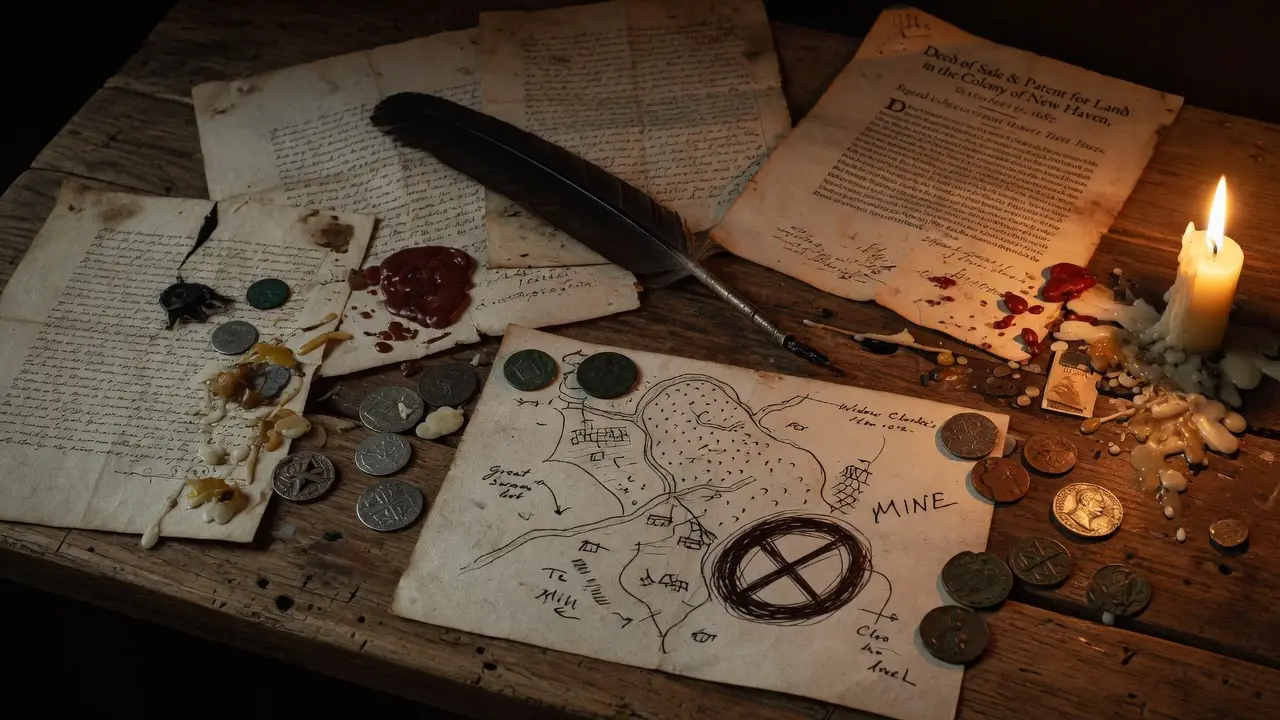
Thomas Putnam, Ann’s father, had already lost several legal battles. His half-brother Joseph had inherited a larger share of the family estate than Thomas believed was rightfully his. The bitterness was deep and personal.
Join The Archive Briefing
Weekly dispatches. The history they didn't teach you — sourced, subverted, delivered to your inbox.
When the accusations began, notice who the Putnams targeted. And notice who they did not.
The Accused Were Not Random
Sarah Good was homeless, begging door to door. Sarah Osborne hadn’t attended church in over a year. Tituba was an enslaved woman with no power and no protection. These first three accused women were, in the brutal logic of Salem’s social hierarchy, expendable. Targeting them was a test. When the courts accepted spectral evidence, the floodgates opened.
What followed was not chaos. It had architecture.
Giles Corey owned a substantial farm. He had been an adversary of the Putnam family and had once been accused of beating a farmhand to death, a charge that never fully resolved in the community’s memory. When he was accused, he refused to enter a plea. He knew that if he stood trial and was convicted, the colonial government could seize his estate. By refusing to plead, his land would pass to his sons. He was pressed to death with heavy stones over the course of two days. He reportedly used his last breath to say “more weight.”
His land stayed in the family. He understood exactly what the game was.
“You are a liar. I am no more a witch than you are a wizard, and if you take away my life, God will give you blood to drink.”
Sarah Good, moments before her hanging, to Reverend Nicholas Noyes
Martha Carrier, executed in August 1692, had been involved in a prolonged boundary dispute over her family’s land in Andover. John Proctor, made famous by Arthur Miller’s play, had feuded openly with several of his accusers. Rebecca Nurse, a seventy-one-year-old woman so well-respected that her initial verdict was acquittal, belonged to a family in a decades-long land dispute with the Putnams. The court was so resistant to that acquittal that the judges sent the jury back to deliberate again. She was convicted the second time and hanged.
Historian Paul Boyer and sociologist Stephen Nissenbaum, in their landmark 1974 study Salem Possessed, mapped the accusations against the documented property disputes and found a pattern so consistent it could not be coincidence. The accusers and the accused lived, almost without exception, on opposite sides of Salem Village’s factional divide.
Europe’s Burning Fields
Salem was not an isolated incident. It was the final, small echo of something that had consumed Europe for nearly three centuries.
Between 1450 and 1750, somewhere between forty thousand and sixty thousand people were executed as witches across the European continent, the majority of them women. The standard narrative attributes this to the Catholic Church, to Inquisitorial fanaticism, to mass superstition. But regional studies keep revealing the same uncomfortable pattern that Boyer and Nissenbaum found in Massachusetts.
In the German territories, the worst outbreaks of witch-hunting coincided almost exactly with periods of crop failure, debt crisis, and land consolidation. In Würzburg and Bamberg during the 1620s, the bishops who oversaw the largest executions were simultaneously consolidating church landholdings and eliminating political rivals. The accused were not exclusively peasants. Wealthy merchants, their wives, and members of local government appeared on the lists. Their assets, upon conviction, were forfeit. The church and secular authorities split the proceeds.
In Scotland, the North Berwick trials of 1590 were orchestrated largely under the personal obsession of King James VI, but local accusations often targeted widows who held property their male neighbors wanted. Widowhood in early modern Europe was one of the few conditions under which a woman could legally own and control land. It was also, not coincidentally, a condition that made women statistically more likely to be accused.
A woman without a husband was a woman without male protection. Her property had no defender.
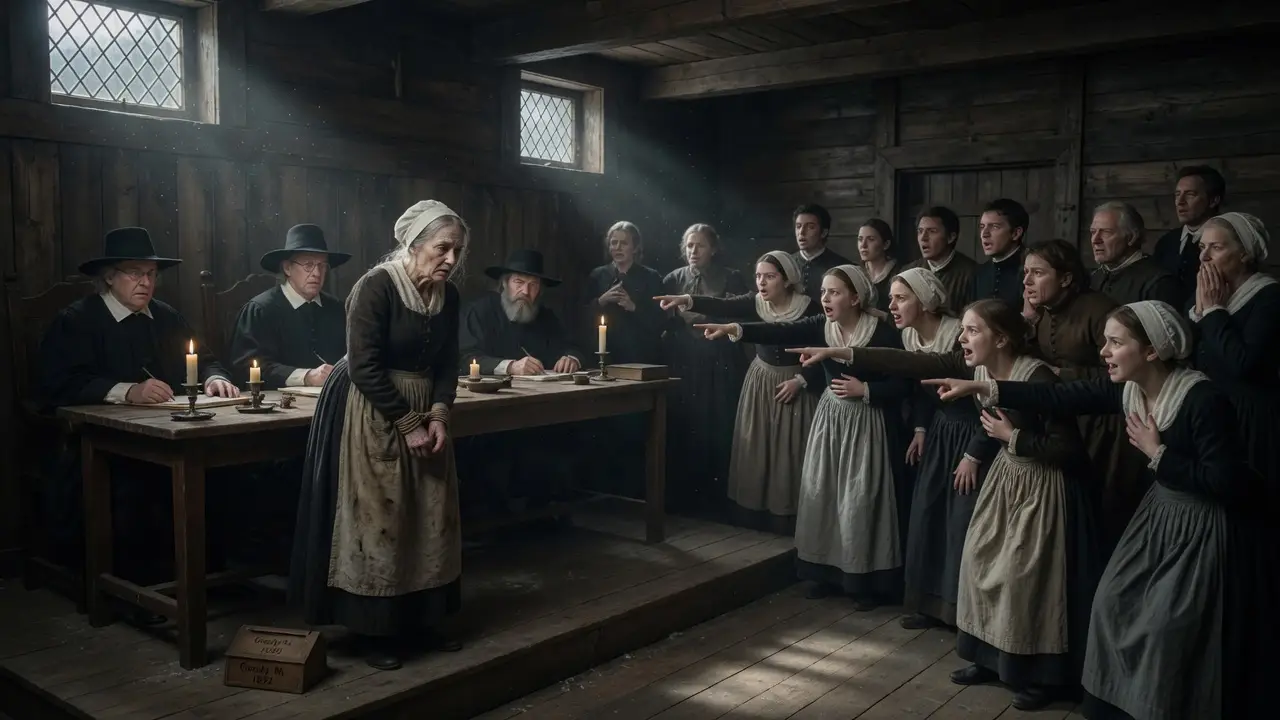
The Confession Machine
One of the most chilling mechanics of both Salem and European trials was this: those who confessed lived. Those who refused to confess and insisted on their innocence were executed.
This created a perverse incentive. Confession required naming additional conspirators. The accused, desperate to survive, would name their neighbors, their rivals, their enemies. Each confession generated new accusations. The circle widened. The property seizures multiplied.
In Salem, not one of the accused who confessed was executed. Every single person who was killed had refused to confess. They chose death over false testimony. The courts, whether intentionally or through stunning structural blindness, had built a machine that rewarded lies and punished integrity.
This is not a system designed to find truth. It is a system designed to produce more accusations.
The Collapse
The trials ended not because the community suddenly regained moral clarity. They ended because the accusations began reaching people with power.
When accusers targeted the wife of Massachusetts Governor William Phips, and when the respected minister Increase Mather began publicly questioning spectral evidence, the political calculus shifted. The same elites who had allowed the machinery to run unchecked abruptly found it moving in their direction. The trials were suspended. Surviving prisoners were released, many of them having spent months in squalid jails. The colony quietly began the long, awkward process of pretending the whole thing had been a regrettable mistake.
“It were better that ten suspected witches should escape than one innocent person should be condemned.”
Increase Mather, minister and one of the first voices to challenge spectral evidence, 1692
Ann Putnam Jr. eventually issued a public apology in 1706, fourteen years later. She framed it as the work of “a great delusion of Satan.” She did not mention the property disputes. She did not mention her father’s debts or his feuds. She offered no material compensation to the families whose relatives she had helped send to the gallows.
Her family kept its land.