The history you were taught was written by the winners. So what they hid?
Propaganda did not begin with television, social media, or even the printing press. It began the moment one person realized that controlling a story was more powerful than controlling an army.
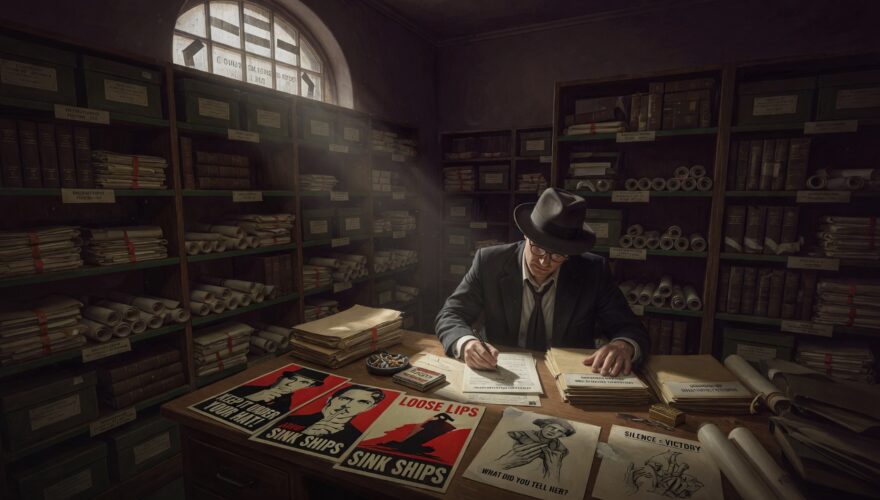
In the winter of 1944, the United States Office of War Information printed millions of copies of a photograph showing a cheerful American soldier sharing his rations with a group of smiling children in a liberated European village. The image ran in newspapers from San Francisco to Boston. It became one of the defining images of Allied moral purpose. There was just one problem. The photograph had been staged. The children were hired. The village had not been liberated yet.
Nobody involved considered it a lie. They considered it a preview. A truth that was about to happen. And that distinction, razor-thin and deliberately blurred, is exactly where propaganda lives.
The Oldest Trick in the World
Long before Goebbels had a radio tower or Stalin had an art committee, rulers understood that the past was not a fixed thing. It was a resource. Ramesses II fought the Battle of Kadesh against the Hittites around 1274 BC. Historians today believe it was, at best, a costly draw. The Egyptians suffered severe losses and failed to take the city they had marched a thousand miles to capture.
But if you had walked through the temples of Abu Simbel, you would have seen something else entirely. Ramesses carved into stone, twice the height of any other figure, standing over broken and bleeding enemies. He had his scribes compose what amounted to the world’s first press release, an epic poem celebrating his personal heroism at Kadesh, and had it inscribed on walls from Luxor to Nubia. The poem still exists. Tens of thousands of people read its claims as fact for centuries.
The Hittite records tell a different story. Both sets of records survived. Almost nobody read both until the 20th century.
When the Church Held the Pen
For roughly a thousand years in medieval Europe, nearly all written history passed through ecclesiastical hands. Monks were the archivists, the scribes, the scholars. They were also, by necessity, loyal to institutions that had a profound interest in what those archives said.
This produced something more subtle than outright falsification. It produced omission. Entire categories of medieval life, folk medicine, women’s legal authority, the sophisticated trading networks of non-Christian merchants, were simply not recorded with the same care as battles, church councils, and the deeds of kings. What got left out shaped the version of the Middle Ages that every schoolchild would later inherit: a world of ignorant peasants, brutal nobles, and a church that represented the only light in the darkness.
Join The Archive Briefing
Weekly dispatches. The history they didn't teach you — sourced, subverted, delivered to your inbox.
That version was not entirely wrong. It was simply incomplete in ways that happened to flatter the institutions doing the recording.
“The most effective propaganda does not make you angry. It makes you certain.” – Jacques Ellul, Propagandes, 1962
The Machine Gets an Upgrade
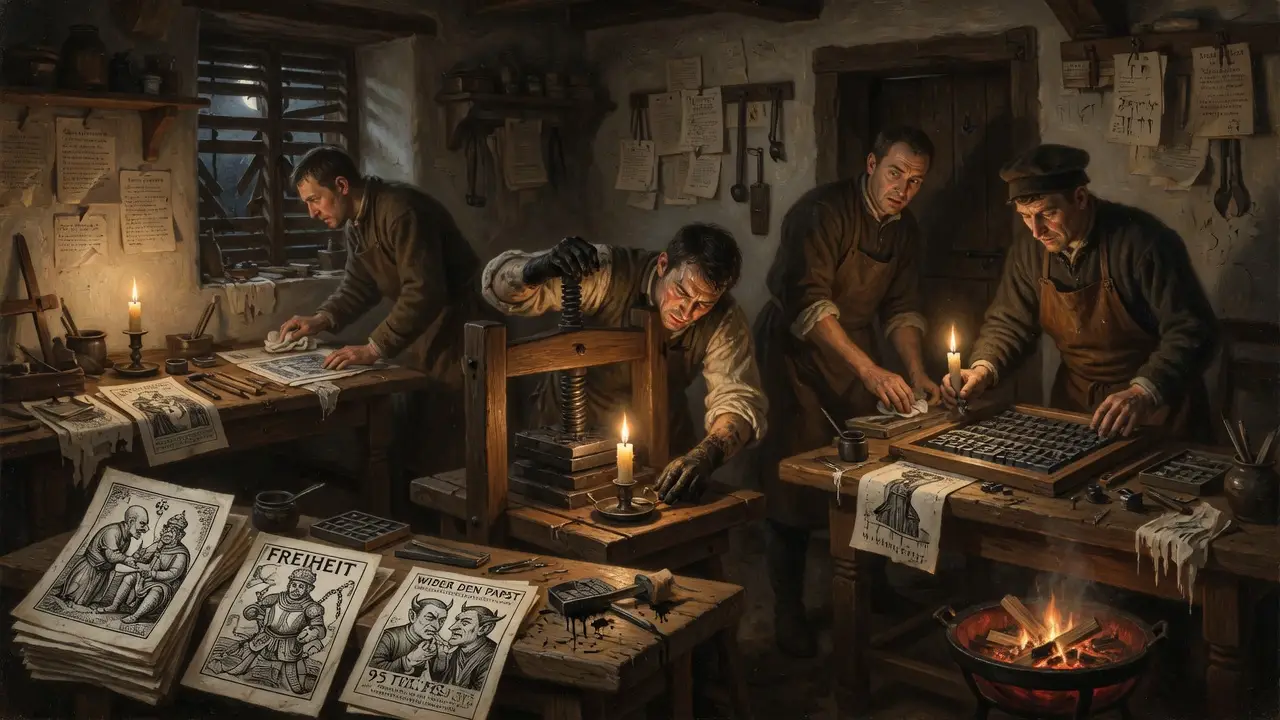
The printing press changed everything, but not immediately in the direction of truth. Within decades of Gutenberg, rulers and religious authorities were using the new technology to flood populations with competing versions of reality. Martin Luther’s Reformation spread not just because his theology was compelling, but because he understood pamphleteering. He wrote in German, not Latin. He used woodcuts. He gave ordinary people something they could hold, read aloud at markets, and pass to a neighbor.
His opponents learned fast. Within years, the same technology was producing anti-Lutheran broadsides, portraits of Luther as a demonic figure, and fabricated accounts of Protestant violence. Neither side had a monopoly on distortion. The printing press had not freed information. It had industrialized the war over it.
The 20th Century Turns the Volume Up
Every era believes it has invented propaganda. The 20th century had better tools and fewer scruples than most. What the Nazis understood, almost clinically, was that repetition could substitute for evidence. Say the same thing often enough, through enough channels, in enough emotional registers, and the brain begins to treat it as background noise, then as ambient truth.
Leni Riefenstahl’s 1935 film Triumph of the Will did not argue that Hitler was a great leader. It demonstrated it through camera angles, music, crowd choreography, and light. You did not watch it and think, “I am being persuaded.” You watched it and felt something vast and certain in your chest. That was the point. Riefenstahl herself insisted until her death that she had made a documentary, not a propaganda film. The distinction was not accidental. It was the whole strategy.
What is less often discussed is the counter-propaganda running from the Allied side, films produced by the U.S. War Department, the British Ministry of Information, Soviet state cinema, all of them shaping not just the war effort but the version of the war that would survive into peacetime. The Allies won. Their version became history. The official Soviet account of World War II, for example, barely acknowledged the Western Front for decades. American school textbooks returned the favor by understating Soviet casualties, which numbered somewhere between 24 and 27 million people.
The Myth That Flatters Itself
Perhaps the most durable form of historical propaganda is the kind that a society produces about itself without a central authority directing it. Americans did not need a Ministry of Truth to construct a version of the frontier West that erased the systematic displacement of indigenous populations. They had dime novels, then Hollywood, then television. The cowboy myth built itself, story by story, because it was useful. It made expansion feel like destiny rather than conquest.
The British Empire produced similar mythology about civilizing missions and grateful subjects, a narrative so thoroughly absorbed by the culture that many people alive today still carry traces of it. As the historian Caroline Elkins documented in her Pulitzer-winning work on British detention camps in 1950s Kenya, atrocities committed within living memory had been effectively sealed from the public record for half a century. The files were not released by accident. Someone had decided they should not exist.
What This Means Now
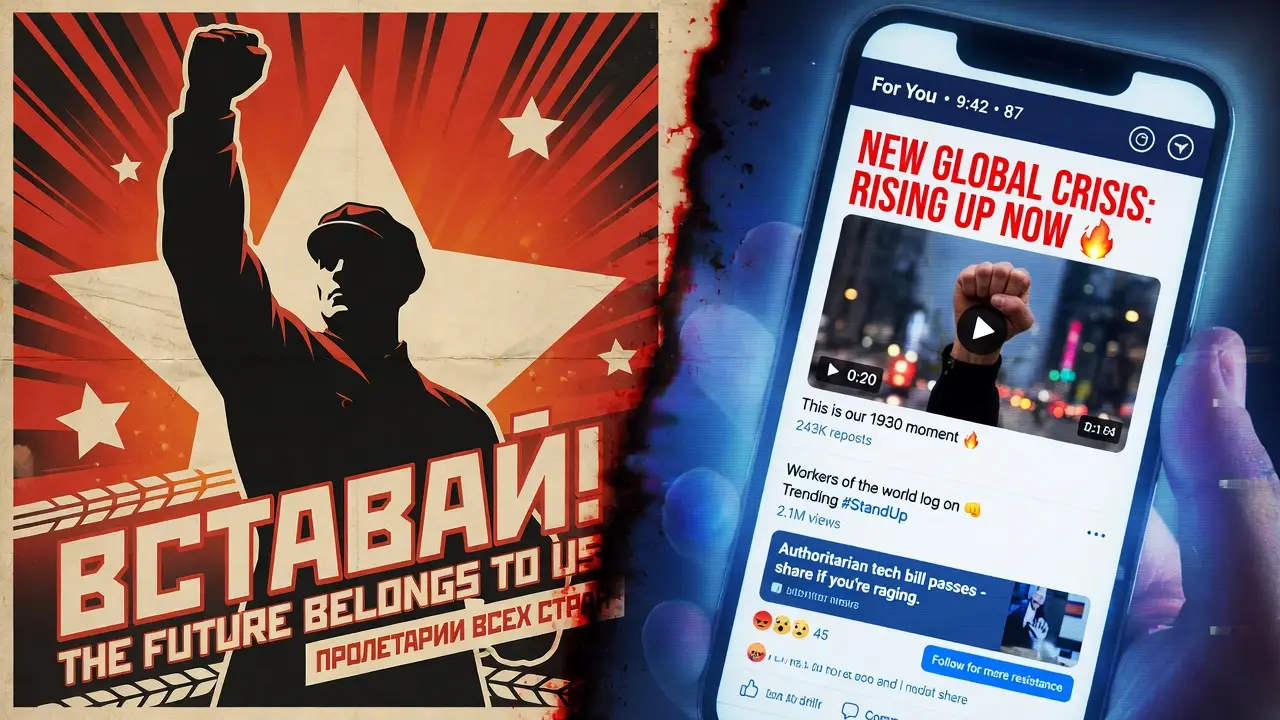
The instinct is to locate propaganda safely in the past, in regimes we already condemn, in technologies we have outgrown. But the mechanism is unchanged. Governments still classify documents. Corporations still fund think tanks. Algorithms now surface the history that confirms what you already believe, faster and more efficiently than any printing press.
The difference today is volume and velocity. A false historical claim can circle the world before the correction has finished loading. And unlike a Riefenstahl film, which required a theater and a projectionist, the modern propaganda apparatus requires nothing more than a share button.
History is not a record of what happened. It is a record of what people with power chose to preserve, emphasize, and repeat. Every civilization has edited its own past. Most have done so with complete sincerity, convinced that what they were amplifying was simply true. The monk who omitted the female herbalist from his chronicle was not lying. He just did not think her worth including. The result is the same as a lie. The record is missing her.
Recognizing propaganda in the past is relatively easy. Recognizing it in the present, inside the stories we feel most certain about, is the harder and more necessary work. Because the story you find completely obvious, the one that needs no argument or evidence, the one that is simply how things are, that is the one most worth questioning.
The most dangerous propaganda is the kind you mistake for common sense.