The Knights Templar didn’t just fight for God, Before the Crusades were a holy war, they were a business model. Discover how the Knights Templar built the world’s first international banking network. The letters of credit, offshore holdings, royal debt, and a treasury that vanished overnight.
A Pilgrim Walks Into a Bank
The year is 1150. A French nobleman stands at the gates of Jerusalem, exhausted, sunburned, and carrying nothing but a small strip of parchment. He departed Paris months ago with a chest of silver coins, too heavy to carry across the Alps, too dangerous to haul through bandit-riddled roads. So instead, he handed the coins to a group of warrior-monks in Paris, received a coded document in return, and walked away with his life savings reduced to paper.
He arrives in the Holy Land and hands that document to another group of warrior-monks. They check the code, nod, and count out the equivalent sum in local currency.
No robbery. No loss. No mule carrying silver through the mountains.
That nobleman had just used the world’s first international banking network and the men who built it wore white mantles with red crosses and carried swords.
The Order That Built Its Vault Before Its Castle
The Knights Templar were founded in 1119, officially to protect Christian pilgrims traveling to Jerusalem after the First Crusade. Nine knights, a cramped headquarters on the Temple Mount, and a mandate from the Church. Noble, certainly. Revolutionary, not yet.
But that changed fast.
Within two decades, donations from European nobility began flooding in… land, money, estates, entire villages. The Templars didn’t spend it all on swords. They built infrastructure. Ports, farms, mills, vineyards across France, England, and the Iberian Peninsula. By the mid-twelfth century, they weren’t just a military order. They were a corporation with an army.
But the financial machinery they constructed was something the world had genuinely never seen before.
Join The Archive Briefing
Weekly dispatches. The history they didn't teach you — sourced, subverted, delivered to your inbox.
Letters of Credit and the Architecture of Trust
The parchment that nobleman carried was what the Templars called a lettre de change, a letter of credit. Simple in concept, world-altering in practice. You deposit funds at one Templar house, receive documentation, and withdraw equivalent funds at another, anywhere across Christendom. The Templars maintained preceptories, essentially branch offices, from London to Acre, from Lisbon to Constantinople.
The Templars are to be believed on their word alone, so great is their reputation for truth.”
Matthew Paris, English chronicler, Chronica Majora, c. 1240s
The system worked because of one thing money always requires and rarely gets: trust. The Templar seal was inviolable. Their reputation for strict accounting and physical security made their vaults the preferred storage facility for kings, merchants, and the papacy itself.
King Louis VII of France used them as his personal treasury. The English Crown stored funds at the London Temple. Pope Innocent III routed Church finances through their accounts.
“The Templars are the bankers of the universal Church,” wrote one papal official in the thirteenth century, without a trace of irony.
And those deposits didn’t sit idle.

The Interest They Weren’t Supposed to Charge
Here is where the story gets complicated… and quietly ruthless.
The Catholic Church formally prohibited usury, the charging of interest on loans, as a mortal sin. This created an obvious problem for a banking institution built inside the Church’s own walls.
The Templars found a way around it that was elegant in its dishonesty. Rather than charging interest outright, they structured loans so that repayment in a different currency, at a different exchange rate, quietly absorbed the profit. They called the difference a commission or a service fee. Everyone understood what it actually was.
They also developed what historians now recognize as an early form of rente, a financial instrument that paid out regular income from a principal investment, functionally identical to modern bond interest. Landowners across France sold their estates to the Templars in exchange for guaranteed annual payments until death. The Templars got the asset. The seller got a pension. And no one called it interest.
By the thirteenth century, they were financing wars. Philip II of France borrowed heavily from the Temple to fund military campaigns. The English Crown ran up debts with them that took decades to clear. King Henry III of England, famously short of funds, once asked the London Temple to hold crown jewels as collateral on a loan.
A military order. Holding the crown jewels.
The Offshore Problem and the Papal Exemption
What made the Templar financial network truly extraordinary and threatening, was its jurisdictional independence.
In 1139, Pope Innocent II issued the papal bull Omne Datum Optimum, granting the Templars an exemption from all local taxation and the authority to cross any border freely. No king, no bishop, no customs officer could touch their assets in transit. They reported only to Rome.
This made them, in every practical sense, the world’s first offshore financial institution.
They have become so arrogant that, whereas in former times they used to request something from our treasury, now they lend to us and our kingdom very large sums.”
Alleged complaint by a French royal counselor to Philip IV
Wealth could move through their network without being taxed, confiscated, or scrutinized by any secular authority. Merchants understood this. So did noblemen with inconvenient assets. The Templars charged for discretion, and discretion was worth an enormous amount.
Their main treasury in Paris, the Temple, was so secure and so trusted that it functioned as the de facto central bank of France for nearly a century. The French royal accounts were managed there. Tax receipts were deposited there. Payroll for the royal household was disbursed from there.
One French chronicler noted that the Templar treasurer knew the state of the royal finances better than the king’s own ministers. That was probably true, and probably the point.
The Crusades as Brand Identity
None of this means the Templars weren’t soldiers. They were, and brutal ones. At the Battle of Montgisard in 1177, fewer than five hundred Templar knights helped rout Saladin’s army of twenty-six thousand. At the Siege of Acre, they held the city long after any rational military calculation said it was lost.
But the Crusades served a second function that is rarely discussed plainly: they were the best possible advertisement for the Templar banking system.
Every pilgrim traveling to the Holy Land needed to move money safely. Every nobleman funding a crusade needed to transfer funds across thousands of miles of hostile territory. Every king raising an army needed short-term credit. The Templars were the only institution on earth capable of providing all three services simultaneously, with the implicit guarantee that your money was being managed by the most battle-tested, papally-protected, morally unimpeachable organization in Christendom.
The sword and the ledger were never in conflict. Each made the other more valuable.

The Day a King Decided to Balance His Books Differently
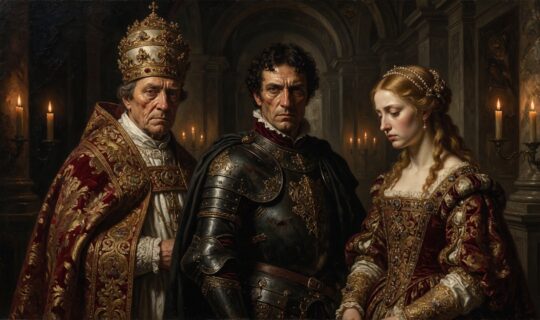
On the morning of Friday, October 13, 1307, King Philip IV of France, deeply in debt to the Templars, and deeply resentful of it, had every Templar in France arrested simultaneously.
The charges were spectacular: heresy, blasphemy, sodomy, idol worship of a mysterious figure called Baphomet, spitting on the cross during initiation ceremonies. The confessions, extracted under torture, were immediate and detailed. Grand Master Jacques de Molay confessed to everything before retracting it all.
The timing of Philip’s action was not about theology. France was broke. Philip had already expelled the Jews and seized their assets in 1306. He had debased the currency twice. The Templar treasury in Paris contained what was likely the largest concentration of liquid wealth in northern Europe.
When the arrests came, that treasury was empty.
Historians have argued about this ever since. Did the Templars move their assets in advance? Did someone warn them? The Templar fleet at La Rochelle, reportedly carrying substantial cargo, vanished from port the night before the arrests and was never recovered. Eighteen ships. Gone.
Where the money went is one of medieval history’s genuinely unsolved problems.
“They departed by night, and neither they nor their treasure have since been found,” wrote one chronicler whose identity has been lost to time but whose frustration has not.
The Burning and What Survived It
Jacques de Molay was burned at the stake in Paris in 1314, on the small island in the Seine now called the Île de la Cité, within sight of Notre-Dame. He died recanting his confession and cursing Philip and Pope Clement V both. According to witnesses, he called them to meet him before God within the year.
“I will endure death with tranquility… the charges laid against the Order are absolutely false.”
Jacques de Molay, at the stake, March 18, 1314
Both were dead within twelve months. Medieval people noticed.
The Order was formally dissolved at the Council of Vienne in 1312. Their assets were theoretically transferred to the Knights Hospitaller. In practice, Philip kept what was in France. Other monarchs did the same in their territories.
But what the arrests and the fires couldn’t destroy was the knowledge. The financial instruments the Templars had pioneered didn’t die with them. The merchants of Lombardy and Genoa — many of whom had done business with the Templars for generations continued developing letters of credit, bills of exchange, and deposit banking. The Medici Bank of the fifteenth century, which became the most powerful financial institution in Europe, was in many respects an inheritance of Templar innovation with better branding.
The Ledger Outlasts the Sword
What the Templars actually built was a proof of concept for the modern financial system: international fund transfers, collateralized loans, institutional credit, tax-exempt financial entities with cross-border reach, and the bundling of moral authority with financial power to create trust.
Every time you wire money internationally, every corporate bond, every offshore holding structure tracing its logic back through the centuries, carries some faint genetic memory of a monk in a white mantle checking a coded document at the gates of Jerusalem.
They were not saints. They were not the secret masters of the world, despite what two centuries of conspiracy literature insist. They were something more interesting than either: pragmatists who understood, earlier than anyone else, that the map of power runs along the same lines as the map of money.
The Crusades gave them a reason to exist. The banking gave them the means to matter.
And when a king finally came to take everything, the treasury was already gone.