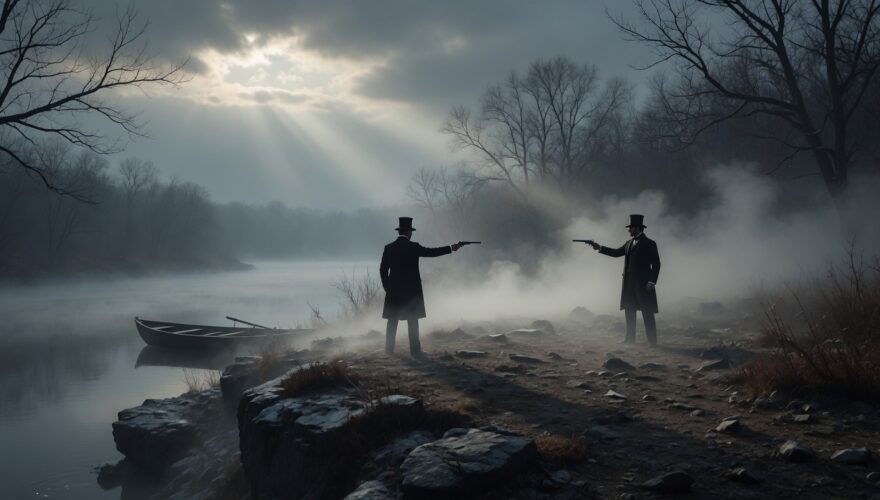
Weehawken, New Jersey. July 11, 1804. Seven in the morning, and the mist still clings to the cliffs above the Hudson. Two men stand ten paces apart on a narrow rock ledge reachable only by rowboat, chosen for that exact reason: nobody on either riverbank can see what’s about to happen. One of them is the sitting Vice President of the United States. The other is a former Secretary of the Treasury.
Within ninety seconds, one man will be lying on the ground with a bullet lodged near his spine. The other will climb back into his rowboat, cross the river, and be home in Manhattan before most of the city has even had breakfast.
Nobody arrests him. No conviction ever sticks. A few weeks later, he walks into the United States Senate and takes his seat as its presiding officer, a wanted man doing his job as though nothing happened.
That’s the detail most history books rush past. Dueling wasn’t just a violent custom that polite society happened to tolerate. It was a fully built system: its own etiquette, its own referees, its own paperwork, engineered so gentlemen could kill one another and walk away clean. Meanwhile, a hungry man caught lifting a loaf of bread from a market stall in that same century could be marched straight to the gallows for it. Same decades. Same countries, more or less. Two completely different kinds of law.
Where the Ritual Came From
Dueling didn’t start as a rich man’s game. Its roots stretch back to trial by combat, medieval Europe’s habit of letting God settle legal disputes by deciding who won a fight. But the version that actually shaped four centuries of European and American history was born in Renaissance Italy, around the 1550s, when writers like Girolamo Muzio began publishing manuals on honor and insult: how a gentleman should recognize when he’d been disrespected, and exactly what he owed himself in response.
“The first offence requires the first apology, though the retort may have been more offensive than the insult.”
Rule I of the 1777 Irish Code Duello
The idea caught on fast, moving through the courts of France, then England, then eventually across the Atlantic to the American colonies. It carried with it a strange, almost bureaucratic premise: a gentleman’s honor was worth more than his life, more than the law, and more than the life of whoever he might have to kill defending it. If someone insulted you in front of witnesses, the law offered nothing useful. Suing for slander was for merchants and tradesmen. A gentleman didn’t sue. He challenged.
The Paperwork of Honor
By the late 1700s, this had hardened into actual written law, or something that looked enough like law to matter. In 1777, a group of Irish gentlemen sat down at the summer assizes in Clonmel, County Tipperary, and did something almost comically bureaucratic: they wrote the rules down. Twenty-six of them, known ever after as the Code Duello, or more memorably, the Twenty-Six Commandments. Delegates came from five counties. They signed their names at the bottom. They even set up a standing committee, meeting alternately in Clonmel and Galway, to settle any dueling disputes the code failed to cover.
A copy was meant to live inside every gentleman’s pistol case, right beside the actual pistols, because ignorance of dueling etiquette was no excuse for getting it wrong.
The rules covered almost everything. Whoever gave the first offense owed the first apology, even if the other man’s retort had landed harder. A misfire counted as a shot fired, no do-overs. A wound bad enough to make a man’s hand shake ended the fight for the day, no exceptions. Seconds, the trusted friends who arranged and witnessed each encounter, were required to attempt a reconciliation before anyone took the field at all.
There was even a rule against faking it. Firing into the air to spare an opponent, a move known as deloping, was explicitly banned: “No dumb shooting or firing in the air is admissible in any case… children’s play must be dishonourable.” The men who wrote the code considered that kind of performative mercy an insult in its own right. Duelists kept doing it anyway, constantly, because once honor got expensive enough, plenty of gentlemen preferred to look brave rather than actually kill a man over a bad joke at dinner.
Join The Archive Briefing
Weekly dispatches. The history they didn't teach you — sourced, subverted, delivered to your inbox.
Physicians came to these meetings too. Not to stop anything: to patch up whoever survived. A doctor sworn to preserve life would stand at a polite distance, bag open, waiting to see which of two men he’d be treating for a bullet wound within the hour. Everyone understood the arrangement. Nobody found it strange.
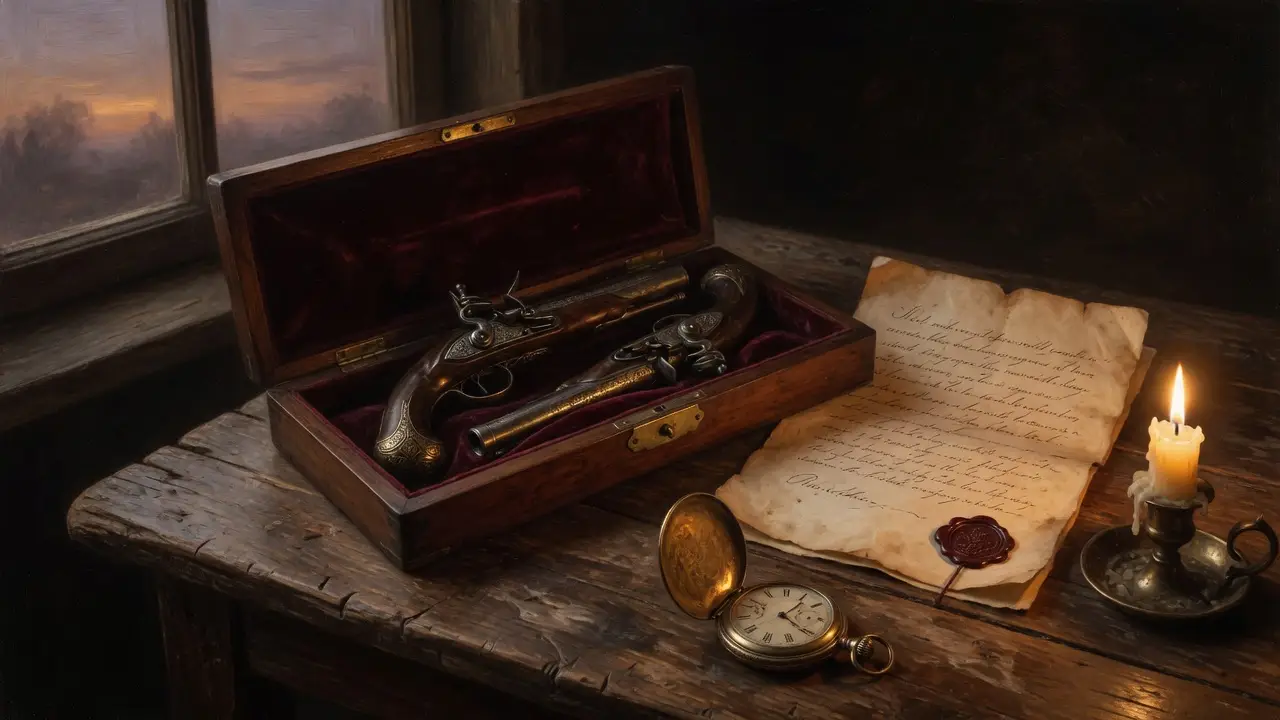
Weehawken, Before Sunrise
This was the machinery Alexander Hamilton and Aaron Burr were operating inside of, in the summer of 1804, after fifteen years of mutual loathing.
The two men had circled each other for over a decade: rival lawyers, rival power brokers, standing on opposite sides of nearly every political fight in New York. By the spring of 1804, Burr’s career was falling apart. He’d just lost the New York governor’s race. President Jefferson had no plans to keep him on as running mate. Then a newspaper printed a secondhand account of a dinner party where Hamilton had allegedly called Burr dangerous, and something even more damning. Burr demanded Hamilton confirm it, deny it, or explain it. Cornered, Hamilton refused to do any of the three cleanly. Burr sent the challenge.
What followed reads less like a spontaneous outburst and more like two men filling out paperwork toward their own funeral. Letters went back and forth for weeks, each one scrupulously polite, each one referring to the coming duel only as an “interview,” since everyone involved knew dueling was illegal, even in New Jersey, and discretion was part of the etiquette. Less than a week before things escalated, the two men had sat at the same table for a Fourth of July banquet, trading pleasantries in front of the same crowd that would soon be reading about one of their deaths.
The night before, Hamilton sat down and wrote out his reasoning in case he didn’t survive. He’d already lost his own son, Philip, on this exact stretch of ground three years earlier, killed in a duel of his own. Hamilton had genuine religious objections to the practice. He went anyway, because refusing meant being branded a coward for the rest of his life, and in his world that counted as its own kind of death. “I have resolved,” he wrote, “to reserve and throw away my first fire, and I have thoughts even of reserving my second fire.” He intended to miss on purpose. He told his second the same thing out loud, moments before they took their places.
At seven that morning, the two parties crossed the river separately to preserve deniability and met on the ledge. Hamilton asked for a short pause to put on his spectacles and judge the light. Then the count began.
Two shots rang out close enough together that historians still argue over which came first. Hamilton’s ball cracked into a tree branch well above and behind Burr, more or less exactly where he’d said he intended to put it. Contrary to the popular version of this story, he didn’t simply hold his fire. He aimed to miss, and missed on purpose, which is a very different thing. Burr’s ball didn’t miss anything. It caught Hamilton low in the right side, shattered a rib, tore through his liver, and lodged near his spine. Hamilton dropped instantly.
When his physician, waiting out of sight to preserve the fiction that he hadn’t witnessed a crime, finally reached him, Hamilton is said to have managed only one sentence: “This is a mortal wound, Doctor.” He died the following afternoon.
“I have resolved, if our interview is conducted in the usual manner, and it pleases God to give me the opportunity, to reserve and throw away my first fire, and I have thoughts even of reserving my second fire.”
Alexander Hamilton, the night before his fatal duel with Aaron Burr, July 10, 1804
Here’s where the loophole shows its full shape. Burr was indicted for murder twice, once in New Jersey, where the shooting happened, once in New York, where Hamilton died. He was never tried in either state. He simply left, waited out the scandal in Georgia and South Carolina until public anger cooled, then returned to Washington and finished his term as Vice President, presiding calmly over the very Senate that, on paper, had every legal right to see him hanged. New York didn’t get around to actually banning dueling until 1816, twelve years after Hamilton bled out on a friend’s floor in Greenwich Village.
The Bullet Andrew Jackson Carried to His Grave
Hamilton and Burr weren’t an aberration. The system was working exactly as designed, and two years later, a Tennessee lawyer and future president proved it all over again.
Andrew Jackson had a well-earned reputation as a man who’d fight over almost anything. In 1806, that anything was a horse race, a disputed betting forfeit, and an escalating newspaper war with a fellow plantation owner named Charles Dickinson, considered one of the finest pistol shots in the state, maybe in the whole South. Things turned personal when Dickinson took a swipe at Jackson’s wife Rachel, whose earlier marriage hadn’t technically been finalized when she wed Jackson, a legal tangle that had nothing to do with her own conduct. Dickinson called her a bigamist in print. For Jackson, that crossed a line nothing else could.
Jackson knew exactly what he was up against, so he and his second worked out a strategy as cold as it was effective: let Dickinson fire first, absorb the hit, and use the moment Dickinson would be forced to stand still and wait his turn.
LESSER-KNOWN DETAIL
Hamilton’s own son, Philip, died in a duel on that same stretch of Weehawken cliffs in 1801, three years before his father did.
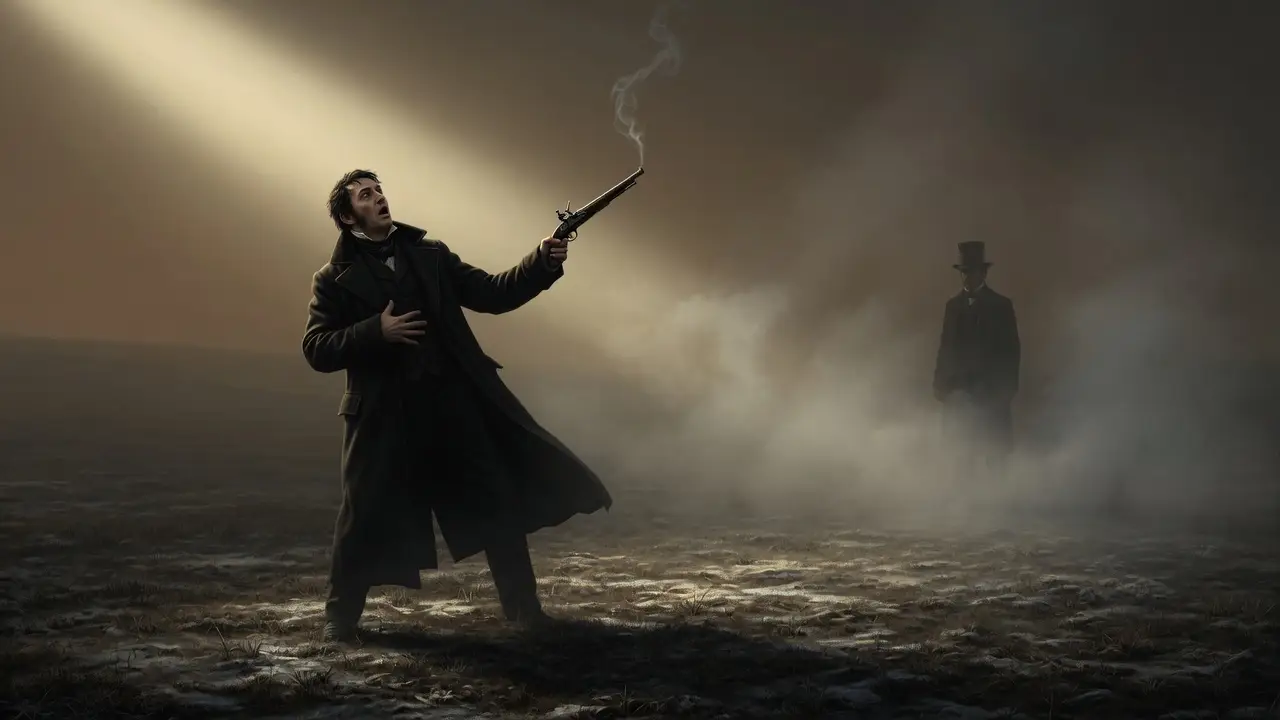
On the morning of May 30, at Harrison’s Mills, just over the Kentucky line from a Tennessee that had already outlawed dueling, Dickinson fired first. His bullet caught Jackson square in the chest, cracking ribs and lodging just inches from his heart. Jackson clapped a hand over the wound, refused to fall, and stayed upright. Watching his opponent still standing, Dickinson reportedly stumbled backward: “Great God, have I missed him?” He hadn’t. Under the code, he now had to hold his ground and take Jackson’s shot without flinching.
Jackson raised his pistol and pulled the trigger. It stopped at half-cock, a misfire that, by strict reading of the rules, should have ended things right there, with Jackson’s turn forfeited. Instead, he calmly recocked the weapon and fired again. This time it worked. Dickinson went down and bled to death within hours.
Jackson had technically broken etiquette by taking a second attempt after a misfire, and some of Dickinson’s friends said so bitterly afterward. None of it mattered. Nobody prosecuted him. He carried Dickinson’s bullet in his chest for the rest of his life, too close to the heart to safely remove, coughing blood on his worst days, and went on to become the seventh President of the United States regardless.
One Law for the Sword, Another for the Loaf of Bread
Now hold that up against what was happening to everyone who wasn’t a gentleman.
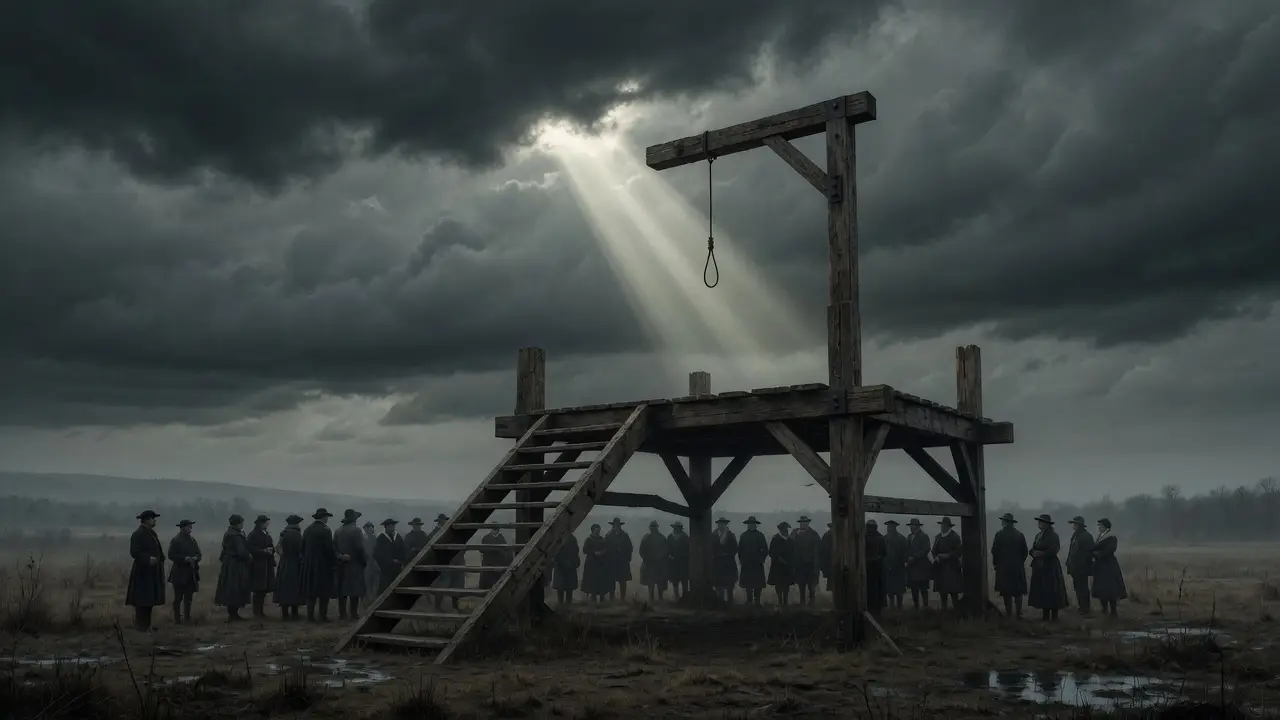
In Britain, across roughly this same stretch of history, lawmakers were quietly assembling what later historians nicknamed the Bloody Code. Between 1688 and 1820, the number of crimes punishable by death in England and Wales climbed from around fifty to more than two hundred. Poaching a rabbit on the wrong land. Cutting down a tree that belonged to someone else. Stealing goods worth more than twelve pence, roughly a twentieth of a skilled worker’s weekly wage. Pick almost any petty crime born of hunger, and there was likely a statute somewhere prescribing a rope for it.
The English statesman George Savile once summed up the entire logic in a single blunt line: men weren’t hanged because they’d stolen a horse, but so that horses might not be stolen at all. The punishment was never really about the man standing in front of the judge. It was about keeping an entire class of poor, hungry people too frightened to touch anyone else’s property.
Meanwhile, if you were wealthy enough to own a matched set of dueling pistols, you could shoot a fellow gentleman dead over a perceived slight and, more often than not, simply walk away. Juries stacked with landowners, many of whom had fought their own duels at some point, were reluctant to convict a man of murder for what they considered an honorable settling of accounts. Judges routinely instructed juries to look for evidence of “foul play” rather than simply asking whether a man had died.
It amounted to two entirely separate justice systems sharing the same country at the same time. One could hang a starving child for lifting a handkerchief. The other could barely be bothered to charge a nobleman for putting a bullet through another nobleman’s chest, so long as both men had shown up in proper coats and observed the correct etiquette on the way there.
When Honor Became Theater
Change came slowly, and mostly from the top, as even the aristocracy’s patience for the practice began to fray.
By the early 1800s, dueling among the powerful had already started shifting from a genuine attempt to kill toward pure performance. Consider 1829, when Britain’s sitting Prime Minister, the Duke of Wellington, the man who’d beaten Napoleon at Waterloo, found himself challenged over a political fight about Catholic emancipation. Wellington had avoided dueling his entire military career and, by most accounts, thought the whole custom was beneath him.
He felt he had no honorable way out once the insult went public. He and the Earl of Winchilsea met at dawn at Battersea Fields with pistols, seconds, and a physician standing by, exactly per custom. Wellington fired first and missed, by his own later account, on purpose. Winchilsea, who along with his second had almost certainly planned this outcome in advance, kept his arm down, then raised it and fired straight into the air.
A written apology, drafted ahead of time, changed hands minutes later. Nobody was hurt. Parliament kept functioning. The philosopher Jeremy Bentham, unimpressed, wrote to Wellington calling him an “ill advised man” and pointing out the chaos that would have followed had Britain’s own Prime Minister been killed, or put on trial for murder, over a political squabble.
LESSER-KNOWN DETAIL
Even the famous 1777 Code Duello has a murky paper trail. Some researchers trace its familiar wording not to a contemporary 1777 record but to a memoir published decades later, raising the possibility that the polished rules everyone quotes today were tidied up well after the fact.
That’s what dueling had become for men at the top by then: a ritual so thoroughly padded with prearranged outs that actual death was almost incidental to it. Honor got satisfied. Nobody had to die. The whole performance simply had to look real enough for the newspapers.
It took far longer to disappear completely than most people assume. Duels persisted through the American Civil War era in the South, where the culture of honor never really loosened its grip, and lingered in parts of Europe well past the point of historical punchline. As late as April 1967, two French politicians, Gaston Defferre and René Ribière, settled a shouting match in the National Assembly with an actual sword duel outside Paris, complete with an official referee.
Defferre had told Ribière to shut up in considerably ruder language, refused to apologize, and Ribière demanded satisfaction the old way. They fought with épées in a garden outside the city. Defferre landed two touches on Ribière’s arm, and the referee called it there. Ribière got married the next day anyway. As far as anyone can verify, it remains the last formal duel ever fought on French soil: illegal, entirely bloodless, and treated by everyone present with complete seriousness.
The Loophole Never Fully Closed
Dueling eventually died out for practical reasons as much as moral ones. Life insurers started refusing to pay out on men killed in duels. Militaries began court-martialing officers who fought them, since a good soldier was worth more alive than symbolically brave and dead. The middle class grew large enough, and its own version of respectability spread far enough, that gentlemen slowly stopped needing a pistol to prove they were gentlemen at all.
But the instinct underneath it, the idea that a certain kind of person gets a different kind of justice, one built on procedure and mutual courtesy rather than actual consequence, never fully disappeared. It just changed clothes. The elaborate rulebook, the friendly seconds smoothing things over in advance, the doctor standing politely out of sight so nobody has to admit what’s really happening: swap out the pistols, and it’s a story that keeps finding new ways to repeat itself.
LESSER-KNOWN DETAIL
In 1786, two Irish duelists agreed in advance through their seconds to use blank powder only, so neither man would be hurt. One of them broke the agreement and shot the other dead anyway.
Hamilton didn’t have to die that morning above the Hudson. He climbed into that boat because a code built by men like him, for men like him, promised that even killing, done properly, with the right paperwork and the right witnesses standing by, could still be called honor instead of murder. Somewhere in Britain that same July, a man was very possibly standing on a gallows for something small enough to fit inside his coat pocket.