From Roman aqueducts to Mongol siege canals, discover how the world’s greatest empires turned water into their deadliest weapon. Floods, poisoned wells, irrigation politics, and the wars fought over the one resource no civilization could survive without.
The empires that mastered water first did more than prove their genius with canals, aqueducts, and reservoirs. They turned water into power. A redirected river could feed a city or ruin a harvest. A broken dike could drown an enemy. A guarded well could decide whether an army marched or died of thirst. In the hands of empire, water was never just a resource, it was a weapon of survival, obedience, and control.
Water was never just water. It was always also power. And the rulers who grasped that first were the ones who lasted longest, built widest, and left the deepest mark on the civilizations that came after them.
The River That Broke an Empire
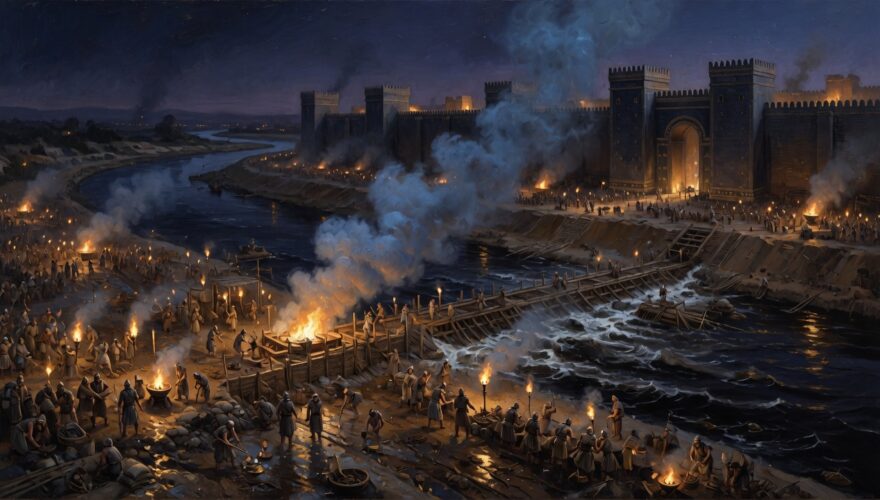
In 539 BCE, the most fortified city on earth fell not to a battering ram or a siege tower. It fell because someone moved a river.
Babylon was, by any measure, unconquerable. Its walls were so thick that chariots raced along the top. The Euphrates flowed directly through the city, guaranteeing a water supply no siege could cut. Nabonidus, its king, reportedly laughed at the Persian army massed outside the gates. He had reason to feel confident. Empires had tried and failed before.
Cyrus the Great didn’t attack the walls. He attacked the water.
Persian engineers diverted the Euphrates into a network of irrigation canals upstream, dropping the river’s level inside the city to knee height. On the night of a great Babylonian festival, when the population was drunk and distracted, Persian soldiers waded up the riverbed and walked through the water gates no one had thought to guard. By morning, Babylon belonged to Persia.
It was not the first time water had decided the fate of nations. It would not be the last.
Join The Archive Briefing
Weekly dispatches. The history they didn't teach you — sourced, subverted, delivered to your inbox.
What Flows Through Everything
Water is not just a resource. It is leverage.
Every ancient civilization built itself around a water source, and every one of them understood, sooner or later, that controlling water meant controlling people. The Nile gave Egypt its agricultural calendar and its capacity to feed millions, but the pharaohs who managed the flood cycles also held a kind of religious authority no army could manufacture. Withhold the irrigation. Redirect the canal. And suddenly, a city starves not from siege but from bureaucratic decision.
“He who controls the water controls the land. He who controls the land controls the people.”
Shang Yang, Legalist philosopher and architect of Qin power, 4th century BCE
The Romans understood this with an engineer’s precision. The Greeks understood it with a philosopher’s instinct. The Mongols understood it the blunt way they understood everything: from the saddle, on the move, burning what they couldn’t use and poisoning what they couldn’t carry.
Water shaped empires from the inside. And when empires went to war, water became the sharpest tool in the arsenal.
Rome’s Stone Rivers
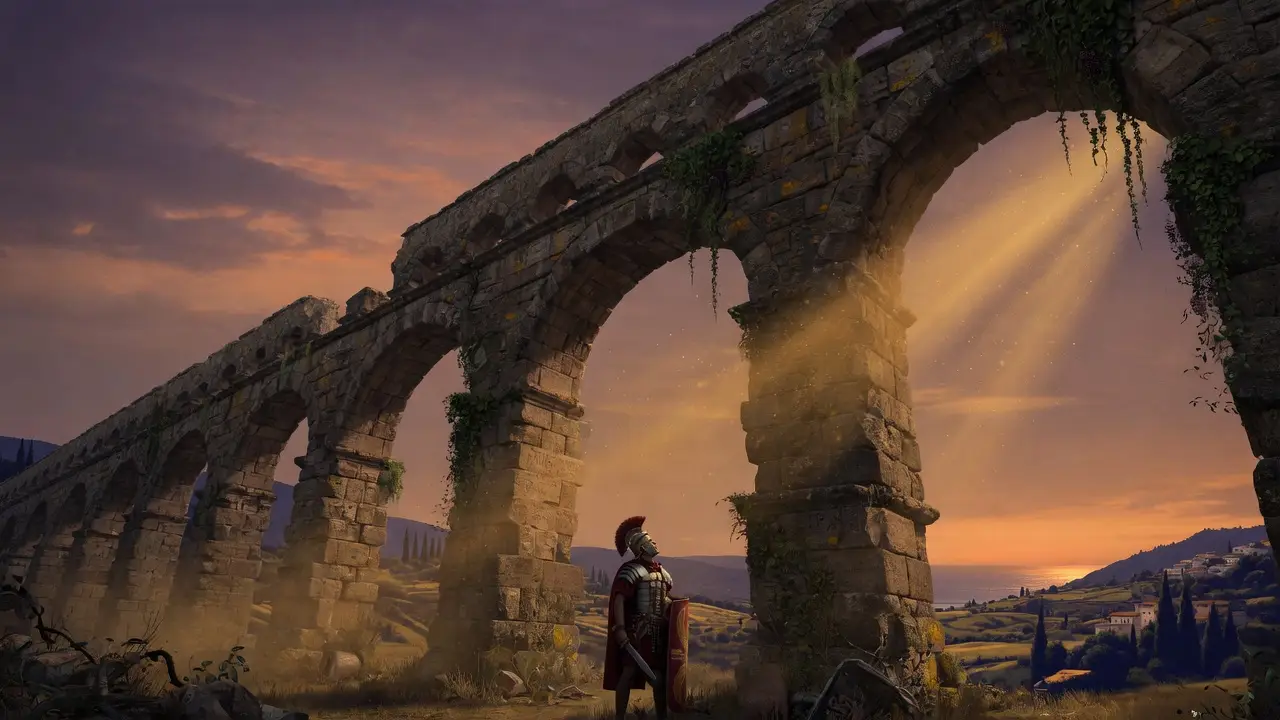
To an enemy watching from the hills, a Roman aqueduct was an advertisement of power. Hundreds of arches marching across the landscape, carrying millions of gallons daily into a city that never went thirsty. The message was architectural and unmistakable: We have mastered nature. You have not.
At its height, Rome’s eleven major aqueducts delivered roughly 1.1 million cubic meters of water per day to a city of a million people. That’s more water per capita than many modern cities manage today. Public baths, fountains, latrines, private villas, industrial mills: all of it fed by gravity and stone over distances of up to ninety kilometers.
But the aqueducts were also a military vulnerability of spectacular proportions.
“The Persian did not assault the walls. He extinguished the river, and the city opened as a flower opens to heat.”
Herodotus, Histories, Book I, on the fall of Babylon
The Goths grasped this immediately. During the siege of Rome in 537 CE, Vitiges cut every aqueduct feeding the city. The baths went cold. The mills stopped grinding. The population that had grown dependent on a hydraulic infrastructure centuries in the making suddenly found itself hauling water from the Tiber like peasants. Belisarius, defending the city for Justinian’s Byzantium, improvised grain mills on boats moored in the river current. It worked, barely. But the psychological damage was done. Rome without water was Rome without Rome.
What Vitiges understood was something siege engineers had known for centuries: you don’t need to break a city’s walls if you can break its supply lines.
The Wells of the Conquered
Not every use of water as a weapon was this monumental. Some of the most effective took place at the bottom of a hole.
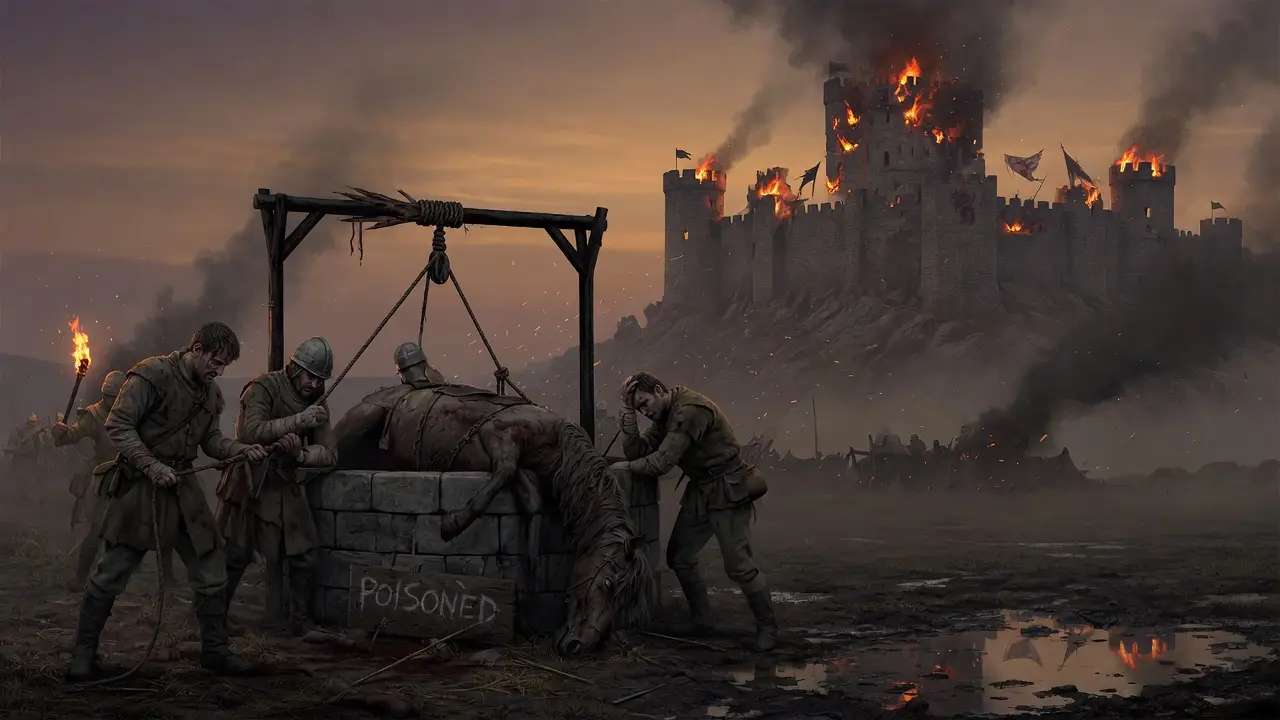
Well poisoning was so common in ancient and medieval warfare that it appears in military manuals, religious prohibitions, and diplomatic treaties as a matter of routine. The Romans used it. The Mongols used it systematically. During the Crusades, both Christian and Muslim forces documented instances of poisoned water sources, though each side typically attributed the practice to the other.
The tactical logic was simple and devastating. An army on the march, in summer heat, in territory it doesn’t know, is utterly dependent on local water sources. Poison or foul those wells and you don’t need to defeat the enemy in the field. You just wait.
LESSER-KNOWN DETAILS
The medieval practice of “fouling” a well often didn’t require actual poison. Dropping animal carcasses into a water source, or simply contaminating it with human waste, was frequently sufficient. Armies that drank from tainted wells didn’t die dramatically. They sickened slowly, their fighting capacity collapsing over days, their commanders unsure whether they were facing an enemy or a plague.
The Mongol campaigns across Central Asia in the 13th century frequently featured the deliberate contamination or destruction of qanat systems, the ancient underground irrigation networks that kept entire populations alive in arid regions. Destroy the qanat, and you don’t just defeat an army. You make the land uninhabitable for generations.
Flood as Artillery
If poisoning a well was subtle, flooding a battlefield was theater.
In 597 BCE, during the siege of Lachish, Babylonian forces under Nebuchadnezzar II reportedly manipulated local water sources to assist their siege operations. But the most spectacular use of engineered flooding as a weapon belongs to a later era and a smaller, more desperate people.
The Dutch, in 1574, were losing.
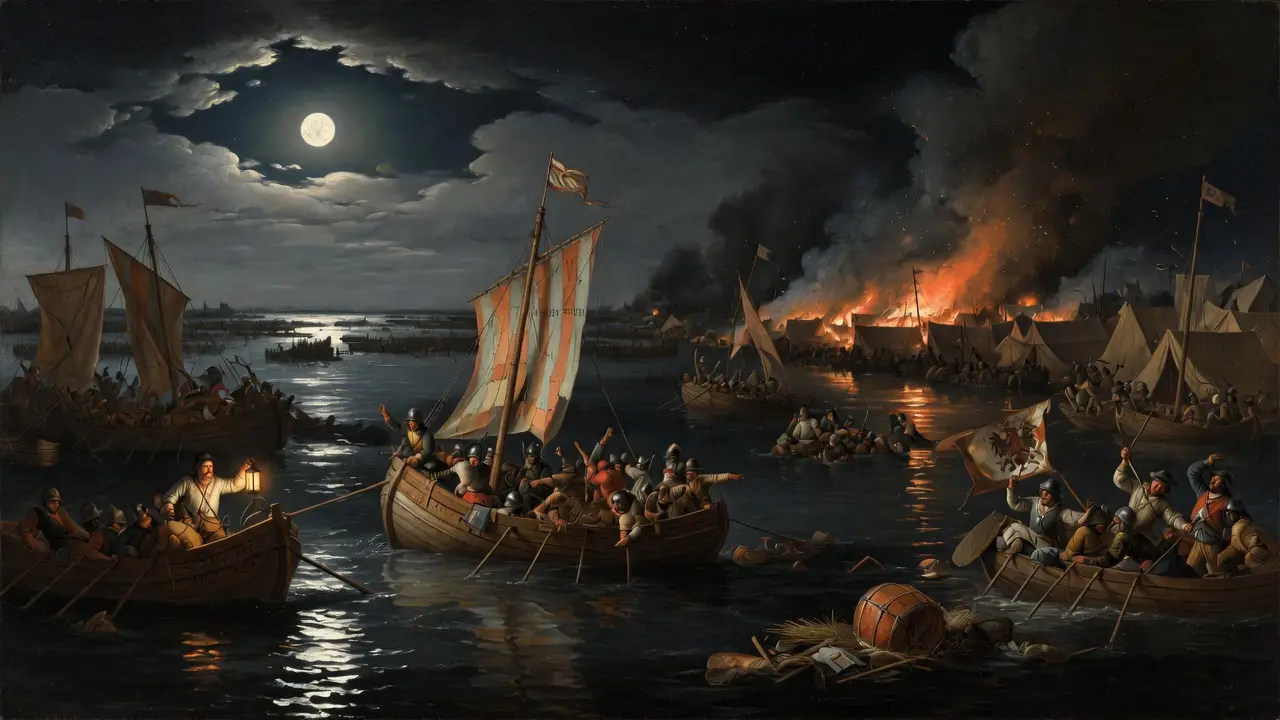
The Spanish Army of Flanders had besieged Leiden for months. The city was starving. Dogs and rats had become dietary staples. The death toll from hunger and disease climbed daily. William the Silent, Prince of Orange, made a decision that horrified his own engineers: he ordered the deliberate breaching of the sea dikes protecting the lowlands south of Leiden.
“Without water, the strongest walls are a tomb, not a fortress.”
Medieval military manual, attributed to the Byzantine strategist tradition, c. 10th century CE
Seawater poured across farmland, drowned crops, destroyed villages, and turned the flat Dutch countryside into a shallow inland sea. A fleet of shallow-draft vessels called geuzen sailed across what had been, days earlier, harvested fields. The Spanish army, camped on slightly higher ground, awoke to find itself surrounded by water and ships. They retreated. Leiden was relieved.
The price was catastrophic for the land. Saltwater killed soil for years. Farmers lost everything. But Leiden survived, and the Dutch Republic continued its fight for independence. The city still celebrates October 3rd as Relief Day. They serve hutspot stew, the dish supposedly found cooking in an abandoned Spanish camp. The dike breach that saved them is barely mentioned in the festivities.
The Politics of the Nile
Not all water wars were fought with swords. Some were fought with bureaucrats.
Egypt’s entire agricultural system depended on the annual Nile flood, and the state machinery that measured, predicted, and managed that flood was among the earliest forms of centralized government on earth. The nilometer, a measuring column inscribed with gradations, told officials exactly how high the flood would rise, and therefore how much tax to levy that year. A high flood meant abundant crops. A low flood meant scarcity. The pharaoh’s administrators adjusted taxation accordingly, which meant the state had a direct financial interest in controlling not just the measurement of water but the narrative around it.
LESSER-KNOWN DETAILS
Sennacherib of Assyria built a 50-kilometer aqueduct to supply Nineveh around 700 BCE, complete with an arched stone bridge carrying water over a valley. It predates the famous Roman aqueducts by centuries and was largely ignored by Western historians until the 20th century.
When the floods were bad, pharaohs sometimes suppressed the nilometer readings. Not because they could change the water, but because they could manage the fear. A population that believed the river was rising might plant more. Might work harder. Might not revolt.
This is water weaponized not against an enemy, but against the governed.
The same dynamic played out millennia later in Mesopotamia, where whoever controlled the headwaters of the Tigris and Euphrates effectively controlled the downstream populations. It’s a tension that persists today between Turkey, Syria, and Iraq, where dam construction upstream continues to reduce flow to agricultural regions that have farmed those riverbanks for ten thousand years. The tactics are different. The leverage is identical.
Siege Thirst: The Long Slow Kill
The most common use of water as a weapon was also the simplest: deny it entirely.
Medieval siege warfare operated on a straightforward premise. A fortified city could withstand direct assault almost indefinitely if its walls held and its supplies lasted. So siege commanders targeted supplies. Food could be stockpiled for months. Water could not.
LESSER-KNOWN DETAILS
Public fountains in Rome ran 24 hours a day, 365 days a year. The water was “free” but the property values around fountains were significantly higher. The poor drank from public basins; the wealthy had private connections. The water system replicated the social hierarchy in liquid form.
Castle engineers understood this. Wells were dug as deep as the bedrock allowed. Cisterns were carved into the rock beneath keeps, filled during rain, hoarded against a siege that might come any season. The Knights Hospitaller at Krak des Chevaliers maintained cisterns capable of holding a year’s worth of water for the entire garrison. The Crusader castle stood for 172 years partly because of those cisterns.
But defenders sometimes ran out, and when they did, the records are grim.
During the siege of Antioch in 1098, the Crusader forces besieging the city suffered worse than those inside. The surrounding countryside had been stripped bare. Wells were fouled. The Crusader army, tens of thousands strong, died of thirst and dysentery in the Syrian summer in numbers that dwarfed battlefield casualties. When the city finally fell, it fell partly because the besiegers had survived long enough through sheer desperation. The water war had nearly consumed both sides.
The Empire That Drank Its Way to Ruin
Rome’s fall has been attributed to a remarkable range of causes over the centuries: moral decay, military overextension, barbarian pressure, economic collapse. Less discussed is what happened when the aqueducts stopped working.
Lead piping is the obvious culprit in popular history, and while its contribution to Roman health is debated among historians, the structural collapse of the water infrastructure is not. As the Western Empire contracted, aqueduct maintenance became impossible. Skilled engineers were lost. Tax revenue to fund repairs dried up. Sections fell into disrepair, then ruin. The population that had grown to nearly a million under the Empire shrank to perhaps twenty thousand in the early medieval period, partly because the city could no longer support large numbers without its hydraulic backbone.
LESSER-KNOWN DETAILS
The famous siege of Masada by Roman forces in 73 CE was partially a water operation. Masada’s elaborate cistern system, hewn from the rock, collected winter rainwater and could sustain the garrison almost indefinitely. Roman engineers built a wall around the entire mesa not just to prevent escape, but to ensure no water could be brought in if the cisterns failed.
A city built around abundant water, stripped of it, does not simply adapt. It depopulates. And a depopulated city cannot defend itself, cannot generate the surplus that funds an army, cannot sustain the institutions that make civilization legible.
The aqueducts did not cause Rome’s fall. But their decline made the fall permanent.
Still Flowing
The Euphrates today carries less than half the water it did fifty years ago. The Jordan River, sacred to three religions, is so depleted that in some stretches it no longer reaches the Dead Sea. The Nile waters are the subject of a tense, unresolved dispute between Ethiopia, Sudan, and Egypt over the Grand Ethiopian Renaissance Dam, a conflict with the potential to destabilize one of the most water-stressed regions on the planet.
Cyrus the Great diverted a river to take a city in a single night. His method was primitive. His logic was not.
The empires that understood water earliest and best did not just build monuments to their engineering skill. They built leverage. They built control. They built the capacity to decide, with a canal or a dike or a poisoned well, who would survive the year and who would not.
The rivers are still there. So is the politics.